<?xml version="1.0" encoding="utf-8"?>
<!DOCTYPE html>
<html xmlns:xsi="http://www.w3.org/2001/XMLSchema-instance"
xsi:schemaLocation="http://www.w3.org/1999/xhtml https://raw.githubusercontent.com/oreillymedia/HTMLBook/master/schema/htmlbook.xsd"
xmlns="http://www.w3.org/1999/xhtml"
lang="en">
<head>
<title>Entrepreneurial Career and Life Design</title>
</head>
<body data-type="book">
<section data-type="halftitlepage">
    <h1 class="title">Entrepreneurial Career and Life Design</h1>
</section>
<section data-type="titlepage">
    <h1 class="title">Entrepreneurial Career and Life Design</h1>
    <p class="subtitle"></p>
    <p class="author">Steve A. Gedeon, Chair of TorontoMet Entrepreneur Institute and Associate Professor of Entrepreneurship and Strategy at the Ted Rogers School of Management</p>
    <p class="publisher">Toronto Metropolitan University</p>
    <p class="publisher-city">Toronto</p>
</section>
<section data-type="copyright-page">
    <h1>Entrepreneurial Career and Life Design</h1>
    <div class="license-attribution">
         <p><img src="https://pressbooks.library.torontomu.ca/ecld/wp-content/themes/pressbooks-book/packages/buckram/assets/images/cc-by-nc.svg" alt="Icon for the Creative Commons Attribution-NonCommercial 4.0 International License" /></p>
         <p>Entrepreneurial Career and Life Design Copyright © by <span>Dr. Steven A. Gedeon</span> is licensed under a <a rel="license" href="https://creativecommons.org/licenses/by-nc/4.0/">Creative Commons Attribution-NonCommercial 4.0 International License</a>, except where otherwise noted.</p>
    </div>
    <p>Cover image created by Dr. Steven A. Gedeon using MidJourney.</p>
</section>
<nav data-type="toc">
    <h1>Contents</h1>
    <ol>
         <li class="front-matter miscellaneous"><a href="#front-matter-why-this-workbook-overview-of-the-course-assignments"><span class="toc-chapter-title">Why this Workbook? - Overview of the Course Assignments</span></a></li>
         <li class="front-matter miscellaneous"><a href="#front-matter-quotes-from-former-students"><span class="toc-chapter-title">Quotes from Former Students</span></a></li>
         <li class="part display-none"><a href="#part-main-body">Entrepreneurial Career and Life Design</a></li>
         <li class="chapter standard"><a href="#chapter-chapter-1-introduction-to-practising-revolutionary-entrepreneurial-principles-and-attitudes-in-your-career-and-life"><span class="toc-chapter-title">Chapter 1: Introduction to Practising Revolutionary Entrepreneurial Principles and Attitudes in Your Career and Life</span></a></li>
         <li class="chapter standard"><a href="#chapter-chapter-2-start-where-you-are-and-goal-setting"><span class="toc-chapter-title">Chapter 2: Start Where You Are and Goal-Setting</span></a>
         <ol class="sections">
              <li class="section"><a href="#chapter-120-section-1"><span class="toc-subsection-title">Tool #9 Goal Setting and Time Management</span></a></li>
              <li class="section"><a href="#chapter-120-section-2"><span class="toc-subsection-title">Tool #9 – Goal-Setting Step-by-Step Review</span></a></li>
         </ol>
         </li>
         <li class="chapter standard"><a href="#chapter-chapter-3-experimentation-using-the-design-thinking-diamond-method-or-looping-the-scientific-method"><span class="toc-chapter-title">Chapter 3: Experimentation using the Design Thinking ‘Diamond’ Method or ‘Looping’ (The Scientific Method)</span></a>
         <ol class="sections">
              <li class="section"><a href="#chapter-98-section-1"><span class="toc-subsection-title">The Scientific Method</span></a></li>
              <li class="section"><a href="#chapter-98-section-2"><span class="toc-subsection-title">Beware of Following Step-by-Step Tools &#38; Methods – The Need for Principles, Attitudes and Mindsets</span></a></li>
              <li class="section"><a href="#chapter-98-section-3"><span class="toc-subsection-title">How to Build the Design Thinking Components of Your Mindset</span></a></li>
              <li class="section"><a href="#chapter-98-section-4"><span class="toc-subsection-title">Use of Art to Keep Principles in Mind – The Explorer</span></a></li>
         </ol>
         </li>
         <li class="chapter standard"><a href="#chapter-chapter-4-co-creating-the-future-and-refining-your-search"><span class="toc-chapter-title">Chapter 4 – Co-Creating the Future and Refining Your Search</span></a>
         <ol class="sections">
              <li class="section"><a href="#chapter-44-section-1"><span class="toc-subsection-title">Tool #11: Self-Reflection Based on Conscious Practice </span></a></li>
              <li class="section"><a href="#chapter-44-section-2"><span class="toc-subsection-title">Assignment #2 –Step-by-Step Process for Refining Your Career-Related Search</span></a></li>
         </ol>
         </li>
         <li class="chapter standard"><a href="#chapter-chapter-5-user-centricity"><span class="toc-chapter-title">Chapter 5 – User-Centricity</span></a>
         <ol class="sections">
              <li class="section"><a href="#chapter-49-section-1"><span class="toc-subsection-title">Tool #5: Getting to Know Your Customers &#38; Customer Personas</span></a></li>
              <li class="section"><a href="#chapter-49-section-2"><span class="toc-subsection-title">Tool #6A: Life Interviewing and Prototype Experiences</span></a></li>
         </ol>
         </li>
         <li class="chapter standard"><a href="#chapter-chapter-6-managing-risk-using-prototypes-and-portfolios"><span class="toc-chapter-title">Chapter 6 – Managing Risk Using Prototypes and Portfolios</span></a>
         <ol class="sections">
              <li class="section"><a href="#chapter-61-section-1"><span class="toc-subsection-title">Deliver Value Before Asking for Value Principle</span></a></li>
              <li class="section"><a href="#chapter-61-section-2"><span class="toc-subsection-title">ENT Principle #5 – Affordable Loss</span></a></li>
              <li class="section"><a href="#chapter-61-section-3"><span class="toc-subsection-title">Remember the Grape Vines Principle</span></a></li>
         </ol>
         </li>
         <li class="chapter standard"><a href="#chapter-chapter-7-seeking-surprise-and-building-grit-resiliency-and-anti-fragility"><span class="toc-chapter-title">Chapter 7 - Seeking Surprise and Building Grit, Resiliency and Anti-Fragility</span></a>
         <ol class="sections">
              <li class="section"><a href="#chapter-142-section-1"><span class="toc-subsection-title">Re-Framing Failure, Anti-Fragility and Growth Mindset</span></a></li>
              <li class="section"><a href="#chapter-142-section-2"><span class="toc-subsection-title">The Doctor Peter Principle</span></a></li>
              <li class="section"><a href="#chapter-142-section-3"><span class="toc-subsection-title">Assignment #3: Make Progress on Your Career-Related Design Challenges</span></a></li>
              <li class="section"><a href="#chapter-142-section-4"><span class="toc-subsection-title">Assignment #3 –Step-by-Step Review of Making Progress on Your Career-Related Design Challenges</span></a></li>
         </ol>
         </li>
         <li class="chapter standard"><a href="#chapter-chapter-8-control-what-you-can-free-will-agency"><span class="toc-chapter-title">Chapter 8 – Control What You Can (Free Will &#38; Agency)</span></a>
         <ol class="sections">
              <li class="section"><a href="#chapter-65-section-1"><span class="toc-subsection-title">The Primary Action – To Focus or Drift on Auto-Pilot </span></a></li>
              <li class="section"><a href="#chapter-65-section-2"><span class="toc-subsection-title">Core Beliefs – What are they and how did they get there?</span></a></li>
              <li class="section"><a href="#chapter-65-section-3"><span class="toc-subsection-title">Values, Desires and Attitudes</span></a></li>
         </ol>
         </li>
         <li class="chapter standard"><a href="#chapter-chapter-9-feedback-and-happiness"><span class="toc-chapter-title">Chapter 9 – Feedback and Happiness</span></a></li>
         <li class="chapter standard"><a href="#chapter-chapter-10-finding-harmony-happiness-through-the-principle-of-integrity"><span class="toc-chapter-title">Chapter 10 – Finding Harmony &#38; Happiness Through the Principle of Integrity</span></a>
         <ol class="sections">
              <li class="section"><a href="#chapter-82-section-1"><span class="toc-subsection-title">Assignment #4: Make Progress on your Character-Related Design Challenges through Positive Self-Talk and Habit Formation</span></a></li>
         </ol>
         </li>
         <li class="chapter standard"><a href="#chapter-chapter-11-taking-control"><span class="toc-chapter-title">Chapter 11 Taking Control</span></a>
         <ol class="sections">
              <li class="section"><a href="#chapter-84-section-1"><span class="toc-subsection-title">Assignment #5: Final Report </span></a></li>
              <li class="section"><a href="#chapter-84-section-2"><span class="toc-subsection-title">Assignment #5 –Step-by-Step Review for Final Report</span></a></li>
         </ol>
         </li>
         <li class="back-matter miscellaneous"><a href="#back-matter-references"><span class="toc-chapter-title">References</span></a></li>
         <li class="back-matter miscellaneous"><a href="#back-matter-image-credits"><span class="toc-chapter-title">Image Credits</span></a></li>
    </ol>
</nav>
<section data-type="halftitlepage" class="front-matter miscellaneous" id="front-matter-why-this-workbook-overview-of-the-course-assignments" title="Why this Workbook? - Overview of the Course Assignments">
    <header>
         <h1 class="front-matter-title">Why this Workbook? - Overview of the Course Assignments</h1>
         <p data-type="subtitle" class="front-matter-number">1</p>
    </header>
    <p>Once upon a time, the vast majority of students in my capstone entrepreneurship courses wanted to start their own businesses. Many had already done so while at university. So my courses were primarily geared toward helping them apply the various entrepreneurial concepts, methods and tools to their own “passion projects”. Students learn best if the subject matter is about something they really care about.</p>
    <p>All the core entrepreneurship methods and tools were initially created and validated in the context of starting up a new company, so my capstone “Advanced Entrepreneurship” course content and assignments included most of the major business, strategy and entrepreneurship books and concepts including:</p>
    <ul>
         <li>Ideation and Opportunity Spotting</li>
         <li>Customer Discovery and Validation</li>
         <li>Persuading, Selling and Growth Hacking</li>
         <li>Design Thinking and Lean Startup</li>
         <li>Business Model Canvas</li>
         <li>Strategy and Business Planning including Business Management, Financial Forecasting, Financial Analysis, Marketing, Operations Management, Competitor Analysis, Value Chain, SWOT, PESTLE, Strategic Group Mapping…</li>
         <li>“100Steps2Startup”, “Disciplined Entrepreneurship”, “Running Lean”, “Value Proposition Design”, “Business Model Generation”, “Effectuation”, “Designing for Growth”, “Entrepreneurial Mindset” and other books.</li>
    </ul>
    <p>There are many different (and sometimes conflicting) business and entrepreneurship books, tools, methods, principles, techniques, ideas and mindsets. My job was to help provide a way for students to learn all these and figure out which tools to use as they ideated, started and grew their new ventures. I provided what entrepreneurship educators call “cognitive scaffolding” to help students understand how all these pieces fit together and when to use the various different tools.</p>
    <p>This seemed to go very well for many years and stimulated me to stay on top of the state-of-the-art in website design, eCommerce, prototyping, growth hacking, A-B testing, interviewing techniques, use of social media to drive traffic and other relevant advances in entrepreneurship education. Students responded well and I won every teaching award that my university offers (Toronto Metropolitan University (TMU), formerly Ryerson University). I started teaching other university professors how to teach entrepreneurship through various European Train-The-Trainer organizations like ConneeectU and entreTime and have taught over 300 professors these concepts over the years.</p>
    <p>Then my students started to change. Many were no longer interested in starting their own businesses, at least not yet. The previous assignments seemed to lose their resonance. Some students no longer seemed interested in ideating new opportunities, interviewing potential customers, building websites, and applying entrepreneurial tools and concepts to their own projects. Or sometimes they just faked it. They went through the motions during the course, but without any intention of learning the material or actually starting a new venture.</p>
    <p>For the first time in my life, I had several students fail the course. Not because the course was too difficult, but because they just didn’t do the work and didn’t seem to care about the course content or the assignments. Increasing, I learned that many students just wanted to finish their degree and get a job. They had little interest in the courses they were paying for. That was new to me.</p>
    <p>Modelling the behaviours I try to instill in my students, I used customer discovery to understand why students would enroll in an entrepreneurship degree program or course if they had no interest in starting a new venture. Many liked the idea of learning how to be creative, innovative, resilient and adaptable but had no interest in starting a company – most also had absolutely no idea what they wanted to do after graduation, or at best, a vague interest in something like sports, cars, fashion or being an influencer of some sort. Their degrees were increasingly seen as being an end in themselves, but not as something useful to be used to achieve their values after graduation.</p>
    <p>Most of these students had no plans for how to discover what they were interested in or what to do with their lives. The most common goal was to take a year off, somehow “find themselves”, and then start to think about getting a job of some sort.</p>
    <p>This “Entrepreneurial Career and Life Design” (ECLD) workbook is the direct result of my attempt to help these students “find themselves” while still in school by learning and applying entrepreneurial ideas, methods and tools. The goal is to learn these entrepreneurial concepts by applying them not to the startup process, but to your career search and your day-to-day life.</p>
    <p>However, just like starting a new company, you need to actually do the work. You can’t just sit around and think about starting a company, you need to actually roll up your sleeves and get busy. Entrepreneurship is about DOING. It is an experiential learning process. In the same way, you can’t figure out what you want in life by sitting around and thinking about it – you need to “Get Out of the Building” to search, explore, and discover what makes you passionate!</p>
    <p>Unlike a self-help or career-planning book, this workbook is designed to go along with a university-level entrepreneurship course and so it is structured around several graded assignments and course deliverables. The goal of these courses is to learn entrepreneurship tools, methods, principles and concepts in addition to applying them to your career and life.</p>
    <p>In addition to this ECLD Workbook, I’ve created 20+ YouTube videos that go along with this book and which I hope you will find engaging, relevant, useful, and at times, humorous. In my courses, I also provide an extensive assortment of ppt slides, videos that provide detailed feedback on previous student assignments, and other resources.</p>
    <p>I’ve published this book and these videos as a free Open Educational Resource (OER). That means this content will be free forever to anyone who wants to use it so you can come back and reference this material anytime you want. Other educators are free to link to and/or cut and paste from this OER in order to use any of my tools, images, figures, ideas, assignments, text or videos in their courses (provided they at least mention where they got it from).</p>
    <p>You may be reading this because it has been assigned in one of your courses at TMU. It may be used for an introductory course like ENT101 or in our most advanced undergraduate course ENT78AB. Or perhaps certain tools or assignments or chapters have been assigned by professors from another university. Because this book is used by such a diverse audience, it is possible, or even likely, that some sections of this workbook may not seem to directly apply to you, your life or your specific course. Some sections are intended for absolute beginners, but other sections are really more intended for my advanced entrepreneurship capstone students who have already taken over 6 previous entrepreneurship courses. Other ideas and concepts may be more appropriate for graduates of our degree program who may continue to refer to this Open Educational Resource in the future. You may want to re-read certain sections (or re-watch certain videos) later during your life as your design challenges change.</p>
    <p>This OER thus has content related to teaching entrepreneurship, design thinking, positive psychology and life design theory and providing cognitive scaffolding in order to integrate, understand and apply concepts from other authors (e.g. Value Proposition Design, Disciplined Entrepreneurship, 100Steps2Startup, Design your Life, Business Model You…) in addition to trying to help you figure out what you are interested in and how to achieve it. So it may not be obvious to you why I’m including certain theoretical ideas or foundational principles the first time you read this book or apply its ideas. You may be tempted to just skip to the detailed Step-By-Step Instructions and Tools but my previous students have clearly demonstrated that this is a big mistake. I even added section 3.1 titled “Beware of Following Step-by-Step Tools &amp; Methods – the Need for Principles, Attitudes and Mindsets” to help you avoid this temptation.</p>
    <p>I may seem to jump around a bit between the content in the videos (which were filmed, edited, produced and uploaded to YouTube in the early days of the pandemic) and this version of the workbook (which is published as an OER by TMU in late 2022). I believe you really need to watch the videos in order to fully understand the workbook which was originally created as a supplement to the videos. The workbook has gone through at least 4 different versions (v 0.5 in 2018, v 0.6 in 2019, 0.7 in 2020 and 0.8 in 2021). During this time, I’ve chopped the number of Tools down from 50 to 10, re-arranged the Tools and added to the Step-by-Step descriptions, included previous student examples and added additional references and theoretical concepts.</p>
    <p>In this ECLD workbook, I’ve organized the content into five incremental assignments designed to help you get feedback (from your professors or from your design team) on your progress during your journey of self-discovery. The goal of the workbook is also to help you stay on top of the weekly activities during any course you may be taking.</p>
    <p>Assignment #1: Start Where You Are – The Wheel of Life (Tool #1) and Goal-Setting (Tool #9)<br />
     Assignment #2: Refining Your Career-Related Search Using the Design Thinking Diamond (Tools #1-4, 9 &amp;11)<br />
     Assignment #3: Make Progress on Your Career-Related Design Challenges (Tools 5, 6A, 6B, 7 &amp; 8)<br />
     Assignment #4: Make Progress on Your Life-Related Design Challenges (Tool #10)<br />
     Assignment #5: Final Report (Update and Improve Assignments #1-4)</p>
    <p>TMU is the largest entrepreneurship program in the world with 75+ different entrepreneurship courses, 10 on-campus incubators, over 300 start-ups per year, grant programs, business plan competitions, Startup School, Zone Learning and the world’s #1 rated university-based incubator – the DMZ. Any TMU student with an interest in entrepreneurship will be exposed to many of the major ideas and methods such as Lean Startup, Business Model Canvas, Design Thinking, Value Proposition Design, 100Steps2Startup, strategy, business management and how to make an investment pitch.</p>
    <p>This workbook provides a guide for when and how to apply these different courses, methods and tools to all areas of your life. It augments, but is NOT a substitute for these courses, methods and tools. It will help you put these ideas into context and give you more advanced ideas around entrepreneurial principles, skills and attitudes. It will help you build an “entrepreneurial mindset” that you apply all the time to all situations in your life to increase your overall happiness. I hope it will inspire and guide you to read further depending on your interests and design challenges.</p>
    <p>Entrepreneurial education is not something you learn about from a book now so that you can perhaps become entrepreneurial in the future. It’s about practising and building entrepreneurial skills and attitudes NOW, every day, in every situation! In this workbook, I will be asking you to apply entrepreneurial tools, methods, principles, skills and attitudes to all aspects of your life. I’m asking you to do this, first of all, in order to personally and selfishly benefit yourself and guide you on your career and life journey. Secondly, the experiential nature of entrepreneurship education means you need to apply these concepts in order to learn them (e.g., you don’t learn about resiliency by reading about it, you learn resiliency by falling down and getting back up again repeatedly).</p>
    <p>To use the guitar analogy, this workbook is about practising the guitar – it is not only about learning music theory or scales. It is about how to practise, how to play and how to improve but you still need to pick which songs you want to play (i.e., you need to set your own design challenges)!</p>
    <p>Some of you may already be working on your own entrepreneurial project, side-hustle or start-up – these assignments will help you do that better, as well as apply those ideas to other areas of your life.</p>
    <p>Some of you want help finding a job – these assignments will help you do that, but will also help you build your human capital and social capital to get the next (better) one through side-hustles and/or volunteer positions.</p>
    <p>Some of you have no clue what you want to do after you graduate and others know exactly what you want in some level of detail (to be a real estate agent, work in wealth management, work in your family business…). These assignments will help you either find direction or refine your search and find clarity in other areas of your life.</p>
    <p>Some of you are looking for a way to find more balance and happiness in your life – these assignments will help do that by building better habits, self-talk, goal-setting and time management skills.</p>
    <p>Some of you may not care much about anything – these assignments will, I hope, help you discover something to care about, or find the inspiration to try.</p>
    <p>Assignment #1 is a short exercise (comprising Tool #1 and Tool #9) to help you get oriented, select your priorities and get some practice setting goals. In Assignment #2, you’ll do your first “loop” or “design thinking diamond” and get some practice with the basic method which includes setting a design challenge, discovering divergent alternatives, making convergent choices, making progress toward resolving your challenge, setting next steps (with a revised design challenge that sparks the next loop) and self-reflecting on your learning.</p>
    <p>Assignments #1 and #2 are short (normally completed during the first 4-5 weeks of a 13-week course) and designed to give you quick feedback and coaching before you start to dig into your major career-related projects for the term where you will be getting out of the building, conducting life interviews, attending networking events and getting involved.</p>
    <p>Assignment #3 (and #5) is where most of the practice and learning takes place and where you will go through several “loops” or “iterations” on your career-related design challenges while applying new entrepreneurial principles, tools, attitudes and skills. Everyone has a different starting point, different challenges and will be doing something different, so a one-size-fits-all approach cannot satisfy everyone. Different design challenges will require the use of different entrepreneurial tools. So you may need to use either qualitative design thinking tools or quantitative lean startup tools, depending on the nature of your design challenge. This is explained in more detail in Chapter 5 and the ECLD Module 5 YouTube video – User Centricity.</p>
    <p>The workbook will focus on giving you advanced entrepreneurial ideas, principles and attitudes and a range of examples. For each assignment you should be the judge of how well you are doing and whether or not you are making progress. In my courses, your grades are based on how well you “Help Yourself” and how well you “Help Me to Help You” (each course will have its own Grading Rubric provide on D2L).</p>
    <p>Most of your time, effort and final report documentation should be related to this externally-focussed portion of the course. To use the guitar analogy, this is when you are playing songs and when you are using “conscious practice” not to just flail away at a song, but consciously practise your scales and theory in real time. This is when you practise pitch control, this is when you practise playing that lead in the scale of A minor and then trying it again in A major, this is when you practise harmonizing and staying in time to the beat. Reading a book about guitar playing does not make you a musician – you still have to get out and play! At least 2/3 of your time should be spent playing! I cannot tell you which songs to play (i.e., which design challenges to pursue), but I can guide you towards making them better.</p>
    <p>An important concept here is the idea of “conscious practice” during this experiential learning course. Pick a specific entrepreneurial idea, principle or attitude, consciously apply it and practise it in a specific area of your life, and learn whether that makes things better or not. Don’t take my word for it, discover for yourself if practising curiosity (or empathy or some other attitude) during your job (or while browsing social media) makes life better or not.</p>
    <p>Assignment #4 will help you take control of your character, habits, emotional responses and happiness to provide life-long opportunities for personal growth, well-being and meaning. These ideas may seem a bit too abstract or advanced for some of you at this stage of your life. I get it. It’s hard to focus on character, well-being and happiness when all you really care about is getting a job, earning some money, moving out on your own, finding a partner, traveling and hanging out with friends. However, I have discovered from my previous students that as you make progress on your near-term design challenges you will also notice that other (more important and foundational) happiness-related challenges will emerge.</p>
    <p>Assignment #5 is the final compilation, refinement and improvement of the first 4 assignments once you have received feedback and have had the opportunity for further practice.</p>
    <p>During this experiential learning journey, you should deepen your existing knowledge, skills and attitudes about entrepreneurship. You may already know many basic ideas and tools around researching, interviewing, active listening, building empathy, iterating, being creative, brainstorming and “getting out of the building” to engage with people. These standard tools and skills from design thinking, lean startup and introductory business and entrepreneurship courses can be learned more deeply by applying them to other areas of your life.</p>
    <p>I will also try to help you learn about and apply more advanced entrepreneurial principles, attitudes and mindsets. I’ll show you how all the different tools and methods relate to one another and how to select which tools to use on your own design challenges. You may also learn a few new tools and techniques and/or teach me a few new ones along the way.</p>
    <p>I started teaching many of these ideas over 15 years ago and my students tell me that they have had a tremendous positive impact on their lives and happiness. I remain in close contact with many alumni of my courses after graduation and I’ve learned a lot about their lives and their careers. They have given me feedback on what has worked for them, what they struggle with, and how the content of these courses could be augmented to help them improve their lives at different stages of their careers.</p>
    <p>Although this workbook is primarily designed for 20ish-year-old university students who are seeking productive careers (not just a job), it is also aimed at anyone who wants to be more entrepreneurial, take control of their life, has lost their job, is about to enter the workforce, is considering a mid-life career change, or is searching for meaningful productive engagement during retirement. However, even the best job or career will not necessarily bring you happiness. So this book also sets the foundation for helping you with other important life-related design challenges and gives you entrepreneurial tools and concepts to help you achieve well-being and happiness over the entire course of your life.</p>
    <p>This workbook and the 20+ videos I created since the start of the COVID-19 pandemic is the culmination of these efforts so far. Please help me and your fellow students/alumni with any feedback you have on what might improve the current version of this book.</p>
    <p>I shot all the videos myself on an iPhone 11 at HD 40fps using a ring-lighting system, RØDE VideoMic Me-L Microphone and green screen in my home studio. Final video editing and production used Adobe Premier, Final Cut Pro or Camtasia. Additional tools included Photoshop, Adobe Creative Suite, PowerPoint, AstroPad, Sketch and Notability. The intro and outro music “End of the Line” and “Asynchronous Jam” was played by a group of TMU professors, including me, called “Professors in Lockdown” and edited/produced by Dr. David Valliere. Both music videos include classic Canadiana and are available on Dave’s YouTube Channel.</p>
    <p>I’d like to thank the Business Innovation Hub (BIH) students for their help with the videos. https://ryersonentinstitute.org/business-innovation-hub/. I think you will agree that the videos have high production quality. They are almost all under 20 minutes each. Please like and share if you find them to be useful.</p>
</section>
<section data-type="halftitlepage" class="front-matter miscellaneous" id="front-matter-quotes-from-former-students" title="Quotes from Former Students">
    <header>
         <h1 class="front-matter-title">Quotes from Former Students</h1>
         <p data-type="subtitle" class="front-matter-number">2</p>
    </header>
    <div class="quotes-from-former-students">
         <blockquote>
              <p class="import-Normal">The tools and principles I had learned from this course made me be at peace with my shortcomings and failures more than anything else in my life has. The work has done wonders for my productivity and motivation and I will be forever grateful for having this opportunity to work on my career and personal development at this time in my life and while I’m at school. The principles I’ve learned from the modules and chapters have made me reconsider things I struggle with within my personal life and gave me perspective and made me view ‘negative’ events as learning experiences. Not to mention the job I found as a result of my interviews for this project. Breaking from the status quo and a planning mindset was scary at first when I first started working on this project, but I learned to embrace it, and this changed my whole outlook on events happening in my life and the world. I appreciate the initiative I found within myself to take control as a result of ECLD and think more people at Ryerson and even people well into their careers should go through the workbook and videos.</p>
         </blockquote>
         <blockquote>
              <p>Before completing this design challenge, I would have been engulfed with fear and anxiety in regards to where I am and what my future will be. Fortunately through adopting the principles of personal empowerment and possessing more than 3 years of entrepreneurial studies, I will come out of this with a sense of resilience, grit, and perseverance. I am taking this chaotic moment in history, and re-framing it to a time for making positive changes and self-reflection. I am hopeful and will be proactive.</p>
         </blockquote>
         <blockquote>
              <p class="import-Normal">I just want to say thank you for bringing the ECLD assignment into my life and here is why: Coming into my fourth year of university my whole life was on cruise control… I felt that I didn’t have much purpose and things just didn’t have meaning to me as much as they maybe should have… So when I embarked on doing the ECLD assignment I was extremely excited because it was a chance to be honest with myself and become a better individual. I have become a way better individual, a well-rounded individual and someone who has become more curious about the world which has helped me so much…</p>
         </blockquote>
         <blockquote>
              <p class="import-Normal">The ECLD made me realize that life is all about seeking the best in the worst situations, I have been extremely productive, open to trying new things and have learned a lot about myself which is important to my self development. I could have easily been like my friends if I didn’t discover the ECLD which is someone who wakes up at 12, plays video games all day, and ubers in junk food. I mean Hey! Whatever makes you happy, but I feel good about myself and where I am at so thanks Steve!</p>
         </blockquote>
         <blockquote>
              <p class="import-Normal">“Through completing all the Life Design Interviews and Prototype experience&#8230; I finally have come to an understanding that things never really go as planned, your situation is always changing, and it is up to you to just control what you can control…. I personally am so glad that I finally have a great understanding of this and it couldn’t come at a better time in my life especially when the whole world is shut down and I have every reason to be negative…but I choose not to be, I choose to control my own destiny and I choose to be happy and continue to pursue being happy. Life is not easy, and nobody ever said it was…”</p>
         </blockquote>
         <blockquote>
              <p class="import-Normal">“When I first came to Ryerson University four years ago I never would have thought that I would have cruised through 3 years of university, everything was just kind of easy to me and I was making friends, getting decent grades and enjoying my time. I can honestly say that this project has changed my whole life&#8230;Like I never realized how much I didn&#8217;t care about myself and care about becoming a better individual every single day until this project. I mean I have been successful in getting A’s on the first three assignments, but the letter grades don&#8217;t even account for how much this project has changed my life. It has allowed me to critically think about my life in all aspects and find ways to keep becoming a better individual.”</p>
         </blockquote>
         <blockquote>
              <p class="import-Normal">“… I just feel ready, I feel prepared for the next chapter of my life and I care so much about learning, growing and trying my best every day. I feel comfortable in my own skin, I feel confident, I am a lot more curious about the world&#8230;maybe the right word is mature? Yes, I guess maybe I have grown up and I&#8217;m excited for what&#8217;s to come: a family, a career, and nothing short of amazing growth. So, Steve&#8230;from the bottom of my heart ‘Thank You’ I will cherish this learning experience for the rest of my life and keep this textbook and continue to learn off of it every day. I am ready to take control of my life.”</p>
              <p class="import-Normal">“I am extremely honoured that you will be using some of my quotes. Just reading them now gives me some goosebumps. I’ve had an extremely productive summer working my dream job, making connections and meeting new people. I still look back on all the little things I learned from ENT class as I have kept my journal with some notes on the principals I really thought applied to my life. This project changed my life in the best way possible.”</p>
         </blockquote>
         <blockquote>
              <p class="import-Normal">“For me this assignment has led me to a lot of really cool findings about myself, how I handle situations, grow and learn. Recording my interactions with people and how I felt about these interactions made personal growth a lot more linear and efficient. I think moving forward I need to continue to focus my energy on setting one overall goal, with little goals along the way…”</p>
              <p class="import-Normal">“Coming into this year in such a slump, I didn’t expect to be leaving University feeling anything but lost and anxious. I needed an assignment like this to push me and encourage me to take stock of my life, decide what I want from it, and take steps to get it. The importance of self reflection and analysis, and of setting intentions and goals, has never been enough to become a priority for me in the past. I have somewhat stumbled through life, letting things fall into my path and seeing where they take me… I’m incredibly glad that I was able to use these tools to improve my life and direct myself towards work that I really enjoy and find rewarding, that didn’t just happen to me by accident. I am confident that by using what I’ve learned over the past two years, about entrepreneurship and about myself, I will become resilient enough and growth oriented enough to not only tackle the challenges that come my way for the rest of my life, but also to flourish.”</p>
         </blockquote>
         <blockquote>
              <p class="import-Normal">“I have never taken an ENT course at Ryerson University and I am happy I did. The lessons I have learned in this course from both assignments are incredibly valuable and I can take these lessons everywhere in my life. Most courses are regurgitation of the course material and don’t force students to think outside of the box. This course challenged my traditional thinking and makes me more interested in the entrepreneurship program at Ryerson. I will keep a copy of the ECLD handbook if I ever feel lost in my career or need some advice. I think it will be a great book to carry throughout my career. Although some of the tools like #5 I did not enjoy doing, the rest of them were fun and created enthusiasm for my graduation and what is next. I love how the course focuses on more than content and goes deeper with tools like positive self-talk and goal setting. I wish every program had a course like this to get students to think deeper about their motivations.”</p>
         </blockquote>
         <blockquote>
              <p class="import-Normal">“I’ve never been able to keep a journal in my life mainly because I didn’t see the value. But from this, I’ve seen patterns, understood my own behavior better, and been able to better myself in the process. So, I think that continuing to track my emotions and find value in activities that I already do, or want to start doing, would be a great way to continue personal growth.”</p>
              <p>“Although I didn’t actually get a concrete job from this assignment I know where I’m trying to go, and I have a plan on getting there. That’s such a big deal for me because walking into second semester I was scared, I had no idea what I was going to do or how I was going to go about getting there. This assignment gave me a road map and allowed me to explore areas of myself and translate them from my life view to work view. I’m so grateful to have been given the opportunity to learn and get advice on something that is so relevant to my success after graduation.”</p>
         </blockquote>
         <blockquote>
              <p class="import-Normal">“Please please please keep offering this assignment to students! This was one of the best opportunities for self-reflection, growth and self-betterment I’ve had and to think that I actually got credit for doing it is mind blowing. I’m so grateful for the opportunity and guidance.”</p>
              <p class="import-Normal">“My time in ENT 401 was a challenging but enriching experience. Going through Steve’s Entrepreneurial Career &amp; Life Design workbook and modules provided me with a foundation to apply design thinking to my personal and professional life. This class forced me to dig deeper into who I am, what I value, and where I want my life to go. By going through several design loops, I was able to gain greater insights into the industries I would like to work in, improve my social venture project and most of all, develop greater self-awareness. That’s the true beauty of ENT 401 and the ECLD curriculum. I have always thought I had a high degree of self-awareness, but this class showed me that I had more to go. But I wasn’t alone; I had Steve, my classmates, and entrepreneurial tools to help me make sense of myself and the direction I want to take my life. The class forced me to test assumptions about myself and the world around me which gave me greater insight into what makes me happy and what drags me down. Without a doubt, the ECLD journey made me a better person.”</p>
         </blockquote>
         <blockquote>
              <p class="import-Normal">“In my four years at Ryerson, I can confidently say that ENT 401 was the most impactful course I have taken, by a long shot. Steve truly cares about his students, teaching, and most of all, helping you help yourself. I would recommend every student at Ryerson to take this course as you grow both personally and professionally while learning quite a lot along the way. While this course is different from most courses students take, I can assure you that you are rewarded tenfold for your effort in your ECLD journey. Applying design thinking to my life has helped me become more productive and happier, and I know that any student that puts in the work receives the same benefits I have. Thank you, Steve, for being an outstanding professor and pushing your students to want the best for themselves.”</p>
              <p class="import-Normal"></p>
         </blockquote>
    </div>
</section>
<section data-type="chapter" class="chapter introduction" id="chapter-chapter-1-introduction-to-practising-revolutionary-entrepreneurial-principles-and-attitudes-in-your-career-and-life" title="Chapter 1: Introduction to Practising Revolutionary Entrepreneurial Principles and Attitudes in Your Career and Life">
    <header>
         <h1 class="chapter-title">Chapter 1: Introduction to Practising Revolutionary Entrepreneurial Principles and Attitudes in Your Career and Life</h1>
         <p data-type="subtitle" class="chapter-number">1</p>
    </header>
    <div class="chapter-1:-introduction-to-practising-revolutionary-entrepreneurial-principles-and-attitudes-in-your-career-and-life">
         <p>The field of entrepreneurship is fairly young. Historically, it came out of economic theory and was all about trying to understand how small businesses got started. Entrepreneurs were seen as risk-takers that started new companies and stimulated the economy. It was originally all about new company start-ups, why certain individuals did it, and the methods by which they did it successfully.</p>
         <p>Then the entrepreneurship field started to discover that entrepreneurs had certain traits, skills, attitudes and behaviors in common such as high proactivity, curiosity, alertness, creativity, passion, grit, perseverance, resilience, internal locus of control (self-directedness), adaptability, motivation and self-efficacy (belief in themselves and their own skills). Finally, these attitudes and behaviors were observed in innovative employees (“intrapreneurship”) social changemakers (“social entrepreneurship”) and others.</p>
         <p>Entrepreneurship, it turns out, is not just about what you do (such as starting new things). It’s also about who you are (how proactive, curious, adaptable, resilient…) and how you do it (by interviewing, experimenting, prototyping, pivoting, learning…). More importantly, we discovered that entrepreneurs are NOT BORN THAT WAY, they LEARN TO BECOME THAT WAY THROUGH PRACTICE!</p>
         <p>Some aspects of being entrepreneurial can be taught through books and lectures, but significant fundamental personal change and growth cannot be taught – it must be learned and habituated through practice!</p>
         <p>That’s why this is a WORKbook. I cannot “teach you” to have entrepreneurial attitudes and mindsets. But you can “learn these” through conscious practice. You can practise being more entrepreneurial while on the job, out on a date, going to school, or just taking a walk. But it takes hard and conscious work – just like playing the guitar, you need to practise with intent to grow and improve!</p>
         <p>You don’t become more entrepreneurial by reading about it or doing homework. You become more entrepreneurial by practising it every day, as often as possible, and in every situation. Regardless of whether you are a waiter, cashier, mom and/or student, you can practise being more empathetic, curious, resilient, action-oriented and creative!</p>
         <p>Entrepreneurship is the science of designing to co-create the future under conditions of extreme uncertainty, spotting opportunities to create new values and discovering what works to achieve success and happiness. The goal of this book is to help you apply these new and radically different entrepreneurship theories, principles and attitudes to not only design your career and life, but to <em>live your day-to-day life more entrepreneurially in order to become more entrepreneurial</em>.</p>
         <p>The ideas and assignments in this book condense revolutionary entrepreneurial and design thinking principles validated in the business and start-up world and apply them to YOU and your career and your life.</p>
         <p>The specific assignments include being more mindful and journaling; discovering your skills, attitudes, core beliefs, values, and interests; spotting opportunities for achieving new values in your life; using design thinking visualization methods; experimenting and testing alternative job, career and life choices; applying time management principles, SMART goals, positive habits and self-talk statements; and proactively taking steps to achieve your own personal happiness.</p>
         <p>These assignments will help you figure out what you are interested in, identify potential career paths, and build personal unique sustainable competitive advantage in an uncertain world. They will help you network, create multiple good offers, and help you re-frame your career not as just a job, or string of jobs, but as a portfolio of career building experiences including side-hustles, changemaking projects and startups designed to help you develop your skills and your social capital outside whatever your current job happens to be. You will spot opportunities to build your human capital, social capital and financial capital – the foundations of long-term self-sufficiency, independence, prosperity, well-being and happiness in a world full of uncertainty and change.</p>
         <p>However, entrepreneurship is not something you can (or should) turn on only when needed during an assignment. You don’t turn your entrepreneurial brain off while you mindlessly do your job while vaguely hoping for a new and better job sometime in the future. You have to consciously practise entrepreneurial attitudes in order to make them habitual, automatic, and “a part of who you are” not just a way you occasionally act from time to time while doing homework assignments.</p>
         <p>I seek to give you the foundations for an integrated, holistic philosophy of personal empowerment based on entrepreneurial principles, attitudes, methods and tools in order to design and achieve the happiest and most meaningful life possible.</p>
         <h2 class="import-Normal"><strong lang="en-US" xml:lang="en-US">Planning vs Searching (Ca</strong><strong lang="en-US" xml:lang="en-US">u</strong><strong lang="en-US" xml:lang="en-US">sal Logic vs Effectuation)</strong></h2>
         <p class="import-Normal"><strong><em>Watch</em></strong><em>: ECLD Module 1 – Introduction to ECLD (13:34)</em></p>
         <p>&nbsp;</p>
         <div class="textbox interactive-content interactive-content--oembed">
              <span class="interactive-content__icon"></span>
              <p>One or more interactive elements has been excluded from this version of the text. You can view them online here: <a href="#oembed-1" title="ECLD 1 Entrepreneurial Career and Life Design: Introduction - Module 1">https://pressbooks.library.torontomu.ca/ecld/?p=29#oembed-1</a> </p>
         </div>
         <h2></h2>
         <figure id="attachment_253" aria-describedby="caption-attachment-253" style="width: 418px" class="wp-caption alignleft">
              <img src="https://pressbooks.library.torontomu.ca/ecld/wp-content/uploads/sites/336/2022/03/ChapterOnePicture1-300x300.png" alt="a picture of a straight arrow athat says 'farm' and a picture of a scriggly arrow with tons of twists and turns that is labelled hunt" width="418" height="418" class="wp-image-253" srcset="https://pressbooks.library.torontomu.ca/ecld/wp-content/uploads/sites/336/2022/03/ChapterOnePicture1-300x300.png 300w, https://pressbooks.library.torontomu.ca/ecld/wp-content/uploads/sites/336/2022/03/ChapterOnePicture1-150x150.png 150w, https://pressbooks.library.torontomu.ca/ecld/wp-content/uploads/sites/336/2022/03/ChapterOnePicture1-65x65.png 65w, https://pressbooks.library.torontomu.ca/ecld/wp-content/uploads/sites/336/2022/03/ChapterOnePicture1-225x225.png 225w, https://pressbooks.library.torontomu.ca/ecld/wp-content/uploads/sites/336/2022/03/ChapterOnePicture1.png 332w" sizes="(max-width: 418px) 100vw, 418px" />
              <figcaption id="caption-attachment-253" class="wp-caption-text">Original diagram for textbook</figcaption>
         </figure>
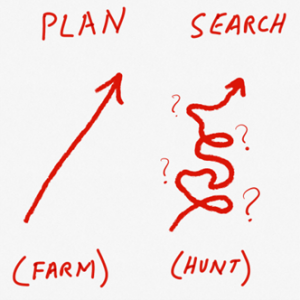
         <p>Until recently, virtually all business courses and job placement books came from a planning-based mindset in a stable environment as shown on the left side of the figure. This works very well for many large established companies and the step-by-step management tools arising from this planning-based approach have been widely taught and validated over many years.</p>
         <p>The vast majority of career-planning, goal-setting, self-help, personal success, and happiness books are also written from this managerial causal thinking perspective. Most of these planning-based methods will urge things like: “begin with the end in mind”, “relentlessly pursue your goals” or “never give up”. Many of these books require you to articulate your goals within the first few pages and then spend the next 90% of the book telling you how to achieve this known goal. But what if you don’t know what you want, or change your mind, or live in a quickly-changing uncertain world where planning just doesn’t work very well?</p>
         <p>The step-by-step planning approach works very well for people who know what they want or have a fairly clear path (e.g. to be a doctor, lawyer, real estate agent or Olympic athlete). These people can set a clear goal and then pursue it until they finally achieve it. Many successful people have used this approach and their resulting success books extol the virtues of tenacity and persistence toward known goals (causal thinking). That’s the underlying assumption of virtually all goal-setting, business planning, self-help, time management, and personal wellness and happiness books. When it works, it works very well!</p>
         <p>It didn’t always work well for me. I didn’t really know exactly what I wanted to do – I didn’t have a perfect vision of a potential future goal toward which I wanted to strive relentlessly. I was good at using all the planning-based tools I’d read about to set and achieve short term and mid-term goals. They helped me become a productive machine, but I lacked an overall direction and the books didn’t help me learn how to piece together a multi-faceted life with balance and long-term happiness. I read over 100 such books, most of which contain good tools and some gems of insight (which I use in this workbook), but also lots of ideas that frustrated me or didn’t work very well in certain situations. Fortunately, the science of entrepreneurship and the field of design thinking transformed this whole line of thinking!</p>
         <p>It turns out that over 80 percent of people are like me and don’t always know what they are passionate about. I was not alone despite what many of the gurus extolled. <strong>Most people discover they are passionate about something only after they’ve tried it, not before. They need to Search and Discover their goals instead of Plan to achieve known goals.</strong> Most entrepreneurs and most people find themselves on the right side of the figure where they need to search or discover instead of plan.</p>
         <p>The entire business planning methodology (left side) is based on imagining a future goal and then figuring out what actions in the present will achieve that goal using causal logic. That’s how most of the tools we teach in the BComm and MBA program have been designed. We teach how to fully analyse and plan to control all aspects of a business in order to reach that envisioned future goal. In contrast, the new entrepreneurial search and discovery tools on the right are about starting where you ARE (not where you want to end up), taking an experimental step in what you think might be the right direction, learning, and then deciding whether to pivot to a new direction or persevere in the same direction using effectual thinking.</p>
         <p>My friend Dr. Matteo Vignoli (a design thinking expert and professor at the University of Bologna in Italy) calls it Farming vs Hunting. Everything on the left side is based on the farming mindset – if your goal is to eat tomatoes you plan your tomato planting for the right time of year, give them water and sunlight, and control for any uncertainties like insects and weather. If the weather is too uncertain you build a greenhouse to exert greater control. Life is stable and predictable and you always get what you plan for. On the right side you need a hunting mindset – the environment is uncertain and you don’t know where the food might be. You may spend the entire day chasing after different prey and you never know what you might find. Obviously, farmers and hunters need different methods and mindsets – farmers plan and hunters search.</p>
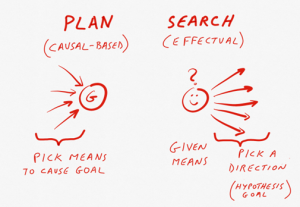
         <p>Using more academic language, the planning side on the left uses causal managerial logic where things are reasonably predictable, the desired future state is reasonably stable and known, and the causal actions (means) needed to achieve the future state (goal) are reasonably known. Think farming. That’s what we’ve been teaching in business schools for most of the last 30+ years.</p>
         <p>The revolutionary new entrepreneurial mindset on the right uses effectual doing instead of managerial thinking and the primary tools are design thinking and agile, lean startup methods. Effectuation does not start with the end in mind. It starts with your current situation (the “Bird-in-the-Hand” Principle) which includes your human capital (education, knowledge, skills), social capital (networks, relationships), character (attitudes, beliefs, values) and financial capital. Instead of setting a firm end goal, you use divergent thinking to envision alternative goals and select a hypothesis that you would like to test (pick a direction). You take proactive steps toward testing that hypothesis, learn, adapt, and then either persevere toward that temporary hypothesis goal or pivot toward a different direction. Think hunting. You don’t know where the food is so you start to search in one direction, find weak signals, learn from the search, and decide whether to continue in that direction or pivot to change course.</p>
         <p>&nbsp;</p>
         <figure id="attachment_252" aria-describedby="caption-attachment-252" style="width: 677px" class="wp-caption alignleft">
              <img src="https://pressbooks.library.torontomu.ca/ecld/wp-content/uploads/sites/336/2022/03/Chapter1Picture2-300x207.png" alt="A diagram that has a label that says plan (casual-based) with arrows point to a circle that says, 'G' that states underneath &quot;pick means to cause goal' and one diagram that says Search (effectual) and a circle with a smiley face wth arrows going out with a label that says given means and pick a direction that says Hypotheis goal" width="677" height="467" class="wp-image-252" srcset="https://pressbooks.library.torontomu.ca/ecld/wp-content/uploads/sites/336/2022/03/Chapter1Picture2-300x207.png 300w, https://pressbooks.library.torontomu.ca/ecld/wp-content/uploads/sites/336/2022/03/Chapter1Picture2-65x45.png 65w, https://pressbooks.library.torontomu.ca/ecld/wp-content/uploads/sites/336/2022/03/Chapter1Picture2-225x155.png 225w, https://pressbooks.library.torontomu.ca/ecld/wp-content/uploads/sites/336/2022/03/Chapter1Picture2-350x241.png 350w, https://pressbooks.library.torontomu.ca/ecld/wp-content/uploads/sites/336/2022/03/Chapter1Picture2.png 505w" sizes="(max-width: 677px) 100vw, 677px" />
              <figcaption id="caption-attachment-252" class="wp-caption-text">Original artwork for textbook</figcaption>
         </figure>
         <p>Farming starts with the end in mind and takes a direct, straight-line approach toward a clearly identified goal using planning methods. This is called “Causal Thinking” (left side of the figure). Hunting/Searching starts with your current situation, brainstorms alternative goals, narrows down the range of choices into a hypothesis goal, takes a proactive action toward that hypothesis goal, and then seeks insights to learn, adapt, and/or pivot in order to create the future. This is called “Effectual Entrepreneurial Doing” (right side of the figure).</p>
         <h2><strong>Effectuation</strong></h2>
         <p>Perhaps the most fundamental and revolutionary idea to arise from the field of entrepreneurship is the concept of Effectuation (“Effectuation: Elements of Entrepreneurial Expertise” by Sarasvathy, 2009). Previously, business planning was based on the desire to predict the future through the use of analysis and causal logic. As shown on the left side of the figure, managerial thinking (“causal thinking”) starts with a given goal and then attempts to select the means required to achieve this goal.</p>
         <p>Effectual Entrepreneurial Doing, in contrast, starts with understanding what means are under the entrepreneur’s control then tries to creatively envision a variety of alternative goals. It does not attempt to <em>predict</em> the future, instead it takes concrete steps that are under the entrepreneur’s control to <em>create</em> the future. Researchers have analyzed the way that successful entrepreneurs use effectual doing, instead of causal thinking, and describe various principles of effectuation and design thinking. These are incorporated throughout this workbook and the 20+ ECLD videos available free on YouTube and include principles such as:</p>
         <ul>
              <li>Bird-In-the-Hand (start where you are, not where you want to end up)</li>
              <li>Lemonade and Surprise Seeking (be curious, action-oriented and resilient)</li>
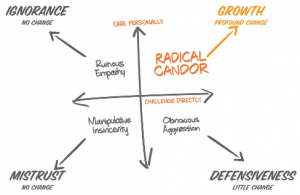
              <li>Crazy Quilt and Radical Candor (focus on customers, not competitors, and remain adaptable and open to changing your ideas)</li>
              <li>Iterate, Re-Frame and Experiment</li>
              <li>Affordable Loss (don’t put all your eggs in one basket, build a portfolio of experiences)</li>
              <li>Pilot-in-the-Plane (use agency to control what is actually under your control such as your own time, attention, character, beliefs and attitudes)</li>
         </ul>
         <p>Not only are these principles, and most entrepreneurial attitudes, revolutionary, but they also fundamentally clash with the way we were all taught to think!</p>
         <p>The educational system is fundamentally designed around step-by-step causal thinking, careful planning and regurgitation of knowledge. Sit quietly in chairs neatly arranged in rows. Do what you are told. Follow the teacher’s instructions. Repeat the right answers. Don’t make mistakes. Once you pass the test you are done.</p>
         <p>Entrepreneurial principles and attitudes break all these norms and are designed around iteration, testing and frequent pivots to overcome uncertainty and discover new things. Work in teams in a messy creative space surrounded by post-it notes, energy drinks and music. Figure out what <em>you</em> want to focus on, not what the teacher tells you to do. There are no fixed instructions, only principles to guide you. There are an infinite number of right answers that could work for you. Make frequent mistakes and learn from them. Once you get to the end of one challenge, there will be new challenges to pursue.</p>
         <p>Making this leap from step-by-step thinking to effectual doing is difficult. Some students have grown quite dependent and accustomed to being told what to do and how to do it. It’s comfortable and change is hard.</p>
         <p>Switching from nice clear step-by-step instruction-based planning to iterative messy search-based doing is HARD. You have to WANT to change. You have to rewire your brain to overcome years of training. This does not happen overnight. You need to practise. This workbook will help, but you need to devote the time and effort and try new ways of being.</p>
         <h2><strong>Uncertainty and Planning for a Job vs Searching for a Career (Framing Your Portfolio of Career-Related Design Challenges)</strong></h2>
         <p>The future is highly unpredictable and uncertain. As described in the ECLD Module 1 video, there will be increased global competition and technological change that will eliminate jobs and destroy entire industries. These days everyone must be entrepreneurial in order not to just adapt to change, but to embrace and thrive amidst uncertainty.</p>
         <p>Getting a university degree no longer guarantees you a good job that you can hold for most of your life. A university degree has become the basic minimum requirement just for many entry-level jobs. Most “good jobs” that pay well and give you autonomy, creative expression, travel and interesting work will require a lot of experience, practical skills, good connections and positive attitudes in addition to a degree.</p>
         <p>According to “What Color is Your Parachute? A Practical Manual for Job-Hunters and Career-Changers” the average worker under 35 years of age will go job-hunting every one to three years throughout their entire working life. That means you can probably look forward to doing a job search up to twenty times over the course of your career. When looked at this way, job-hunting becomes one of the most important happiness-enhancing skills you can spend time learning and there are lots of <em>how to</em> books and articles out there full of useful tips on how to network, how to write a resume, how to interview, and how to negotiate around a job offer.</p>
         <p class="import-Normal">I’m sure you’ve heard the expression “It’s not what you know, it’s who you know.”</p>
         <p>This is one of those facts of reality that is outside of your control and you just need to accept. According to Karine Blackett in “Career Achievement”, less than 20% of all jobs are ever advertised and the other 80% are part of the so-called “hidden job market” only accessible through networking and building your Social Capital. So, reality demands that you get out there and speak with a lot of people. There is simply no substitute for networking and meeting lots of people. Co-creating the job of your dreams, or getting any job for that matter, is basically a numbers game. You should conservatively expect to speak with at least 30-50 people. Don’t panic or be afraid of that number, it’s just a fact of reality to be accepted and used to guide your actions.</p>
         <p>Finding a job is not empowering. You are not in control of any aspect of this process. You don’t create the job, it is not designed for you, you may or may not get it, and it will rarely be a perfect fit with your desires, skills, values and interests. Jobs come and go outside of your control. The world is simply too uncertain to plan around getting a job and living happily ever after (Editorial Cartoon by Graeme MacKay, USA Today – June 22, 2020).</p>
         <p>In the past, people could find a job they held onto for their entire lives, but, with rare exceptions, that is simply no longer the case. Jobs often disappear due to external market forces outside of your control. See any job-hunting book for lots of discouraging statistics about the job market and process of finding a job. Not only do jobs disappear without warning, but most employees don’t even like the ones they have. Over half of all Americans are unhappy at work and 70% are actively disengaged at work. Many people just hate their jobs.</p>
         <p>Jobs are created by employers without thinking about you. They invite everyone to apply for jobs through what is often a dysfunctional and discouraging process, and they hire the people they think are the best fit with <em>their</em> needs. Employers consider their own interests above yours. Jobs are often a weak fit with your unique skills and interests and they almost always pay less than positions that are custom-made for you. Since you may be one of hundreds applying for a job, the company can also pay you less because they can just go to the next person on the list if you decline their offer.</p>
         <p>Once you have that job, it is unlikely to give you everything you want – authority, autonomy, travel, advanced training, interesting work, great colleagues, lots of money, vacation time and sabbatical breaks. So it’s not really about getting just any job, it’s about getting a job that will help prepare you to get the next one that will be better. But unfortunately, employers are not really looking out for <em>your</em> career progression. They don’t want to help you find a better job with the competition. Very few will pay for you to build your human capital or social capital beyond what <em>they</em> need. You need to build the skills and connections needed for your next job on your own, outside of, and in addition to, your current job.</p>
         <p>So how do you build these social and human capital requirements outside of your current job? Reading a book, watching a video, or paying for a course or certificate are great ways to build your human capital, but there are also entrepreneurial opportunities for you to build even better human capital while getting paid through a side-hustle or start-up. Similarly, you can attend networking events to build your social capital, but there are entrepreneurial opportunities to forge even deeper relationships and connections by being involved directly in a social venture.</p>
         <p>Building a career is broader than any single job. You can think of a career as a proactive portfolio of experiences that could encompass several jobs, start-ups, side-hustles, and volunteer positions, logically tied together in a way that enhances your personal growth and experience (i.e. your human and social capital). <strong><em>You need to do things outside of your current job to grow your character, human and social capital to help you get your next (better) job.</em></strong></p>
         <p>Building a career is empowering because you are proactively experimenting and being alert to spotting opportunities to create value and build the future. Instead of applying for given jobs, you build your social capital and interview prospective collaborators to design a job that is the best fit with your skills, interests and career goals. If any one job happens to disappear outside of your control, your career mindset will mean you are well connected, with desirable skills and attitudes, and well positioned for co-creating an alternative work situation. Jobs within your career generally pay better too because you are more efficacious and produce greater value when you are doing something you are good at, like, and are interested in.</p>
         <p>It is estimated that the average person under 35 will go through a job-hunting process every 2 years so building your human and social capital pays off in the long term.</p>
         <p>Building a career is empowering because it puts you in control of your destiny. You are not reliant on any one single job because you are positioning yourself more broadly within an industry and actively growing your network and skills that are critical to success in that industry. Even if you take a particular full-time job, you are continuously growing your network to find the next one, and taking on a side-hustle to develop skills and connections outside those that your current employer offers.</p>
         <p>Unless you get very lucky, you cannot expect any one particular job to give you everything you need for a successful career. The skills, attitudes and connections needed for a successful career (human and social capital) are broader than those needed for whatever your current job happens to be.</p>
         <p>So how do you gain the skills, attitudes and connections needed for your next job while you are currently working in your first one? This is where the idea of a “side-hustle” is so critical! A side-hustle is something you do <em>in addition to</em> your current job that positions you for your next one.</p>
         <p>A side-hustle gives you a broader range of skills and connections and allows you to run hypothesis tests on things that might interest you. It could be an entrepreneurial business that you start up and run evenings and weekends (like a Shopify store or YouTube Channel), it could be a volunteer position, it could be an educational project, evening class or master’s degree – it might be called Life-Long Learning. It doesn’t really matter what you do as long as it is outside the scope of your current job and positions you more broadly in the direction of your overall career path. Even after they have achieved financial security and no longer need to “work”, most happy people choose to continue being productive and active long after they can “retire” (e.g. starting a second or third career).</p>
         <p>If your immediate emotional reaction to the idea of a side-hustle in addition to a job is negative, consider this. Don’t pick a side-hustle that you don’t <em>want</em> to do. Don’t think of it as work. Think of it as something fun and engaging and personally interesting. This is an issue of re-framing. Instead of sitting around watching TV or hanging out, you can be doing something that is of higher value to your long-term happiness, and potentially earns you money. There are probably a great many things that you actually value more than watching TV, once you start to explore what really makes you happy.</p>
         <p>Designing a great productive career is central to achieving self-sufficiency, financial independence, personal empowerment and happiness and is normally one of the biggest design challenges (or “needs”, “problems” or “jobs to get done”) in a young person’s life. Later on, the need to design a new career may be thrust upon you by circumstances outside of your control.</p>
         <h2><strong>What is Entrepreneurship and Personal Empowerment?</strong></h2>
         <p>Entrepreneurship is far more than just starting a new business using effectuation instead of planning-based methods. It involves being alert to what IS and spotting opportunities for what MIGHT or OUGHT TO BE. It involves proactively bringing about this positive change in the world by TAKING ACTION. It’s about overcoming obstacles or inertia and creating value through experimentation, iteration and continuous LEARNING.</p>
         <p>Entrepreneurship involves understanding what IS by being curious not only about the world around you, such as potential customers and industries, but also about yourself, and your values, beliefs and interests. It involves envisioning what MIGHT or OUGHT TO BE by imagining a better product, a stronger network, a more fulfilling career, more supportive relationships, or a happier life. Spotting opportunities to add value to your life seldom happens by random chance – it takes ACTION like attending events, joining an organization, or reaching out to interview someone. LEARNING from your experiments and actions doesn’t happen automatically either – it takes a proactive process of self-reflection and feedback.</p>
         <p>This holistic philosophy of entrepreneurship is fundamental to the human spirit! Entrepreneurship is not just a business discipline, but a different way of seeing, thinking and acting. It’s that certain something that enabled humanity to harness fire, steam, sunlight and the atom; to create something new by spotting opportunities for a better future; to innovate and improve.</p>
         <p>I’ve been researching and promoting this holistic philosophy of entrepreneurship for over a decade through my publications, public speaking, courses and work with ConeeectU – Educating Entrepreneurship Educators and EntreTime, a Train-The-Trainer program for entrepreneurship professors (<a href="http://www.entretime.com">www.entretime.com</a>). These ideas have influenced over 300 university entrepreneurship professors through ConeeectU and EntreTime alone.</p>
         <p>In “What is Entrepreneurship?” I identify four major domains of entrepreneurship that apply to life design including:</p>
         <ul>
              <li>Starting a New Venture – this includes small business ownership, side-hustles, gigs and self-employment as well as founding high growth start-ups,</li>
              <li>Intrapreneurship – this involves proactively creating new value as an employee which is also referred to as innovation or corporate entrepreneurship,</li>
              <li>Social Entrepreneurship – which involves creating social or other non-economic values and is also called social innovation, active citizenry or changemaking, and</li>
              <li>Personal Empowerment – this involves overcoming adversity and/or creating new values, happiness and well-being for yourself through personal growth and transformation and consists of exerting agency over your career and life by spotting opportunities to build your character, human capital, social capital and financial capital.</li>
         </ul>
         <p>In “Best Practices in Entrepreneurship Education” I provide the following definition:</p>
         <p>“Entrepreneurship education encompasses holistic personal growth and transformation that provides students with knowledge, skills and attitudinal learning outcomes. This empowers students with a philosophy of entrepreneurial thinking, passion, and action-orientation that they can apply to their lives, their jobs, their communities, and/or their own new ventures.”</p>
         <p>The definition of entrepreneurship is not a mere technicality. Defining it only in terms of starting a new venture makes it relevant primarily to business students. In contrast, a broader perspective makes the entrepreneurial mindset relevant to all individuals and all disciplines. In “Embedding Experiential Learning in Cross-Faculty Entrepreneurship Education” we show how this definition of entrepreneurship was used at the Munich University of Applied Sciences to embed entrepreneurship into every faculty and department on campus. “We have found that these more inclusive, holistic, four domains of entrepreneurship allowed us to form collaborative partnerships across campus including with engineering, social sciences, humanities, art, and design. In particular, broadening the preconceived notions of entrepreneurship beyond strictly a business discipline into a more holistic philosophy of personal growth, creativity, leadership, problem solving and teamwork has encouraged the collaboration of diverse perspectives.”</p>
         <p>In “Theory-Based Design of an Entrepreneurship Micro-Credentialing and Modularisation System within a Large University Eco-System” I show how this definition of entrepreneurship impacted our mission statement at TMU through the Toronto Met Entrepreneur Institute (TMEI), Enactus TMU and the Entrepreneurship &amp; Strategy Department.</p>
         <div class="textbox shaded">
              <p><strong>TMU Entrepreneurship &amp; Strategy Department Mission</strong></p>
              <p>“Our goal is to provide students with a deeply experiential and transformative learning experience in a vibrant urban environment. We empower students with a philosophy of entrepreneurial thinking, passion, and action-orientation that they can apply to their lives, their jobs, their communities, and/or their own new ventures.</p>
         </div>
         <p>We ignite students’ passions and empower them to achieve extraordinary goals. Canada’s pre-eminent and largest entrepreneurship program, we deliver innovative educational programs and support multi-disciplinary experiences across campus with local, national and global impact. We provide access to world-class support and funding for our students’ new ventures and are embedded within our community.”</p>
         <p>Personal Empowerment results from the application of entrepreneurial principles to your own life – being curious about yourself and what makes you tick, spotting opportunities for adding value to your life, and proactively creating the best possible career and life. This approach to your own life uses entrepreneurial tools and attitudes to achieve personal happiness and growth in your character, human capital, social capital and financial capital.</p>
         <p>Empowered individuals are in charge of their own future! They may not be able to predict the future, but they can proactively create it through actions that are within their control. They have their hands on the steering wheel of their lives. They know their strengths, weaknesses, beliefs and values. They have a purpose and take positive action toward achieving values in harmony with their beliefs. They actively track their own happiness and spot opportunities where they can improve their well-being. They use entrepreneurial methods to set and achieve goals to live the kind of empowered lives they desire. They climb Maslow’s Hierarchy of Values as they achieve financial security, love, meaning, fulfillment, self-actualization, well-being and happiness.</p>
         <p>Empowered individuals have Agency over their careers and lives. They take deliberate conscious control over their own character, skills, beliefs and attitudes. They are aware of why they are doing things, what values they are trying to achieve, and what is causing their emotional reactions. They are not forced to take just any job that fate, destiny or the system happens to offer. They have conscious career goals, proactively build their human and social capital, and use entrepreneurial principles to build value in their career and achieve personal happiness.</p>
         <p>Empowered individuals do not drift through life and hope for the best. They don’t just apply to whatever jobs happen to be available – they take proactive steps to create their career based on their articulated values. They look beyond their current job to proactively develop their human and social capital through side-hustles, startups, changemaking projects or volunteer activities. They don’t just allow a hodgepodge of subconscious beliefs, put there by other people, to control their actions and emotions – they take proactive conscious control over their beliefs, self-talk and values and seek out and eliminate contradictions that cause unhappiness. They don’t just float and see what happens next – they find opportunities that might improve their happiness and then test them using entrepreneurial methods. Their happiness is not something that may or may not happen in the future – they take conscious control of measuring and achieving their happiness now and maintaining it throughout life.</p>
         <p>All the entrepreneurial mindset and tools that have been developed to create a successful company can also be used to create a successful <em>YOU</em> – to design a successful career and life!</p>
         <p>&nbsp;</p>
         <p><strong><em>Your Career is far more than just any Job.</em></strong></p>
         <p><strong><em>Your Life is far more than just being Alive!</em></strong></p>
         <p>&nbsp;</p>
         <p class="import-Normal">You will benefit from the following additional optional video content on D2L:</p>
         <p class="import-Normal"><strong><em>Watch</em></strong><em>: SCE 1 of 4 Video Series What is Entrepreneurship &amp; How to Teach It? (14:48)</em></p>
         <div class="textbox interactive-content interactive-content--oembed">
              <span class="interactive-content__icon"></span>
              <p>One or more interactive elements has been excluded from this version of the text. You can view them online here: <a href="#oembed-2" title="What is Entrepreneurship &amp; How to Teach It?">https://pressbooks.library.torontomu.ca/ecld/?p=29#oembed-2</a> </p>
         </div>
         <p>&nbsp;</p>
         <p>&nbsp;</p>
         <p class="import-Normal"></p>
    </div>
</section>
<section data-type="chapter" class="chapter introduction" id="chapter-chapter-2-start-where-you-are-and-goal-setting" title="Chapter 2: Start Where You Are and Goal-Setting">
    <header>
         <h1 class="chapter-title">Chapter 2: Start Where You Are and Goal-Setting</h1>
         <p data-type="subtitle" class="chapter-number">2</p>
    </header>
    <div class="chapter-2:-start-where-you-are-and-goal-setting-">
         <p><strong><em>Watch</em></strong> <em>ECLD Module 2 – Bird-in-Hand Principle (15:58)</em></p>
         <div class="textbox interactive-content interactive-content--oembed">
              <span class="interactive-content__icon"></span>
              <p>One or more interactive elements has been excluded from this version of the text. You can view them online here: <a href="#oembed-1" title="ECLD 2 Entrepreneurial Career and Life Design: Module 2 - Bird-in-the-Hand Principle">https://pressbooks.library.torontomu.ca/ecld/?p=120#oembed-1</a> </p>
         </div>
         <p>Planning-based thinking begins with the end in mind and assumes at least a somewhat predictable and stable future. Searching, in contrast, starts where you are, not where you think you might want to end up. You can’t control an unpredictable world. You can only understand the means at your disposal which dictate what is possible, what potential directions you might want to explore, and who might be able to help you on the adventure. It starts by being curious about yourself and your interests, values, beliefs, attitudes, skills and character. Both planning and searching require good goal-setting and time management skills to set priorities, fit everything in, and enhance your productivity and overall happiness.</p>
         <h2><strong>Entrepreneurial Principle #1: Bird-in-the-Hand </strong></h2>
         <p>Unlike managers who can control vast amounts of resources and capital to achieve their goals, entrepreneurs start with few resources, but an understanding of themselves. Most start with nothing but their own character, human capital and social capital. This is certainly true when trying to spot opportunities to discover an interesting potential future career.</p>
         <p>There are three primary aspects of the Bird-in-the-Hand Principle: your Character, Human Capital and Social Capital. (I note that personal Financial Capital is also important, especially when considering life design questions around viable careers, goals or retirement.)</p>
         <p>Your Character involves understanding who you are, your personality, interests, values and beliefs. Certain basic traits or personality types are “sticky” and difficult, if not impossible, to change such as whether you make decisions quickly or prefer to gather more detail and seek other opinions. It is important that you understand your basic preferences such as whether you are introverted or extraverted or like to work in teams or prefer working on your own. However, it is far more important to understand and judge your characteristics, beliefs and attitudes that are changeable. Do you make and keep commitments or do you frequently let people down? Are you a hard worker or do you give up easily? Are you curious, alert, engaged, proactive and motivated or does it take a lot to make you exert effort? Are you optimistic, hopeful, positive, conscientious and trustworthy? Do you have grit, tenacity and resiliency? All these attitudes, habits and values are under your control and thus changeable through life design. More importantly, as we’ll show in chapters 8-10, these aspects of your character have a far greater impact on your happiness and well-being than job, money, marriage, age or health!</p>
         <p>Your Human Capital involves your productive capacity or sustainable competitive advantage over other people – your knowledge and skills that differentiate you. This can include your education and experience but also includes what you do outside of these formal roles. What life-long learning do you pursue like reading books, watching instructional videos or engaging in focused practice? What organizations or side-hustles do you work with so that you can practice and improve your skills (such as building websites, doing research and gaining customers)? Can you demonstrate what you can do? What values can you create for a potential employer? What are your signature strengths, interests and talents that you can build into something exceptional and unique?</p>
         <p>Your Social Capital or Relationship Capital consists of how strong your relevant network is for supporting your career aspirations. I mentioned earlier the expression “It’s not what you know, it’s who you know” and the fact that less than 20% of all jobs are advertised and the other 80% are only available to those within the employer’s social network. These are the so-called insiders or friends-of-friends or referrals; people who can be, or introduce you to, a potential employer and ideally vouch for your character and human capital. In addition to those in your career-related network, your friends and social circle can support and enhance your career and life goals. “You’re the average of the five people you spend the most time with” is a common phrase attributed to Abraham Lincoln and Jim Rohn.</p>
         <p>Potential employers, partners, team members or investors deeply care about your character and human capital and may not even consider you if your social capital does not overlap with theirs.</p>
         <p>In “Trust, Ethics, Character and Competence in Angel Investing” I interviewed dozens of Angel investors about why they invest in certain entrepreneurs and not others and discovered that the entrepreneur’s trustworthiness, ethics, character, human and social capital was far more important than the startup idea, traction, customers or revenues. I describe how to assess these intangible assets in my book “A Practical Guide to Angel Investing: How to Achieve Good Investment Returns” published by the National Angel Capital Association (NACO).</p>
         <p>Why would any employer pay you more than minimum wage or more than what someone else would be willing to work for on the other side of the planet in a low-wage country? What do you know how to do that others can’t do as well? Have you merely gone from one entry-level job to another over your lifetime or have you built up a portfolio of increasingly distinctive and rare capabilities to build a sustainable competitive advantage? How are you different from the other millions of graduates with a BComm degree? What can you become exceptional at?</p>
         <p>I remember an ex-boss of mine once rejecting a potential new hire by stating that “He doesn’t have 20 years of experience; he only has one year of experience that he’s been doing for 20 years.” Building a career means that you are not only learning more and more each year within your current job, but also building your portfolio of capabilities, skills, interests and connections outside of your job.</p>
         <p>Dr. Seligman, the founder of Positive Psychology and one of the world’s leading authorities on how to build and sustain long-term happiness and well-being, says that you should discover what your “signature strengths” are. In order to flourish in your career, be satisfied in your work and find happiness, the research shows that you are far better off focusing on building upon your strengths and interests rather than fixing your weaknesses. We’ll dig into that more in Tool #3, but let’s get started by seeing what your life looks like now.</p>
         <h2 class="import-Normal"><strong lang="en-US" xml:lang="en-US">Tool</strong> <strong lang="en-US" xml:lang="en-US">#1: </strong><strong lang="en-US" xml:lang="en-US">Start Where You Are – </strong><strong lang="en-US" xml:lang="en-US">The Wheel of Life</strong></h2>
         <p class="import-Normal"><strong><em>Watch and Use</em></strong> <em>Tool </em><em>#</em><em>1 – Wheel of </em><em>Life (15:25 or 25:40)</em> <em>The longer version of this tool includes an example of my Wheel of Life, my Draft Design Challenges, my Patterns and finally my Final Design Challenges. Recognizing that my challenges are very different from yours, I also created a shorter version of the video without these examples if you want to save time.</em></p>
         <p>&nbsp;</p>
         <div class="textbox interactive-content interactive-content--oembed">
              <span class="interactive-content__icon"></span>
              <p>One or more interactive elements has been excluded from this version of the text. You can view them online here: <a href="#oembed-2" title="ECLD Tool #1 - Wheel of Life (short version)">https://pressbooks.library.torontomu.ca/ecld/?p=120#oembed-2</a> </p>
         </div>
         <p class="import-Normal">The purpose of this assignment is to help you check your pulse, identify what your design challenges might be in a variety of areas, and set goals for the remaining assignments in this course. You want to get started searching in the right direction and focus your time and attention on the right activities. You also want to make sure that your life has balance and that, over time, each of the major elements of your wheel gets the attention it needs in order to achieve overall long-term happiness. You can and should defer some elements while you focus on others, but over the long-term your wheel has to be in balance in order to spin properly. Goal-Setting Tool #9 will improve your time management skills and help set goals for the rest of the course.</p>
         <p class="import-Normal">In ENT 401 and 78AB, our focus is on your career-related design challenges. You can and should set and pursue a wide variety of design challenges in each area of your life, but the emphasis of this course and the majority of the assignments are related to your career.</p>
         <p class="import-Normal"><img src="http://pressbooks.library.ryerson.ca/ecld/wp-content/uploads/sites/336/2022/03/image2-3.png" width="304" height="245" alt="Wheel of life with the following sections: Job, start-up/self employed &quot;gigs&quot;, social changemaking/volunteer opportunities, events/organizations/relationships, school/books, thoughts/habits/values/interests, spiritual/organized religion, family/love/friends, health/sports/food/play." class="alignleft" /></p>
         <p class="import-Normal">Each person’s Wheel of Life will look different, so please don’t feel constrained to use only the one I show you in the video. As a minimum you should consider the three elements of the Bird-in-the-Hand Principle as well as a portfolio of career-related elements such as a job and all those things you do outside your job in order to position yourself more broadly in your chosen career (i.e. side-hustles, startup ventures, and/or social changemaking projects).</p>
         <p class="import-Normal">Here are a couple examples of student assignments using this tool – the 3<sup>rd</sup> one is particularly excellent and thorough. (<span lang="en-US" xml:lang="en-US">A</span><span lang="en-US" xml:lang="en-US">lso watch </span><span lang="en-US" xml:lang="en-US">on D2L the in-class feedback video on </span><span lang="en-US" xml:lang="en-US">Week 2 </span><span lang="en-US" xml:lang="en-US">W</span><span lang="en-US" xml:lang="en-US">heel of </span><span lang="en-US" xml:lang="en-US">L</span><span lang="en-US" xml:lang="en-US">ife </span><span lang="en-US" xml:lang="en-US">15Sep2020. You can learn a lot from seeing the strengths and weaknesses of your fellow students</span><span lang="en-US" xml:lang="en-US">’ assignments</span><span lang="en-US" xml:lang="en-US">.)</span></p>
         <p class="import-Normal"><img src="http://pressbooks.library.ryerson.ca/ecld/wp-content/uploads/sites/336/2022/03/image3-3.png" width="443" height="402" alt="Sample wheel of life filled out." class="alignright" /><img src="http://pressbooks.library.ryerson.ca/ecld/wp-content/uploads/sites/336/2022/03/image4-3.png" width="385" height="365" alt="Sample filled out wheel of life." class="alignleft" /></p>
         <p class="import-Normal"><img src="http://pressbooks.library.ryerson.ca/ecld/wp-content/uploads/sites/336/2022/03/image5-3.png" width="618" height="480" alt="Sample wheel of life filled out." class="aligncenter" /></p>
         <p class="import-Normal"><img src="http://pressbooks.library.ryerson.ca/ecld/wp-content/uploads/sites/336/2022/03/image6-2.png" width="453" height="339" alt="Sample wheel of life." class="alignright" />I find that having more than 10 major elements in my life starts to become overwhelming and stress-inducing. So I deliberately group some things together. For example, I used to have a category for sailing, one for music, another for friends, another one for sports and another for health but have since decided to lump these all together. I also used to separate my various Toronto Met-related jobs (one for teaching, one for research, one for Enactus, one for TMEI, one for starting up the DMZ…) but I now combine these or categorize them differently. Enactus, for example, is now included as a social changemaking project that I do for my own reasons and not because it’s related to my job at TMU.</p>
         <p class="import-Normal">Just make sure that your wheel captures all the major elements of your life that are important to you as a springboard for brainstorming what’s working and what’s not. What aspects of your life give rise to different design challenges that you want to focus time and attention on?</p>
         <p class="import-Normal">As described in the YouTube video <em lang="en-US" xml:lang="en-US">ECLD </em><em>Tool </em><em>#</em><em>1 – Wheel of Life</em>, once you create your wheel, rate each element for level of satisfaction, need for change and activities or challenges that arise. Use Post-it notes to capture your brainstorming. You are seeking quantity over quality during this divergent thinking phase. Try to create at least 30 post-it notes using good visualization techniques. You need to be able to read them at a distance. In the longer version of the video, I go around my wheel and describe some of my personal activities, priorities and challenges that arise from each element.</p>
         <p class="import-Normal"><img src="http://pressbooks.library.ryerson.ca/ecld/wp-content/uploads/sites/336/2022/03/image7-1.png" width="379" height="251" alt="This figure shows the general process we are following in this tool. Starting at the far left, you start by drawing a blank wheel with the major categories of your life. You then brainstorm activities, challenges and issues to fill up your wheel with post-it notes." class="alignright" /></p>
         <p class="import-Normal">This figure shows the general process we are following in this tool. Starting at the far left, you start by drawing a blank wheel with the major categories of your life. You then brainstorm activities, challenges and issues to fill up your wheel with post-it notes.</p>
         <p class="import-Normal">In the convergent thinking phase, you want to remove the post-its from the wheel and manipulate your post-it notes to look for patterns by clustering, separating, organizing and/or rearranging them (plot by level of importance, urgency, interest, satisfaction, need for change, etc.) in order to gain insights. I show you an example of how I organized my long-term priorities into a 2×2 matrix in the video.</p>
         <p><img src="http://pressbooks.library.ryerson.ca/ecld/wp-content/uploads/sites/336/2022/03/image8-1.png" width="359" height="379" alt="Here’s a simple example of how one student prioritized his general design challenge categories into level of satisfaction (shown by the sad and happy faces) and need for change (at left shown by the delta) to no need for change (at right) before digging into the ones that most needed change and caused unhappiness (the side-hustle, social capital and social changemaking categories)." class="alignright" style="padding-left: 0px;" /><span></span></p>
         <p class="import-Normal">Here’s a simple example of how one student prioritized his general design challenge categories into level of satisfaction (shown by the sad and happy faces) and need for change (at left shown by the delta) to no need for change (at right) before digging into the ones that most needed change and caused unhappiness (the side-hustle, social capital and social changemaking categories).</p>
         <p class="import-Normal">Here are a couple student examples of 2 x 2 matrices used in the convergent phase.</p>
         <p class="import-Normal"><img src="http://pressbooks.library.ryerson.ca/ecld/wp-content/uploads/sites/336/2022/03/image9-e1647616657751-300x272.jpeg" alt="2x2 matrix example" width="429" height="389" class="alignleft wp-image-109" style="font-size: 1em;" srcset="https://pressbooks.library.torontomu.ca/ecld/wp-content/uploads/sites/336/2022/03/image9-e1647616657751-300x272.jpeg 300w, https://pressbooks.library.torontomu.ca/ecld/wp-content/uploads/sites/336/2022/03/image9-e1647616657751-65x59.jpeg 65w, https://pressbooks.library.torontomu.ca/ecld/wp-content/uploads/sites/336/2022/03/image9-e1647616657751-225x204.jpeg 225w, https://pressbooks.library.torontomu.ca/ecld/wp-content/uploads/sites/336/2022/03/image9-e1647616657751-350x317.jpeg 350w, https://pressbooks.library.torontomu.ca/ecld/wp-content/uploads/sites/336/2022/03/image9-e1647616657751.jpeg 677w" sizes="(max-width: 429px) 100vw, 429px" /></p>
         <p>&nbsp;</p>
         <p>&nbsp;</p>
         <p>&nbsp;</p>
         <p><img src="http://pressbooks.library.ryerson.ca/ecld/wp-content/uploads/sites/336/2022/03/image10-1.png" width="490" height="504" alt="2x2 matrix example." class="alignright" /><span style="font-size: 1em; text-align: initial;"></span></p>
         <p>&nbsp;</p>
         <p>&nbsp;</p>
         <p>&nbsp;</p>
         <p>&nbsp;</p>
         <p>&nbsp;</p>
         <p>&nbsp;</p>
         <p>&nbsp;</p>
         <p>&nbsp;</p>
         <p>&nbsp;</p>
         <p>&nbsp;</p>
         <p>&nbsp;</p>
         <p>&nbsp;</p>
         <p>&nbsp;</p>
         <p class="import-Normal">Finally, you want to capture your learnings into a set of design challenges to get you searching in the right directions. As shown in the longer video, one <span style="font-size: 1em; text-align: initial;">of my examples is “How Might I (HMI)… hire students to work on a relevant COVID-related Social Changemaking Project and put money into student pockets and the economy while also helping me with video editing and technology?” Another design challenge was “HMI… Reduce the number of my work-related projects while retaining all my international social network?”</span></p>
         <h2 class="import-Normal"><strong>How to Write a Good Design Challenge Question (DCQ)</strong></h2>
         <p class="import-Normal">A Good Design Challenge Question gives you a direction to search in. You don’t need to have a specific goal, but at least need a hypothesis to give you some direction or orientation. The DCQ should be HELPFUL. “How do a find a great career that I love”, for example, provides no direction. It could have been written by anyone and is not helpful to YOU. So you want to add any specificity that might help guide you. “How do I find a career in the field of law?” provides slightly more direction, as does “How do I figure out if I want to work in a large Bay Street law firm or a small boutique law firm where I can bring my dog to work?”</p>
         <p class="import-Normal">If you are just getting started on your search, your DCQs may be quite vague if you don’t know if you want to work in a place that is fast-paced or slow and stable, or whether you want to live in Toronto or someplace else, or work in a 9-5 job or someplace more entrepreneurial. Different individuals will have different levels of specificity. One person may know they want to be a lawyer or real estate agent or wealth manager, whereas another might have absolutely no clue. That’s why one of the key principles of the search-based effectual method includes iteration and testing. This is really just your first “loop” or “diamond” or “iteration” to get you started.</p>
         <p class="import-Normal">Designers love good questions because they stimulate progress. Your brainstorming phase should include asking yourself a number of questions such as “Do I want to stay in Toronto?” “Do I want to work in a big or small company?” “Do I want to work in a graphic communication company or do I want a graphic communications role inside a company that does something else?” “Do I want to be the only graphic artist at a company or do I want to work with a lot of other graphic artists?”</p>
         <p class="import-Normal">You can see examples of other students’ assignments, along with feedback, by watching the previous term’s in-class feedback sessions posted on D2L.</p>
         <h2 class="import-Normal"><strong>ECLD Tool #1: Wheel of Life Step-by-Step Review</strong></h2>
         <ol>
              <li class="import-Normal">Draw your Wheel and document your current activities using post-it notes (or other digital alternatives) on Your Wheel of Life (what currently occupies your time, what are your current interests, obligations, activities, jobs, chores and time spent on?).</li>
              <li class="import-Normal">Go around the Wheel again and brainstorm any new activities, interests, goals or values you would like to pursue (use post-it notes to get a nice number of divergent thinking topics to work with).</li>
              <li class="import-Normal">Go around each pie-shaped element of your wheel and Rate Level of Satisfaction, Need for Change, or Challenges in Each Slice of Your Wheel (what changes can you envision to make progress toward achieving your desires?).</li>
              <li class="import-Normal">Look for Patterns during the Convergent Thinking Phase. Now that you have 30+ post-it notes, you can remove them from the wheel and use visualization methods to identify patterns, plot them on different axes and see if you find anything insightful or beneficial to you.
              <ul>
                   <li>Cluster, Separate, Label and Add New Post-Its</li>
                   <li>Remove the post-its from your wheel and rearrange them along either a single line or into 2×2 matrices such as:
                   <ul>
                        <li>Importance</li>
                        <li>Importance toward achieving your Career-Related Design Challenge</li>
                        <li>Urgency</li>
                        <li>Need for Change</li>
                        <li>Long-term vs Short-term</li>
                        <li>Things You Want to Do vs Don’t Want to Do</li>
                        <li>Level of Interest or Excitement</li>
                   </ul>
                    </li>
              </ul>
               </li>
              <li class="import-Normal">Capture the Learning
              <ul>
                   <li class="import-Normal">Focus on your Career-Related portions of the Wheel and condense the information into Potential Design Challenges you face regarding:
                   <ul>
                        <li class="import-Normal">Job Search, Intrapreneurial Opportunities</li>
                        <li class="import-Normal">Side-Hustle, Startup, Self-Employment, Gig</li>
                        <li class="import-Normal">Social Capital, Social Venture, Changemaking Projects</li>
                        <li class="import-Normal">Human Capital and Character</li>
                        <li class="import-Normal">Overall Balance</li>
                   </ul>
                    </li>
              </ul>
               </li>
         </ol>
         <ul>
              <li style="list-style-type: none;">
              <ul>
                   <li>Identify your Top 3-5 Career and Life Balance Design Challenges</li>
                   <li>Pick the most important career-related design challenge as your first draft and expand upon it to turn it into a Good Design Challenge Question</li>
                   <li>Document Your Process (Take Photos of Your Work)</li>
                   <li>Iterate to Improve Your Wheel of Life and Capture any Insights</li>
                   <li>Write a Report for the course assignment that meets university standards and includes Table of Contents, Introduction, Background, Next Steps and other relevant sections to help us to help you</li>
              </ul>
               </li>
         </ul>
         <p class="import-Normal">Upload Your Work to D2L at least 24 hours before class if you would like Public Feedback (Please Note that You Must Agree to Open Access Sharing for such Feedback)</p>
         <h2 class="import-Normal"><strong>Goal-Setting and Time Management Skills</strong></h2>
         <p class="import-Normal">When searching for and discovering what you might be passionate about, it is important to always keep the Bird-in-the-Hand principle in mind to ensure that your goals are realistic and you are growing your character, human and social capital (as well as your financial capital of course). You still need to set goals, but often these are more hypotheses or general directions to explore. Some goals are fairly easy to reach with minimal experimentation, searching or decision-making. For example, getting a university degree is a fairly straight-forward goal to achieve and almost entirely within your complete control to attain (once you get accepted by a university, all you need to do is sign up for classes and do the assignments, both of which are almost entirely within your control). Other goals are somewhat outside of your control such as getting the perfect job (the employer may hire someone else) or the perfect spouse (the other person may not love you back or may not want to get married). Many goals require a combination of search-based effectual principles combined with more traditional goal-setting and time management planning skills.</p>
         <p class="import-Normal">Good goal-setting will help you take control of your time and find a way to fit all your hopes, dreams and desires into your busy life while maintaining balance and keeping all the pieces of your life in context. Goal-setting and time management tools are essential elements of productivity, success and happiness. I know that most of you have had some introductory classes or lessons in goal-setting so let me give you some additional advanced knowledge. It’s a foundational skill but hard to master. I’ve personally read well over 100 books on goal setting and I’ve been applying it for over 25 years. Trust me on this, we can all use more practice.</p>
         <p class="import-Normal">Goal-setting theories originally arose as fundamental aspects of the planning-based causal reasoning approach to management and happiness. You still need goals for search-based effectual thinking, but we call them hypotheses instead of goals. Instead of knowing your goals in advance you can use experimentation, surprise and serendipity to discover them. Instead of single-mindedly pursuing them, we instead test them against reality to discover if they are good goals or if we need to “pivot” in another direction. You still need goals, but they are more malleable! Even if you don’t know your long-term goals and are searching to discover your values, you still need to set short-term hypotheses to guide your day-to-day actions.</p>
         <p class="import-Normal">Goal-setting (a.k.a “Intent”) is an essential link between your beliefs and values and your actions. Goals condense and focus your attention in order to guide your actions.</p>
         <p class="import-Normal"><img src="http://pressbooks.library.ryerson.ca/ecld/wp-content/uploads/sites/336/2022/03/image11.png" width="938" height="164" alt="Chart showing flow from beliefs to attitudes (values) to intent (goals) to behaviour (actions)." class="aligncenter" /></p>
         <p class="import-Normal">We’ll discuss this in more detail in Chapter 8, but this figure is based on perhaps the most heavily researched and validated model of human behavior. Your core beliefs (like your view of yourself, other people and the world around you) tend to be vague and largely subconscious. Your attitudes, desires and values (like curiosity, proactivity, hope, resiliency, wanting to build a career around sports, work in a fast-paced start-up or make a positive change in the world) are more consciously held, but also tend to be quite vague. Goals help you take these vague thoughts and feelings and focus them like a laser on specific plans and intentions (like signing up for a resume-building workshop or attending a job fair event). Goals are critical to success by helping crystalize a vague value like “work hard and do a good job” into something specific like “compile the monthly sales numbers and send a report by Friday at 5pm”.</p>
         <p class="import-Normal">In the same way that a laser can focus mere harmless lightwaves into a powerful beam that cuts through steel, goals can transform your vague interests, values and desires into an unstoppable series of actions that can make your wildest dreams come true.</p>
         <p class="import-Normal">Sometimes we set goals (like going to the gym three times a week) but just fail to do them due to laziness, procrastination, inertia, unforeseen events, poor time management or weak self-control. Psychologists, philosophers and self-help gurus have written hundreds of books about how to actually do what you say you want to do, but we’ll get to that later. For now, let’s get some practice at least identifying how to properly set goals in the first place.</p>
         <p class="import-Normal">Edwin Locke and Gary Lantham are the most widely-cited goal-setting, motivation and job satisfaction experts in the world. They summarize their 35 years of ground-breaking research on goal-setting in “Building a Practically Useful Theory of Goal Setting and Task Motivation – A 35-Year Odyssey”. They extensively document that the effects of goal setting are very reliable and also very generalizable. “With goal-setting theory, specific difficult goals have been shown to increase performance on well over 100 different tasks involving more than 40,000 participants in at least eight countries working in laboratory, simulation, and field settings… The time spans have ranged from 1 minute to 25 years…” Goal-setting works, and goal-setting theory is among the most valid and practical theories of motivation in psychology.</p>
         <p class="import-Normal">Not only are conscious goals and motivations the primary drivers of performance, but Locke and Lantham are particularly clear that their experimental results repudiate theories of determinism and behaviorism (such as fate, destiny or divine will) which reject human motivation saying:</p>
         <p class="import-Normal">“Goal-setting theory states that, irrespective of the subconscious, conscious motivation affects performance and job satisfaction. This is especially true for people who choose to be purposeful and proactive (Binswanger, 1991). As Bandura (1997) noted, people have the power to actively</p>
         <p class="import-Normal">control their lives through purposeful thought; this includes the power to program and reprogram their subconscious, [beliefs, attitudes and values] to choose their own goals, to pull out from the subconscious what is relevant to their purpose and to ignore what is not, and to guide their actions based on what they want to accomplish.” (Locke, 1995)</p>
         <p class="import-Normal">The research is clear, goals direct attention toward goal-relevant activities, increase persistence and have an energizing function – “high goals lead to greater effort than low goals”.</p>
         <p class="import-Normal">Locke and Lantham also “compared the effect of specific, difficult goals to a commonly used exhortation in organizational settings, namely, to do one’s best. We found that specific, difficult goals consistently led to higher performance than urging people to do their best… <strong><em>In short, when people are asked to do their best, they do not do so.</em></strong>” (Locke &amp; Lantham, 2002)</p>
         <p class="import-Normal">Goals are primarily what guide your daily actions. From a business planning perspective, you don’t revise your company’s plans every day. You set measurable goals perhaps once every quarter or year and they then guide your daily actions until the next review period. When using lean agile design thinking entrepreneurial methods you still set measurable goals, you just set them more frequently (e.g. weekly) and call them a hypothesis to test using experimentation. But you still need to set measurable goals and get them onto your To Do list.</p>
         <p class="import-Normal"><img src="http://pressbooks.library.ryerson.ca/ecld/wp-content/uploads/sites/336/2022/03/image12-2.png" width="371" height="226" alt="Image of star with arrows pointing towards it, and snake with arrow pointing to the outside." class="alignright" /></p>
         <p class="import-Normal">Following effectual entrepreneurial design thinking methods, don’t think of a goal as a static end point that you must reach to be happy. Think of it as a direction to head in or guide to follow (i.e. a Hypothesis) while you experiment, learn and then decide whether to pivot or persevere. Never think of a goal as something you <em>have to</em> do or <em>should</em> do – then it becomes a burden in your life and a duty or demand on you rather than something you <em>want</em> to do. Remember, goals should be positive value driven and not negative pain avoiding. They are meant as a guide to orient you as you experiment. It is certainly true that avoiding a snake will motivate you to run away (“motivation by fear”), but this kind of pain-avoiding does not direct you <em>where to run</em>. Positive goals provide BOTH increased motivation as well as direction.</p>
         <h2 class="import-Normal"><strong>Big Hairy Audacious Goals (BHAG) – The CN Tower </strong></h2>
         <p class="import-Normal">I’m a sailor and when explaining BHAG Goals, I like to use the analogy of trying to get to a port while sailing on Lake Ontario. If you’ve never been sailing on Lake Ontario, I have to tell you that from the middle of the lake every direction appears the same. The shoreline is flat everywhere you look. You can’t tell east from west by looking at the shoreline.</p>
         <p class="import-Normal"><strong><img src="http://pressbooks.library.ryerson.ca/ecld/wp-content/uploads/sites/336/2022/03/image13.jpeg" width="469" height="160" alt="Image of shoreline on water." class="alignright" /></strong>Whether you want to go to Rochester or Kingston, there is nothing to steer toward so you always drift off course. You have to frequently look down at the compass or check the GPS to see how far you’ve drifted off course. This is especially annoying during a long distance race or if you want to reach your destination before nightfall. However, if you are heading towards Toronto, there’s the CN Tower, once the tallest free-standing structure in the world. Every other direction looks alike, but Toronto has this big, hairy, massive goal that you can see from clear across the lake. You can’t get lost when trying to sail to Toronto – just point towards the CN Tower. Because your eyes are naturally directed toward the biggest thing on the lake, you almost can’t help but steer towards it.</p>
         <p class="import-Normal">The wind may be in your face. You may need to tack back and forth to achieve your goal. But it is very easy to sail to Toronto because the goal is just so easy to see. That’s the way all goals should be – big and bold and highly visible! Set big goals – they provide greater motivation and performance!</p>
         <h2 class="import-Normal"><strong>Goal-Setting Process </strong></h2>
         <p class="import-Normal">The extensive literature on goal-setting and happiness also shows that more specific and short-term incremental goals provide a better guide to action and better performance. “Lose ten kilograms” is certainly an objective, but it doesn’t provide a guide to action. Should you exercise more? What kind of exercise? When will you do it and how often? As described in Tool #9, SMART goals help you break your larger, longer-term or more vague BHAG goals into actionable things you can put in your Day-Timer or daily “To Do” list.</p>
         <p class="import-Normal">So instead of thinking about only one big goal, break them down into an array of smaller, more detailed action items that make positive steps toward the big goal (using the Affordable Loss Principle). “Lose ten kilos” may be the big goal, but “get a gym membership this week” is a more detailed and actionable goal you can pursue today toward losing weight. If the goal is too big or too vague to put onto today’s To Do list, then you need to break it down into smaller goals.</p>
         <h2 class="import-Normal"><strong>Goals</strong> <strong>and</strong> <strong>Intent</strong> <strong>vs Self-Discipline</strong></h2>
         <p class="import-Normal">One reason why so many people fail to achieve their goals is that they never really, truly intend to keep them in the first place! Many don’t want to set goals because they are afraid they will fail to achieve them and this will make them feel bad or lower their self-esteem and self-efficacy. Others set goals in the same way that many people set New Year’s resolutions – they do it half-heartedly with no real commitment and no follow through. They break their New Year’s resolutions before the end of the month because they never really took them seriously in the first place. Having a Goal is not the same thing as actually having Intent.</p>
         <p class="import-Normal">It turns out that Intent is not a simple switch that is either on or off. It’s more like a dimmer switch. Just because you <em>say</em> you’ll do something or set a goal does not mean you’ll actually <em>do</em> it! At least not for long…</p>
         <p class="import-Normal">It turns out that this contradiction between what people <em>want to do</em> and what they <em>actually do</em> has been the subject of study by philosophers and psychologists for centuries. Why do people sabotage their own self-interests? We know that we need to exercise, we value our health, we want to look good, we buy a gym membership, we tell all our friends about it, we set goals and then we just mysteriously fail to do it. Some would call it laziness, procrastination, weakness or self-sabotage.</p>
         <p class="import-Normal">The ancient Greeks called it <em>akrasia</em> which means “lack of command”. The philosopher Plato believed that people were simply confused over what they really valued – they didn’t truly know themselves and were not in command of their self-understanding. They would claim to value health and exercise, but then, it turns out that they really valued sleeping, relaxing, eating or doing other things more. The cure would be greater self-understanding and use of reason to guide their motivations and pick better goals. Aristotle, on the other hand, believed that these failures are entirely due to a lack of willpower and self-discipline. Some people are either too passionate and cannot control their emotions, or they are too weak-willed and not strong enough to follow through on their desires. Nietzsche believed that a person’s willpower was erratic and needed to be trained through self-discipline to align our desires and interests with what is good for us. Freud wrote that our unconscious minds (which developed and became fixed during early childhood) worked to undermine and subvert our conscious desires and negatively impact our proper behaviours and emotional responses. Skinner and the Behaviourists theorized that goals and motivations are not as important as learning through stimulus and response (e.g. reward good behaviors and punish incorrect behaviors). The Stoics embraced adversity and hardship as a way to enhance self-discipline and goal attainment (i.e. <em>no pain no gain</em><em>!</em>). Eastern Kaizen methods use small incremental process improvements, habit and a zero-tolerance of failure. [If you would like to know more about these foundational ideas, I can suggest “Philosophies on Self-Discipline: Lessons from History’s Greatest Thinkers on How to Start, Endure, Finish and Achieve” by Hollins (2021).]</p>
         <p class="import-Normal">A I said, I’ve read hundreds of books on goal-setting, self-discipline, positive psychology and happiness. A lot has been written about this topic and everyone has their favourite system that seems to help them set, follow through and achieve their goals. Here are a few of my favourite tips:</p>
         <ul>
              <li>Use frequent mini rewards to reinforce your accomplishments. This can include tracking your progress (it’s rewarding to see that you exercised 5 times this week on your chart or Day-Timer) or giving yourself a treat.</li>
              <li>Break long-term goals down into smaller, incremental gains.</li>
              <li>Use the power of ritual and habit.</li>
              <li>Don’t rationalize or justify negative behaviours or make excuses. Own your failures.</li>
              <li>Articulate the values behind your goals (don’t focus on the exercise itself, focus on your health and how good it will feel after you have exercised).</li>
              <li>Focus on building your willpower and self-discipline as its own reward.</li>
              <li>Embrace adversity and hardship as something that makes you stronger.</li>
              <li>Re-frame or shift your mindset about what you consider to be pleasurable.</li>
              <li>Expect your goals to be hard and expect it to be hard to stay on track, that way you are not upset or disappointed when hurdles arise.</li>
              <li>Explore your subconscious beliefs and re-program your own beliefs. Negative beliefs such as “I’m lazy”, “I’m worthless”, “life sucks” or “nothing matters anyway” will sabotage your ability to follow through on goals (this will be covered later in the course).</li>
              <li>Use Positive Self-Talk (such as ECLD Tool #10)</li>
              <li>Set up your life and environment to support your goals (the people around you, your work space, the music you listen to, the time you work on things). Remove temptations.</li>
              <li>Budget your self-discipline wisely. Don’t have too many goals at once. Give yourself a break.</li>
              <li>Use small continuous improvements rather than try to make big changes.</li>
              <li>Surround yourself with people who support your goals.</li>
              <li>Use better Goal-Setting Methods (such as ECLD Tool #9 – coming up next).</li>
         </ul>
         <p class="import-Normal">Extensive research and testing have shown that having goals is absolutely critical to success and the higher the goals, the higher the performance. If we set low goals or no goals, we get low results. If we set mediocre goals, we get mediocre performance. If we set high goals, we get the highest performance. Regardless of whether or not we are setting annual goals or short-term hypothesis goals, the key is to set high (but not impossible) goals in the first place and then to act on them by developing good habits and building self-discipline. [In ECLD Module 11, I give an example of my apparently simple goal to drink more water and how I needed to form a new habit rather than simply set the goal itself. Willpower and self-discipline alone were not enough for me.]</p>
         <h1 class="section-header import-Normal" id="chapter-120-section-1"><strong>Tool #9 Goal Setting </strong><strong>and Time Management</strong></h1>
         <p class="import-Normal"><strong><em>Watch and Use</em></strong> <em>Tool </em><em>#</em><em>9 – Goal</em><em>-S</em><em>etting &amp; Hypothesis </em><em>Testing (19:38)</em> <em>I suggest you watch and complete Tool #1 before you begin to watch and complete Tool #9 as part of Assignment #1.</em></p>
         <p>&nbsp;</p>
         <div class="textbox interactive-content interactive-content--oembed">
              <span class="interactive-content__icon"></span>
              <p>One or more interactive elements has been excluded from this version of the text. You can view them online here: <a href="#oembed-3" title="ECLD Tool #9 - Goal Setting &amp; Hypothesis Testing">https://pressbooks.library.torontomu.ca/ecld/?p=120#oembed-3</a> </p>
         </div>
         <p class="import-Normal">Start with your major design challenges from your Wheel of Life and use divergent thinking tools to generate potential goals and hypotheses for things you can do over the next 1-10 weeks to take a positive step toward them. For each of these ideas, check to see if they are specific enough to write down and be completed in a single day. Something like “get a job” could take weeks or months whereas “make an appointment with the BCH to have someone review my resume” can be done in a single sitting. Similarly, “study for a test” or “write a final report” is too vague and may take several evenings of work to complete.</p>
         <p class="import-Normal"><strong><img src="http://pressbooks.library.ryerson.ca/ecld/wp-content/uploads/sites/336/2022/03/image14-2.png" width="337" height="252" alt="Diagram showing flow of various design thinking tools." class="alignright" /></strong>If the goal or idea is too big, you may need to use a Mind-Map or other technique to break it down into a number of manageable chunks. A good framework for screening to make sure something is specific enough is the SMART framework.</p>
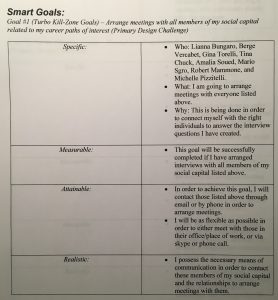
         <p class="import-Normal">SMART stands for Specific, Measurable, Action-oriented, Realistic and Timely. Note that <strong><em>‘A’ stands for Action instead of Attainable</em></strong> which is already covered under Realistic (this is a common mistake that many students make). Look at any goal and see if it meets all five criteria. If it doesn’t, then continue setting smaller and more Specific, Measurable, Action-oriented, Realistic and Timely goals until you get it down to something small enough to potentially fit onto today’s To Do list. There’s nothing wrong with having a lot of vague, high-level, broad or long-term goals – these are good for yearly or monthly goals, but we’re trying to ensure you then break it down small enough to fit into your day-to-day life.</p>
         <p class="import-Normal">Saying that you “want to find a job” is a good goal but it doesn’t tell you what to do today. You can redefine this as “set up 6 job interviews by next week” which is better but still pretty vague – it is not S (who will the interviews be with?), nor is it A (what actions are you supposed to take?). Most of your goals don’t “need” to be SMART. Sometimes you want them to be a bit fuzzy like “figure out who to interview”. So you need both high-level as well as very detail-oriented SMART goals.</p>
         <p class="import-Normal">There are a couple INCORRECT ways of using SMART goals that I see a lot. As shown in the figures here, some people describe one goal as being specific and another one as being realistic and yet a different one as being timely. Another incorrect way is to give one goal and then explain in separate descriptions how it is specific, realistic or timely (as though they were trying to convince the reader that it’s a good goal – you don’t need to try to convince others of anything, these goals are for yourself and must be <em>useful to you</em>). The correct way is that each goal should be screened against the criteria of being SMAR &amp;T. Some will (and should) be SMT, others will be MR, others are SMRT. But making at least some of your goals SMART will help ensure you get them onto your daily To Do list and check them off to ensure you are making progress toward those bigger goals.</p>
         <p class="import-Normal">If you think all of your goals are SMART then you are almost certainly doing it wrong. Most of the smaller short-term and highly specific goals on your To Do list should be SMAR and T.</p>
         <p class="import-Normal"><img src="https://pressbooks.library.torontomu.ca/ecld/wp-content/uploads/sites/336/2022/03/image15-1-e1647618691870-278x300.jpeg" alt="Sample of smart goals." width="278" height="300" class="alignleft wp-image-115 size-medium" srcset="https://pressbooks.library.torontomu.ca/ecld/wp-content/uploads/sites/336/2022/03/image15-1-e1647618691870-278x300.jpeg 278w, https://pressbooks.library.torontomu.ca/ecld/wp-content/uploads/sites/336/2022/03/image15-1-e1647618691870-948x1024.jpeg 948w, https://pressbooks.library.torontomu.ca/ecld/wp-content/uploads/sites/336/2022/03/image15-1-e1647618691870-768x830.jpeg 768w, https://pressbooks.library.torontomu.ca/ecld/wp-content/uploads/sites/336/2022/03/image15-1-e1647618691870-1422x1536.jpeg 1422w, https://pressbooks.library.torontomu.ca/ecld/wp-content/uploads/sites/336/2022/03/image15-1-e1647618691870-65x70.jpeg 65w, https://pressbooks.library.torontomu.ca/ecld/wp-content/uploads/sites/336/2022/03/image15-1-e1647618691870-225x243.jpeg 225w, https://pressbooks.library.torontomu.ca/ecld/wp-content/uploads/sites/336/2022/03/image15-1-e1647618691870-350x378.jpeg 350w, https://pressbooks.library.torontomu.ca/ecld/wp-content/uploads/sites/336/2022/03/image15-1-e1647618691870.jpeg 1848w" sizes="(max-width: 278px) 100vw, 278px" /><br />
          <img src="https://pressbooks.library.torontomu.ca/ecld/wp-content/uploads/sites/336/2022/03/image17-e1647618679320-219x300.jpeg" alt="Sample of smart goals." width="219" height="300" class="alignright wp-image-116 size-medium" srcset="https://pressbooks.library.torontomu.ca/ecld/wp-content/uploads/sites/336/2022/03/image17-e1647618679320-219x300.jpeg 219w, https://pressbooks.library.torontomu.ca/ecld/wp-content/uploads/sites/336/2022/03/image17-e1647618679320-747x1024.jpeg 747w, https://pressbooks.library.torontomu.ca/ecld/wp-content/uploads/sites/336/2022/03/image17-e1647618679320-768x1053.jpeg 768w, https://pressbooks.library.torontomu.ca/ecld/wp-content/uploads/sites/336/2022/03/image17-e1647618679320-1121x1536.jpeg 1121w, https://pressbooks.library.torontomu.ca/ecld/wp-content/uploads/sites/336/2022/03/image17-e1647618679320-1494x2048.jpeg 1494w, https://pressbooks.library.torontomu.ca/ecld/wp-content/uploads/sites/336/2022/03/image17-e1647618679320-65x89.jpeg 65w, https://pressbooks.library.torontomu.ca/ecld/wp-content/uploads/sites/336/2022/03/image17-e1647618679320-225x308.jpeg 225w, https://pressbooks.library.torontomu.ca/ecld/wp-content/uploads/sites/336/2022/03/image17-e1647618679320-350x480.jpeg 350w, https://pressbooks.library.torontomu.ca/ecld/wp-content/uploads/sites/336/2022/03/image17-e1647618679320.jpeg 1497w" sizes="(max-width: 219px) 100vw, 219px" /><img src="https://pressbooks.library.torontomu.ca/ecld/wp-content/uploads/sites/336/2022/03/image18-e1647618670863-216x300.jpeg" alt="Sample of smart goals." width="216" height="300" class="aligncenter wp-image-117 size-medium" srcset="https://pressbooks.library.torontomu.ca/ecld/wp-content/uploads/sites/336/2022/03/image18-e1647618670863-216x300.jpeg 216w, https://pressbooks.library.torontomu.ca/ecld/wp-content/uploads/sites/336/2022/03/image18-e1647618670863-739x1024.jpeg 739w, https://pressbooks.library.torontomu.ca/ecld/wp-content/uploads/sites/336/2022/03/image18-e1647618670863-768x1064.jpeg 768w, https://pressbooks.library.torontomu.ca/ecld/wp-content/uploads/sites/336/2022/03/image18-e1647618670863-1108x1536.jpeg 1108w, https://pressbooks.library.torontomu.ca/ecld/wp-content/uploads/sites/336/2022/03/image18-e1647618670863-1478x2048.jpeg 1478w, https://pressbooks.library.torontomu.ca/ecld/wp-content/uploads/sites/336/2022/03/image18-e1647618670863-65x90.jpeg 65w, https://pressbooks.library.torontomu.ca/ecld/wp-content/uploads/sites/336/2022/03/image18-e1647618670863-225x312.jpeg 225w, https://pressbooks.library.torontomu.ca/ecld/wp-content/uploads/sites/336/2022/03/image18-e1647618670863-350x485.jpeg 350w, https://pressbooks.library.torontomu.ca/ecld/wp-content/uploads/sites/336/2022/03/image18-e1647618670863.jpeg 1555w" sizes="(max-width: 216px) 100vw, 216px" /></p>
         <p class="import-Normal" style="text-align: center;">INCORRECT ways to use SMART Goals</p>
         <p class="import-Normal">Next, look at what is already on your daily To Do list and see how your SMART goals compare with them. You may need to shift around (or not do) some of your less important To Do items to make room for the goals you need to achieve to make progress on your 5 most important design challenges in your life. A good way to do this is to compare your SMART Goals and other To Do items on a 2 x 2 matrix of Importance vs apparent Urgency. [<em>NOTE: you may want to do this with your long-term goals first </em><em>(as part of the Wheel of Life) </em><em>instead of your SMART goals</em>. <em>Each person is different. If you are having trouble with too many SMART goals, then try this on your high</em><em>–</em><em>level goals instead.]</em></p>
         <p class="import-Normal">The Pilot-in-the-Plane principle says to focus your time and attention on things that are within your control. You can’t control time, but you can control what you choose to do with it and the support systems you set up around time management. Don’t waste time and energy on those things you cannot change. Focus on the things you <em>CAN</em> control like distractions, time robbers and your own procrastination. You can also concentrate on higher value activities that enhance your efficiency and personal productivity.</p>
         <p class="import-Normal">Have a look again at your goals, and determine which of these are high leverage Quadrant II activities (upper right corner as described in the video for Tool #9). These are goals that will make you more effective in the long run. They might be difficult and inconvenient to do today (like building your social capital), but they really pay off. A classic example of a Quadrant II activity for a manager is hiring and training people to do some of the things you must currently do yourself. You have to stop doing what you are doing and devote the time to hire and train. This makes you less productive now, but more efficient later. There are many such goals that ultimately enhance your effectiveness but are inconvenient in the short run such as exercise, building better relationships, joining an organization, getting proper rest, reading, watching a video on how to do something more efficiently, or compiling your class notes into more useful study aids.</p>
         <p class="import-Normal">All these high leverage activities are important to your long-term effectiveness and happiness, but are never urgent. You can always exercise tomorrow, go to a networking event next week, hire that new person next month, or focus on an important relationship next term. You can always find a way to procrastinate or put off these important goals and instead “waste” your time on lower value activities like Quadrant III and IV (lower left and right corners as described in the video for Tool #9). You should try to stop or defer doing Quadrant IV activities and change your habits around Quadrant III. The classic example of a Quadrant III activity is allowing yourself to be distracted by the text message, email or phone call that you just received when you know you should ignore it and continue to focus on a matter of higher value to your life like a Quadrant I or II activity. If you don’t have any high leverage Quadrant II goals, go back and set some!</p>
         <p class="import-Normal"><strong><img src="http://pressbooks.library.ryerson.ca/ecld/wp-content/uploads/sites/336/2022/03/image19-1.png" width="90" height="166" alt="Image of rocks in a jar." class="alignleft" /></strong></p>
         <p class="import-Normal">You’ve all heard the story about trying to fill a jar. If you fill it up with rocks is it full? Of course not. You can add some smaller pebbles. Is it full now? Of course not, you can still add some sand. Finally, you can fit in even more by adding water. The problem is if you first fill your jar with water, sand and pebbles, there is no room left for the rocks. You must fit your big rocks into your daily agenda first and these are your Quadrant II goals!</p>
         <p class="import-Normal">When do you work on these Quadrant II goals? During your peak productivity time of day. Do them when you are at your best – don’t try to squeeze them into the end of your day when you are tired. Everyone has their own personal peak productivity time of day when they are most awake, resilient and effective. Don’t let any so-called “guru” tell you that you have to do important things at 6am because “the early bird gets the worm!” That might have worked for them, but it might not work for you. Personally, I’m useless before 10am and at least one cup of coffee! My peak times are around 10am-1pm and 4pm-7pm. I used to have another peak from 10pm-2am, but I try not to work in the evening anymore because it ruins my sleep.</p>
         <p class="import-Normal">Find your peak productivity time of day and block it off in your calendar. Try to avoid having meetings, answering phone calls, or looking at email during your peak times of day. I turn off my phone, notifications and email entirely during my peak hours. These are usually low value activities (the sand) that you can easily batch-process and squeeze in during your off-peak times.</p>
         <h1 class="section-header import-Normal" id="chapter-120-section-2"><strong>Tool #9 – Goal-Setting Step-by-Step Review</strong></h1>
         <ol>
              <li class="import-Normal"><span lang="en-US" xml:lang="en-US"></span>Start with your major design challenges from your Wheel of Life and generate ideas for potential goals and/or hypotheses that you can do within the next 1-10 weeks to make progress on your design challenges. You can create post-it notes, draw freehand figures, or write your goals/tasks down on a list – whatever works best for you.</li>
              <li class="import-Normal"><span lang="en-US" xml:lang="en-US"></span>For each of these goals/hypotheses, create a series of increasingly specific goals (some may be MT, SMT, SMRT…) until you craft some that can be completed in a single day. If they are too long-term, vague or broad, you may want to use a Mind-Map or other method for breaking down the larger goals into smaller tasks.</li>
              <li class="import-Normal">Use the SMART framework to set specific, measurable, <span lang="en-US" xml:lang="en-US" style="text-align: initial; font-size: 1em;">action-oriented</span><span style="text-align: initial; font-size: 1em;">, realistic and timely goals for your 5 major design challenges that can be completed in a single sitting. You may want to set goals for things like: how many people you will meet with, how many networking events you will attend, and how much time you will devote to resolving your design challenges.</span></li>
              <li class="import-Normal">Transfer your SMART goals onto a 2×2 matrix of Importance vs Urgency and add the other major things you need “To Do” during the day. Evaluate which things you can eliminate (Quadrant IV) or change habits and batch-process to become more efficient (Quadrant III).</li>
              <li class="import-Normal">Create time in your Day-Timer (or calendar or agenda or “To Do” list or other system that you use to make sure you do everything you need in your busy life) to “Get the Big Rocks In!” during your Peak Productivity times to focus on your Quadrant II goals.</li>
              <li class="import-Normal">You should have a running list of annual, monthly and weekly goals to make sure you don’t forget anything. Categorize these by long or short-term goals like “Bucket List” for BHAG goals that you would like to do someday to “Turbo Kill-Zone Goals” for things you plan to do right away.</li>
              <li class="import-Normal">Document Your Process (e.g. Take Photos of Your Work). Be sure to include in your report a section for “So What?”, “Insights Gained” or “What I Learned”. Write a Report for the course assignment that meets university standards and includes Table of Contents, Introduction, Background, Next Steps and other relevant sections to help us to help you.</li>
         </ol>
         <p class="import-Normal"><strong><img src="http://pressbooks.library.ryerson.ca/ecld/wp-content/uploads/sites/336/2022/03/image20.png" width="668" height="501" alt="Diagram showing flow of various design thinking tools." class="aligncenter" /></strong>Upload Your Work to D2L at least 24 hours before class if you would like Public Feedback (Please Note that You Must Agree to Open Access Sharing for such Feedback)</p>
    </div>
</section>
<section data-type="chapter" class="chapter introduction" id="chapter-chapter-3-experimentation-using-the-design-thinking-diamond-method-or-looping-the-scientific-method" title="Chapter 3: Experimentation using the Design Thinking ‘Diamond’ Method or ‘Looping’ (The Scientific Method)">
    <header>
         <h1 class="chapter-title">Chapter 3: Experimentation using the Design Thinking ‘Diamond’ Method or ‘Looping’ (The Scientific Method)</h1>
         <p data-type="subtitle" class="chapter-number">3</p>
    </header>
    <div class="chapter-3:-experimentation-using-the-design-thinking-‘diamond’-method-or-‘looping’-(the-scientific-method)">
         <p class="import-Normal"><strong><em>Watch</em></strong><em>: Module 3 – Design Thinking Diamond Method (17:25)</em></p>
         <div class="textbox interactive-content interactive-content--oembed">
              <span class="interactive-content__icon"></span>
              <p>One or more interactive elements has been excluded from this version of the text. You can view them online here: <a href="#oembed-1" title="ECLD 3 Entrepreneurial Career and Life Design Module 3 - the Design Thinking Experimentation Diamond">https://pressbooks.library.torontomu.ca/ecld/?p=98#oembed-1</a> </p>
         </div>
         <p class="import-Normal">Design Thinking has emerged as an essential set of tools, methods, principles and mindsets to use for the effectual thinking entrepreneurial search activities (on the right side of the figure). Or as my friend, design thinking expert Matteo Vignoli, calls it “Dancing with Ambiguity”. There’s a lot to cover on this topic. We’ll continue to dig deeper into Design Thinking later during this program with these future videos being especially helpful:</p>
         <p class="import-Normal"><strong><em>Watch</em></strong><em>: Module 5 – User Centricity (29:39)</em></p>
         <div class="textbox interactive-content interactive-content--oembed">
              <span class="interactive-content__icon"></span>
              <p>One or more interactive elements has been excluded from this version of the text. You can view them online here: <a href="#oembed-2" title="ECLD 5 Entrepreneurial Career and Life Design (ECLD) Module 5 - User Centricity">https://pressbooks.library.torontomu.ca/ecld/?p=98#oembed-2</a> </p>
         </div>
         <p class="import-Normal"><strong><em>Watch</em></strong><em>: SCE 3 of 4 What is Design Thinking? Part 1 (10:26)</em></p>
         <div class="textbox interactive-content interactive-content--oembed">
              <span class="interactive-content__icon"></span>
              <p>One or more interactive elements has been excluded from this version of the text. You can view them online here: <a href="#oembed-3" title="What is Design Thinking and how to use it in the entrepreneurial process?">https://pressbooks.library.torontomu.ca/ecld/?p=98#oembed-3</a> </p>
         </div>
         <p class="import-Normal"><strong><em>Watch</em></strong><em>: SCE 4 of 4 What is Design Thinking? Part 2 (19:42)</em></p>
         <div class="textbox interactive-content interactive-content--oembed">
              <span class="interactive-content__icon"></span>
              <p>One or more interactive elements has been excluded from this version of the text. You can view them online here: <a href="#oembed-4" title="What is Design Thinking (Part 2 of 2)">https://pressbooks.library.torontomu.ca/ecld/?p=98#oembed-4</a> </p>
         </div>
         <p class="import-Normal"><img src="http://pressbooks.library.ryerson.ca/ecld/wp-content/uploads/sites/336/2022/03/image1.jpeg" width="303" height="181" alt="Students in design thinking course surrounded by poster boards filled with sticky notes." class="alignright" />One reason why Design Thinking is such an effective tool for unleashing creativity and discovering non-obvious insights is the use of visualization techniques to allow teams of people to draw connections, spot patterns, and develop insights from large amounts of confusing information. Imagine interviewing hundreds of different potential customers. How could anyone remember all that information unless we found new ways of capturing, visualizing, rearranging and working with the information? This is why Design Thinking sessions almost always include working with large numbers of post-it notes. Most of the Tools suggested in this book are based on the creation and manipulation of post-it notes by teams of individuals working in a shared creative space. The photo here shows a Design Thinking course we taught at the DMZ, notice how messy their space is with coffee, candy, water, food, a timer and lots and lots of post-it notes.</p>
         <p class="import-Normal"><em>[I would like to be able to suggest an alternative digital visualization tool (instead of post-its) to use during COVID-19. The best tool I’ve discovered is </em><em>Jamboard</em> <em>which works as a plug-in to Zoom. </em><em>If you find something that works well let me know and I’ll share it with the class</em><em>.]</em></p>
         <p class="import-Normal"><img src="http://pressbooks.library.ryerson.ca/ecld/wp-content/uploads/sites/336/2022/03/image2-2.png" width="250" height="235" alt="Divergent and convergent map." class="alignright" />The basic Design Thinking method starts with a “Design Challenge Question” (DCQ) and uses an iterative series of divergent-convergent thinking pairs (in the shape of a diamond) as illustrated in the figure. Some authors also call this diamond a “Loop” or “Iteration” (the various design thinking methods are reviewed in detail in ECLD Module #5: User Centricity). First you expand the number of choices using divergent thinking tools like research, observation, interviewing, brainstorming and mind mapping. You use visualization techniques to capture all this information in post-it notes, photos and other documents and artifacts. You’re seeking quantity at this stage – at least 20+ post-it notes for even a simple design challenge.</p>
         <p class="import-Normal">In the second half of the pair, you want to manipulate these post-it notes and use visualization techniques to look for patterns, identify insights, and select priorities. Convergent thinking tools include cluster &amp; separate, 2×2 matrices, customer journey map, weighted average and dotmocracy. The convergent process is complete when you can essentialize the insights gained into something that can start the next divergent-convergent pair or “diamond”. There are a wide variety of potential tools to choose from depending on the design challenge under consideration and we’ll continue to cover these in future chapters, video modules and video tools.</p>
         <p class="import-Normal"><img src="http://pressbooks.library.ryerson.ca/ecld/wp-content/uploads/sites/336/2022/03/image3-2.png" width="255" height="216" alt="Various visualization maps used in design thinking." class="alignright" />In each iteration, you move from left to right using a number of divergent thinking tools that help you broaden your understanding of the challenge, customer persona, problem or solution. You are seeking to discover deeper issues involving problems or needs and using a wide range of tools to generate data. During this phase you use various effectuation principles such as the lemonade principle, crazy quilt and surprise seeking as well as various entrepreneurial skills and attitudes such as curiosity, alertness, empathy and proactivity (as well as grit and resiliency when this turns out to be frustrating, confusing or difficult!).</p>
         <p class="import-Normal">Once you have collected a lot of data in the divergent phase, you move to the convergent phase where you interact with your post-it notes to search for patterns, seek to eliminate, condense, and/or select from among these alternatives. It is often a good idea to start with a blank canvas such as shown here, label the axes or different fields, and then start moving your Post-It notes to see if you find anything interesting.</p>
         <p class="import-Normal">This pair of divergent-convergent thinking sessions ends when you can essentialize all the information into a single canvas, statement or question (which I normally call your DCQ). This could also be called a Point of View (from Stanford dSchool), a Purpose, a Hypothesis Statement, a Customer Need, a Value Proposition or Business Model. Your DCQ can be in the form of a sentence, a napkin pitch, specification (from D4G), Customer Profile Canvas (from VPD), Value Proposition Canvas (from VPD), Lean Canvas or Business Model Canvas.</p>
         <p class="import-Normal">As I explain in the video (ECLD Module #3 – The Basic Design Thinking Diamond Process) you now need to review the process and document your learning before moving on. There are 5 basic questions to analyze and document about your Loop/Iteration. (Hint: answer each of these questions in your assignments)</p>
         <ul>
              <li>Did you use<img src="http://pressbooks.library.ryerson.ca/ecld/wp-content/uploads/sites/336/2022/03/image4-2.png" width="391" height="284" alt="Divergent and convergent diagram that illustrates how good questions lead to good visualization which leads to good insights." class="alignright" />&nbsp;good visualization techniques? Did you generate enough divergent perspectives and evaluate a number of potentially relevant patterns? (hint: show pictures)</li>
              <li>Did you discover something interesting, exciting, surprising, new or insightful? (hint: use a section called “What I Learned”)</li>
              <li>Did you make progress? Are you closer to resolving your design challenge? Did you make any important decisions or pivots? (hint: include a section called “So What”)</li>
              <li>Is your revised DCQ a good starting point for the next Diamond/Loop? (hint: add a section called “Next Steps”)</li>
              <li>Which specific principles, skills or attitudes did I practise during this Iteration – (hint: use ECLD Tool #11 – Self-Reflection)</li>
         </ul>
         <h1 class="section-header import-Normal" id="chapter-98-section-1"><strong>The Scientific Method</strong></h1>
         <p class="import-Normal">Design Thinking, Lean Startup, Effectuation and all these new agile entrepreneurial search-based discovery methods are deeply rooted in the scientific method. That’s why they work so well. It really doesn’t matter what the entrepreneur believes or wishes to be true. It really doesn’t matter what the business plan predicts. Visions, dreams and hopes are irrelevant. The only thing that matters is testing the entrepreneur’s hypothesis goals against reality and then learning and reacting with agility. The lean method does this quickly with fast iterations to generate competitive advantage (e.g. drive traffic, click-throughs, optimize pricing, “growth hacking”).</p>
         <p class="import-Normal">The scientific method revolutionized the world, overthrowing centuries of religious authority, dogma and superstition (based on faith) and allowing humans to discover for themselves how things work (based on reason): that the world revolves around the sun, that germs (not demons or the evil eye) cause disease, and how to harness the power of steam, oil, wind and the atom. What the scientific method did for discovering the laws of reality and sparking the renaissance, it can also do for discovering the laws of the market and figuring out what works for you on your path to personal empowerment and happiness. Spark your own personal renaissance and enlightenment!</p>
         <h1 class="section-header import-Normal" id="chapter-98-section-2"><strong>Beware of </strong><strong>Following</strong> <strong>Step-by-Step Tools &amp; Methods</strong> <strong>– The Need for Principles, Attitudes and Mindsets</strong></h1>
         <p class="import-Normal"><span lang="en-US" xml:lang="en-US"></span>In “Design Thinking-Based Entrepreneurship Education: How to Incorporate Design Thinking Principles into an Entrepreneurship Course” we <span lang="en-US" xml:lang="en-US">review</span> <span lang="en-US" xml:lang="en-US">the literature on design thinking and</span> <span lang="en-US" xml:lang="en-US">summarize how it applies to the domain of entrepreneurship. We won the best paper award for this article at the European Entrepreneurship Education conference in 2016. </span></p>
         <p class="import-Normal"><span lang="en-US" xml:lang="en-US"></span><span lang="en-US" xml:lang="en-US">Most students first learn design thinking through the use of specific tools and step-by-step methods found in a textbook. Unfortunately, this tends to reinforce inappropriate planning-based thinking. Blindly following the steps and filling in various tools and canvases rarely leads to significant insights and progress. While beginners like to use the methods and tools alone</span><span lang="en-US" xml:lang="en-US">, </span><span lang="en-US" xml:lang="en-US">without the use of the higher-level design principles</span><span lang="en-US" xml:lang="en-US">, attitudes and mindsets</span><span lang="en-US" xml:lang="en-US">, they normally only achieve beginners</span><span lang="en-US" xml:lang="en-US">’</span> <span lang="en-US" xml:lang="en-US">results</span><span lang="en-US" xml:lang="en-US">. </span></p>
         <p class="import-Normal"><span lang="en-US" xml:lang="en-US"></span><span lang="en-US" xml:lang="en-US">Every year I rewrite this workbook to try to help students overcome the weaknesses uncovered in the previous year. </span><strong lang="en-US" xml:lang="en-US">One of the biggest and most consistent weaknesses I see are student assignments that simply follow the step-by-step tools and never make any actual progress toward resolving their design challenges</strong><span lang="en-US" xml:lang="en-US">. In some cases, it is clear that students are simply going through the motions and doing the absolute minimum required to pass the course. But in other cases, their deeply ingrained step-by-step planning mindset is so entrenched that they just can’t seem to go beyond the tools and methods to use the principles and mindsets. </span></p>
         <p class="import-Normal" style="margin-left: 28.35pt;margin-right: 28.55pt"><span lang="en-US" xml:lang="en-US"></span><span lang="en-US" xml:lang="en-US">That’s why this year I’m increasing the emphasis on “conscious practice” and application of the entrepreneurial principles, skills and attitudes throughout all phases and assignments as well as all aspects of your daily life. Don’t just interview 3-5 people, as required by the assignment. </span><span lang="en-US" xml:lang="en-US">Practise</span> <span lang="en-US" xml:lang="en-US">active listening skills and an empathetic attitude while conducting these interviews and then write a short self-reflection (ECLD Tool #11) to help you integrate and habituate the skill or attitude. Don’t just go to a networking event, as required by the assignment. </span><span lang="en-US" xml:lang="en-US">Practise</span> <span lang="en-US" xml:lang="en-US">curiosity, proactivity, surprise-seeking, radical candor and the crazy quilt principle while attending the event. </span></p>
         <p class="import-Normal"><span lang="en-US" xml:lang="en-US"></span><span lang="en-US" xml:lang="en-US">This requires the ability to think at two levels simultaneously. At one level (System 1) you are paying attention to the conversation and deciding what to say next. But at a higher meta-level (System 2), you should be analyzing the direction of the conversation, your engagement, what principles you are currently applying and what attitudes you are demonstrating or want to apply. Strengthening your higher-level executive functioning meta-level thinking (System 2) takes practice and concerted effort (our brains are lazy as we’ll discuss in the Pilot-in-the-Plane chapter). These assignments and workbook are designed to help you do that so you’ll see this self-reflective component woven into the remaining assignments.</span></p>
         <p class="import-Normal"><span lang="en-US" xml:lang="en-US"></span><span lang="en-US" xml:lang="en-US">As shown in the pyramid diagram from our research publication, these higher-level thinking functions (like principles and mindsets) are needed to guide your decisions about which tools and methods to use, when to switch, and how to properly apply them. </span><span lang="en-US" xml:lang="en-US">It’s important to </span><span lang="en-US" xml:lang="en-US">be able to </span><span lang="en-US" xml:lang="en-US">figure out when to apply the abstract principles to specific actions. Designers</span> <span lang="en-US" xml:lang="en-US">and </span><span lang="en-US" xml:lang="en-US">coaches have certain principles, patterns of behavior and mindsets that are more important than simply following the methods, tools and processes described in the textbooks. They consciously create and follow certain </span><img src="http://pressbooks.library.ryerson.ca/ecld/wp-content/uploads/sites/336/2022/03/image5-2.png" width="344" height="154" alt="Pyramid diagram that illustrates tools and methods, flowing to process (implicit and explcit), flowing to principles and rules, peaking and mindset and beliefs." class="alignright" /><span lang="en-US" xml:lang="en-US">principles</span> <span lang="en-US" xml:lang="en-US">(sometimes</span> <span lang="en-US" xml:lang="en-US">known as rules, heuristics, rules-of-thumb and expert scripts</span><span lang="en-US" xml:lang="en-US">)</span><span lang="en-US" xml:lang="en-US">. Over time, with practice and conscious application to different challenges, these principles and rules become deeply ingrained </span><span lang="en-US" xml:lang="en-US">and habituated </span><span lang="en-US" xml:lang="en-US">to create a</span><span lang="en-US" xml:lang="en-US">n</span> <span lang="en-US" xml:lang="en-US"></span><span lang="en-US" xml:lang="en-US">entrepreneurial</span> <span lang="en-US" xml:lang="en-US">mindset and </span><span lang="en-US" xml:lang="en-US">attitudes</span> <span lang="en-US" xml:lang="en-US">such as </span><span lang="en-US" xml:lang="en-US">empathy, grit, resiliency, adaptability, internal locus of control, </span><span lang="en-US" xml:lang="en-US">self-efficacy, tolerance for ambiguity and creative confidence.</span></p>
         <h1 class="section-header import-Normal" id="chapter-98-section-3"><strong>How to Build the Design Thinking Components of Your </strong><strong>Mindset</strong></h1>
         <p class="import-Normal">Most design thinkers agree that mindset is more important than the collection of tools and methods applied to any given design challenge. I can suggest dozens of different tools throughout this book, but without the right mindset or principles, you will not be fully effective. A mindset is a combination of deeply held beliefs and patterns of action that become subconscious habits over time. Unlike an abstract principle which must be consciously called to mind in order to apply it to a given situation (e.g. “I should apply the idea of radical collaboration or active listening to this conversation”), a mindset is something you do almost automatically, reflexively, without needing to think explicitly about it.</p>
         <p class="import-Normal">You might originally learn about these mindsets in a textbook and start to apply them as explicit principles, but over time these principles sink in as you apply them to a wide variety of your daily actions over a prolonged period. A mindset comes from experience and practice and habit-formation and changes your subconscious attitudes and beliefs so that eventually they become a part of who you are.</p>
         <p class="import-Normal">Mindsets don’t happen by accident – you must practise them to become good at them. It’s like playing the guitar. You may know the scales and theory (Head), but without practice you cannot become skilled enough to play great riffs as your fingers glide over the fretboard (Hand). It seems like great guitarists play their solos effortlessly and adaptively change to fit into the rest of the band and the vibe of the evening. Practice makes the difference between a skilled and unskilled guitarist.</p>
         <p class="import-Normal">I’d like to introduce you to three, out of several, important mindsets early on here in this workbook. Later in this program I’ll offer some tips on how to form good habits and mindsets (especially ECLD Module 11 – Eliminate Contradictions that Cause Unhappiness and Tool #10 – Self-Talk).</p>
         <p class="import-Normal"><strong>1) Curiosity</strong><strong>, Alertness and Opportunity Spotting</strong> – Although most children are naturally curious, most adults are not. We are so inundated by information that most people start to tune it out over time. We become so caught up in the details of our own email, texts, and inner thoughts that we start to ignore much of the world around us during our daily routines and work. We become creatures of habit and stop noticing things (I describe this as your Elephant or System 1 auto-pilot in ECLD Module #9). A fundamental aspect of design thinking is to train ourselves to have a “beginner’s mind” in order to see things as if for the first time – to notice things that others may miss, to see things through the eyes of another, to spot opportunities to create value, launch a new business or enhance your life. The entrepreneurship literature would call it entrepreneurial attitudes and skills like alertness and opportunity spotting. The lean startup movement would say “Get out of the building!”</p>
         <p class="import-Normal">Unless you went to a Montessori or Reggio Emilia Approach school, the educational system can also beat the curiosity out of us over time. We are instructed to remember and regurgitate what the teacher is teaching. We’re not supposed to get distracted by things that interest us, or ask questions driven by our own curiosity. We’re told what to think about and what the right answers are, with our chairs nailed to the floor in neat rows. We’re also taught that there is only one right answer which the teacher knows and you have to learn through memorization to pass on standardized tests. This is called the “teacher-centric” method of teaching which is primarily comprised of lectures, textbooks and exams. In contrast, the student-centric method of learning used in entrepreneurship education puts the student’s curiosity at the center and the teacher is a “guide from the side” instead of the “sage on the stage” (described by Grant &amp; Gedeon in “Teaching and Learning in the 21<sup>st</sup> Century University”).</p>
         <p class="import-Normal">You have to devote conscious practice in order to build a mindset, especially if you are trying to overcome a completely different mindset. You have to call it into your mind, as a principle and consciously say to yourself “OK I’m practising this mindset, attitude or skill right now”. It all starts with developing your curiosity – to notice, to see, to hack, to seek insights and to see something “as if for the first time” metaphorically speaking. Whatever your current level of curiosity may be, building it higher than it currently is does not come automatically without “conscious practice”. As I explain later in the book (ECLD Module 9), you need to turn on your System 2 Executive to apply a principle because your normal System 1 Elephant doesn’t do it on its own.</p>
         <p class="import-Normal">You may demonstrate curiosity in this assignment by going beyond the detailed step-by-step structure of this Workbook to follow your own curiosity, challenges and interests. This one-size-fits-all workbook provides generalized guidance that I think all of you will be interested in and benefit from. But who wants to live an average life? Let your curiosity lead you to discovering something new and important to yourself, regardless of what you turn in for the graded assignments.</p>
         <p class="import-Normal"><strong>2) Bias to Action</strong> <strong>and Proactivity</strong> – Designers and entrepreneurs try stuff, they build things, they tinker, they hack, they experiment. Instead of only thinking and planning, they act. They have a proactive attitude and practise bootstrapping, hacking and guerilla skills. Instead of planning to predict and control the future, they create the future through their actions and collaborations. Designers embrace change and surprise and serendipity because they are not overly attached to any particular final goal or outcome. They focus on the journey instead of a hypothetical future destination. In the entrepreneurship field it can include concepts like Proactivity, Propensity for Action and Mobilizing Resources. Entrepreneurs and empowered individuals don’t wait for others to tell them what to do or think, they are proactive with a high Internal Locus of Control. They demonstrate Agency.</p>
         <p class="import-Normal">There is an important spin-off benefit to this kind of mindset. Since designers don’t fall in love with their ideas/end-points, they don’t let their egos get bound up in them. If an experiment (e.g. a business idea, website landing page or hypothesis goal) does not turn out the way they guessed, rather than being disappointed and discouraged, designers are delighted to be surprised and to learn something new. This builds resiliency, grit and tenacity! Designers are good at coping with failure because they don’t see a failed experiment as a personal failure. A failed experiment is just another opportunity to learn a new insight.</p>
         <p class="import-Normal">Consider the scientist trying to understand gravity. She climbs the Leaning Tower of Pisa to measure how much faster a heavy rock falls than a light one. Try as she might, however, the darned rocks always fall at the same rate. She was wrong. The weight of the rock doesn’t matter – gravity is constant. Using the scientific method, she has discovered the law of gravity! Her hypothesis was incorrect, but through the “failed” experimentation she has discovered the truth. Rather than being bummed out over her incorrect hypothesis, she is excited to discover the law of gravity.</p>
         <p class="import-Normal"><strong>3) Re-Framing</strong> <strong>and Resiliency</strong> – This is fundamental to how designers come up with good questions and get unstuck. Re-framing helps you eliminate unproductive beliefs that lead to wasted time and unhappiness and replace these with beliefs that get you working on the right design problems and better solutions.</p>
         <p class="import-Normal">Perhaps the most important re-frame is to change from a management planning-based mindset where goals are static future states that you <em>must</em> attain, to an entrepreneurial/effectual searching-based mindset where goals are merely hypotheses that you want to test. Instead of fixating on goals, fixate on the journey and leave yourself open to surprise. Instead of trying to predict the future, create the future through your actions!</p>
         <p class="import-Normal">Designers know that great designs take time and effort but if you stick with it, eventually you will find a solution that works. Experiments may fail, prototypes may be thrown away, you may need to iterate, and you may sometimes get frustrated or pivot, but it is precisely from these experiences that we learn the deepest insights and make the best decisions. Focus more on the process (the journey) and less on the goal (the destination). Don’t get frustrated and stalled out by the disappointing experiments; grow and learn from them and use the design thinking tools and methods to seek insights. This element of the growth mindset helps you build resiliency, grit, tenacity, perseverance and anti-fragility.</p>
         <p class="import-Normal">Happiness is a journey too, not a destination. Finding happiness is a process. Be aware of how the process guides you toward understanding your skills, interests, beliefs and values and how they change over time as you experiment and grow.</p>
         <h1 class="section-header import-Normal" id="chapter-98-section-4"><strong>Use of Art to Keep Principles in Mind – The Explorer</strong></h1>
         <p><img src="https://pressbooks.library.torontomu.ca/ecld/wp-content/uploads/sites/336/2022/03/sgedeon_httpss.mj_.runnVnB0L6DT3Q_cartoon_graphic_image_of_a_f_b152b837-54e7-4c66-80e1-3c0390aff540_1-300x168.png" alt="Hiker overlooking a mountain in the distance." width="300" height="168" class="alignright wp-image-329 size-medium" srcset="https://pressbooks.library.torontomu.ca/ecld/wp-content/uploads/sites/336/2022/03/sgedeon_httpss.mj_.runnVnB0L6DT3Q_cartoon_graphic_image_of_a_f_b152b837-54e7-4c66-80e1-3c0390aff540_1-300x168.png 300w, https://pressbooks.library.torontomu.ca/ecld/wp-content/uploads/sites/336/2022/03/sgedeon_httpss.mj_.runnVnB0L6DT3Q_cartoon_graphic_image_of_a_f_b152b837-54e7-4c66-80e1-3c0390aff540_1-1024x574.png 1024w, https://pressbooks.library.torontomu.ca/ecld/wp-content/uploads/sites/336/2022/03/sgedeon_httpss.mj_.runnVnB0L6DT3Q_cartoon_graphic_image_of_a_f_b152b837-54e7-4c66-80e1-3c0390aff540_1-768x430.png 768w, https://pressbooks.library.torontomu.ca/ecld/wp-content/uploads/sites/336/2022/03/sgedeon_httpss.mj_.runnVnB0L6DT3Q_cartoon_graphic_image_of_a_f_b152b837-54e7-4c66-80e1-3c0390aff540_1-65x36.png 65w, https://pressbooks.library.torontomu.ca/ecld/wp-content/uploads/sites/336/2022/03/sgedeon_httpss.mj_.runnVnB0L6DT3Q_cartoon_graphic_image_of_a_f_b152b837-54e7-4c66-80e1-3c0390aff540_1-225x126.png 225w, https://pressbooks.library.torontomu.ca/ecld/wp-content/uploads/sites/336/2022/03/sgedeon_httpss.mj_.runnVnB0L6DT3Q_cartoon_graphic_image_of_a_f_b152b837-54e7-4c66-80e1-3c0390aff540_1-350x196.png 350w, https://pressbooks.library.torontomu.ca/ecld/wp-content/uploads/sites/336/2022/03/sgedeon_httpss.mj_.runnVnB0L6DT3Q_cartoon_graphic_image_of_a_f_b152b837-54e7-4c66-80e1-3c0390aff540_1.png 1456w" sizes="(max-width: 300px) 100vw, 300px" /></p>
         <p class="import-Normal">I like to use the artistic image of an explorer to help me remember the various design thinking mindsets, effectuation principles and entrepreneurial attitudes. Explorers are curious and proactive. They work hard and have perseverance and tenacity. They don’t get upset or disappointed when they come across a mountain; they study it, name it and draw it on their maps. Then they go around it (or climb it!). They don’t quit when they find a river, they build a boat and explore it. They don’t go running off into the woods on their own, they bring a team with diverse skills. When they meet people along the way they trade with them, share stories, learn from them, and create win-win relationships (e.g. the Crazy Quilt Principle). They set goals and directions, but leave open the potential to adjust their course when needed. They roll with the punches. They continuously take measurements, map their progress, learn and grow in knowledge, skills and attitudes.</p>
         <p class="import-Normal">Explorers know it will rain and that the wind will often be in their faces. They can’t control the weather, but they can be prepared and control their emotional reaction to it. They can’t control the wind, but they can adjust their sails or tack (e.g. Pilot-in-the-Plane Principle).</p>
         <figure id="attachment_228" aria-describedby="caption-attachment-228" style="width: 300px" class="wp-caption alignleft">
              <img src="https://pressbooks.library.torontomu.ca/ecld/wp-content/uploads/sites/336/2022/03/48764535448_19257a56ec_o-300x200.jpg" alt="Marble sculpture by Michelangelo." width="300" height="200" class="wp-image-228 size-medium" srcset="https://pressbooks.library.torontomu.ca/ecld/wp-content/uploads/sites/336/2022/03/48764535448_19257a56ec_o-300x200.jpg 300w, https://pressbooks.library.torontomu.ca/ecld/wp-content/uploads/sites/336/2022/03/48764535448_19257a56ec_o-1024x683.jpg 1024w, https://pressbooks.library.torontomu.ca/ecld/wp-content/uploads/sites/336/2022/03/48764535448_19257a56ec_o-768x512.jpg 768w, https://pressbooks.library.torontomu.ca/ecld/wp-content/uploads/sites/336/2022/03/48764535448_19257a56ec_o-1536x1024.jpg 1536w, https://pressbooks.library.torontomu.ca/ecld/wp-content/uploads/sites/336/2022/03/48764535448_19257a56ec_o-2048x1365.jpg 2048w, https://pressbooks.library.torontomu.ca/ecld/wp-content/uploads/sites/336/2022/03/48764535448_19257a56ec_o-65x43.jpg 65w, https://pressbooks.library.torontomu.ca/ecld/wp-content/uploads/sites/336/2022/03/48764535448_19257a56ec_o-225x150.jpg 225w, https://pressbooks.library.torontomu.ca/ecld/wp-content/uploads/sites/336/2022/03/48764535448_19257a56ec_o-350x233.jpg 350w" sizes="(max-width: 300px) 100vw, 300px" />
              <figcaption id="caption-attachment-228" class="wp-caption-text">“<a href="https://www.flickr.com/photos/43714545@N06/48764535448">Michelangelo, David, detail, 1502-1504; Accademia, Florence (22)</a>” by <a href="https://www.flickr.com/photos/43714545@N06">Prof. Mortel</a> is marked with <a href="https://creativecommons.org/licenses/by/2.0/?ref=openverse">CC BY 2.0</a>.</figcaption>
         </figure>
         <p class="import-Normal">See how that one single artistic image or role model can help you retain several different mindsets, principles and attitudes into a retainable inspiration? Who/What are your role models, literary characters, inspirations or favourite images?</p>
         <p class="import-Normal">You’ll be inspired by the story of David and Goliath to remember entrepreneurial principles in ECLD Module 6 – Hunting (the shortest and most entertaining video in the series).</p>
         <p class="import-Normal"></p>
    </div>
</section>
<section data-type="chapter" class="chapter introduction" id="chapter-chapter-4-co-creating-the-future-and-refining-your-search" title="Chapter 4 – Co-Creating the Future and Refining Your Search">
    <header>
         <h1 class="chapter-title">Chapter 4 – Co-Creating the Future and Refining Your Search</h1>
         <p data-type="subtitle" class="chapter-number">4</p>
    </header>
    <div class="chapter-4-–-co-creating-the-future-and-refining-your-search-">
         <p class="import-Normal"><strong><em>Watch</em></strong><em>: Module 4 – Radical Collaboration (15:53)</em></p>
         <div class="textbox interactive-content interactive-content--oembed">
              <span class="interactive-content__icon"></span>
              <p>One or more interactive elements has been excluded from this version of the text. You can view them online here: <a href="#oembed-1" title="Entrepreneurial Career and Life Design - Module 4: Radical Collaboration &amp; the Crazy Quilt Principle">https://pressbooks.library.torontomu.ca/ecld/?p=44#oembed-1</a> </p>
         </div>
         <p class="import-Normal">The third key entrepreneurial principle, Radical Collaboration, involves co-creating the future and being open to changing directions and leveraging the unique resources of others. Design thinking calls it Radical Collaboration and the theory of effectuation calls it the Crazy Quilt Principle (Crazy Quilt Image Courtesy of PublicDomainPictures.net). In both cases Radical Candor is important for getting the most out of working with others.</p>
         <figure id="attachment_226" aria-describedby="caption-attachment-226" style="width: 300px" class="wp-caption alignright">
              <img src="https://pressbooks.library.torontomu.ca/ecld/wp-content/uploads/sites/336/2022/03/4046764327_630ab3292c_o-300x201.jpg" alt="Image of quilt made up of different coloured fabrics and handprints." width="300" height="201" class="wp-image-226 size-medium" style="padding-left: 0px" srcset="https://pressbooks.library.torontomu.ca/ecld/wp-content/uploads/sites/336/2022/03/4046764327_630ab3292c_o-300x201.jpg 300w, https://pressbooks.library.torontomu.ca/ecld/wp-content/uploads/sites/336/2022/03/4046764327_630ab3292c_o-768x514.jpg 768w, https://pressbooks.library.torontomu.ca/ecld/wp-content/uploads/sites/336/2022/03/4046764327_630ab3292c_o-65x44.jpg 65w, https://pressbooks.library.torontomu.ca/ecld/wp-content/uploads/sites/336/2022/03/4046764327_630ab3292c_o-225x151.jpg 225w, https://pressbooks.library.torontomu.ca/ecld/wp-content/uploads/sites/336/2022/03/4046764327_630ab3292c_o-350x234.jpg 350w, https://pressbooks.library.torontomu.ca/ecld/wp-content/uploads/sites/336/2022/03/4046764327_630ab3292c_o.jpg 1020w" sizes="(max-width: 300px) 100vw, 300px" />
              <figcaption id="caption-attachment-226" class="wp-caption-text">“<a href="https://www.flickr.com/photos/28364885@N02/4046764327">Diversity quilt</a>” by <a href="https://www.flickr.com/photos/28364885@N02">OregonDOT</a> is marked with <a href="https://creativecommons.org/licenses/by/2.0/?ref=openverse">CC BY 2.0</a>.</figcaption>
         </figure>
         <p class="import-Normal">Design is a multi-disciplinary collaborative process where othe<span style="font-size: 1em;text-align: initial">r people can help you brainstorm divergent alternatives and make connections. A co-creation mindset helps you learn from others, accept help and embrace diverse perspectives to create win-win relationships. Certain divergent thinking processes like brainstorming rely heavily on using a design team. [If you are by yourself Mind Mapping is often a better tool to use and I cover that in Tool #8.] Working with other people also helps you see new patterns, get unstuck and check your premises during the convergent thinking phases. We often have unconscious biases that others can help us spot.</span><img src="https://pressbooks.library.torontomu.ca/ecld/wp-content/uploads/sites/336/2022/03/Picture2-300x195.png" alt="&quot;&quot;" width="300" height="195" class="alignright wp-image-199 size-medium" style="font-size: 1em" srcset="https://pressbooks.library.torontomu.ca/ecld/wp-content/uploads/sites/336/2022/03/Picture2-300x195.png 300w, https://pressbooks.library.torontomu.ca/ecld/wp-content/uploads/sites/336/2022/03/Picture2-65x42.png 65w, https://pressbooks.library.torontomu.ca/ecld/wp-content/uploads/sites/336/2022/03/Picture2-225x147.png 225w, https://pressbooks.library.torontomu.ca/ecld/wp-content/uploads/sites/336/2022/03/Picture2-350x228.png 350w, https://pressbooks.library.torontomu.ca/ecld/wp-content/uploads/sites/336/2022/03/Picture2.png 488w" sizes="(max-width: 300px) 100vw, 300px" /></p>
         <p class="import-Normal">Being open to surprising new insights and suggestions enables us to increase our range of options and helps us spot new opportunities for personal growth and greater happiness. But asking others to spend the time to help us, ask uncomfortable questions and go out on a limb to suggest ideas, requires that all involved use Radical Candor. This benevolent approach is foundational to working with others. It takes practice to get it right – being a bit too honest with people can easily be perceived as obnoxious aggression. And, of course, when you are the one asking for this help, you must be able and willing to accept their candor. (Image from Kim Scott “Radical Candor”)</p>
         <p class="import-Normal">Life (or the perfect job, marriage, etc.) is not a jigsaw puzzle to be figured out once and then remain static and perfect forever. This is why planning-based methods around “happily ever after” futures don’t work for so many people. Building a career is more like a crazy quilt co-created with others. Everyone brings their own cloth sections, patterns, colors and resources. Everyone must be open to change of direction and the final quilt must be useful and beneficial to everyone with win-win outcomes.</p>
         <h2 class="import-Normal"><strong>Assignment #2: Refining Your Career-Related Search Using the Design Thinking Diamond and </strong><strong>a Few </strong><strong>Tools</strong></h2>
         <p class="import-Normal">Ok, let’s practise using the design thinking diamond and radical collaboration principles with our next Loop or Iteration. We’ll start with 2-3 of your career-related DCQs in Assignment #1 and run through a single Diamond/Loop and practise using a number of different Tools.</p>
         <p class="import-Normal">We already did your first Loop in Assignment #1 which included a single principle (Entrepreneurial Principle #1: Bird-in-the-Hand) and two tools (ECLD Tool #1 – The Wheel of Life and ECLD Tool #9 – Goal-Setting). Now we’re going to practise using multiple Tools and Principles within a single Loop.</p>
         <p class="import-Normal">There are hundreds of excellent design thinking, workshop, sprint, and hackathon sets of tools available. Each textbook has their own, but so do many instructors, consultants, organizations, and books (I review the foundational ones in ECLD Module 5 – User Centricity). We also created our own course toolbox in ENT 56AB and 78AB for the four-semester-long experiential capstone stream in the entrepreneurship degree program. There are several dozen tools in this toolbox and these are shared with you on D2L. I’ll introduce you to a few introductory tools here in this workbook and in the ECLD Tool #2, #3, and #4 videos available on YouTube and D2L.</p>
         <p class="import-Normal"><img src="http://pressbooks.library.ryerson.ca/ecld/wp-content/uploads/sites/336/2022/03/image3-1.png" width="363" height="272" alt="&quot;&quot;" class="alignright" /></p>
         <p class="import-Normal">This figure illustrates how your first two assignments, diamonds and tools fit together. Going from left to right, in Assignment #1 we started our first diamond with our given means using ENT Principle #1: Bird-in-the-Hand and Tool #1: Wheel of Life where you created several draft design challenge questions (DCQs).</p>
         <p class="import-Normal">In Assignment #2, we begin our diamond with 1 or 2 of your Career-Related DCQs and will refine your career related search and get a bit more practice using the diamond-based scientific method with additional principles and tools. You start the Diamond/Loop by looking at your DCQs to see what kind of direction they point you in and start creating post-it notes to decide what additional related questions you have, which tools might be appropriate to try, and what you want to learn in order to make progress during this Diamond/Loop/Iteration.</p>
         <p class="import-Normal"><img src="http://pressbooks.library.ryerson.ca/ecld/wp-content/uploads/sites/336/2022/03/image4-1.png" width="458" height="286" alt="&quot;&quot;" class="alignleft" /></p>
         <p class="import-Normal">There are many general categories of divergent techniques to choose from and many different sources of specific tools from within those categories. Brainstorming, for example, is a general method for teams or individuals to create a large number of diverse ideas. But there are many specific tools from different organizations that give details such as whether you use post-it notes or digital collaboration, whether the brainstorming session is facilitated, whether there are creativity-enhancing activities, how much time, whether or not there is music, whether participants write their contributions quietly on their own or piggyback on each other’s contributions, rules of participant interactions and many other aspects of how to get the most out of the brainstorming session. Similarly, there are dozens of different ways to do research, observe and interview customers. In this workbook, I suggest you include, <strong>as a minimum</strong>, Tool #2 and Tool #3 (Please watch the ECLD YouTube videos I created for you) but you are not limited to only these tools and can be guided by your curiosity and proactivity.</p>
         <p class="import-Normal">Tool #2 is a divergent Observation tool that uses journaling to help you observe yourself, your interests, your habits, your use of time, your reactions and your self-talk. In particular, Tool #2 helps you document which activities you really like (or hate) and want to include (or exclude) in your career-related design specifications and canvases in Assignment #2. Tool #3 is a divergent Research tool that includes using various free on-line websites that offer advice on personality, values and interests that might help you with your career choices.</p>
         <p class="import-Normal">Once you’ve used a variety of divergent methods and tools to generate ideas, post-it notes, information, data and options you’ll enter the convergent phase where you want to move this information around and play with it using good visualization techniques. You can re-arrange your post-it notes in a number of ways to look for patterns and gain insights. Which of your strengths give you the greatest sustainable competitive advantage? Which of your weaknesses are the greatest threats to your career? Which of your interests or values are most suitable for pursuing in a job, side-hustle or start-up? Is travel more important than salary or autonomy more important than flexibility? Are there certain things that must be included in your career? I like to use a number of different 2 x 2 matrices to help me visualize things, but you may want to try other convergent visualization techniques. Tool #4 gives you a few different commonly used methods for condensing and conveying information to others such as SWOT diagram, T-shaped profile, Customer Profile Canvas and USP.</p>
         <p class="import-Normal">These tools should help you refine your career-related search parameters and give you a clearer sense of direction, or at least highlight things you still need to discover like where you want to live, whether you prefer working indoors or out, at a big or small company, a fast-paced environment or more stable and long-range planning organization, etc.</p>
         <p class="import-Normal">Trying to figure all this out on your own, inside your own head, is difficult. Working with a design team using the Crazy Quilt Principle in a spirit of collaboration and candor will help you brainstorm, ask deeper questions, recognize patterns and come up with alternatives. The team can help you determine if your revised DCQs are significantly better than the starting ones and identify whether your documentation of the process makes sense.</p>
         <p class="import-Normal"><img src="http://pressbooks.library.ryerson.ca/ecld/wp-content/uploads/sites/336/2022/03/image5.png" width="383" height="276" alt="Diagram that shows flow from good questions to good visualization to good insights." class="alignright" /></p>
         <p class="import-Normal">Finally, in putting together your Assignment #2 Report, don’t forget to answer the 5 key questions about whether you have used good visualization techniques, found insights, practised building your principles and attitudes, made progress and have crafted good DCQs to start the next Loop/Iteration. Be sure to include Tool #11 – Self-Reflection, which is designed to help reinforce your learning and ensure that you are getting good practice at applying specific entrepreneurial principles, skills and attitudes during your experiential learning.</p>
         <h2 class="import-Normal"><strong lang="en-US" xml:lang="en-US">Tool #2: </strong><strong lang="en-US" xml:lang="en-US">Observe Yourself by Journaling to Identify Career-Related Activities of Interest</strong></h2>
         <p class="import-Normal"><strong><em>Watch and Start Using</em></strong> <em>Tool </em><em>#</em><em>2 – Building Your Dashboard (16:08)</em></p>
         <div class="textbox interactive-content interactive-content--oembed">
              <span class="interactive-content__icon"></span>
              <p>One or more interactive elements has been excluded from this version of the text. You can view them online here: <a href="#oembed-2" title="ECLD Tool #2: Build Your Dashboard and Journaling">https://pressbooks.library.torontomu.ca/ecld/?p=44#oembed-2</a> </p>
         </div>
         <p class="import-Normal">This tool could take a couple weeks, so I urge you to get started on it right away.</p>
         <p class="import-Normal">Searching requires lots of divergent data. If you’re trying to discover what interests you, then get out there, experience plenty of things, and observe your emotional responses to them. However, it’s hard to keep track of more than 20 things without writing them down either in a journal or post-it notes or a dashboard of some sort.</p>
         <p class="import-Normal">Buy a journal that you like and enjoy spending time with. I suggest something small enough to carry around easily on the bus and on plane trips (mine are around 7” x 9” x 1”). You can use this journal for a wide range of observations including the things you spend your time on, your self-talk and your emotional reactions to things as well as to document your thoughts around design challenges, goals and insights discovered along the way.</p>
         <p class="import-Normal">In this particular tool, we are using the journal to observe and track the things that impact your energy, engagement, flow and happiness level over time. You don’t have to be formal with 1-10 ratings if that doesn’t fit your style, but you should track the things that make you happy and train yourself to notice and pay attention to your happiness. Use all the various nuances of emotional states such as joy, thrill, contentment, satisfaction, excitement, pleasure, euphoria, flourishing, well-being and meaning rather than only a single term like ‘happiness’. You can and should also track what makes you unhappy, but don’t let that be the focus of your writing. You want to focus on the positive motivations around values and happiness.</p>
         <p class="import-Normal">What things, activities, objects and people make you engaged, energized and/or happy? Why do they ‘make you’ that way? Use the ‘5 Whys’ to dig deeper and try to develop insights into what makes you happy. Can you find a way to add more of these things/activities/people to your career and life?</p>
         <p class="import-Normal">You are looking for things that affect your career-related design challenge. [Everything in this course should be USEFUL to you, or you are not doing it correctly.] If working in a team or talking with other people gives you engagement and happiness, then you know that you want a career that involves teamwork. If, on the other hand, you hate group meetings and get flow and engagement by working alone on a report, then you want a career with greater autonomy. All the data you collect in this tool should be useful toward helping you refine your design challenge and get closer to your goals.</p>
         <p class="import-Normal">Be sure that you break your activities and time increments down into small enough chunks. For example, let’s say that school work does not bring energy or engagement one day. So What? How does that impact your career-related DCQ? Do you want to avoid a job where you have to read? Or write? Or work with other people? Or do you just hate school so much that you dislike all aspects of everything associated with it but might love doing these things if they were associated with a job? If you break things down into small enough time increments (e.g. 1 hour) you may discover that some aspects of school work (e.g. reading and writing reports) bring you engagement and flow, but other aspects (e.g. working with certain individuals) make you unhappy.</p>
         <p class="import-Normal">Not everything will impact your career-related design challenge.</p>
         <p class="import-Normal">Let’s say you love spending time with your dog. So what? Does that affect your career in some way? Do you want a career working with dogs? Or perhaps you want to work in an office environment where people bring their dogs? Or perhaps this has absolutely nothing to do with your career. Similarly, you may love spending time with your mom, but since she cannot join you at work, you may decide that this observation does not affect your career-related design challenge.</p>
         <p class="import-Normal">You can think of this tool as accomplishing several purposes. First of all, you are training your mindset of curiosity and developing the positive habit of focusing on your happiness. Just thinking about your happiness, and remembering the things that make you happy, makes most people happier. Every evening, list 3 different things that made you happy that day or that you are grateful for.</p>
         <p class="import-Normal">As I said before, you should also track what things, activities or people make you unhappy. But don’t focus on the unhappiness itself. Focus on what you can do to remove these things or re-frame them in a way that <em>does</em> make you happy. Use the ‘5 Whys’ to get at what’s <em>really</em> causing the unhappiness and see if the root cause is not the actual thing/activity/person, but rather a core belief. Later in this program, we’ll help you try to come up with positive self-talk statements to <img src="http://pressbooks.library.ryerson.ca/ecld/wp-content/uploads/sites/336/2022/03/image6.png" width="348" height="212" alt="&quot;&quot;" class="alignright" />re-frame these negative beliefs into a positive. For example, instead of saying “avoid being in meetings with A”, you can say “I try to only go to meetings that involve people I trust and respect.” You want your positive value-oriented motivation system to guide you toward a value and help you focus on good things, instead of your negative disvalue motivation system causing you to simply avoid or run away from things, like a snake.</p>
         <p class="import-Normal">You can also use this journal for other purposes like helping you analyze your inner dialogue, thoughts, ideas, goals, and values. You can use it as a notebook to track things you want to remember later, like To Do lists or important things you want to remember (like where that awesome restaurant in Venice was). A journal is different from a diary. A diary focuses on documenting daily events by date. A journal is more like a laboratory notebook. You’re running experiments, taking data and measuring feedback.</p>
         <p class="import-Normal">Having a journal will help you track what you spend your time doing. Track the time you spend doing different activities during the day and categorize them by your Wheel of Life. For example, how much of your time is spent doing social media, watching shows, hanging out, doing school-related or family-related activities etc.? Which values are you pursuing during these activities? Do you see any contradictions between what you say your values are and the actual things you spend time on? Do you like the status quo or would you like to change the balance?</p>
         <p class="import-Normal">When deciding what to document in your journal, it helps to know if you are merely tweaking your life or looking for a major change. You need to figure out what might be important to your design challenges and track those things that matter.</p>
         <p class="import-Normal">If you care about cash in your business, for example, you need to closely track it with some kind of accounting/finance system. If you care about your retirement savings or ability to buy a home, then you need to track your finances and make career and life decisions based on that information. If you care about your weight, you should monitor your exercise, eating habits, weight and overall health. If you don’t care about your savings (or weight) because the status quo is good, then you don’t need to track those things very closely. In most cases you need to closely track and potentially hire a professional to assist you in these critical components of your security, prosperity and happiness.</p>
         <p class="import-Normal">If you care about doing work you love, you should track those activities, things or considerations that you want embedded in your career. Most people agree that these would include engagement, energy, flow and happiness. You can, and should, consider adding or changing categories to something more appropriate to your design challenge. Here’s a sample dashboard for you to consider for collecting data. You can also download a free template to use at designingyour.life:</p>
         <p class="import-Normal"><img src="http://pressbooks.library.ryerson.ca/ecld/wp-content/uploads/sites/336/2022/03/image7.png" width="458" height="188" alt="Various meters that are labelled &quot;engagement&quot;, &quot;energy&quot;, and &quot;happiness&quot;." class="aligncenter" /></p>
         <p class="import-Normal"><span lang="en-US" xml:lang="en-US"></span><span lang="en-US" xml:lang="en-US">[NOTE: Be sure to break your activities down into relatively small time increments with only a single activity</span><span lang="en-US" xml:lang="en-US">! </span>For example ‘doing schoolwork’ is not very helpful in identifying things you want in your career, whereas ‘reading and understanding complicated things’ or ‘writing reports’ or ‘meeting with group members on zoom’ are all potentially career-related activities that you may want to include or avoid in your life.]</p>
         <h2 class="import-Normal"><strong lang="en-US" xml:lang="en-US">Tool #3: Research Your Personality, Values &amp; Interests</strong></h2>
         <p class="import-Normal"><strong><em>Watch &amp; Use</em></strong> <em>Tool </em><em>#</em><em>3 – Research your Personality, Values &amp; Interests (13:47)</em></p>
         <div class="textbox interactive-content interactive-content--oembed">
              <span class="interactive-content__icon"></span>
              <p>One or more interactive elements has been excluded from this version of the text. You can view them online here: <a href="#oembed-3" title="ECLD Tool #3 Research Your Personality, Values &amp; Interests">https://pressbooks.library.torontomu.ca/ecld/?p=44#oembed-3</a> </p>
         </div>
         <p class="import-Normal">This divergent thinking set of research guides helps you develop a broader perspective about yourself and helps you identify information/data to include to your career-related design challenge assignments. There are hundreds of potential tests, assessments, questionnaires, frameworks, inventories, scales and instruments for helping you better understand who you are, what makes you tick and what a good career might entail. Why not benefit from a few?</p>
         <p class="import-Normal">Your most stable characteristics are called your traits or personality. Your beliefs, values, interests and attitudes are more open to change through conscious practice. Researchers normally try to measure these things by asking you to self-rate your preferences or whether you strongly agree or strongly disagree with various statements in a questionnaire or survey. Most surveys suggest that you fill them out rather quickly to get at your subconscious beliefs and most honest assessment of where you currently are instead of where you think you’d like to be. Each research tools uses different assessment frameworks to give you a different viewpoint on your interests, career matches, personality, values, beliefs, etc.</p>
         <p class="import-Normal">I suggest that you pick 1 or 2 tests from each of the 3 categories (perhaps 5 tests in total) and see if you learn anything new about yourself and your career direction.</p>
         <p class="import-Normal">Even if you already have a fairly detailed knowledge of your primary job search direction (e.g. lawyer, family business, real estate agent) you should see if these tools help you refine this search (e.g. what size of company? What kind of working vibe do you want? Where do you want to live?). If not, then perhaps you can apply these tools to your side-hustle or volunteer-related career challenges to help you grow your human and social capital (e.g. finding a social cause you want to get involved in, an advocacy website to start-up, or a professional association to join).</p>
         <p class="import-Normal">If you are starting with a vague DCQ, you don’t have well-defined career interests, or are struggling with too few or too many interesting directions for your career-related design challenge, then you will probably benefit from trying several additional research tools from the list. I suggest you keep taking tests as long as you are still discovering new things about yourself. Stop when they seem to repeat the results they are giving you. Like everything in life, you get out what you put in. If you need direction, then here is an opportunity to put in the effort to try to find the help you need.</p>
         <h3 class="import-Normal"><strong>Career Interest Assessments</strong></h3>
         <p class="import-Normal">Ratings and Lists of Career-Aptitude Tests</p>
         <ul>
              <li><a class="rId12" href="https://www.careeraddict.com/the-12-best-career-aptitude-tests"><span class="import-Hyperlink">https://www.careeraddict.com/the-12-best-career-aptitude-tests</span></a></li>
              <li><a class="rId13" href="https://www.thebalancecareers.com/the-strong-interest-inventory-526173"><span class="import-Hyperlink">https://www.thebalancecareers.com/the-strong-interest-inventory-526173</span></a> <a class="rId14" href="https://www.thebalancecareers.com/self-assessment-tools-choose-a-career-526172"><span class="import-Hyperlink">https://www.thebalancecareers.com/self-assessment-tools-choose-a-career-526172</span></a></li>
              <li><a class="rId15" href="https://openpsychometrics.org/"><span class="import-Hyperlink">https://openpsychometrics.org/</span></a></li>
              <li><a class="rId16" href="https://www.123test.com/"><span class="import-Hyperlink">https://www.123test.com/</span></a></li>
         </ul>
         <p class="import-Normal">Career Aptitude Test</p>
         <p class="import-Normal"><a class="rId17" href="https://www.whatcareerisrightforme.com/career-aptitude-test.php"><span class="import-Hyperlink">https://www.whatcareerisrightforme.com/career-aptitude-test.php</span></a></p>
         <p class="import-Normal">Sokanu Career Explorer</p>
         <p class="import-Normal"><a class="rId18" href="https://www.careerexplorer.com/"><span class="import-Hyperlink">https://www.careerexplorer.com/</span></a></p>
         <p class="import-Normal">O*NET Interest Profiler</p>
         <p class="import-Normal"><a class="rId19" href="https://www.onetcenter.org/IP.html"><span class="import-Hyperlink">https://www.onetcenter.org/IP.html</span></a></p>
         <p class="import-Normal">Interest Inventory</p>
         <p class="import-Normal"><a class="rId20" href="https://www.myworldofwork.co.uk/"><span class="import-Hyperlink">https://www.myworldofwork.co.uk/</span></a></p>
         <p class="import-Normal">Aptitude Test</p>
         <p class="import-Normal"><a class="rId21" href="https://www.aptitude-test.com/"><span class="import-Hyperlink">https://www.aptitude-test.com/</span></a></p>
         <p class="import-Normal">JobBank Career Quiz</p>
         <p class="import-Normal">Career One Stop Skills</p>
         <p class="import-Normal">Education Planner</p>
         <p class="import-Normal">Gallup Report Strengths Insight Guide</p>
         <p class="import-Normal">Holland Code Career Test</p>
         <p class="import-Normal"><a class="rId22" href="https://www.truity.com/personality-test/206/result/13102046"><span class="import-Hyperlink">https://www.truity.com/personality-test/206/result/13102046#</span></a></p>
         <h3 class="import-Normal"><strong>Personality Tests</strong></h3>
         <p class="import-Normal">Myers Briggs Personality Type Inventory</p>
         <p class="import-Normal"><a class="rId23" href="https://www.mbtionline.com/TaketheMBTI"><span class="import-Hyperlink">https://www.mbtionline.com/TaketheMBTI</span></a></p>
         <p class="import-Normal">DiSC Personality Test</p>
         <p class="import-Normal"><a class="rId24" href="https://www.123test.com/disc-personality-test/"><span class="import-Hyperlink">https://www.123test.com/disc-personality-test/</span></a></p>
         <p class="import-Normal">Personality Belief Questionnaire</p>
         <p class="import-Normal"><a class="rId25" href="http://www.psychology-for-friendly-people.com"><span class="import-Hyperlink">www.psychology-for-friendly-people.com</span></a></p>
         <p class="import-Normal">Big Five Personality Test</p>
         <p class="import-Normal"><a class="rId26" href="https://openpsychometrics.org/tests/IPIP-BFFM/"><span class="import-Hyperlink">https://openpsychometrics.org/tests/IPIP-BFFM/</span></a></p>
         <p class="import-Normal">Strong Interest Inventory and Holland Code (RIASEC)</p>
         <p class="import-Normal"><a class="rId27" href="https://openpsychometrics.org/tests/RIASEC/">https://openpsychometrics.org/tests/RIASEC/</a></p>
         <p class="import-Normal">16 Personalities Quiz</p>
         <p class="import-Normal"><a class="rId28" href="https://www.16personalities.com/"><span class="import-Hyperlink">https://www.16personalities.com/</span></a></p>
         <p class="import-Normal">Enneagram Test</p>
         <p class="import-Normal"><span lang="it-IT" xml:lang="it-IT"></span><a class="rId29" href="http://www.gimmemore.com"><span class="import-Hyperlink" lang="it-IT" xml:lang="it-IT">http://www.gimmemore.com</span></a> <span lang="it-IT" xml:lang="it-IT"></span></p>
         <p class="import-Normal"><span lang="it-IT" xml:lang="it-IT"></span><span lang="it-IT" xml:lang="it-IT">HEXACO </span><span lang="it-IT" xml:lang="it-IT">Personality</span> <span lang="it-IT" xml:lang="it-IT">Inventory</span></p>
         <p class="import-Normal"><span lang="it-IT" xml:lang="it-IT"></span><a class="rId30" href="http://hexaco.org/hexaco-online"><span class="import-Hyperlink" lang="it-IT" xml:lang="it-IT">http://hexaco.org/hexaco-online</span></a></p>
         <h3 class="import-Normal"><strong>Beliefs and Values</strong></h3>
         <p class="import-Normal">VIA Survey</p>
         <p class="import-Normal"><a class="rId31" href="http://www.authentichappiness.org"><span class="import-Hyperlink">www.authentichappiness.org</span></a></p>
         <p class="import-Normal">Core Beliefs</p>
         <p class="import-Normal"><a class="rId32" href="https://www.cci.health.wa.gov.au/~/media/CCI/Consumer%20Modules/Back%20from%20The%20Bluez/Back%20from%20the%20Bluez%20-%2008%20-%20Core%20Beliefs.pdf"><span class="import-Hyperlink">https://www.cci.health.wa.gov.au/~/media/CCI/Consumer%20Modules/Back%20from%20The%20Bluez/Back%20from%20the%20Bluez%20-%2008%20-%20Core%20Beliefs.pdf</span></a></p>
         <p class="import-Normal">Core Beliefs</p>
         <p class="import-Normal"><a class="rId33" href="https://mylatherapy.com/wp-content/uploads/2018/01/corebeliefs.pdf"><span class="import-Hyperlink">https://mylatherapy.com/wp-content/uploads/2018/01/corebeliefs.pdf</span></a></p>
         <p class="import-Normal">Core Beliefs</p>
         <p class="import-Normal"><a class="rId34" href="https://www.harleytherapy.co.uk/counselling/core-beliefs-cbt.htm"><span class="import-Hyperlink">https://www.harleytherapy.co.uk/counselling/core-beliefs-cbt.htm</span></a></p>
         <p class="import-Normal">Personal Values Assessment</p>
         <p class="import-Normal"><a class="rId35" href="https://www.valuescentre.com/tools-assessments/pva/"><span class="import-Hyperlink">https://www.valuescentre.com/tools-assessments/pva/</span></a></p>
         <p class="import-Normal">Work Values Test</p>
         <p class="import-Normal"><a class="rId36" href="https://www.123test.com/work-values-test/"><span class="import-Hyperlink">https://www.123test.com/work-values-test/</span></a></p>
         <p class="import-Normal"><span lang="fr-CA" xml:lang="fr-CA"></span><span lang="fr-CA" xml:lang="fr-CA">The (Schwartz) Portrait Values Questionnaire (PVQ)</span></p>
         <p class="import-Normal"><span lang="fr-CA" xml:lang="fr-CA"></span><a class="rId37" href="https://www.idrlabs.com/human-values/test.php"><span class="import-Hyperlink" lang="fr-CA" xml:lang="fr-CA">https://www.idrlabs.com/human-values/test.php</span></a></p>
         <p class="import-Normal"><span lang="fr-CA" xml:lang="fr-CA"></span><span lang="fr-CA" xml:lang="fr-CA">The </span><span lang="fr-CA" xml:lang="fr-CA">Core</span> <span lang="fr-CA" xml:lang="fr-CA">Values Index</span></p>
         <p class="import-Normal"><span lang="fr-CA" xml:lang="fr-CA"></span><a href="https://ws.taylorprotocols.com/Handlers/ProgressiveReport.ashx?hash=9edc8098f24f4627bb00dfb0a70 b7045&amp;lang=de-DE"><span lang="fr-CA" xml:lang="fr-CA">https://ws.taylorprotocols.com/Handlers/ProgressiveReport.ashx?hash=9edc8098f24f4627bb00dfb0a70 b7045&amp;lang=de-DE</span></a></p>
         <p class="import-Normal"><span lang="fr-CA" xml:lang="fr-CA"></span><span lang="fr-CA" xml:lang="fr-CA">The </span><span lang="fr-CA" xml:lang="fr-CA">Personal</span> <span lang="fr-CA" xml:lang="fr-CA">Values </span><span lang="fr-CA" xml:lang="fr-CA">Assessment</span> <span lang="fr-CA" xml:lang="fr-CA">(PVA)</span></p>
         <p class="import-Normal"><span lang="es-ES" xml:lang="es-ES"></span><a href="https://survey.valuescentre.com/survey.html?id=5l1OmCPgJO6FGafKLmkogR4E3lIuZOgB0EGag0Ki1C IOvC8MbC5eSA"><span lang="es-ES" xml:lang="es-ES">https://survey.valuescentre.com/survey.html?id=5l1OmCPgJO6FGafKLmkogR4E3lIuZOgB0EGag0Ki1C IOvC8MbC5eSA </span></a></p>
         <p class="import-Normal">What are your Values?</p>
         <p class="import-Normal"><a class="rId38" href="https://www.mindtools.com/pages/article/newTED_85.htm"><span class="import-Hyperlink">https://www.mindtools.com/pages/article/newTED_85.htm</span></a></p>
         <p class="import-Normal">List of over 300 values</p>
         <p class="import-Normal"><a class="rId39" href="https://www.stevepavlina.com/blog/2004/11/list-of-values/"><span class="import-Hyperlink">https://www.stevepavlina.com/blog/2004/11/list-of-values/</span></a></p>
         <h2 class="import-Normal"><strong lang="en-US" xml:lang="en-US">Tool #</strong><strong lang="en-US" xml:lang="en-US">4</strong><strong lang="en-US" xml:lang="en-US">: </strong><strong lang="en-US" xml:lang="en-US">Convergent Tools for Condensing &amp; Sharing Insights on Your Design Challenges</strong></h2>
         <p class="import-Normal"><strong><em>Watch and Use</em></strong> <em>Tool </em><em>#</em><em>4 – Condense and Capture Insights with Your Design Challenges (17:56)</em></p>
         <div class="textbox interactive-content interactive-content--oembed">
              <span class="interactive-content__icon"></span>
              <p>One or more interactive elements has been excluded from this version of the text. You can view them online here: <a href="#oembed-4" title="ECLD Tool #4 - Condense and Capture Insights">https://pressbooks.library.torontomu.ca/ecld/?p=44#oembed-4</a> </p>
         </div>
         <p class="import-Normal"><strong><em>Watch</em></strong><em>: “Job to be Done” by Christensen (5:06)</em></p>
         <p>https://www.youtube.com/watch?v=1SfUsSyGWJ8</p>
         <p class="import-Normal">We started Assignment #2 with 2-3 of your Career-Related DCQs and Goals from Assignment #1. You then brainstormed related questions and issues and used a few divergent thinking tools like Tool #2 and Tool #3. After generating lots of divergent data, you started playing with your many post-it notes to look</p>
         <p><img src="http://pressbooks.library.ryerson.ca/ecld/wp-content/uploads/sites/336/2022/03/image8.png" width="303" height="293" alt="&quot;&quot;" class="alignright" style="padding-left: 0px" /><span style="text-align: initial;font-size: 1em">for patterns and insights using convergent methods like cluster and separate and 2 x 2 matrices. Working with your design team in a spirit of radical collaboration and crazy quilt using ENT Principle #3, you’ve received additional fee</span><span style="text-align: initial;font-size: 1em">dback and suggestions.</span></p>
         <p class="import-Normal">Here in Tool #4, I offer you six common ways to help you capture your insights and share them&nbsp;with others. Your design team should help you review everything you’ve learned in the first 3 tools as well as give you feedback on the following tools described in the Tool #4 video.</p>
         <ul>
              <li><span style="font-size: 1em">T-Shaped Profile</span></li>
              <li class="import-Normal">SWOT</li>
              <li class="import-Normal">Customer Profile Canvas</li>
              <li class="import-Normal">Resume or Curriculum Vitae</li>
              <li class="import-Normal">Unique Selling Proposition (USP) or Objective in Resume</li>
              <li class="import-Normal">Capture Your 5 Primary Design Challenges
              <p class="import-Normal"></p>
              </li>
         </ul>
         <p class="import-Normal"><img src="http://pressbooks.library.ryerson.ca/ecld/wp-content/uploads/sites/336/2022/03/image9.png" width="338" height="253" alt="&quot;&quot;" class="alignright" />The T-shaped Profile Tool was created to help you select, form and introduce design team members. It’s a great graphical way to start the conversation among team members and learn about what each person brings to the table. You used it in ENT 56A. It basically captures some of your strengths and interests in a way that also shows off your personality and graphical talents. It shows your character or style and how interesting you might be to have on a team.</p>
         <p class="import-Normal">In a T-shaped Profile, the horizontal component represents your broad skills that you can contribute to a team. The vertical component shows what deep expertise or interests you have in different domains, markets, and industries. If you have marketing skills (e.g. build or manage a website, social media channel, create promotional materials) that would go on the top/horizontal portion of the T Profile. Working as a marketer is very different from knowing how to work within the marketing industry (e.g. at a marketing agency or advertising agency) which would go on the vertical component of the T Profile.</p>
         <p class="import-Normal">The SWOT (Strengths, Weaknesses, Opportunities and Threats) diagram arises out of the planning-based strategic management literature and is a tool primarily for your own use to try to help you identify your sustainable competitive advantage. The SW portions are based on internal analysis and the OT portions are primarily based on external factors (e.g. PESTEL, Porter’s Five Forces). Ideally, you will develop deep expertise and thus higher earnings in a niche of interest (watch my video on “Finding Your Niche”). It’s a good first step toward creating your USP. The Strengths and Weaknesses should include your Personality results from Tool #3. The Opportunities start from your interest areas (e.g. Career Interest results in Tool #3) but are more specific, externally focused and should be a good step toward refining your design challenges (DCQs). The more specific your opportunities are, the better.</p>
         <p class="import-Normal"><img src="http://pressbooks.library.ryerson.ca/ecld/wp-content/uploads/sites/336/2022/03/image10.png" width="260" height="158" alt="Digram depicting value proposition (including sections for gain creators, pain relievers, and products/services), and a customer profile (including sections for gains, pains, and customer jobs." class="alignleft" /></p>
         <p class="import-Normal">The Customer Profile Canvas was designed to help you capture the needs and wants of customers (ECLD Module #5), but we’re using it here to help you capture your own needs and desires. Each of your major design challenges (e.g. a job, side hustle, social capital, character, balance) will normally require its own CPCanvas. I’m not asking you to create 3 of these, but you may want to use the CP Canvas to help organize your post-it notes around at least one or two of your most important design challenges. <strong><em>Be sure to watch the video on “Job to be Done”</em></strong><strong><em>(5:06)</em></strong><strong><em>before using the CP Canvas.</em></strong></p>
         <p class="import-Normal">A resume or CV is something everyone needs to have, and I include this in my list here so you get the opportunity to receive feedback on it. It takes time and effort to transform a weak, boring and/or ugly resume into something that really stands out and is entirely free of mistakes. Getting feedback can really help before you need to give it to a prospective partner or employer. As I describe in the video, each resume should be highly customized for the intended audience, so for the purposes of this course you may want to create a longer CV-style version that includes all the material you may end up putting into shorter customized resumes.</p>
         <p class="import-Normal"><img src="http://pressbooks.library.ryerson.ca/ecld/wp-content/uploads/sites/336/2022/03/image11-scaled.jpeg" width="258" height="172" alt="image of Steve Gedeon." class="alignright" /></p>
         <p class="import-Normal">The first 4 convergent thinking tools don’t really have a word count limit and so you are free to include whatever you like. The Unique Selling Proposition and Design Challenge tools, however, must be short. It can be quite difficult to edit your longer wording into something that condenses the essential elements into a single sentence or two. Make it memorable and interesting and unique to you. Your USP is promotional and primarily based on your strengths and opportunities. Each USP will probably be specific to each design challenge. Again, I’m not asking you to create 5 USPs but do at least one for your primary design challenge and you can probably repurpose it to include in your resume. You may want to check out my convocation address to the Graduating Class of 2009 on D2L: <em>Watch “Finding your Niche” (Gedeon, 2009)</em> to learn about earning more through building your USP.</p>
         <div class="textbox interactive-content interactive-content--oembed">
              <span class="interactive-content__icon"></span>
              <p>One or more interactive elements has been excluded from this version of the text. You can view them online here: <a href="#oembed-5" title="Find Your Niche Convocation Address">https://pressbooks.library.torontomu.ca/ecld/?p=44#oembed-5</a> </p>
         </div>
         <p>&nbsp;</p>
         <p class="import-Normal"><img src="http://pressbooks.library.ryerson.ca/ecld/wp-content/uploads/sites/336/2022/03/image12.png" width="280" height="220" alt="&quot;&quot;" class="alignleft" /><img src="http://pressbooks.library.ryerson.ca/ecld/wp-content/uploads/sites/336/2022/03/image13.png" width="221" height="226" alt="&quot;&quot;" class="alignright" />Finally, capture your learnings and insights into your new-and-improved design challenge question (DCQ). This is the final condensation of everything you’ve learned during this diamond and Tools 1-4. As I discuss in ECLD Module 3, your new-and-improved DCQs at the end of Assignment #2 should be an improvement over your DCQs in Assignment #1 and a good starting point for launching your next Diamond/Loop. Show your starting and end point DCQs to your design team members, discuss how you progressed during Assignment #2 and encourage them to give you honest and authentic feedback using radical candor.</p>
         <p class="import-Normal">Your first draft design challenges from Assignment #1 may have been very vague. After completing this diamond they should now be longer and more detailed and potentially reference things like your Job to Be Done, Gains, Pains, SWOT or USP. Here are a few examples to consider.</p>
         <div class="textbox textbox--key-takeaways">
              <header class="textbox__header">
                   <h3 class="import-Normal"><strong>Sample Career-Related Design Challenge</strong> <strong>Statements</strong></h3>
              </header>
              <div class="textbox__content">
                   <p class="import-Normal"><strong>Startup Stephanie</strong> – My job to be done is to start a new high growth startup in the music or digital media space. I want to find an exciting opportunity with intellectual property, raise financing, and find great people to join! Potential gains would include getting equity or options and a pain would be having to punch a time clock or track billable hours.</p>
                   <p class="import-Normal"><strong>Ecosystem Ernie</strong> – My job to be done is to work somewhere in the entrepreneurship eco-system, but not necessarily at a startup, at least not yet. My preference is full-time work and I really want to pay off my student loans. Gains would include making a lot of connections into the VC world but I don’t want to be in sales or marketing.</p>
                   <p class="import-Normal"><strong>Freelance Francine</strong> – My job to be done is to be self-employed and work by myself. I don’t want to have employees, or at least not very many and not right away. I want to work for a variety of different clients as a freelancer, contractor, or consultant. I have solid skills and interest in the domains of videography, photography, internet marketing, and web development.</p>
                   <p class="import-Normal"><strong>Changemaker Charlie</strong> – My job to be done is to get a side-hustle in the field of social entrepreneurship related to food and the circular economy. I want to make a difference and I have the energy and time aside from my current full-time job to do it. I also want to build my career-related human capital related to finance and accounting outside my current job which is good and solid, but not really fulfilling.</p>
                   <p class="import-Normal"><strong>Family Business Bonnie</strong> – My job to be done is to find something exciting to do within my parents’ business. I know I will someday inherit and run the business, but that’s a long way off and I still need to prove myself. Plus, they are already running the business and I don’t really want to get in the way, so I need something to do on my own but still within the business as a new division or international marketing or new product. A gain would be profit-sharing or being paid a percent of revenues I create. A pain would be reporting to my parents or tracking hours.</p>
                   <p class="import-Normal"><strong>Parent Pat</strong> – My job to be done is to find my ideal full-time job that gives me purpose, stability, financial security, and lots of benefits like paid paternity leave, healthcare and retirement package. A big challenge is that I don’t have any strong interests or expertise in any domain or industry and I’ve completely neglected to take advantage of any social capital connections during my time at university. As a minimum I need to start getting more involved in building my social capital in order to have any hope of finding this dream job.</p>
                   <p class="import-Normal"><strong>Real Estate Rakesh</strong> – My job to be done is make lots of money as a real estate agent right away and maybe become a broker later on. I have great connections in the industry and can’t wait to jump right in! I really have no other interests at this stage of my life, but realize that I should add some through a side-hustle or volunteer position to boost my human and social capital.</p>
              </div>
         </div>
         <h1 class="section-header import-Normal" id="chapter-44-section-1"><strong>Tool #11: Self-Reflection </strong><strong>Based on</strong> <strong>Conscious Practice </strong></h1>
         <p class="import-Normal">This short tool helps you reinforce and document your ability to practise appling principles, concepts, skills and/or attitudes to new situations in your daily life. Changing mindsets or attitudes takes conscious practice where you turn on your System 2 Executive and consciously select and practise applying a specific principle to a specific application (explained more fully in ECLD Module 9 Pilot-in-the-Plane Principle).</p>
         <p class="import-Normal">This short, but highly structured, self-reflective method is based on how your mind works to form, store, and retrieve concepts which I’ll cover in class (You can also watch the video “Philosophy for Entrepreneurs: Part 1 – The Crow”).</p>
         <p class="import-Normal">Each Self-Reflection should be self-contained. It should be short (a page or two max).</p>
         <p class="import-Normal"><strong>The 5 Steps of Self-Reflection</strong></p>
         <p class="import-Normal">First, you must “<strong>Identify</strong>” a specific concept, tool, competency, skill, attitude, principle, heuristic, or expert script. Your new file folder needs a file name – it should be short. Ideally a single word or principle name or story title. The more concise you can be, the better. You may need to iterate to get this right, so you can start with a more generalized fuzzy idea to start with, but then you must come back to refine, shorten or change the name during editing. Don’t beat around the bush in this step – you must be concise!</p>
         <p class="import-Normal"><strong>“Describe”</strong> how you applied the identified concept in plain language that someone not in the class would understand. This should also be relatively short – especially in your first few tries. If you would like to use enhanced technology features such as photos and videos, your descriptions can become richer and more memorable.</p>
         <p class="import-Normal">“<strong>Analyze</strong>” how you applied this concept/principle and how it helped improve the situation. What were you working on when you discovered that you needed to apply the concept? Was there a problem or issue you were trying to solve? How did you “turn on” your System 2? Was there an “aha!” moment?</p>
         <p class="import-Normal"><strong>“Synthesize</strong>” how this learning relates to other things you know. Contrast or differentiate this concept from other related concepts. [Note that this step is designed to help you differentiate this concept from other related concepts – for example, how was this being curious but not proactive? If you used multiple concepts at the same time, describe why you needed all of them.] If the concept is part of a larger idea, then synthesize how the concepts relate to each other. Are they at the same hierarchical level or is one included in the other? (For example, you can differentiate chairs from tables but furniture is a higher level concept that includes both tables and chairs). If you’re not sure how to use this step correctly, you should watch “Philosophy for Entrepreneurs: Part 1 – The Crow”.</p>
         <p class="import-Normal">“<strong>Integrate</strong>” how you will use this understanding or practise this principle in the future. How will you do things differently now that you know this lesson? How would someone else observe your actions and see for themselves that you have learned this lesson?</p>
         <p class="import-Normal">Here are a few general ideas to get you started on things you might want to consider using as the basis for some of your Self-Reflections:</p>
         <p class="import-Normal">What specific principle did you use, where and when?</p>
         <p class="import-Normal">What specific personal competencies, attitudes or characteristics have you practised or improved?</p>
         <p class="import-Normal">How has your understanding of some entrepreneurial concept been changed, deepened or transformed during this experience? (e.g. opportunity spotting, alertness, use of a tool or method, internal locus of control, proactivity, self-efficacy, intent, value-creation, resource acquisition)</p>
         <p class="import-Normal">How will you be a better, more thoughtful or insightful entrepreneur, changemaker or value-creator?</p>
         <p class="import-Normal">What do you now “get” in a deeper way that you did not previously?</p>
         <p class="import-Normal">How have you improved at managing tasks, deadlines, people and projects?</p>
         <p class="import-Normal">How have you changed your interactions with others as a result of this experience?</p>
         <p class="import-Normal">How has your application of a key entrepreneurial skill (e.g. opportunity spotting, entrepreneurial mindset, negotiation, sales) or principle (e.g. “Don’t drink the Kool-Aid”, “Don’t believe your own BS”, “Doctor Peter principle”) been developed or transformed during this experience?</p>
         <p class="import-Normal">For the first few tries, I suggest you use the following format to ensure you are following the correct structure based on Bloom’s Taxonomy:</p>
         <table>
              <tbody>
                   <tr class="TableNormal-R">
                        <td class="TableNormal-C" style="background-color: transparent;padding: 0pt 5.4pt 0pt 5.4pt;border: solid windowtext 0.5pt">
                        <p class="import-Normal" style="text-align: center"><strong>Identify</strong></p>
                         </td>
                        <td class="TableNormal-C" style="background-color: transparent;padding: 0pt 5.4pt 0pt 5.4pt;border: solid windowtext 0.5pt">
                        <p class="import-Normal">Identify a specific concept related to your experiential learning that you practised and now understand better as a result of your reflection on that experience.</p>
                         </td>
                   </tr>
                   <tr class="TableNormal-R">
                        <td class="TableNormal-C" style="background-color: transparent;padding: 0pt 5.4pt 0pt 5.4pt;border: solid windowtext 0.5pt">
                        <p class="import-Normal" style="text-align: center"><strong>Describe</strong></p>
                         </td>
                        <td class="TableNormal-C" style="background-color: transparent;padding: 0pt 5.4pt 0pt 5.4pt;border: solid windowtext 0.5pt">
                        <p class="import-Normal">Describe the experience in short, plain language so that someone not in the class would understand it.</p>
                         </td>
                   </tr>
                   <tr class="TableNormal-R">
                        <td class="TableNormal-C" style="background-color: transparent;padding: 0pt 5.4pt 0pt 5.4pt;border: solid windowtext 0.5pt">
                        <p class="import-Normal" style="text-align: center"><strong>Analyze</strong></p>
                         </td>
                        <td class="TableNormal-C" style="background-color: transparent;padding: 0pt 5.4pt 0pt 5.4pt;border: solid windowtext 0.5pt">
                        <p class="import-Normal">Now you can fill in some details. What specifically happened? When was that “aha” moment? How do you now understand this concept differently and more deeply than you did previously? What do you see now that you did not before (e.g. complexities, new dimensions)?</p>
                         </td>
                   </tr>
                   <tr class="TableNormal-R">
                        <td class="TableNormal-C" style="background-color: transparent;padding: 0pt 5.4pt 0pt 5.4pt;border: solid windowtext 0.5pt">
                        <p class="import-Normal" style="text-align: center"><strong>Synthesize</strong></p>
                         </td>
                        <td class="TableNormal-C" style="background-color: transparent;padding: 0pt 5.4pt 0pt 5.4pt;border: solid windowtext 0.5pt">
                        <p class="import-Normal">How is this concept different from other similar, but different, concepts?</p>
                         </td>
                   </tr>
                   <tr class="TableNormal-R">
                        <td class="TableNormal-C" style="background-color: transparent;padding: 0pt 5.4pt 0pt 5.4pt;border: solid windowtext 0.5pt">
                        <p class="import-Normal" style="text-align: center"><strong>Integrate</strong></p>
                         </td>
                        <td class="TableNormal-C" style="background-color: transparent;padding: 0pt 5.4pt 0pt 5.4pt;border: solid windowtext 0.5pt">
                        <p class="import-Normal">How will you now integrate this understanding into your life? What would you do differently with this new level of learning?</p>
                         </td>
                   </tr>
                   <tr>
                        <td></td>
                        <td></td>
                   </tr>
              </tbody>
         </table>
         <p class="import-Normal">Short example of a Self-Reflection</p>
         <table>
              <tbody>
                   <tr class="TableNormal-R">
                        <td class="TableNormal-C" style="background-color: transparent;padding: 0pt 5.4pt 0pt 5.4pt;border: solid windowtext 0.5pt">
                        <p class="import-Normal" style="text-align: center"><strong>Identify</strong></p>
                         </td>
                        <td class="TableNormal-C" style="background-color: transparent;padding: 0pt 5.4pt 0pt 5.4pt;border: solid windowtext 0.5pt">
                        <p class="import-Normal">Ability to accept feedback</p>
                         </td>
                   </tr>
                   <tr class="TableNormal-R">
                        <td class="TableNormal-C" style="background-color: transparent;padding: 0pt 5.4pt 0pt 5.4pt;border: solid windowtext 0.5pt">
                        <p class="import-Normal" style="text-align: center"><strong>Describe</strong></p>
                         </td>
                        <td class="TableNormal-C" style="background-color: transparent;padding: 0pt 5.4pt 0pt 5.4pt;border: solid windowtext 0.5pt">
                        <p class="import-Normal">In order to grow, I need to be able to take feedback. Normally my first thought is to disagree with the other person and argue. But sometimes the other person is right and I really do need to change.</p>
                        <p class="import-Normal">During several presentations in my communications class, I grew my ability to accept feedback by consciously practising this skill.</p>
                         </td>
                   </tr>
                   <tr class="TableNormal-R">
                        <td class="TableNormal-C" style="background-color: transparent;padding: 0pt 5.4pt 0pt 5.4pt;border: solid windowtext 0.5pt">
                        <p class="import-Normal" style="text-align: center"><strong>Analyze</strong></p>
                         </td>
                        <td class="TableNormal-C" style="background-color: transparent;padding: 0pt 5.4pt 0pt 5.4pt;border: solid windowtext 0.5pt">
                        <p class="import-Normal">I gave a presentation in class and several students and professors asked lots of questions. I argued with them and explained that I really had addressed all their questions. I thought they were all so stupid and that they just failed to pay enough attention to my presentation. I thought they were being mean to me and I was angry.</p>
                        <p class="import-Normal">I complained to my friend about this and she said that she also thought that my presentation was not as good as I believed and that I really could have done a better job. She also had the same questions as the professors. She used Radical Candor and I did not initially accept her feedback either.</p>
                        <p class="import-Normal">This really bothered me and I lost sleep over it. However, after thinking about this I decided to closely watch everyone else’s presentations the next week to see if I fully understood everything. I started to notice that many students gave weak presentations and that I often had critical questions to ask them.</p>
                        <p class="import-Normal">That was my ‘aha’ moment when I realized that I could have done a better job and that the professors and students were just trying to help me.</p>
                        <p class="import-Normal">The following week, I consciously applied the principle of accepting feedback and found that I was not angry and instead learned from the experience.</p>
                         </td>
                   </tr>
                   <tr class="TableNormal-R">
                        <td class="TableNormal-C" style="background-color: transparent;padding: 0pt 5.4pt 0pt 5.4pt;border: solid windowtext 0.5pt">
                        <p class="import-Normal" style="text-align: center"><strong>Synthesize</strong></p>
                         </td>
                        <td class="TableNormal-C" style="background-color: transparent;padding: 0pt 5.4pt 0pt 5.4pt;border: solid windowtext 0.5pt">
                        <p class="import-Normal">Feedback is not the same thing as being critical. Good feedback is different from bad feedback. Sometimes people say things to be mean, but usually they are just trying to understand or help me improve. This is particularly important when my partner gives me feedback. Instead of arguing with her, I should assume that she wants to help me improve.</p>
                        <p class="import-Normal">Tough feedback is one of many aspects of Radical Candor. Other aspects could include being authentic and keeping the other person’s best interests in mind.</p>
                         </td>
                   </tr>
                   <tr class="TableNormal-R">
                        <td class="TableNormal-C" style="background-color: transparent;padding: 0pt 5.4pt 0pt 5.4pt;border: solid windowtext 0.5pt">
                        <p class="import-Normal" style="text-align: center"><strong>Integrate</strong></p>
                         </td>
                        <td class="TableNormal-C" style="background-color: transparent;padding: 0pt 5.4pt 0pt 5.4pt;border: solid windowtext 0.5pt">
                        <p class="import-Normal">In the future, when someone gives me feedback, I will calm my mind and try to accept the feedback without getting mad. I will assume they are being helpful to me (not mean) and that just maybe there is some improvement that I could make. This is how I will continue to grow and improve as a human being. This will also make me more resilient.</p>
                        <p class="import-Normal">I will also try to be more transparent and honest and apply Radical Candor when I give people I care about feedback.</p>
                         </td>
                   </tr>
                   <tr>
                        <td></td>
                        <td></td>
                   </tr>
              </tbody>
         </table>
         <p class="import-Normal" style="margin-right: -0.35pt">Be sure to watch my video “Philosophy for ENTs Part 1 – The Crow” if you are interested in Self-Reflection, concept formation and how to essentialize, recall and use information and experiences.</p>
         <h1 class="section-header import-Normal" id="chapter-44-section-2"><strong>Assignment #2 –Step-by-Step </strong><strong>Process for Refining Your Career-Related Search</strong></h1>
         <ol>
              <li class="import-Normal">Review your Assignment #1 and any feedback you received on it. Watch the feedback videos posted to D2L to see the feedback given to other student assignments in the class and get a sense of how to improve your current DCQs and Goals. From among your 5 DCQs, select 2 or 3 of your Career-Related ones to focus on in Assignment #2. Your Career-Related challenges should include what you do to earn money (financial capital), social capital and human capital through some combination of job, side-hustle and social activities.</li>
              <li class="import-Normal">It helps to start your divergent discovery phase with Good Questions. Do your current DCQs point you toward actions you can take to resolve the challenge? Do they suggest people to speak with, things to find out, events to attend or organizations to join? What are potential activities you can do to get more information that might help? Brainstorm, on your own, different questions that arise from your DCQs and start creating post-it notes to decide what additional related questions you have, which tools might be appropriate to try, and what you want to learn in order to make progress during this Diamond/Loop/Iteration.</li>
              <li class="import-Normal">Buy a Journal. I suggest that you invest in a nice journal that you can enjoy spending time with and carrying around with you. You’ll be using it for Tool #2, but also for lots of other important ideas, issues, goals, values, and beliefs to help you spot opportunities to improve your happiness. Some people like to use an organizing structure of some sort (e.g. Bullet Journal) so you can find things later. Or remember to leave the first couple pages blank so you have space to create an index later.</li>
              <li class="import-Normal">In your journal, for Tool #2 track the activities, things, and people that affect your Engagement, Flow, Energy and Happiness (minimum 2 weeks) and see which of these you want to include or avoid in your career and your DCQ. Include a section for prior experiences you recall where you found engagement, flow, energy or happiness in addition to your current life. [Especially during COVID-19 you may need to use your memory of events and activities.] Tracking your daily experiences gives you more accurate data, but pandemics don’t last forever so you’ll want to include experiences that are not currently part of your daily routines. Track what you spend your time doing and categorize your major time commitments. You may want to use the Good Time Journal Activity Log <a class="rId47" href="https://designingyour.life/wp-content/uploads/2016/08/DYL-Good-Time-Journal-Activity-Log-v21.pdf" style="text-align: initial;font-size: 1em"><span class="import-Hyperlink">https://designingyour.life/wp-content/uploads/2016/08/DYL-Good-Time-Journal-Activity-Log-v21.pdf</span></a></li>
              <li class="import-Normal">Create Post-It Notes to Capture Key Discoveries, Issues, and Things that Stand Out using Tool #2. Practise using creativity and good visualization techniques in your Post-Its.</li>
              <li class="import-Normal">Try several of the research tools provided in Tool #3: Research Your Personality, Values and Interests. These often provide summary pages or graphics that you can print out to augment your post-it notes (e.g. you can draw arrows on the pages to point to post-it notes or similarities or contradictions you notice between different tools). Try as many Tool #3 tools as you need in order to learn something interesting. Create Post-It Notes to Capture Key Discoveries, Issues, and Things that Stand Out using Tool #3. Practise using creativity and good visualization techniques in your Post-Its.</li>
              <li>Sometimes, starting with a few blank canvases can help you create post-it notes in the prior steps as well as guide your convergent pattern seeking efforts in the next steps. Here are a few sample canvas templates you might want to consider.<a href="http://pressbooks.library.ryerson.ca/ecld/wp-content/uploads/sites/336/2022/03/image3-2.png"><img src="https://pressbooks.library.torontomu.ca/ecld/wp-content/uploads/sites/336/2022/03/image3-2-300x254.png" alt="Various design thinking tools." width="300" height="254" class="alignright wp-image-95 size-medium" srcset="https://pressbooks.library.torontomu.ca/ecld/wp-content/uploads/sites/336/2022/03/image3-2-300x254.png 300w, https://pressbooks.library.torontomu.ca/ecld/wp-content/uploads/sites/336/2022/03/image3-2-1024x868.png 1024w, https://pressbooks.library.torontomu.ca/ecld/wp-content/uploads/sites/336/2022/03/image3-2-768x651.png 768w, https://pressbooks.library.torontomu.ca/ecld/wp-content/uploads/sites/336/2022/03/image3-2-1536x1302.png 1536w, https://pressbooks.library.torontomu.ca/ecld/wp-content/uploads/sites/336/2022/03/image3-2-65x55.png 65w, https://pressbooks.library.torontomu.ca/ecld/wp-content/uploads/sites/336/2022/03/image3-2-225x191.png 225w, https://pressbooks.library.torontomu.ca/ecld/wp-content/uploads/sites/336/2022/03/image3-2-350x297.png 350w, https://pressbooks.library.torontomu.ca/ecld/wp-content/uploads/sites/336/2022/03/image3-2.png 2023w" sizes="(max-width: 300px) 100vw, 300px" /></a></li>
              <li>Look for Patterns.
              <ul>
                   <li>Cluster, Separate, Label and Add New Post-Its</li>
                   <li>Try a number of different canvas templates and 2 x 2 Matrices (e.g. Things You Like vs Things You Spend Time On or Things You Spend Time On vs Whether They are Good or Bad for You.)</li>
                   <li>Try using some of the convergent tools in Tool #4.</li>
                   <li>You can also consider using the Energy Engagement Map <a class="rId49" href="https://designingyour.life/wp-content/uploads/2016/08/DYL-Energy-Engagement-Worksheet-v21.pdf"><span class="import-Hyperlink">https://designingyour.life/wp-content/uploads/2016/08/DYL-Energy-Engagement-Worksheet-v21.pdf</span></a></li>
              </ul>
               </li>
              <li>&nbsp;Capture the Learning and Revise your Design Challenge Question (DCQ) to incorporate anything you learned into your new-and-improved DCQ. Show a Before and After to demonstrate how your DCQ improved over the course of Assignment #2. Will these new DCQs be a good start for the next Loop? Do they suggest good people to interview, networks to join, opportunities to pursue and events to attend in your next assignment? Update your Goal-Setting Tool #9 goals and highlight any major updates or differences.</li>
              <li>Meet with your Design Team using the crazy quilt principle and practise radical candor to review and discuss your progress, brainstorm alternatives, get their feedback and make any changes to address their suggestions. Capture your team members’ feedback in post-it notes with questions, observations, feedback, and suggestions for improvement.</li>
              <li>Use Tool #11 – Self-Reflection to document which principles, attitudes and/o<img src="http://pressbooks.library.ryerson.ca/ecld/wp-content/uploads/sites/336/2022/03/image5-1.png" width="297" height="214" alt="&quot;&quot;" class="alignright" />r skills you practised during this assignment.</li>
              <li>Write your Report to Document Your Process (Take Photos of Your Work) and be sure to answer the 5 questions illustrated in the figure (i.e. did you start with good questions, use visualization, find good insights, make progress, practise, and end up at a better place that will help you launch your next Loop/Iteration? Be sure to structure your report with sections such as “So What?” or “Insights I Gained” or “What I Learned”. Write a Report for the course assignment that meets university standards and includes Table of Contents, Introduction, Background, Next Steps and other relevant sections to help us to help you.</li>
         </ol>
         <p class="import-Normal">Upload Your Work to D2L at least 24 hours before class if you would like Public Feedback (Please Note that You Must Agree to Open Access Sharing for such Feedback)</p>
         <p class="import-Normal"><img src="http://pressbooks.library.ryerson.ca/ecld/wp-content/uploads/sites/336/2022/03/image15.png" width="471" height="362" alt="&quot;&quot;" class="aligncenter" /></p>
         <p class="import-Normal"></p>
    </div>
</section>
<section data-type="chapter" class="chapter introduction" id="chapter-chapter-5-user-centricity" title="Chapter 5 – User-Centricity">
    <header>
         <h1 class="chapter-title">Chapter 5 – User-Centricity</h1>
         <p data-type="subtitle" class="chapter-number">5</p>
    </header>
    <div class="chapter-5-–-user-centricity-">
         <p class="import-Normal"><strong><em>Watch</em></strong><em>: Module 5 – User Centricity (29:39)</em></p>
         <div class="textbox interactive-content interactive-content--oembed">
              <span class="interactive-content__icon"></span>
              <p>One or more interactive elements has been excluded from this version of the text. You can view them online here: <a href="#oembed-1" title="ECLD 5 Entrepreneurial Career and Life Design (ECLD) Module 5 - User Centricity">https://pressbooks.library.torontomu.ca/ecld/?p=49#oembed-1</a> </p>
         </div>
         <p class="import-Normal">We’ve been doing a lot of introspection, self-analysis and naval-gazing so far in this course. Now that you have refined your search in Assignment #2, it’s time to focus on understanding your customer and the activities you will engage in during your next Loops. Your primary activities at this stage will involve “getting out of the building” to meet with people, build connections and learn from them through life interviews (Tool #6A) and networking (Tool #6B).</p>
         <p class="import-Normal">As I describe in the video, the entrepreneurial tools and methods you use in Assignment #3 will depend on what your design challenge is and who your potential customers are. If you are looking to find a job, your customers are potential employers and the social capital networks to reach them. If you are seeking to be more intrapreneurial within an existing job, then your customers are your employer’s customers as well as relevant stakeholders within your company. If you want to freelance/consult or start a side-hustle, then you will have multiple customers using either a B2C, online B2C, or B2B relationship. <em>In the video I describe which set of entrepreneurial methods and tools to use for each of these four major categories of customer.</em> Regardless of which career-related design challenges you are now pursuing, the Entrepreneurial Principle of User Centricity will help guide whichever specific set of entrepreneurial methods or tools you are using (e.g. qualitative design thinking, quantitative lean startup, VPD, D4G, 100Steps2Startup, 24 steps of Disciplined Entrepreneurship).</p>
         <p class="import-Normal">Design thinking is often referred to as human-centric innovation which includes human-computer interfaces, usability, interface design, customer discovery and other associated fields. The core to all this is entrepreneurial Principle #4 – User-Centricity. This sounds pretty obvious, but it is shocking how frequently the customer is forgotten or their problems/needs not placed firmly at the centre of all design decisions. Traditional marketers want to advertise their products rather than understand what their customers actually want. Job-seekers send the same resumes to potential employers with drastically different job advertisements. Inventors come up with new gadgets and products that don’t really solve a problem. Entrepreneurs believe in their ideas, rush to build the proverbial “better mousetrap” and expect the world to rush to buy it (“If you build it, they will come”). Conscious application of the principle of user-centricity will help you avoid this common failure sometimes known as “technology push over market pull”.</p>
         <p class="import-Normal">You need to get out there and meet with people using tools like Tool #6A (Life Interviewing) and Tool #6B (NetWORKING).</p>
         <p class="import-Normal"><strong><img src="http://pressbooks.library.ryerson.ca/ecld/wp-content/uploads/sites/336/2022/03/image1-1.png" width="409" height="159" alt="&quot;&quot;" class="alignleft" /></strong>This does not mean that you can expect your potential customer to know what they need or be clear or consistent about their problems. But it does mean that you should clearly address the problems that human beings have before coming up with solutions. It often takes a lot of work to “walk a mile in their shoes” and develop empathy and deep understanding of the problem. That means you need a double-diamond approach. It starts with understanding the problems of real people. For example, any project or company designed to “solve the problem of food waste” or “attack climate change” has dropped the issue of just which human being has the problem of food waste or climate change. The planet may have a problem with climate change, but planets don’t buy things or make decisions. The planet cannot be your customer (neither can a company – only specific individuals or key stakeholders within the company have problems and can make buying decisions). That’s one important reason why the problem of climate change is so difficult to solve – it really is not any one person’s problem (or company or country). It’s kind of nobody’s problem, which makes it everybody’s problem. The planet doesn’t care – in fact it wants to kill us with malaria, zika virus, snakes and smallpox. Just staying alive is hard work!</p>
         <p class="import-Normal">Design thinking addresses this issue by starting with people. Why do individuals or companies or farmers throw away food in the first place? Does this cost them money? Do they feel bad? Why did they grow or buy too much? Once you start to look at the problem through their eyes you may discover that it’s not a problem for them at all, or is insignificant compared to their other problems, which is why they do it. Simply telling people not to throw away food, or offering to take it off their hands, or getting them to change their habits may not work. The farmer may not want to sell their “ugly fruit” at a reduced price and prefer for it to rot in the field rather than undercut their prices. Parents may not care about throwing away $30 of food per month because they are more concerned about trying to get their kids to try food they may not like, or they prefer to buy too much rather than run out of food while one of them is too busy to go shopping that day. Or maybe supermarkets are just too good at inducing them to buy more than what’s on their shopping list. Restaurants may also buy too much food and prefer to throw some away rather than run the risk of running out of a popular item on a busy night. Perhaps their actual problem is inventory prediction and control rather than food waste.</p>
         <p class="import-Normal">Trying to come up with a solution before you fully understand the human-centric problem often just doesn’t work very well. The same thing is true of finding a job. Simply asking a company to hire you (your solution) and explaining how awesome and impressive you are (with your resume) may not work as well as first trying to discover what their needs are. Once you understand what their problem is, you can better pitch how you can help them solve it (including your USP and highly-customized resume to highlight the things you can do for them).</p>
         <p class="import-Normal">That’s why all the major entrepreneurship methods include several Diamond/Loop/Iterations. VPD uses one Iteration to create the Customer Profile Canvas, another to fill in the Value Proposition Canvas, and then uses Iterative Loops in the Lean Learning Process to test each aspect of the Business Model Canvas (see VPD pgs. 198-199). D4G uses four iterative loops (What is, What if, What wows, and What works). Discipline Entrepreneurship uses 24 steps with each step comprising a single Diamond/Loop. Sean Wise’s 100Steps2Startup has broken the process down into 100 steps.</p>
         <p class="import-Normal">In ECLD Module 5 – User-Centricity, I describe four different kinds of potential customers and the major important books, thought-leaders and methods used for each. I also describe a variety of tools that arise from these different methods and empower you to understand the literature to learn more about them. In addition to all the useful tools in the literature, I also provide you with a few more customized videos that I created because I thought they would be particularly important for this course and assignment: ECLD Tool #5 – Customer Persona, Tool #6A – Interviewing and Tool #6B – NetWORKING.</p>
         <p class="import-Normal">You are bound to get frustrated as you work through the various tools in the double-diamond to resolve your design challenges, so I also provide a video for Tool #7 – Re-Framing Failure, Anti-Fragility and Growth Mindset.</p>
         <figure id="attachment_232" aria-describedby="caption-attachment-232" style="width: 312px" class="wp-caption alignleft">
              <img src="http://pressbooks.library.ryerson.ca/ecld/wp-content/uploads/sites/336/2022/03/Holy-Grail-of-Specificity-1-212x300.jpg" alt="Cartoon image of tornado titled &quot;holy grail of specificity&quot;" width="312" height="442" class="wp-image-232" srcset="https://pressbooks.library.torontomu.ca/ecld/wp-content/uploads/sites/336/2022/03/Holy-Grail-of-Specificity-1-212x300.jpg 212w, https://pressbooks.library.torontomu.ca/ecld/wp-content/uploads/sites/336/2022/03/Holy-Grail-of-Specificity-1-724x1024.jpg 724w, https://pressbooks.library.torontomu.ca/ecld/wp-content/uploads/sites/336/2022/03/Holy-Grail-of-Specificity-1-768x1086.jpg 768w, https://pressbooks.library.torontomu.ca/ecld/wp-content/uploads/sites/336/2022/03/Holy-Grail-of-Specificity-1-1086x1536.jpg 1086w, https://pressbooks.library.torontomu.ca/ecld/wp-content/uploads/sites/336/2022/03/Holy-Grail-of-Specificity-1-1448x2048.jpg 1448w, https://pressbooks.library.torontomu.ca/ecld/wp-content/uploads/sites/336/2022/03/Holy-Grail-of-Specificity-1-65x92.jpg 65w, https://pressbooks.library.torontomu.ca/ecld/wp-content/uploads/sites/336/2022/03/Holy-Grail-of-Specificity-1-225x318.jpg 225w, https://pressbooks.library.torontomu.ca/ecld/wp-content/uploads/sites/336/2022/03/Holy-Grail-of-Specificity-1-350x495.jpg 350w, https://pressbooks.library.torontomu.ca/ecld/wp-content/uploads/sites/336/2022/03/Holy-Grail-of-Specificity-1-scaled.jpg 1810w" sizes="(max-width: 312px) 100vw, 312px" />
              <figcaption id="caption-attachment-232" class="wp-caption-text">Used with permission of Bill Aulet, MIT.</figcaption>
         </figure>
         <p class="import-Normal">It all starts with understanding your customer. Even within any one of the four major categories I describe, individual people are very different from each other, so if you try to cast your net too broadly, you get contradictory information and rapidly become confused. Everyone tells you something different about their problems and you end up nowhere. In fact, instead of trying to please everyone (you probably can’t), you should seek to reduce your number of potential customers and become increasingly specific with each Loop!</p>
         <p class="import-Normal">That’s where I find Bill Aulet’s Holy Grail of Specificity to be so helpful (from “Disciplined Entrepreneurship”). Break your potential customers (or employers) down into smaller and smaller market segments with each Iteration/Loop. You may have an interest in fashion, but that’s a multi-billion-dollar industry and just too broad to get your mind around. You can break that down into clothing, brands, beauty…. And you can segment that further by potential job function such as being involved in purchasing, retail, product design, marketing, sustainability….</p>
         <p class="import-Normal">Keep doing increasingly specific Loops until you can pick a beachhead market (your first and hopefully most important customer segment that is small enough for you to figure out and approach) and then you can use ECLD Tool#5 – Customer Persona to help further guide and refine your search.</p>
         <h1 class="section-header import-Normal" id="chapter-49-section-1"><strong lang="en-US" xml:lang="en-US">Tool #</strong><strong lang="en-US" xml:lang="en-US">5</strong><strong lang="en-US" xml:lang="en-US">: </strong><strong lang="en-US" xml:lang="en-US">Getting to Know Your Customers &amp; Customer Personas</strong></h1>
         <p class="import-Normal"><strong><em>Watch and Use</em></strong> <em>Tool </em><em>#</em><em>5 – Customer Personas (25:16)</em></p>
         <div class="textbox interactive-content interactive-content--oembed">
              <span class="interactive-content__icon"></span>
              <p>One or more interactive elements has been excluded from this version of the text. You can view them online here: <a href="#oembed-2" title="ECLD Tool #5 - Customer Persona and Holy Grail of Specificity">https://pressbooks.library.torontomu.ca/ecld/?p=49#oembed-2</a> </p>
         </div>
         <p class="import-Normal">It will take you several iterations to really get this tool right. Your first iteration will be too vague because you will probably find you don’t know your target customer as well as you would like once you start to look closely. You will also probably get the first beachhead market segment wrong too. That’s OK, it is supposed to capture insights that ONLY you know and when you are starting out you won’t have any yet.</p>
         <p class="import-Normal">In the beginning you’ll likely have to create your customer persona “out of thin air” – meaning that you’ll just have to make it up out of your own imagination. That’s OK for a first attempt, but don’t lie to yourself and act like your fantasy persona is even close to being accurate. Your job is not to try to fool your professor into thinking you nailed this. Be humble and use a beginner’s mind to recognize that you probably will be miles off the target when you first start. Otherwise, your confirmation bias will step in and you’ll stop learning new things.</p>
         <p class="import-Normal">That’s why I decided to give you a few customer personas based on my personal experience as founder and CEO of 3DNA Corp in the early 2000s. It took us a long time to figure out what the right market segment was and which customers in this segment we should focus on. Our initial persona was as vague as “a head of sales within a hardware company” or “an avid video gamer”, but after meeting with dozens and dozens of these people (and pivoting) we were able to really focus our attention on more detailed and accurate personas such as I describe in the video.</p>
         <p class="import-Normal">Each of the dozen books and methods I describe in the videos will give you their own approach to creating a customer persona. There’s also a lot of online content you can easily find about how to create one. Please be warned that some of these are far too superficial and/or arise out of planning-based mindsets and, frankly, can be garbage. Your persona should give you a <em>guide to action</em> on how to reach them. Personas based on demographics (e.g. age, gender, income) are often of low value. Always ask yourself the question, “How does this customer persona help me find and understand these people?” If you find that your persona is useless, don’t blame the tool. It means you still have too superficial an understanding of your customer.</p>
         <p class="import-Normal">The ideal customer persona does not come out of your own head. It arises organically from the actual interviews you have conducted and the actual people you have spoken with. You may start with a handful of fantasy personas, but once you start to meet with real people, capture your interviews with post-it notes, and start to look for patterns, you will find that your persona arises from patterns in the data and not from your own imagination. That’s when the customer persona starts to become an important tool in your toolkit!</p>
         <h2 class="import-Normal"><strong>Tool #</strong><strong>5</strong> <strong>– </strong><strong>Customer Personas </strong><strong>Step-by-Step Review</strong></h2>
         <p class="import-Normal">Start with your Career-Related Design Challenge and Use a Mind-Map on your own and/or Brainstorm with your Design Team (Tool # 8A) Potential Market Segments (employers, customers, users… it depends on your challenge) in harmony with your design challenge. Try to come up with at least 20 different market segments. In this divergent phase you are seeking quantity over quality.</p>
         <p class="import-Normal">Use an appropriate convergent thinking tool and Select a Primary Beachhead Customer Segment. You could, for example, use a 2×2 matrix of exciting to you vs ease of contacting. You can do this in a single step or use two steps as suggested by Bill in his Holy Grail of Specificity in “Disciplined Entrepreneurship”.</p>
         <p class="import-Normal">Once you select your Beachhead Segment, use divergent thinking tools like Mind-Map or Brainstorming to Identify Your First 10 Customers.</p>
         <p class="import-Normal">Create a couple of draft fantasy Customer Personas based on these customers. Try to be specific and include enough details that your personas give you a good sample of the potential range of differences. Don’t fall in love with your fantasy personas.</p>
         <p class="import-Normal">Reach out and start life interviewing real people from your list (don’t ask for a job) just ask to understand them and their needs and problems. This is covered in ECLD Tool #6A.</p>
         <p class="import-Normal">Capture your interviews using Post-It Notes and use any insights to further refine and iterate your Customer Persona over time.</p>
         <p class="import-Normal">Capture the Learning and post to D2L.</p>
         <p class="import-Normal">Document Your Process (e.g. Take Photos of Your Work). Be sure to include a section in your report such as “So What?” or “Insights I Gained” or “What I Learned by Using this Tool”.</p>
         <p class="import-Normal">Upload Your Work to D2L at least 24 hours before class if you would like Public Feedback (Please Note that You Must Agree to Open Access Sharing for such Feedback)</p>
         <h1 class="section-header import-Normal" id="chapter-49-section-2"><strong lang="en-US" xml:lang="en-US">Tool #</strong><strong lang="en-US" xml:lang="en-US">6A</strong><strong lang="en-US" xml:lang="en-US">: </strong><strong lang="en-US" xml:lang="en-US">Life Interviewing and Prototype Experiences</strong></h1>
         <p class="import-Normal"><strong><em>Watch and Use</em></strong> <em>Tool </em><em>#</em><em>6A – Interviewing &amp; Prototype Experiences (15:23)</em></p>
         <div class="textbox interactive-content interactive-content--oembed">
              <span class="interactive-content__icon"></span>
              <p>One or more interactive elements has been excluded from this version of the text. You can view them online here: <a href="#oembed-3" title="ECLD Tool #6A - Interviewing &amp; Prototype Experiences">https://pressbooks.library.torontomu.ca/ecld/?p=49#oembed-3</a> </p>
         </div>
         <p class="import-Normal"><strong><em>Watch</em></strong><em>: Tool </em><em>#</em><em>6B – NetWORKING B</em><em>efore </em><em>C</em><em>OVID</em> <em>(15:59</em><em>)</em></p>
         <div class="textbox interactive-content interactive-content--oembed">
              <span class="interactive-content__icon"></span>
              <p>One or more interactive elements has been excluded from this version of the text. You can view them online here: <a href="#oembed-4" title="ECLD Tool #6B - NetWORKING BC">https://pressbooks.library.torontomu.ca/ecld/?p=49#oembed-4</a> </p>
         </div>
         <p><strong><em>Read:</em></strong> <em>Talking to Humans</em></p>
         <p class="import-Normal"><img src="http://pressbooks.library.ryerson.ca/ecld/wp-content/uploads/sites/336/2022/03/image6-1.png" width="386" height="203" alt="Exponential graph that shows flow: intro yourself, intro project, build rapport, evoke stories, explore emotions, question statements, thank and wrap up." class="alignright" /><br />
          This is an ongoing assignment that will last throughout the remainder of this course and continue until you accomplish your design challenge or replace it with another more urgent or important one. The purpose is to discover what a career might look like within your fields of interest. You’re not interested in just getting the first job with the first person you meet. You are trying to establish empathy and understanding and ask a lot of questions to experience what the other person’s life looks like. It helps if you know what assumptions you are trying to test and what questions you want to ask before the meeting.</p>
         <p class="import-Normal">You probably don’t even want to mention the word ‘interview’ to make sure the other person doesn’t get the wrong idea. If they think it’s a job interview, the entire tone will change and they will start to ask you more questions and perhaps become a bit promotional (or turn down the interview request entirely because they don’t have any openings). Before you wrap up the interview, be sure to ask your interviewee if they can introduce you to others who may have other perspectives. You may want to ask to speak with someone who is more junior or earlier in their career or potentially someone more senior with more experience.</p>
         <p class="import-Normal">If you like what you hear and want to dig deeper, you should consider prototyping what an actual work experience within your career of interest would be like. I list a number of these in the video and also describe “simulating” aspects of the career (like standing for 8 hours, travelling, working with children). “The best way to experience an experience is to experience it.” Try describing a roller coaster experience to someone who’s never been on one.</p>
         <h2 class="import-Normal"><strong>Tool #6A – </strong><strong>Life </strong><strong>Interviewing Step-by-Step Review</strong></h2>
         <ol>
              <li class="import-Normal">Start with your Primary Design Challenge and Use a Mind-Map on your own and/or Brainstorm with your Design Team potential Assumptions you would like to test. Try to come up with at least 10 different Assumptions.</li>
              <li class="import-Normal">Use an appropriate convergent thinking tool and select your top Assumptions.</li>
              <li class="import-Normal">Now do another divergent thinking phase to brainstorm or mind-map potential interviewees. You can start directly with specific individuals you already know from within your network or you can start with categories of companies, industries and job titles for the kind of people you would like to reach out to. You may need to use Linked In or other online research to help you with this phase. Try to come up with a range of diverse people who might have different perspectives.</li>
              <li class="import-Normal">Use an appropriate convergent thinking tool and select which potential interviewees you would like to meet with to help you address your assumptions.</li>
              <li class="import-Normal">Finally, do another divergent thinking phase to brainstorm or mind-map potential questions.</li>
              <li class="import-Normal">Create a table to help you prepare for your interviews. The first column should be your list o<img src="http://pressbooks.library.ryerson.ca/ecld/wp-content/uploads/sites/336/2022/03/image10.jpeg" width="429" height="263" alt="Collage of various images." class="alignright" style="padding-left: 0px" /><span style="font-size: 1em;text-align: initial"></span>f assumptions, the second column should be your potential interviewees and the third column should be your list of questions for each interviewee. You may want to add another column for how you plan to reach your interviewees (what Social Capital connections you have).</li>
              <li class="import-Normal">Reach out and start interviewing people.</li>
              <li class="import-Normal">Capture your life interviews with plenty of notes. You may want to use your table to help you organize your notes. Use Post-It Notes to capture any insights to further refine and iterate your Customer Persona, assumptions and questions. Identify additional interviewees you are able to contact.</li>
              <li class="import-Normal">Document Your Process (e.g. Take Photos of Your Work). Be sure to include a section in your report such as “So What?” or “Insights I Gained” or “What I Learned by Using this Tool”.</li>
         </ol>
         <p class="import-Normal">Upload Your Work to D2L at least 24 hours before class if you would like Public Feedback (Please Note that You Must Agree to Open Access Sharing for such Feedback)</p>
         <p class="import-Normal"></p>
    </div>
</section>
<section data-type="chapter" class="chapter introduction" id="chapter-chapter-6-managing-risk-using-prototypes-and-portfolios" title="Chapter 6 – Managing Risk Using Prototypes and Portfolios">
    <header>
         <h1 class="chapter-title">Chapter 6 – Managing Risk Using Prototypes and Portfolios</h1>
         <p data-type="subtitle" class="chapter-number">6</p>
    </header>
    <div class="chapter-6-–-managing-risk-using-prototypes-and-portfolios">
         <p class="import-Normal"><strong><em>Watch</em></strong> <em>Module 6 – Hunting (</em><em>7</em><em>:2</em><em>6</em><em>)</em></p>
         <div class="textbox interactive-content interactive-content--oembed">
              <span class="interactive-content__icon"></span>
              <p>One or more interactive elements has been excluded from this version of the text. You can view them online here: <a href="#oembed-1" title="ECLD 6 Entrepreneurial Career and Life Design Module #6 - Hunting/Searching Advice">https://pressbooks.library.torontomu.ca/ecld/?p=61#oembed-1</a> </p>
         </div>
         <p class="import-Normal"><strong><em>Watch</em></strong><em>: Module 7 – Affordable Loss (15:04)</em></p>
         <div class="textbox interactive-content interactive-content--oembed">
              <span class="interactive-content__icon"></span>
              <p>One or more interactive elements has been excluded from this version of the text. You can view them online here: <a href="#oembed-2" title="ECLD 7 Entrepreneurial Career and Life Design (ECLD): Module 7 - Affordable Loss">https://pressbooks.library.torontomu.ca/ecld/?p=61#oembed-2</a> </p>
         </div>
         <p class="import-Normal">As you work on Assignment #3, you should have several well-refined Career-Related DCQs and know which entrepreneurial methods and tools you are following depending on who your customer is. You are using a number of divergent and convergent tools to research, interview, network and get to know your potential customers. You are setting goals, managing your time and achieving your daily To Do list of activities to ensure you stay on track.</p>
         <p class="import-Normal">So now that you are off and hunting for customers with your first handful of principles and tools, I thought it would be a good time to give you a fun video with a hunting analogy and a lighter approach to remembering and using the principles and attitudes associated with your effectual search-based approach to discovering what kind of career will bring meaning, well-being and happiness to your life.</p>
         <p class="import-Normal">It’s also time to give you a few more principles and show how they can help you improve your search as your make progress during Assignment #3.</p>
         <p class="import-Normal">We’ve covered 4 key principles so far:</p>
         <p class="import-Normal"><strong>ENT Principle # 1 – Bird-in-the-Hand</strong>. Start with your given means. David is a great artistic image to remember this principle by. A young boy, armed with nothing but a slingshot and belief in his own skills and the righteousness of his cause brought down the greatest warrior of his age. A great role model for any entrepreneur fighting to survive in a world full of giants like Goliath.</p>
         <p class="import-Normal"><strong>ENT Principle #2 – Experiment and Learn using the Diamond Design Thinking Method</strong>. It doesn’t matter what your hopes and dreams are, you need to test them against reality using the Scientific Method. In the same way that scientists use reason and experimentation to discover the laws of gravity, entrepreneurs use design thinking and lean methods to discover the laws of the market. But use the right tool – don’t bring a knife to a gunfight.</p>
         <p class="import-Normal"><strong>ENT Principle #3 – Radical Collaboration, Radical Candor and Crazy Quilt. Never Go Hunting Alone!</strong> You are looking for weak signals and you may need help when you find your prey.</p>
         <p class="import-Normal"><strong>ENT Principle #4 – User-Centricity. Think Like Your Prey</strong>. Understand your customers’ problems before you try to sell them on your solutions. <strong>Follow the Flow</strong>. Understand your customers’ habits and behaviors in order to find their watering holes (i.e. conferences, networking events, blogs, magazines, etc.)</p>
         <p class="import-Normal">We’ve also touched on several important entrepreneurial attitudes and mindsets like curiosity, alertness, proactivity, and re-framing. You can remember these with the principle or expression “<strong>Never Stop Hunting</strong>” (Image from Covertress.blogspot.ca).</p>
         <p class="import-Normal">You may recall from ECLD Module 3 that I also gave you a bonus principle I discovered while Hiring a VP Sales at 3DNA – <strong>Deliver Value Before Asking for Value Principle</strong> and the power of volunteering before taking a job. I’ve heard this one also called something like “<strong>Dig the Well </strong><strong>B</strong><strong>efore You’re Thirsty</strong>”.</p>
         <p class="import-Normal">This principle will become increasingly important to you as you meet with more interested potential employers/customers/partners/connections. Sometimes you need to give something to your network before you can ask for something from them.</p>
         <div class="textbox textbox--key-takeaways">
              <header class="textbox__header">
                   <h1 class="section-header import-Normal" id="chapter-61-section-1"><strong>Deliver Value Before Asking for Value Principle</strong></h1>
              </header>
              <div class="textbox__content">
                   <p class="import-Normal">When I was CEO and Co-Founder of 3DNA Corp., a Toronto-based startup company building immersive 3D Desktop software sold to graphics card, motherboard and chipset companies as well as consumers, we wanted to hire a VP of Sales. We found an interesting guy, Dave, living in California with significant experience in the gaming industry. He seemed like a very strong fit.</p>
                   <p class="import-Normal">We wanted to offer him a position and discuss his salary and stock option expectations. He demurred and suggested that he work for free for us for a few weeks and set up client meetings for us at an upcoming trade show. (I think it was the Electronic Entertainment Expo or COMDEX in Las Vegas.) Boy we thought we were getting a good deal since we didn’t have much cash and our revenues were less than $1million at the time.</p>
                   <p class="import-Normal">Dave exceeded our expectations! He seemed to know everyone and pre-arranged meetings with high level executives at all the companies we most wanted to see, including hardware vendors, game publishers, magazines and a few customers we hadn’t even imagined. His in-person sales skills were amazing, asking targeted questions about who the decision makers were, their budgets and signing authority, purchase process, next steps, and clarifying objections and proof-points. He seemed to really “get” our company and our products and be able to pitch our vision without us having to train him.</p>
                   <p class="import-Normal">By the end of the trade show my co-founder and I were drooling. Dave was perfect – we had to hire this guy! Then we finally discussed his salary and stock options and we ended up giving him <em>far</em> <em>more</em> than we had ever budgeted for. If he had told us what he wanted <em>before</em> the show, we would have laughed and said no. But after delivering value and proving himself to us, we paid way more than we could have imagined and were happy to do so.</p>
                   <p class="import-Normal">I learned a real lesson by forming this principle and I’ve followed that same principle with almost every one of my clients ever since. I formed a principle to “<strong>always deliver value before I ask for value</strong>”. Get to know the client, impress them, and allow them to recognize the tremendous value I can deliver before I tell them what I’d like to be paid. People rarely try to bargain me down on my fees after they know what I can do. If for any reason I can’t deliver tremendous value, then I normally decline to ask for the contract.</p>
              </div>
         </div>
         <p class="import-Normal">An expert entrepreneur should be fluent with dozens of principles, rules-of-thumb, stories, heuristics and expert scripts. These are powerful ways to remember how to act in any given situation. This is why so many successful entrepreneurs and executives write books about their top 10 leadership lessons, or top 20 things an entrepreneur should do, or the 7 habits of highly effective people (now with an 8th habit and sold alongside its companion Franklin-Covey Day-Timer). These experts summarize and essentialize the lessons learned during their successful lives and give them to you nicely pre-packaged with examples and stories. But simply reading about something in a book is not of much value if you have not consciously memorized it and practised how to apply the principles to your own life.</p>
         <p class="import-Normal">That’s one reason why stories are such a powerful way to convey principles through “The Moral of the Story”. Stories are sticky. People remember them and can more easily remember the morals embedded in a good story. Who can forget “The Boy Who Cried Wolf” or “Don’t Kill the Goose that Lays the Golden Eggs”?</p>
         <p class="import-Normal">A former boss of mine used to annoy me with his stories. I would ask him what to do in a given situation and he’d invariably reply with “Let me tell you a story about that.” I wanted a quick 10 second answer and instead always received a 5 minute story and then still had to figure out for myself what to do. I hated it at the time, but many of his stories still stick 20 years later and I have long ago forgotten all the specific situations! I now find myself doing the same thing with my students. They want a quick answer and I reply with a story and a principle or two to consider. [I’m sure they love this as much as I did!]</p>
         <p class="import-Normal"><img src="http://pressbooks.library.ryerson.ca/ecld/wp-content/uploads/sites/336/2022/03/image13-1.png" width="344" height="154" alt="&quot;&quot;" class="alignright" /></p>
         <p class="import-Normal">Like my younger self, I find that many students prefer simple answers and like to blindly follow a prescriptive step-by-step method or process rather than figure out how to apply the more abstract principles and mindsets. It takes less effort and if it doesn’t easily work the first time, then just ask for more instructions or another simple answer or tool to use.</p>
         <p class="import-Normal">We’ve also been deeply trained by an educational system designed for us to sit in rows and follow the same instructions as everyone else to create obedient citizens and rule-following employees. We’re trained to follow established rules of order, give the correct answers and fit into corporate hierarchy structures. In this teacher-centric teaching approach to education, the teacher knows the answers and transfers that knowledge to the student primarily through lecture, textbooks, and examinations by the “sage on the stage”. There are right and wrong answers (goals) to be learned (using planning-based logic).</p>
         <p class="import-Normal">These step-by-step approaches don’t work very well for entrepreneurial effectuation search-based design and discovery. Instead of teacher-centric teaching, the educational pedagogy is based on student-centric learning where students have to discover for themselves and construct their own learning. There are no right and wrong answers to questions like what career might bring you prosperity and happiness. Or who your customer should be. There are hundreds of different perfectly valid paths you can take and lives you could happily lead. There are many potential goals/hypotheses you may pursue with your design challenges. Instead of answers to be taught, the educator is a “guide from the side” helping coach students to apply principles using a student-centric experiential learning approach. The educator sets the learning environment; provides content, assignments and coaching; and helps the students figure things out on their own or with their peers.</p>
         <p class="import-Normal">In order to be learned and integrated into your activities, principles must be consciously called into your active mind in order to be applied to any given situation (e.g. “which element of active listening should I apply to this current conversation”). After consciously practising a given principle over time you eventually transform it into a Mindset that you apply almost automatically as a habit. It’s kind of like playing the guitar. The scales are principles that you need to practise and practise until they become automatic and your fingers seem to fly over the fretboard of their own accord to nail the right notes without you thinking about it at all.</p>
         <h1 class="section-header import-Normal" id="chapter-61-section-2"><strong>ENT Principle #5 – Affordable Loss</strong></h1>
         <p class="import-Normal"><strong>ENT Principle #5 – Affordable Loss</strong> gives you some additional advice now that you are off and hunting your customers, interacting with them, segmenting them, understanding them and using divergent and convergent tools to document their problems that you might be interested in solving. This principle involves more than just establishing what you are willing to lose – it also includes the idea of using a portfolio approach and prototyping.</p>
         <p class="import-Normal"><img src="http://pressbooks.library.ryerson.ca/ecld/wp-content/uploads/sites/336/2022/03/image14-1.png" width="249" height="187" alt="&quot;&quot;" class="alignleft" /></p>
         <p class="import-Normal">We’ve all heard the expression “Don’t Put All Your Eggs in One Basket.” You can rarely expect any single job to help you develop all the human and social capital you need for your next job. Employers in general care about training you to meet their needs, not some other company that you might work for next as you advance in your career.</p>
         <p class="import-Normal">That’s why I am strongly urging you to have a portfolio of design challenges and consider making progress toward finding a job, but also toward building your human and social capital outside of that through side-hustles and/or changemaking involvement (as shown in the figure).</p>
         <p class="import-Normal">This portfolio approach holds true in most aspects of your life. Don’t invest in only one stock – buy a portfolio of stocks or mutual funds. Don’t play only one sport – try a number of them to discover which ones work for you and expect to change them as you age. Don’t have only one friend – seek out relationships in a variety of areas with a number of people. Don’t interview for only one job – shop around. Don’t expect to have one job for the rest of your life – anticipate changing jobs every 2-3 years on average and having several major career changes during your life.</p>
         <p class="import-Normal">The other important aspect of this principle is the idea of prototyping everything. Prototyping is absolutely fundamental to design and design thinking and is normally considered to be its own tool and one of the stages in every method or textbook. Instead of spending 2 years building the “perfect” product (that nobody wants), get a rough prototype into a customer’s hands (or Minimum Viable Product – MVP) early and start getting feedback and learning and pivoting. Here’s one sub-principle that I’ve discovered.</p>
         <div class="textbox textbox--key-takeaways">
              <header class="textbox__header">
                   <h1 class="section-header import-Normal" id="chapter-61-section-3"><strong>Remember the Grape Vines Principle</strong></h1>
              </header>
              <div class="textbox__content">
                   <p class="import-Normal">My wife once asked me to cut a few pieces from the old grape vines in our backyard so she could make a Christmas wreath. In my enthusiasm, I did a good job clearing away a fairly large section of wild grape vines and gave her much more than she needed to do the job. Instead of being thrilled with the large selection of vines, she was unhappy. “Why did you cut down so much? The vines looked charming before. I just wanted a small amount.” She said, “Now it looks bare and it will be over ten years before they all grow back.” I should have cut down the minimum required, seen how it looked, consulted with her on this prototype and then gone back later to cut down more if needed.</p>
                   <p class="import-Normal">I had failed to follow the Loss Avoidance Principle! In fairness to me, effectuation had not yet been published so I had never learned this principle. My wife and I had to create our own new principle and now, whenever I am gardening or trimming trees, we tell each other “Remember the Grape Vines”.</p>
                   <p class="import-Normal">Recently a couple of trees needed to come down at my wife’s family cottage. The arborist in charge of the job convinced us to cut down several trees more than we had planned on. Afterward we were very upset. There is too much sun on the cottage and an empty space we don’t like. We forgot to “Remember the Grape Vines.” We should have told them to cut down only 2 or 3 trees first, seen how that looked, and then asked them to come back again if more trees needed to go, or we could have had them remove just a few branches. There are so many incremental steps we could have taken, but we forgot to “Remember the Grape Vines.”</p>
              </div>
         </div>
         <p class="import-Normal">You can prototype virtually anything before you go “all in”. If you are interested in bicycling, you should start off by renting a bike or using someone else’s bike to prototype how you like it and what style of biking you prefer (off-road, long-distance, touring or just exercise around your neighborhood). Don’t run out and blow $8,000 on a top-end model that you rarely use.</p>
         <p class="import-Normal">The same principles apply before getting a pet dog which you will be stuck with for 10-14 years. You might want to care for a friend’s dog for a few weeks first, or try providing a foster home for a dog or even start with an easier pet first like a cat or hamster. This last idea works especially well as a prototyping tool if your children want a dog – get them a plant or hamster first and see how well they handle the responsibility.</p>
         <p class="import-Normal">In a similar vein, don’t just agree to marry the first person you meet or the first person you date. You can apply the explorer mindset (i.e. curiosity and experimentation) to first get a divergent set of experiences with different people and develop insights into the kind of person you might want to spend the rest of your life with, and the kind of relationship you might want to have. You can apply the Affordable Loss Principle to prototype what such a relationship or marriage might look like. You can go on a number of dates in different circumstances and see how the prospective candidate interacts with your friends, family and work colleagues. You can travel together on a vacation or go camping together to see how the other person deals with uncertainty and getting out of their comfort zone. There may be rare “love at first sight” experiences that work out “happily ever after”, but the rate of divorce seems to indicate the people could learn to look a bit more closely before they leap.</p>
         <p class="import-Normal">This brings up the question of having children, a major life-long commitment from which you cannot get divorced. Here again you can prototype before committing by spending time with other people’s children, interviewing parents, analyzing how much education and child care cost, and trying to determine if having children is a higher value to you than other values you might pursue if you chose not to have children. If you really love children, perhaps your career could involve teaching or coaching kids before deciding whether or not to have your own. The key is to make all your choices based on prototyping and experimentation and not have a decision thrust onto you accidentally or by making no choice at all.</p>
    </div>
</section>
<section data-type="chapter" class="chapter introduction" id="chapter-chapter-7-seeking-surprise-and-building-grit-resiliency-and-anti-fragility" title="Chapter 7 - Seeking Surprise and Building Grit, Resiliency and Anti-Fragility">
    <header>
         <h1 class="chapter-title">Chapter 7 - Seeking Surprise and Building Grit, Resiliency and Anti-Fragility</h1>
         <p data-type="subtitle" class="chapter-number">7</p>
    </header>
    <p class="import-Normal"><strong><em>Watch</em></strong><em>: Module 8 – Lemonade Principle (16:30)&nbsp;</em></p>
    <div class="textbox interactive-content interactive-content--oembed">
         <span class="interactive-content__icon"></span>
         <p>One or more interactive elements has been excluded from this version of the text. You can view them online here: <a href="#oembed-1" title="Entrepreneurial Career and Life Design (ECLD) Module 8 - the Lemonade Principle &amp; Surprise-Seeking">https://pressbooks.library.torontomu.ca/ecld/?p=142#oembed-1</a> </p>
    </div>
    <p>&nbsp;</p>
    <p class="import-Normal"><strong><em>Watch</em></strong><em>: Resilience (19:33)</em></p>
    <div class="textbox interactive-content interactive-content--oembed">
         <span class="interactive-content__icon"></span>
         <p>One or more interactive elements has been excluded from this version of the text. You can view them online here: <a href="#oembed-2" title="Steven Gedeon: Resilience">https://pressbooks.library.torontomu.ca/ecld/?p=142#oembed-2</a> </p>
    </div>
    <p><img src="https://pressbooks.library.torontomu.ca/ecld/wp-content/uploads/sites/336/2022/03/image15-300x198.jpeg" alt="Sculpture of lion with wings." width="300" height="198" class="alignright wp-image-53 size-medium" style="padding-left: 0px" srcset="https://pressbooks.library.torontomu.ca/ecld/wp-content/uploads/sites/336/2022/03/image15-300x198.jpeg 300w, https://pressbooks.library.torontomu.ca/ecld/wp-content/uploads/sites/336/2022/03/image15-1024x677.jpeg 1024w, https://pressbooks.library.torontomu.ca/ecld/wp-content/uploads/sites/336/2022/03/image15-768x508.jpeg 768w, https://pressbooks.library.torontomu.ca/ecld/wp-content/uploads/sites/336/2022/03/image15-1536x1016.jpeg 1536w, https://pressbooks.library.torontomu.ca/ecld/wp-content/uploads/sites/336/2022/03/image15-2048x1355.jpeg 2048w, https://pressbooks.library.torontomu.ca/ecld/wp-content/uploads/sites/336/2022/03/image15-65x43.jpeg 65w, https://pressbooks.library.torontomu.ca/ecld/wp-content/uploads/sites/336/2022/03/image15-225x149.jpeg 225w, https://pressbooks.library.torontomu.ca/ecld/wp-content/uploads/sites/336/2022/03/image15-350x232.jpeg 350w" sizes="(max-width: 300px) 100vw, 300px" /></p>
    <p class="import-Normal">I hope you enjoyed my Carnivale costume and history lesson on the resiliency and anti-fragility of those fleeing the ruins of the Roman empire. They found refuge in a swamp and built one of the most magnificent cities in the world with the Venetian Empire (“La Serenissima Repubblica di Venezia) lasting over 1000 years.</p>
    <p class="import-Normal">I lived in a building built in 1070 (20 generations before Columbus set sail for the New World) and travelled extensively for a few years while working there. Sounds exotic, but I didn’t tell you about the problems and frustrations with weak infrastructure, erratic train schedules and total absence of mail or fax. Back in 1989 there was no internet, GPS or mobile phones and you had to embrace the uncertainty, getting lost, and spontaneous closure of shops, hotels and museums. But you also learned how to seek and cherish surprise – discovering a magnificent church not shown on the map or being stuck at an amazing restaurant overlooking a bucolic vista. Looking back, I primarily remember all the wonderful surprises that defined my experience and led me to return 20+ years later as a professor of entrepreneurship.</p>
    <p class="import-Normal">This anti-fragility and surprise-seeking behind ENT Principle #6 – Lemonade Principle is far deeper than merely making the best of a bad situation. Lemons are awesome – you can use them for more than just lemonade. You can make lemon merengue pie, vinaigrette, or lemon martini cocktails. You would be surprised at their usefulness (e.g. you can also use their anti-bacteriological properties as a cleanser).</p>
    <p class="import-Normal">When you are searching for insights and discoveries, you want to explore the design space and that means finding non-users, extreme users, workarounds, and contradictions. You need the zen concept of ‘Shoshin’ – the curious beginner’s mind. Otherwise you only find what you are expecting. When exploring Italy thirty years ago, it used to be easy to get off the beaten path and be surprised – I was lost most of the time! Nowadays everyone stares at their phone and always knows exactly where they are and what their next destination is – conveniently listed and rated on Trip Advisor along with photos of what to expect when you get there. You can’t be surprised when you try to plan out every aspect of your day.</p>
    <p class="import-Normal">In the video, I share the example of discovering what people <em>really</em> do with their clothes rather than simply believing what they told us while working on a design challenge in Germany. We had to work hard to catch people as they really acted and not how they told us they acted. Then we had to figure out what all these surprises meant and how we could help them solve their real problems instead of the problems we imagined they had.</p>
    <h1 class="section-header import-Normal" id="chapter-142-section-1"><strong lang="en-US" xml:lang="en-US">Re-Framing Failure, Anti-Fragility and Growth Mindset</strong></h1>
    <p class="import-Normal"><strong><em>Watch and Use</em></strong> <em>Tool </em><em>#</em><em>7 – Re-Framing Failure, Anti-Fragility and Growth Mindset</em></p>
    <div class="textbox interactive-content interactive-content--oembed">
         <span class="interactive-content__icon"></span>
         <p>One or more interactive elements has been excluded from this version of the text. You can view them online here: <a href="#oembed-3" title="ECLD Tool #7 - Re-Framing Failure, Anti-Fragility and Growth Mindset">https://pressbooks.library.torontomu.ca/ecld/?p=142#oembed-3</a> </p>
    </div>
    <p class="import-Normal">As you grapple with your portfolio of design challenges, you are undoubtedly experiencing some frustrations. Some of your potential interviewees will ignore your emails or Linked In messages. Others may not have much to say or will say contradictory things. You may feel that you are not making as much progress or are not as “smart” as other students. Maybe you’re feeling confused and don’t like “Dancing with Ambiguity”. Maybe you feel like quitting.</p>
    <p class="import-Normal">I was taught that someone’s IQ was fixed and that we were all born with a given number of brain cells. Some people were just better at things and would be for the rest of their lives no matter how much you worked. It turns out that this is just not accurate. Human brains have plasticity and we can not only grow new brain cells, but we can re-train our brains, change habits and learn new things throughout our entire lives.</p>
    <p class="import-Normal">Nobody is born smart. We become smart through focus and effort as we learn new things. Someone who is “bad at math’ can become good at math with effort and focus. Nobody is born an Olympic athlete, each and every one of them must work hard to achieve that status. Every professional athlete has their story of overcoming adversity through dedication and hard work.</p>
    <p class="import-Normal">It is true that some people are born with certain proclivities and seem to learn some things faster and more easily than others. Each of us tends to like and be better at certain things, but we are NOT stuck that way forever. Gender and racial stereotypes have been proven to be false – each of us has the capacity to learn and grow regardless of our genes or hormones.</p>
    <p class="import-Normal">Human beings are not stuck with their beliefs, values or interests regardless of how early they form or who instilled them into us. Researchers have discovered that people who believe in a fixed mindset act differently from those who have a growth mindset as I describe in detail in the video.</p>
    <p class="import-Normal">The purpose of Tool #7 is to help you reinforce a growth mindset by re-framing your “failures” as learning opportunities. The growth mindset helps you build positive attitudes like grit, tenacity, perseverance and resilience.</p>
    <p class="import-Normal">“<em>Everyone wants to </em><strong><em>have</em></strong> <em>grit, but nobody wants to </em><strong><em>earn it</em></strong> <em>by being exposed to adversity, pain or failure</em>.” — Steve Gedeon</p>
    <div class="textbox textbox--key-takeaways">
         <header class="textbox__header">
              <h1 class="section-header import-Normal" id="chapter-142-section-2"><strong>The Doctor Peter Principle</strong></h1>
         </header>
         <div class="textbox__content">
              <p class="import-Normal">When I was 29, I started a new job as Director of Research and Technology at a technology transfer institute in Canada. It was the Number 2 position in the organization and I was pretty young for such an important job. I was confident in my technical skills but a bit nervous about managing a relatively large team of scientists, engineers, technicians and administrators. I was also new to Toronto and had no friends or support network.</p>
              <p class="import-Normal">My first day on the job, Doctor Peter confronted me in the hallway. He was a tall guy and he got right in my face – about 2” from my nose – and he had an angry sneer as he looked down at me. “You don’t belong here,” he said. “I should have been hired for the job you have. I’m smarter and more experienced and know your job better than you do. We’re never going to get along!”</p>
              <p class="import-Normal">I was more than a bit shocked and didn’t know what to say. My experience had not prepared me for this and I had no specific principle or expert script to apply to what was a new situation for me. I tried to appease. I said something polite like, “I hope to earn your respect over time and I’m sure we’ll find a way to work together.”</p>
              <p class="import-Normal">It didn’t work. I tried everything, but he made my life as miserable as he possibly could for about 2 years. He constantly undercut me, bad-mouthed me behind my back, and said negative things to clients. Despite his arrogance, in truth he was just a mediocre scientist with poor writing skills and weak ability to sell projects to clients. Between his poor performance and even worse attitude, I eventually had to fire him. I went to the President of the organization and asked him to fire Dr. Peter. He refused to do it. He said it was my job and that firing him was an important part of my career growth. I had to fire Dr. Peter and boy did he curse me out! He said some very ugly things, blamed me for everything, and still insisted that he was absolutely amazing. He did the best he could to shred my dignity and make it one of the worst days of my life. I needed grit and resiliency to bounce back from this horrible, but ultimately growing, experience.</p>
              <p class="import-Normal">Everyone at the centre was thrilled to finally be rid of him and his former clients all appreciated having someone else on their projects. He wasn’t just a jerk to me – he was a jerk to everyone. Despite his PhD, he never did find another job within our field even though he went around to all his former clients and tried to get them to hire him.</p>
              <p class="import-Normal">What’s the lesson here? How could I learn and grow some anti-fragility from this experience? Was there a general principle that I could form so that next time this happened to me I would know what to do? I formed what I call the “Doctor Peter Principle”. It was not based solely on this one experience of course. It was also influenced by other interactions with bullies who were similar to Dr. Peter, but he really embodied the kind of person and attitude I needed to form a principle or policy around, so I named it after him. It basically says next time someone tells me “we’ll never get along” (or something like that) politely shake their hand, thank them for their honesty, and fire them on the spot. I’ve heard other people call this their “no jerks” policy (or “no a**hole policy”). Jerks are toxic and nobody is so amazing or indispensable that they should not be fired immediately if they are a jerk. Never tolerate a jerk in your company. I’ve since read this principle in many other people’s books, but it took me 2 years to form it on my own.</p>
              <p class="import-Normal">A few years later a similar thing happened to me my first day on the job as the new CEO of a publicly traded company. The board of directors had fired the former CEO the day before and I had flown into the head office to take over running this multi-national company, meet with the employees at that location, and deal with some very disturbing and potentially criminal allegations. The CFO lied to me about what was going on, said they should have been hired instead of me, and that we would not get along.</p>
              <p class="import-Normal">The Doctor Peter Principle immediately leapt to mind and this time I knew exactly what I had to do. By this point in my career I had obtained my MBA and so I had another principle in mind regarding the role of important symbolic gestures. I not only fired the CFO on the spot, but I also called the police to have them seize the person’s computer and escort them off the property as a symbolic gesture and to make a point. The individual in question helped make the point even louder by screaming obscenities as they were literally dragged out the door.</p>
              <p class="import-Normal">Everyone got the message! Talk of this spread like wildfire throughout the company and all its international divisions in 15 different countries. Don’t lie. Don’t be a jerk. There’s a new sheriff in town. Act with integrity or be fired on the spot. The application of these two principles had a dramatically positive effect on the company and its employees after only my first day on the job. And I became a bit more anti-fragile. I earned a bit more personal grit and resiliency.</p>
         </div>
    </div>
    <h2 class="import-Normal"><strong>Tool #7 – Re-Framing Failure Step-by-Step Review</strong></h2>
    <ol>
         <li class="import-Normal">Using your Journal, keep track of your disappointments, difficulties, frustrations and failures during the day or week. The goal is not to dwell on these problems, but merely to record them.</li>
         <li class="import-Normal">Categorize these issues into one of three potential buckets: Was it just a simple mistake that you are unlikely to repeat? Was it some kind of regular weakness that you can avoid? Or is this an opportunity for growth – can you exhibit anti-fragile behavior and enhance your grit and resilience? You may consider downloading a worksheet template to use from www.designingyour.life.</li>
         <li class="import-Normal">As you go through and work on improving your growth mindset and practising resiliency, capture any insights and reflections.</li>
         <li class="import-Normal">Document Your Process (e.g. Take Photos of Your Work). Be sure to include a section in your report such as “So What?” or “Insights I Gained” or “What I Learned by Using this Tool”.</li>
    </ol>
    <p class="import-Normal">Upload Your Work to D2L at least 24 hours before class if you would like Public Feedback (Please Note that You Must Agree to Open Access Sharing for such Feedback)</p>
    <h1 class="section-header import-Normal" id="chapter-142-section-3"><strong>Assignment #3: Make Progress on </strong><strong>Y</strong><strong>our Career-Related Design Challenges</strong></h1>
    <p class="import-Normal"><img src="http://pressbooks.library.ryerson.ca/ecld/wp-content/uploads/sites/336/2022/03/image17.png" width="240" height="173" alt="&quot;&quot;" class="alignright" /></p>
    <p class="import-Normal">Let’s continue to make progress on your portfolio of career-related design challenges while incorporating these new principles and tools. Each loop will involve setting a direction with a good DCQ, selecting which principles or tools to use, divergent thinking to evaluate a range of alternatives and a convergent phase to make a final decision and move onto the next step of your design challenge. Some of my tool descriptions also include the use of multiple divergent-convergent iterations.</p>
    <p class="import-Normal">Assignment #3 is focussed on user-centricity, getting out of the building, enhancing your social capital, conducting life interviews, and using the customer persona tool to help guide your focus and document your quest for the holy grail of specificity. Start by reviewing the feedback you received on your DCQs and Goals in Assignment #2 and iterate to see if you can improve the impulse questions that will launch your Assignment #3. As I describe in ECLD Module 5 – User-Centricity the entrepreneurial tools and methods you use in Assignment #3 will depend on what your design challenge is and who your potential customers are. Your job-related DCQ may follow Stanford dSchool qualitative design thinking methods whereas your side-hustle-related DCQ may follow Lean methods, VPD or 100Steps2Startup methods. Your intrapreneurial-related DCQ may followDisciplined Entrepreneurship methods.</p>
    <p class="import-Normal">In addition to all these general methods and tools, I suggest that you will also benefit from using the following specific divergent tools and videos that I created to help you with this course and assignment. I cover Brainstorming, Creative Visualization and Mind-Mapping techniques in the first half of Tool #8. Interviewing and Networking Skills are described in Tools 6A and 6B.</p>
    <p><img src="http://pressbooks.library.ryerson.ca/ecld/wp-content/uploads/sites/336/2022/03/image18.png" width="310" height="165" alt="&quot;&quot;" class="alignleft" /></p>
    <p class="import-Normal"><img src="http://pressbooks.library.ryerson.ca/ecld/wp-content/uploads/sites/336/2022/03/image19.png" width="304" height="203" alt="&quot;&quot;" class="alignright" /></p>
    <p class="import-Normal">Tool #5 – Customer Persona can be used as both a divergent thinking tool to start brainstorming, but is also an excellent tool to use at the end of the convergent thinking phase to document your discoveries and guide your focus in the next Iteration/Loop. I also give you the Odyssey Journey Map in the second half of Tool #8 because students love it and it’s a nice way to capture and see how your different career-related paths fit together to give you everything you want to squeeze into your amazing life.</p>
    <h2 class="import-Normal"><strong lang="en-US" xml:lang="en-US">Tool </strong><strong lang="en-US" xml:lang="en-US">#8</strong><strong lang="en-US" xml:lang="en-US">: </strong><strong lang="en-US" xml:lang="en-US">Mind-Mapping, Brainstorming &amp; the Odyssey Journey</strong></h2>
    <p class="import-Normal"><strong><em>Watch</em></strong> <em>Tool </em><em>#</em><em>8 –</em><em>Mind-Mapping, Brainstorming &amp; the</em> <em>Odyssey </em><em>Journey (15:11)</em></p>
    <div class="textbox interactive-content interactive-content--oembed">
         <span class="interactive-content__icon"></span>
         <p>One or more interactive elements has been excluded from this version of the text. You can view them online here: <a href="#oembed-4" title="ECLD Tool #8 Mind Map, Brainstorming &amp; Odyssey Journey">https://pressbooks.library.torontomu.ca/ecld/?p=142#oembed-4</a> </p>
    </div>
    <p class="import-Normal">You’ve now refined a series of design challenges and are making progress toward them by interviewing people and learning more about what a career in your interest areas might look like. You are looking for more than just a job and are also considering what kinds of side-hustles, startups, changemaking projects and social capital networks will better position you in your career of choice. You’ve been exposed to a variety of design thinking books, methods and tools that you can use during your customer-centric double-diamond.</p>
    <p class="import-Normal">In addition to these external customers, you are noticing your ‘failures’ and re-framing them as growth opportunities. You’ve been journaling and tracking what you spend your time on, what activities and people bring you happiness, and monitoring your self-talk.</p>
    <p class="import-Normal">You’ve learned a number of divergent thinking tools to expand your range of choices as well as convergent thinking tools to help you select from these choices and capture insights. You know something about your own problems/jobs/gains/pains as well as your potential customers/employers. You have learned and practised a number of entrepreneurial principles and know that the step-by-step use of Tools are only a rough guide and that search-based design challenges cannot be solved by simply following any step-by-step planning-based causal approach.</p>
    <p class="import-Normal">As you iterate through your diamonds/loops there are several divergent thinking tools that I can suggest to help stimulate your creativity and provide inspiration for alternatives to explore.</p>
    <p class="import-Normal"><a href="http://pressbooks.library.ryerson.ca/ecld/wp-content/uploads/sites/336/2022/03/BeingOutdoor.png"><img src="https://pressbooks.library.torontomu.ca/ecld/wp-content/uploads/sites/336/2022/03/BeingOutdoor-300x221.png" alt="Image of mind map." width="300" height="221" class="alignright wp-image-164 size-medium" srcset="https://pressbooks.library.torontomu.ca/ecld/wp-content/uploads/sites/336/2022/03/BeingOutdoor-300x221.png 300w, https://pressbooks.library.torontomu.ca/ecld/wp-content/uploads/sites/336/2022/03/BeingOutdoor-65x48.png 65w, https://pressbooks.library.torontomu.ca/ecld/wp-content/uploads/sites/336/2022/03/BeingOutdoor-225x166.png 225w, https://pressbooks.library.torontomu.ca/ecld/wp-content/uploads/sites/336/2022/03/BeingOutdoor-350x258.png 350w, https://pressbooks.library.torontomu.ca/ecld/wp-content/uploads/sites/336/2022/03/BeingOutdoor.png 502w" sizes="(max-width: 300px) 100vw, 300px" /></a></p>
    <p class="import-Normal">The first one is called a Mind-Map which is especially useful if you are doing this on your own rather than with your design team. This starts with a single word or idea and gives you a structured approach to ideating a larger and richer set of ideas. The example shown here is taken from <a class="rId25" href="http://www.designingyour.life"><span class="import-Hyperlink">www.designingyour.life</span></a> and shows someone who starts with an interest in being outdoors which stimulates a chain of career ideas. The goal is to unleash the creative right-side of your brain using word associations. The words closer to the centre tend to be logical left-brain ideas whereas the words at least 3 levels out (along the outer circumference) tend to be more creative right-brain ideas.</p>
    <p class="import-Normal">In this person’s case, they ideated from an interest in being outdoors to perhaps wanting a career that involves exotic locations, tropical beaches, pirates, exploring and/or racing. Armed with this divergent set of ideas, they are better prepared to engage in convergent selection methods to help refine their ideas. Often, we just lack imagination and quantity, but can more easily discard and condense among alternatives.</p>
    <p class="import-Normal">Brainstorming is perhaps the most common divergent thinking method, but this works best with a diverse team (think Radical Collaboration). The goal here is to start with an “impulse” question, design challenge or idea and come up with a large number of divergent ideas with a focus on crazy and extreme ideas which help us get at our right-brain creativity. This normally involves everyone on the team coming up with as many ideas as possible for 20 minutes and writing them onto post-it notes. The team seeks quantity over quality and nobody is allowed to criticize any ideas during this 20-minute creative sprint. Often, using word association, one person’s idea can spark a creative idea in others (this is called “piggy-backing”).</p>
    <figure id="attachment_237" aria-describedby="caption-attachment-237" style="width: 300px" class="wp-caption alignright">
         <img src="https://pressbooks.library.torontomu.ca/ecld/wp-content/uploads/sites/336/2022/03/7646064120_14ddfc5fb1_o-1-300x242.jpg" alt="hand holding paper airplane with sky in the background." width="300" height="242" class="wp-image-237 size-medium" srcset="https://pressbooks.library.torontomu.ca/ecld/wp-content/uploads/sites/336/2022/03/7646064120_14ddfc5fb1_o-1-300x242.jpg 300w, https://pressbooks.library.torontomu.ca/ecld/wp-content/uploads/sites/336/2022/03/7646064120_14ddfc5fb1_o-1-65x52.jpg 65w, https://pressbooks.library.torontomu.ca/ecld/wp-content/uploads/sites/336/2022/03/7646064120_14ddfc5fb1_o-1-225x181.jpg 225w, https://pressbooks.library.torontomu.ca/ecld/wp-content/uploads/sites/336/2022/03/7646064120_14ddfc5fb1_o-1-350x282.jpg 350w, https://pressbooks.library.torontomu.ca/ecld/wp-content/uploads/sites/336/2022/03/7646064120_14ddfc5fb1_o-1.jpg 744w" sizes="(max-width: 300px) 100vw, 300px" />
         <figcaption id="caption-attachment-237" class="wp-caption-text">“<a href="https://www.flickr.com/photos/33347083@N06/7646064120">paper airplane</a>” by <a href="https://www.flickr.com/photos/33347083@N06">hgz09</a> is marked with <a href="https://creativecommons.org/licenses/by-nc/2.0/?ref=openverse">CC BY-NC 2.0</a>. Modified by cropping.</figcaption>
    </figure>
    <p class="import-Normal">Another method to help spark some creative juices is to use a picture to stimulate ideas. Consider the photograph here (from freepik.com) and write down as many words/ideas that come to mind as you can for 10 minutes. There are 3 categories of words/ideas. The first category of words might include things like blue, fly, plane, propel or hand – these are left-brain ideas that are directly contained within the picture itself. A second category of words/ideas might include things like freedom, travel, adventure or crash – these are also left-brain ideas that directly arise from the picture but are not actually contained in the picture itself. The third category of words/ideas would be something like Elvis Presley which arises from your creative right-brain – Elvis was like a plane that lifted off and flew high before falling and crashing. It takes practice to get your brain limbered up to allow this third category of creative association. Most of us tend to be trapped in our left-brain logical thinking throughout most of the day.</p>
    <p class="import-Normal">There are several good techniques that you can find online to help you get your creativity flowing. If you are not accustomed to spending time being creative, you should probably devote at least 10 minutes to getting in the right frame of mind (using Mind-Mapping or Brainstorming) before trying the Odyssey Journey tool.</p>
    <p class="import-Normal">The Odyssey Journey helps you ideate what a potential future career journey might look like. You can expect that there will be a lot of crazy twists and turns. That’s why it’s called an Odyssey which is based on the famous ancient Greek Homeric poetry of the Iliad and the Odyssey. The Iliad is a story about the Trojan War and the Odyssey gives the story of Odysseus’s 10-year journey home from the Trojan War. He and his crew are continuously blown off course (by one of the gods he accidentally angered) and battle with the Cyclops, witches, sirens, harpies and other fantastic creatures before the hero Odysseus finally returns home to his wife and children after his multi-year Odyssey. It’s an adventure story about a clever and resourceful hero exhibiting grit, tenacity and resilience – just like you!</p>
    <p class="import-Normal">The goal is to brainstorm 3 radically different versions of what your life might look like over the next few years. The first version is your most likely Plan A journey. The second one is the version of your life you would choose if Plan A was suddenly taken away from you. If Plan A is becoming an accountant, you can imagine that suddenly all accounting is done by AI or perhaps all accounting work is outsourced to lower cost countries (not so improbable it turns out) so you must choose a Plan B divergent alternative. For the third version, Plan C, imagine you suddenly won the lottery and had absolutely no need to work ever again. This is where your creative talents can really roam to dream big and bold. Be the hero of your own life’s story!</p>
    <p class="import-Normal"><a href="http://pressbooks.library.ryerson.ca/ecld/wp-content/uploads/sites/336/2022/03/SiliconValleyStory.png"><img src="https://pressbooks.library.torontomu.ca/ecld/wp-content/uploads/sites/336/2022/03/SiliconValleyStory-300x190.png" alt="&quot;&quot;" width="300" height="190" class="alignleft wp-image-165 size-medium" srcset="https://pressbooks.library.torontomu.ca/ecld/wp-content/uploads/sites/336/2022/03/SiliconValleyStory-300x190.png 300w, https://pressbooks.library.torontomu.ca/ecld/wp-content/uploads/sites/336/2022/03/SiliconValleyStory-65x41.png 65w, https://pressbooks.library.torontomu.ca/ecld/wp-content/uploads/sites/336/2022/03/SiliconValleyStory-225x143.png 225w, https://pressbooks.library.torontomu.ca/ecld/wp-content/uploads/sites/336/2022/03/SiliconValleyStory-350x222.png 350w, https://pressbooks.library.torontomu.ca/ecld/wp-content/uploads/sites/336/2022/03/SiliconValleyStory.png 531w" sizes="(max-width: 300px) 100vw, 300px" /></a>Designingyour.life suggests that you pick a 5-year timeline for your Odyssey Journey. That’s not so far into the future that it’s a total fantasy, but it’s far enough away that you can use some creativity in imagining a lot of cool things happening. They have a template on their website that you can use along with a few examples of what other people have come up with.</p>
    <p class="import-Normal">You should rate each of your Plans A, B and C and then spend some time finding a way to bring the best elements of all three into alignment into your new-and-improved Plan D. For example, if your fabulously wealthy Journey C includes travel, then you should see if you can find a way to bring more travel into your Plan A. If Journey C includes starting a social venture, then perhaps you can squeeze in or explore joining a social venture in your Plan D too.</p>
    <p class="import-Normal">Regardless of what you put into your Odyssey Journeys, you can use these creative ideas to inform your set of interviewees, the questions you ask them, and the kind of life journey alternatives you might want to consider exploring.</p>
    <h2 class="import-Normal"><strong>Tool </strong><strong>#8</strong> <strong>– </strong><strong>Odyssey Journey </strong><strong>Step-by-Step Review</strong></h2>
    <ol>
         <li class="import-Normal">Warm up by doing a couple creativity exercises such as the Mind Map, Brainstorming, or Word Association using photographs as described in the Tool #8 video. Start with an Impulse such as “How Might I… (achieve my career-related design challenge)”. Generate a good assortment of right-brain creative words and ideas that you can draw upon to create your Odyssey Journeys.</li>
         <li class="import-Normal">Create your 5-year Plan A Odyssey Journey potentially using the template found at designingyour.life. [NOTE: Don’t skip the first step! You want to start with a lot of creative ideas, otherwise your Odysseys may be boring, predictable and similar to each other.]</li>
         <li class="import-Normal">Now imagine that you are absolutely prevented from following this plan. You must choose an alternative Plan B that hopefully will also bring you happiness.</li>
         <li class="import-Normal">Create the Journey C of your dreams. One where you have all the money you might need – perhaps by winning the lottery or making a great investment or discovering a long-lost rich old aunt.</li>
         <li class="import-Normal">Finally rate all 3 of these plans, identify any questions you might want to resolve in your design challenge and create a New-And-Improved Odyssey Journey that incorporates the best elements from all 3 plans (Plan D)!</li>
         <li class="import-Normal">Document Your Process (e.g. Take Photos of Your Work). Be sure to include in your report a section for “So What?”, “Insights Gained” or “What I Learned”.</li>
    </ol>
    <p class="import-Normal">Upload Your Work to D2L at least 24 hours before class if you would like Public Feedback (Please Note that You Must Agree to Open Access Sharing for such Feedback)</p>
    <h1 class="section-header import-Normal" id="chapter-142-section-4"><strong>Assignment #</strong><strong>3</strong> <strong>–Step-by-Step </strong><strong>Review of Making Progress on Your Career-Related Design Challenges</strong></h1>
    <ol>
         <li>Review your Assignment #2 and any feedback you received on it. Watch the feedback videos posted to D2L to see the feedback given to other student assignments in the class and get a sense of how to improve your current DCQs and Goals. From among your DCQs, select 2 or 3 of your Career-Related ones to focus on in Assignment #3. Your Career-Related challenges should include what you do to earn money (financial capital), social capital and human capital through some combination of job, side-hustle and social activities. Based on ECLD Module 5 – User-Centricity, select the primary entrepreneurial methods and tools you will be using based on which of the four primary customer categories your DCQ is in.</li>
         <li>It helps to start your divergent discovery phase with Good Questions. Do your current DCQs point you toward actions you can take to resolve the challenge? Do they suggest people to speak with, things to find out, networking events to attend or organizations to join? What are potential activities you can do to get more information that might help? Brainstorm, on your own, different questions that arise from your DCQs and create post-it notes to decide what additional related questions you have, which tools might be appropriate to try, and what you want to learn in order to make progress during this Diamond/Loop/Iteration.</li>
         <li>Practise Mind-Mapping, Creative Visualization and Brainstorming using Tool #8A. Practise Life Interviewing and Networking using Tools #6A and 6B. <strong>I suggest doing at least 1-2 interviews per week and at least 2 networking events per month.</strong> Use the Customer Persona in Tool #5 and any other relevant entrepreneurial tools and methods depending on your cus<img src="http://pressbooks.library.ryerson.ca/ecld/wp-content/uploads/sites/336/2022/03/image23.png" width="231" height="196" alt="&quot;&quot;" class="alignright" /><span style="font-size: 1em"></span>tomer category (e.g. dSchool, VPD, BMC, 100Steps2Startup).</li>
         <li>Create Post-It Notes to Capture Key Discoveries, Issues, and Things that Stand Out using these tools. Practise using creativity and good visualization techniques in your Post-Its.</li>
         <li>Sometimes, starting with a few blank canvases can help you create post-it notes in the prior steps as well as guide your convergent pattern seeking efforts in the next steps. Here are a few sample canvas templates you might want to consider.</li>
         <li>Look for Patterns
         <ul>
              <li>Cluster, Separate, Label and Add New Post-Its</li>
              <li>Try a number of different canvas templates and 2 x 2 Matrices.</li>
              <li>Try using the convergent Odyssey Journal Map in Tool #8B.</li>
         </ul>
          </li>
         <li>Capture the Learning and Revise your Design Challenge Question (DCQ) to incorporate anything you learned into your new-and-improved DCQ. Show a Before and After to demonstrate how your DCQ improved over the course of Assignment #3. Will these new DCQs be a good start for the next Loop? Do they suggest good people to interview, networks to join, opportunities to pursue and events to attend during the remainder of the course? Update your Goal-Setting Tool #9 goals and highlight any major updates or differences.</li>
         <li>Meet with your Design Team using the crazy quilt principle and practise radical candor to review and discuss your progress, brainstorm alternatives, get their feedback and make any changes to address their suggestions. Capture your team members’ feedback in post-it notes with questions, observations, feedback, and suggestions for improvement.</li>
         <li>Use Tool #11 – Self-Reflection to document which principles, attitudes and/or skills you practised since the last assignment. Don’t just copy the ones you used previously, demonstrate what you practised since the last assignment.</li>
         <li>Write your Report to Document Your Process (Take Photos of Your Work) and be sure to answer the 5 questions illustrated in the figure (i.e. did you start with good questions, use visualization, find good insights, make progress, practise, and end up at a better place that will help you launch your next Loop/Iteration? Be sure to structure your report with sections such as “So What?” or “Insights I Gained”or “What I Learned”. Write a Repo<img src="http://pressbooks.library.ryerson.ca/ecld/wp-content/uploads/sites/336/2022/03/image17-1.png" width="263" height="190" alt="&quot;&quot;" class="alignright" />rt for the course assignment that meets university standards and includes Table of Contents, Introduction, Background, Next Steps and other relevant sections to help us to help you.</li>

    </ol>
    <p class="import-Normal">Upload Your Work to D2L at least 24 hours before class if you would like Public Feedback (Please Note that You Must Agree to Open Access Sharing for such Feedback)</p>
    <p class="import-Normal">
    <!-- pb_fixme -->
    </p>
</section>
<section data-type="chapter" class="chapter introduction" id="chapter-chapter-8-control-what-you-can-free-will-agency" title="Chapter 8 – Control What You Can (Free Will &#38; Agency)">
    <header>
         <h1 class="chapter-title">Chapter 8 – Control What You Can (Free Will &#38; Agency)</h1>
         <p data-type="subtitle" class="chapter-number">8</p>
    </header>
    <div class="chapter-8-–-control-what-you-can-(free-will-&amp;-agency)">
         <p class="import-Normal"><strong><em>Watch</em></strong><em>: Module 9 – Pilot-In-the-Plane Principle (40:59)</em></p>
         <p>&nbsp;</p>
         <div class="textbox interactive-content interactive-content--oembed">
              <span class="interactive-content__icon"></span>
              <p>One or more interactive elements has been excluded from this version of the text. You can view them online here: <a href="#oembed-1" title="ECLD 9 Entrepreneurial Career and Life Design - Module 9: Pilot-in-the-Plane Principle &amp; Agency">https://pressbooks.library.torontomu.ca/ecld/?p=65#oembed-1</a> </p>
         </div>
         <p class="import-Normal">In this chapter, we’ll focus on Entrepreneurial Principle #7 – Pilot-in-the-Plane. In a chaotic unpredictable world, the entrepreneur can’t really plan or control what’s going to happen. You fundamentally can’t control whether or not someone else hires you, buys from you, goes to your website, or falls in love with you. Instead, you can only control your own actions and focus on those actions that most directly affect the final outcome. In this video I give you an overview of the most important thinkers and schools of thought over what is, and what is not, under your control – especially the things you can control that affect your happiness and well-being.</p>
         <p class="import-Normal">There really is not all that much that we can fully control. We cannot control the weather, disease, time, death or other people. But we can control our own thoughts, attention, behaviors, emotional responses and character. It starts with getting your hands on the wheel and focusing on what you want to change.</p>
         <p class="import-Normal">You can drift along on auto-pilot or cruise-control through most of your life. But to take charge of your life and make decisions or change course, you need a pilot with their hands on the wheel. Do you have an Internal Locus of Control with your conscious mind in charge of your life, do you primarily drift along on auto-pilot or do you have an External Locus of Control where the course of your life is dictated by your genes, fate, destiny, determinism, society, cultural programing, God or the stars?</p>
         <h1 class="section-header import-Normal" id="chapter-65-section-1"><strong>The Primary Action – To Focus or Drift on Auto-Pilot </strong></h1>
         <p class="import-Normal">There is one primary action that controls all your other actions. That is the decision of whether or not to focus your conscious attention. This decision to focus conscious effort or not is the essence of Free Will and exerting Agency over your life with an Internal Locus of Control. Cognitive psychologists call this “deliberate self-regulation”.</p>
         <p class="import-Normal">The blockbuster book “Thinking Fast and Slow” by Nobel prize winning psychologist Daniel Kahneman condenses the current state of the art in behavioral psychology, behavioral economics and happiness studies. He explains that humans usually drift along out of focus and base their actions on habits and subconscious thinking processes – what he calls “Fast Thinking” or “System 1 Thinking”. This mode of thinking usually works pretty well for people who have developed good habits and he provides numerous examples of how and why people tend to act following these fast and mostly automatic thinking patterns. He also shows how System 1 thinking can get things terribly wrong and why we absolutely need System 2.</p>
         <p class="import-Normal">System 2 (“Slow Thinking”) takes active effort and mental focus to bring all your brain’s resources to bear on any given action or decision. As a simple example consider the question “What is 6 x 7?” Most people can quickly answer “42” based on fast System 1 processes formed by memorization and retained in the subconscious. But how about answering the question “What is 13 x 36?” Notice how your brain can’t automatically give you the answer and how you must apply conscious effort and focus and time to answer using slower System 2 processes. System 1 is automatic pilot; System 2 requires active executive intervention and the deliberate self-regulatory choice to focus attention and effort on the task at hand.</p>
         <p class="import-Normal">Go ahead, take some time right now to figure out what 13 x 36 is in your head without using a calculator. Experience what this deliberate focus feels like. Don’t just give up. Practise grit and perseverance.</p>
         <p class="import-Normal">Observe your thinking process and how you have to apply deliberate conscious effort, break the problem down into smaller bits, and then recombine into the final answer (hmm, 10 x 36 = 360, now I only need to calculate 3 x 36, should I break that down too or simplify it by calculating 3 x 40 and subtracting 12?).</p>
         <p class="import-Normal">Your System 2 requires effort and energy. A chess master consumes more calories playing chess (just thinking) than most athletes consume during their sport! That’s why most people don’t use their System 2 very often. Your System 2 is lazy and most people just don’t exercise it or practise. Good luck running a marathon if you haven’t become accustomed to it. The same is true with thinking if you don’t practise.</p>
         <p class="import-Normal">The big key (the Primary Action) is whether or not to deliberately self-regulate by focusing your System 2 consciousness on your actions. The default operation is System 1 where you follow emotion, impulses, habits and subconscious processes – thinking on autopilot. Switching to System 2 requires deliberate conscious choice and effort – self-regulation to think or not.</p>
         <p class="import-Normal">In an excellent book called “The Executive and the Elephant: A Leader’s Guide for Building Inner Excellence” Richard Daft describes your System 1 as a careless but powerful elephant that goes wherever it wants and does whatever it wants regardless of consequences, and needs to be controlled and guided by your System 2 inner executive. Your lazy elephant likes to eat outside of your diet, sleep in, skip going to the gym, show up late for class, and fail to follow through on the goals that your executive set last week!</p>
         <p class="import-Normal">In “The Illusion of Determinism, Why Free Will is Real and Causal”, goal-setting guru Edwin Locke explains the difference between the subconscious and conscious and describes how most humans usually go about their daily lives primarily driven by their subconscious desires and emotions and acting on impulse or out of habit. The ancient Greek philosopher Aristotle called this the sensory level of life, and this is what sets animals apart from plants. Animals spend all their time living at the sensory level and most people spend a great deal of their time living at this level too.</p>
         <p class="import-Normal">Once you “switch on” System 2 as your “Primary Action”, Locke guides you through what he calls “consciously guided goal-directed action” which includes long range planning, creating your desires by consciously choosing your own values, and using reason to form concepts and apply principles to the task at hand.</p>
         <p class="import-Normal">“Aristotle calls this the intellectual level of life which includes conscious deliberation and foresight (Bandura, 1997), both aspects of the conceptual level. This sets people, despite possessing the vegetative and sensory levels, apart from animals, just as the sensory level sets animals apart from plants. Through reason people can not only adapt to varied environments, but they can adapt environments, including changing environments, to their own needs through farming, irrigation, building, manufacturing, etc.” (Locke, 2017 pp. 54).</p>
         <p class="import-Normal"><img src="https://pressbooks.library.torontomu.ca/ecld/wp-content/uploads/sites/336/2022/03/sgedeon_man_riding_an_elephant_169_-v_5.2_4b8a96d2-ae80-4bb5-b5ac-59d30d056afa-300x300.png" alt="Man riding an elephant in the desert." width="300" height="300" class="alignright wp-image-331 size-medium" srcset="https://pressbooks.library.torontomu.ca/ecld/wp-content/uploads/sites/336/2022/03/sgedeon_man_riding_an_elephant_169_-v_5.2_4b8a96d2-ae80-4bb5-b5ac-59d30d056afa-300x300.png 300w, https://pressbooks.library.torontomu.ca/ecld/wp-content/uploads/sites/336/2022/03/sgedeon_man_riding_an_elephant_169_-v_5.2_4b8a96d2-ae80-4bb5-b5ac-59d30d056afa-150x150.png 150w, https://pressbooks.library.torontomu.ca/ecld/wp-content/uploads/sites/336/2022/03/sgedeon_man_riding_an_elephant_169_-v_5.2_4b8a96d2-ae80-4bb5-b5ac-59d30d056afa-768x768.png 768w, https://pressbooks.library.torontomu.ca/ecld/wp-content/uploads/sites/336/2022/03/sgedeon_man_riding_an_elephant_169_-v_5.2_4b8a96d2-ae80-4bb5-b5ac-59d30d056afa-65x65.png 65w, https://pressbooks.library.torontomu.ca/ecld/wp-content/uploads/sites/336/2022/03/sgedeon_man_riding_an_elephant_169_-v_5.2_4b8a96d2-ae80-4bb5-b5ac-59d30d056afa-225x225.png 225w, https://pressbooks.library.torontomu.ca/ecld/wp-content/uploads/sites/336/2022/03/sgedeon_man_riding_an_elephant_169_-v_5.2_4b8a96d2-ae80-4bb5-b5ac-59d30d056afa-350x350.png 350w, https://pressbooks.library.torontomu.ca/ecld/wp-content/uploads/sites/336/2022/03/sgedeon_man_riding_an_elephant_169_-v_5.2_4b8a96d2-ae80-4bb5-b5ac-59d30d056afa.png 1024w" sizes="(max-width: 300px) 100vw, 300px" />The use of reason (e.g. planning, forming concepts, and applying principles to a given task) is a conscious System 2 level of executive thinking. You must consciously turn on your ability to reason using self-regulation. It is not automatic. It takes effort. Elephants can only operate at the sensory level, but humans are capable of operating at the intellectual level or executive level as long as they consciously switch this level on!</p>
         <p class="import-Normal">Note that these experts all focus on the use of your conscious mind to achieve happiness. They do <em>NOT</em> suggest you simply “trust your gut” or “follow your instincts” or “let your emotions guide you” or “accept yourself just as you are”. Quite the opposite – they show how this System 1 mode of thinking can lead to poor life choices, bad outcomes and unhappiness. <em>You need to guide your elephant.</em> (public domain from clipartpal.com)</p>
         <div class="textbox textbox--key-takeaways">
              <header class="textbox__header">
                   <p class="textbox__title">Key Takeaways</p>
              </header>
              <div class="textbox__content">
                   <p><strong>Always Believe Your Gut when it says No, but Never Trust your Gut when it says Yes</strong></p>
                   <p>In the 2<sup>nd</sup> edition of my book “A Practical Guide to Angel Investing: How to Achieve Good Investment Returns” an Angel investor shared with me one of his principles when deciding whether or not to make an investment. He explained that if something seems wrong and your gut says no, always believe it – run from the deal! There are plenty of other deals out there and saying no doesn’t cost you anything. However, <em>never</em> <em>ever</em> believe your gut when it falls in love with a deal – keep doing your due diligence and only believe your mind.</p>
              </div>
         </div>
         <p class="import-Normal"><strong>Focus on What?</strong></p>
         <p class="import-Normal">OK, your pilot is in the plane, your hands are on the wheel and System 2 is turned on. Your executive is paying attention to your elephant. What now?</p>
         <p class="import-Normal">This is where the fields of Positive Psychology, Happiness, Mindfulness, Cognitive Behavioral Therapy (CBT) and Positive Self-Talk are really important. Pay attention to your “inner monologue”, “automatic thoughts” or self-talk and take control of programming your own subconscious.</p>
         <p class="import-Normal">System 1 fast thinking on auto-pilot results in automated emotional responses based on whatever programming your subconscious happens to have. But how did that subconscious programming get there in the first place? It was stuck in there primarily by other people at a young age before you became an adult. It was stuck there by the media, authority figures, other children and the culture around you. Unless you take conscious adult control over your own programming, “just be yourself” really means “just be what other people made you to be”.</p>
         <p class="import-Normal">If you don’t take conscious control of your own subconscious programming, there really is no ‘self’ in being yourself.</p>
         <p class="import-Normal">Maybe you got lucky. Maybe other people did a good job programming your subconscious for you. You’re perfectly well adjusted and happy and don’t need to focus your System 2 on deciding who you want to be.</p>
         <p class="import-Normal">The odds are against you with this approach. An important book written by Greg Lukianoff &amp; Jonathan Haidt, “The Coddling of the American Mind”, reviews the important global trends affecting the current generation of students and conclude that:</p>
         <p class="import-Normal" style="margin-left: 28.35pt;margin-right: 35.65pt">“Many university students are learning to think in distorted ways, and this increases the likelihood of becoming fragile, anxious, and easily hurt.” [They identify] “six interacting trends: rising political polarization; rising rates of adolescent depression and anxiety; a shift to more fearful, protective and intensive parenting in middle-class and wealthy families; widespread play deprivation and risk deprivation for members of iGen; an expanding campus bureaucracy taking an increasingly overprotective posture; and a rising passion for justice combined with a growing commitment to attaining “equal outcomes” in all areas.” (p. 9, 264)</p>
         <p class="import-Normal">As I show in an article I wrote called “Empowering Students for Future Work and Productive Citizenry through Entrepreneurship Education”,</p>
         <p class="import-Normal" style="margin-left: 28.35pt;margin-right: 35.65pt">“These pronounced trends show that students are becoming <em>less</em> entrepreneurial precisely at a time when the future of work and social change demands that they need to become <em>more</em> entrepreneurial! They are becoming fragile when the world needs them to have more grit, tenacity and resilience. They are becoming more dependant when they should be becoming more independent, self-sufficient and autonomous. They are more timid, anxious and risk-averse when they should be learning agility, adaptability and how to deal with uncertainty and risk. They seek more protection, trigger warnings and bureaucratic interference at a time when they should be confidently embracing life’s greatest adventures and decisions. They are more and more setting themselves up to becoming lifelong wards of the nanny state (or their parents) just when states (or their parents) are running out of money and need them to stand tall and take their rightful places in positions of leadership.”</p>
         <p class="import-Normal"><strong><em>I wrote this book to help you combat these social ills affecting you and your generation</em></strong>. Positive Psychology, Mindfulness, Cognitive Behavior Therapy (CBT) and Neuro-Linguistic Programming (NLP) are useful and proven techniques for helping you program your own subconscious to train your elephant with good habits and beliefs and positive self-talk that will lead to increased well-being and happiness. I also draw from recovery-oriented cognitive therapy (CT-R), an adaption of CBT which emphasizes strengths, personal qualities, skills and resources that strengthen and maintain positive mood and behaviors (rather than overcoming negative mood and behaviors).</p>
         <p class="import-Normal">I should point out that I’m NOT talking here about just telling yourself how great you are. You’ve probably already been exposed to too much of that meaningless notion “everyone is the Most Valuable Player” that arises from the self-esteem movement within early childhood education and bogus self-help books. You need to earn your own respect and be honest with yourself. You know if you are lying to yourself. You can’t fake your way into having self-esteem! You have to own your failures, but be kind to yourself and be growth-oriented.</p>
         <p class="import-Normal">ECLD Tool #10 will give you some suggestions for helping you craft your own Positive Self-Talk Statements. I’d like to give you a bit more theoretical research and ideas and language first.</p>
         <div class="textbox textbox--examples">
              <header class="textbox__header">
                   <p class="textbox__title"><strong>Mental Health and Professional Treatment</strong></p>
              </header>
              <div class="textbox__content">
                   <p class="import-Normal">This entrepreneurship course is not a substitute for professional therapy, counselling or medical treatment. Toronto Metropolitan University has excellent and welcoming professionals who can help you access these important resources. I am also <strong>not</strong> suggesting that you can just “talk yourself into being happy” if you need professional help. If you think you might require a medical professional and/or psychologist to help you, then you should seek their assistance. Seeking help is <strong>not</strong> a personal weakness or failure on your part, it is simply accepting the facts of reality and acting accordingly!</p>
                   <p class="import-Normal">The entire field of Positive Psychology and all the ideas and techniques I discuss in the videos and this workbook are based on helping you get from a happiness and well-being level of +2 to +8. If you are struggling with depression and anxiety and need help getting from -7 to -2, then you should consider seeking professional help that I am not qualified to provide.</p>
              </div>
         </div>
         <h1 class="section-header import-Normal" id="chapter-65-section-2"><strong>Core Beliefs – What are they and how did they get there?</strong></h1>
         <p class="import-Normal">Whereas the career counselling literature does a good job of revealing your strengths and weaknesses and helping identify potential careers of interest, the psychology, self-help and happiness literature really gives us tremendous insights into your values and beliefs. These are even more fundamental and important to your long-term well-being and happiness than just finding a job.</p>
         <p class="import-Normal">While having a great career may be <em>necessary</em> for achieving happiness – it is not <em>sufficient</em> for achieving happiness. In fact, the research shows that building your attitudes of resiliency, hope and optimism (<em>which are entirely within your control</em>!) is more important for your happiness than money, promotion, career, marriage, age or health (<em>none of which </em><em>is</em> <em>entirely within your control</em>)! So helping you build these attitudes is actually more important than helping you get a job!</p>
         <p class="import-Normal">As we previously discussed, the two most robust models of human behavior (the Theory of Reasoned Action (TRA) and Theory of Planned Behavior (TPB)) both demonstrate that your beliefs (both conscious and subconscious) drive your attitudes (such as values, resiliency, optimism, self-efficacy, internal locus of control) which drive your intentions (goals and hypotheses) which drive your behavior (actions) that result in emotional consequences. So before we can discuss which values or goals you would like to achieve, we first need to help you understand your beliefs.</p>
         <p class="import-Normal"><img src="http://pressbooks.library.ryerson.ca/ecld/wp-content/uploads/sites/336/2022/03/image25.png" width="790" height="138" alt="&quot;&quot;" class="aligncenter" /></p>
         <p class="import-Normal">Core beliefs are typically held at the subconscious level and are created over many years through interaction with many different people while you are growing up. Your mind, especially when you are a child, is like a tape recorder, simply storing things directly into your subconscious without you taking conscious control over what is going into your long-term storage system. This means your subconscious beliefs are essentially put there by other people such as parents and relatives, other children, religious leaders, teachers, and the media, long before you reach adulthood. For example, it is widely recognized that body image beliefs (e.g. you’re beautiful, fat, ugly, skinny) are impressed upon children at a young age by their exposure to media images of the so-called perfect body in advertisements and movies.</p>
         <p class="import-Normal">Core beliefs such as self-esteem, self-efficacy, optimism and internal/external locus of control include your most basic value judgments about how you view yourself, others, the world and the future. Even though you probably never consciously chose your core beliefs, once they get in there, they normally become surprisingly rigid and inflexible because they subconsciously guide you to focus on information that supports the belief and ignore evidence that contradicts it.</p>
         <p class="import-Normal">In some cases, you may be aware of which conscious beliefs agree with your subconscious beliefs. However, in other cases, your conscious beliefs may <em>not</em> agree with your subconscious beliefs. For example, you may consciously disagree with the media’s depictions of the perfect body, but subconsciously continue to accept their standards and feel badly about your own body. Unfortunately, most people don’t know what their subconscious beliefs are, or what caused them, much less whether they are actually true, or if they are beneficial or detrimental to their happiness. In most cases, you can discover your own subconscious beliefs through introspection, journaling, mindfulness or meditation. In other cases, therapy can help people sort through their subconscious beliefs and how they are affecting their behaviors and emotions.</p>
         <p class="import-Normal">Even though core beliefs are normally subconscious, they exert tremendous control over our values/attitudes, and consequently our intent (goals), behaviors (actions), inner self-talk and emotional responses. They also dramatically affect our emotional feedback mechanism causing us to feel guilty or unhappy, for example, when we shouldn’t.</p>
         <p class="import-Normal">In the field of Cognitive Behavior Therapy (CBT) and its more positive-oriented sibling Recovery-oriented Cognitive Therapy (CT-R), three main categories of dysfunctional beliefs about the world and oneself have been identified by the world’s leading expert Judith Beck:</p>
         <ul>
              <li>Helplessness: being ineffective in getting things done, self-protection and/or measuring up to others using self-talk such as:
              <ul>
                   <li>“I’m incompetent, ineffective, useless, needy…”</li>
                   <li>“I’m powerless, weak, vulnerable, a victim, trapped, out of control…”</li>
                   <li>“I am inferior, a failure, a loser, defective, flawed…”</li>
              </ul>
               </li>
              <li>Unlovability: having personal qualities resulting in an inability to get or maintain love and intimacy from others using self-talk such as:
              <ul>
                   <li>“I am unlovable, unlikeable, undesirable, unattractive, boring, unimportant…”</li>
                   <li>“I am different, a nerd, bad, defective, not good enough, have nothing to offer…”</li>
              </ul>
               </li>
              <li>Worthlessness: being an immoral sinner or dangerous to others using self-talk such as:
              <ul>
                   <li>“I am immoral, morally bad, a sinner, worthless, unacceptable…”</li>
                   <li>“I don’t deserve to live”</li>
              </ul>
               </li>
         </ul>
         <p class="import-Normal">Most people will catch themselves saying things like this occasionally, when they make a mistake or forget something. However, whereas healthy people forgive themselves for their lapses, a depressed person may allow these thoughts to dominate their lives, interactions and emotional responses. One of the core principles of CBT is to help people identify these dysfunctional beliefs and automatic self-talk and remind themselves of their strengths, resources and past behaviors that refute these beliefs (e.g. by recalling a time when they did something competently or remembering that they do, in fact, have friends/family who care for them).</p>
         <p class="import-Normal">Empowered people have the choice over whether or not to take control of these subconscious beliefs rather than leaving them to chance. As an adult you have the capacity, if you take the time to do it, to bring your subconscious beliefs into line with your conscious beliefs. You can <em>choose</em> your conscious beliefs and then use Positive Self-Talk (and/or CBT and CT-R) to slowly, over time, re-write your subconscious beliefs to be in harmony with your conscious beliefs.</p>
         <p class="import-Normal">So what are the conscious beliefs that are within your control? Four of the primary categories of beliefs, defined and measured by psychologists and shown to positively impact happiness and well-being are: self-esteem (also called core self-evaluation), self-efficacy, optimism/hope and Internal Locus of Control. Self-esteem is a measure of your belief that you like yourself and are worthy of happiness and love. Having positive self-esteem is essential to happiness, but out of control self-esteem, an overly inflated ego or being inappropriately absorbed with yourself results in narcissism – a dysfunctional belief. Self-efficacy measures your belief in whether or not you are competent and capable of achieving your goals and optimism/hope measures whether or not you have a positive view of the future and expectations that things will improve.</p>
         <p class="import-Normal">A critically important core belief (directly related to the Pilot-in-the-Plane principle) is whether you primarily have an Internal Locus of Control or an External Locus of Control. Someone with an External Locus of Control might, for example, believe they are helpless due to fate, destiny, astrology, the system or some form of determinism. Do you control your life or are you helpless because some external agency dominates your outcomes like God, society, your genes or the stars? People with an External Locus of Control primarily act out of duty, obedience to authority or hedonistic whim (doing whatever they please since it doesn’t matter anyway).</p>
         <p class="import-Normal">Empowered people have a strong Internal Locus of Control (ILC) – they are in charge of their own lives and they decide what to believe, what goals to set and what actions to take. They don’t do things merely because others tell them to. They do things because they believe they are worthy (self-esteem) and capable of making their own decisions and bringing about the positive changes in their lives that they desire (self-efficacy). They have Agency. They are the Pilot-in-the-Plane with their own hands on the wheel.</p>
         <p class="import-Normal">Having positive self-esteem, self-efficacy, optimism/hope and ILC is a foundation for long-term well-being and happiness, but how many times have you heard or even thought to yourself the following? “It’s a dog-eat-dog world.” “Life sucks and then you die.” “Everything happens for a reason.” “I’m only human.” “What’s the point?” “What’s your sign?” or “I’m stupid/lazy/fat.” All these thoughts, so prevalent throughout society and reinforced by the media, reduce your self-esteem and self-efficacy at the subconscious level. If you don’t <em>want</em> to have these beliefs, then you should consider taking steps to immunize yourself from them.</p>
         <p class="import-Normal">In the words of the professional psychologist Ruth Welsh, “Core beliefs form the foundation for your life. They underpin how you live life and they directly affect how fulfilled your life will be. It’s worth making sure that your core beliefs offer a true picture of yourself, others and the world around you. Your happiness really does depend on it…. Thinking through some of these questions, and others which you can consider for yourself, you can begin to recognise some of your inner, deep seated core beliefs.”</p>
         <p class="import-Normal">“To further uncover your core beliefs you need to begin listening to the views you hold about yourself and others. Notice your ‘self-talk’ as it is called in counselling circles. Are the words you use about yourself and others largely negative or positive? Do you celebrate your victories or focus on your failures? Do you look truthfully at what you are doing in your own life and what others are doing?” (These quotes are from Dr. Welsh in “Be Your Own Counsellor &amp; Coach”).</p>
         <h2 class="import-Normal"><strong>Re-Evaluating My Own Core Beliefs</strong></h2>
         <p class="import-Normal">I went to Catholic school for 13 years from kindergarten through till the end of high school – all my most formative years. I received “a good education” in that I learned English grammar, math, history, physics and other important subjects. But it was lousy for my sense of self-esteem and self-efficacy. I was taught that I was born evil. I had the Stain of Original Sin on my soul and there was absolutely nothing that I could do to remove it through my own actions. I was taught “ashes to ashes and dust to dust” and that nothing I did on this earth was important. Regardless of how kind I was, or how many people I helped, I could not earn my way into heaven because I had to be forgiven for my evil nature. Humanity is inherently wicked, cast out of the Garden of Eden, and cursed to suffer on earth. Humanity is so corrupt that God’s son, Jesus, had to brutally suffer and die on the cross for our sins so that God would forgive our sins and allow us back into heaven. Before Jesus’s sacrifice, not one single human being was ever allowed into heaven. Anyone not baptised (i.e. most of humanity) is condemned to hell and eternal torture.</p>
         <p class="import-Normal">I learned that the sole purpose of my life is getting into heaven – the purpose of life is death. It was certainly not my own happiness, or meaning, or love, or anything from Maslow’s Hierarchy of Values. This was bad for my self-esteem.</p>
         <p class="import-Normal">It was even worse for the girls at my school. They were taught that they were the cause of all this wretchedness. Original Sin was a woman’s fault after all (based on the Biblical story of Adam and Eve eating from the forbidden Tree of Knowledge) and the Catholic Church doesn’t even permit women to become priests. This didn’t help their self-esteem either.</p>
         <p class="import-Normal">Not only was I bad, but, not surprisingly, I was also taught to have a poor view of humanity in general. I was taught that “nothing straight from this crooked stick was ever wrought” and because of humanity’s inherent wickedness, we need the church authorities to keep us from hurting each other by following its commandments and other authoritarian rules like weekly attendance at church, tithing 10% of our earnings and going to regular confessions. Homosexuality, sex outside of marriage and a woman’s reproductive rights were all condemned. “I’m only human” meant “I’m flawed”. We are all immoral sinners – the very definition of one of the three primary dysfunctional beliefs in CBT!</p>
         <p class="import-Normal">I later learned that the stated purpose of this kind of education was to “break the child’s will and make it subservient to God’s will”. The Catholics claim they do this out of love for my immortal soul and the best way for me to get into heaven would be to have low self-esteem, low self-efficacy, and a strong External Locus of Control. Obedience was good. Duty was good. Pride was one of the seven deadly sins. Corporal punishment is encouraged because “Spare the rod and spoil the child.” [In the spirit of truth and reconciliation I suggest you read about the Canadian Residential School System to learn how the Catholic Church treated the 150,000 indigenous children entrusted to their care over the years.]</p>
         <p class="import-Normal">I learned all this stuff right along with math and physics and straight it went into my childhood and adolescent subconscious beliefs. At the conscious level, I never really entirely bought into me being evil and all that. But I couldn’t help noticing the many contradictions between what different priests, nuns and other teachers were telling me about the subject of God, my life, the purpose of education, and getting into heaven. It appeared there might be some good ideas associated with Judeo-Christian philosophy buried underneath all the bad things, but organized religion seemed to be a real source of misery on the planet with its crusades, inquisitions, hatred of homosexuality and witch-burning not to mention the scandalous scourge of abuses committed by the ranks of the clergy and its cover-up.</p>
         <p class="import-Normal">Clearly my Wheel of Life included an important design challenge around my spiritual beliefs and the impact on my self-esteem, self-efficacy, optimism/hope and locus of control. I had many serious disagreements with Catholicism, but were there other religions or spiritual beliefs that might be less offensive or might work better for me? Or none at all? Every religion seemed to offer certainty but they couldn’t all be right if they all contradicted each other. Perhaps they were all wrong? I was too busy to deal with this challenge while at university, but I started reading and asking other people about this and it was certainly on my radar screen as part of my portfolio of challenges.</p>
         <p class="import-Normal">Many years later, after finally taking adult control of my life and my conscious beliefs, when I consciously decided that I was no longer a Catholic, I still had all those lingering subconscious core beliefs in my head. Those didn’t magically disappear as soon as I consciously stopped believing in Catholicism.</p>
         <p class="import-Normal">My subconscious beliefs were not in harmony with my conscious beliefs and this was a cause of contradiction and personal unhappiness despite my significant career-related success.</p>
         <h2 class="import-Normal"><strong>Building Your </strong><strong>Self-Efficacy</strong></h2>
         <p class="import-Normal">First of all, what is self-efficacy? Self-efficacy has been defined as an individual’s belief in their ability to accomplish a job or certain set of tasks. More specifically, it includes “… beliefs in one’s capabilities to mobilize the motivation, cognitive resources, and courses of action needed to meet given situational demands.” (Wood &amp; Bandura, 1989, p. 408)</p>
         <blockquote>
              <p class="import-Normal" style="margin-left: 35.45pt;margin-right: 28.55pt;text-align: left">Self-efficacy beliefs regulate human functioning through cognitive, motivational, affective [emotional], and decisional processes (Bandura, 1997). They affect whether individuals think in self-enhancing or self-debilitating ways, how well they motivate themselves and persevere in the face of difficulties, the quality of their emotional well-being and their vulnerability to stress and depression, and the choices they make at important decisional points. (Bandura &amp; Locke, 2003 p. 87)</p>
         </blockquote>
         <p class="import-Normal">The message is clear – beliefs are important! If you don’t believe that your actions matter (e.g. due to belief in fate, destiny, God or determinism) then you won’t try or persevere. If you think you are bad at something, then you give up more easily and don’t try as hard.</p>
         <p class="import-Normal">A person’s self-efficacy is one of the best predictors of future performance. If you think you are good at something you will try it more often, stick with it longer, exert more effort, and accomplish the goal more frequently than someone who does not believe they are good at something. If you value something and find it desirable, and you think it is feasible or possible to achieve, then you will more likely intend to take action. This might seem pretty obvious, but this stream of highly validated management research stands in stark contrast to other theories which hold that your actions are determined or caused, for example, by your genes or your environment. For a more explicit refutation of these deterministic ideas see Locke’s book “The Illusion of Determinism, Why Free Will is Real and Causal”.</p>
         <p class="import-Normal">You can’t just talk yourself into having improved self-efficacy through positive self-talk. Martin Seligman, the founder of Positive Psychology, documents the extensive research showing that the path to well-being and happiness starts with discovering your strengths. Rather than devoting too much time to trying to fix your weaknesses, you should find the things you are <em>good</em> at and then focus your efforts on using them more frequently and becoming better at them not only in your career, but in all aspects of your life. You may have used Seligman’s VIA questionnaire back in ECLD Tool #3. He calls these your “signature strengths” and says that the path to authentic happiness lies in doing what you are good at. By focusing on your strengths, you build your self-efficacy and self-esteem. In his two landmark books “Authentic Happiness” and “Learned Optimism”, Seligman provides a wealth of proven techniques for changing your core beliefs in order to increase your happiness and well-being.</p>
         <h2 class="import-Normal"><strong>Building Your Optimism, Hope and Positivity</strong></h2>
         <p class="import-Normal">The field of Positive Psychology has found that optimists are happier and have a greater sense of well-being than pessimists. Optimists experience less distress when experiencing difficulties and suffer much less anxiety and depression than pessimists. Being optimistic promotes better problem-solving, coping, humour, planning and positive re-framing. Optimists thus exert greater effort than pessimists and don’t give up as easily when confronted with difficulties. Optimists are also more productive at work, win more elections and are more successful sales people.</p>
         <p class="import-Normal">I’m not talking about blind optimism, carelessness, unrealistic expectations or being a “Pollyanna” who sees everything with rose-coloured glasses. I’m talking about realistic optimism or positive realism. Optimists do not ONLY expect positive outcomes, but they have confidence that even when things do go wrong, they will be able to deal with it and perhaps even find a way to turn lemons into lemonade (i.e. resiliency). Optimists must still be realistic about risk, uncertainty and their chances of success, but they have better coping skills and don’t let things bother them as much as pessimists.</p>
         <p class="import-Normal">Fortunately, greater optimism, hope and positivity can be learned despite whatever genetic predispositions and early childhood experiences have shaped your beliefs to date. In his bestseller “Learned Optimism”, Martin Seligman shows how to carefully monitor and recognize your pessimistic thoughts and dispute them. In the same way that you might defend yourself from a false accusation, you can learn how to self-dispute your negative thoughts by asking yourself what evidence you have for the negative belief and find an alternative (more positive) explanation that energizes you in a positive way. [In many ways this is similar to the ABCs of CBT that I show in ECLD Tool # 10, but Seligman adds D (disputation) and E (energization) components.]</p>
         <p class="import-Normal">Optimists and pessimists have different explanatory styles when they experience good or bad events. The optimist sees good things as being normal and arising from their general competence (“Of course I did well on that test, I’m smart and a good student who studies hard”). They explain negative events as unusual and highly specific (“Wow that test was unusually hard. I guess I need to study harder in this particular course.”). Pessimists are the opposite; their negative events are explained by their being generally incompetent or helpless or the world being a harsh place where bad things are to be expected. Good events, on the other hand, are seen as unusual or lucky and not due to their own general competence or a benevolent worldview.</p>
         <p class="import-Normal">Hope is closely related to optimism, but slightly different. Here are some thoughts from experts on the subject:</p>
         <p class="import-Normal">“Rick Snyder, one of the leading specialists in hope, represents it as an ability to conceptualize goals, find pathways to these goals despite obstacles and have the motivation to use those pathways (Lopez, et al., 2004). To put it more simply, we feel hopeful if we: (a) know what we want, (b) can think of a range of ways to get there and (c) start and keep on going.” (quoted from Boniwell’s “Positive Psychology in a Nutshell: The Science of Happiness” pg 27.)</p>
         <p class="import-Normal">“Snyder’s research supports the idea that hope is a cognitive or “thinking” state in which an individual is capable of setting realistic but challenging goals and expectations and then reaching out for those aims through self- directed determination, energy, and perception of internalized control. This is what Snyder and colleagues refer to as “agency” or “willpower.” However, often overlooked in common usage of the term, but as defined by Snyder and colleagues, another equally necessary and integral component of hope is what is referred to as the “pathways” or “waypower.” In this component of hope, people are capable of generating alternative paths to their desired destinations should the original ones become blocked” (quoted from Luthens, et al., “Psychological Capital: Developing the Human Competitive Edge” pg 66.)</p>
         <p class="import-Normal">“Hopeful employees tend to be independent thinkers. They possess an internal locus of control… [and] need a high degree of autonomy in order to express and utilize their agency. (also quoted from Luthens, et al., pg 77.)</p>
         <p class="import-Normal">Hope (and thus happiness and well-being) can be built by setting goals; breaking them down into detailed plans, tasks and sub-goals to achieve them; building self-discipline habits to motivate yourself; and re-framing any obstacles. [<strong>You can build hope using ECLD Tools #7, 9 and 10.</strong> <strong>I also plan to give you a short in-class exercise called WOOP – Wish, Outcome, Obstacle, Plan </strong>based on the book “Rethinking Positive Thinking: Inside the New Science of Motivation.]</p>
         <h1 class="section-header import-Normal" id="chapter-65-section-3"><strong>Values, Desires and Attitudes</strong></h1>
         <p class="import-Normal">Whereas most people’s beliefs are subconscious (e.g. self-esteem, self-efficacy, hope, ILC/ELC, helplessness, worthlessness) and discovered by monitoring their automatic self-talk, their values/desires/attitudes tend to be more consciously held. A value is something you act to gain and/or keep. This can be something tangible such as a car, person, or money, or intangible such as achievement, love, belonging, or security. Intangible values like curiosity, alertness, resiliency, optimism, proactivity or “propensity to act” are also called attitudes.</p>
         <p class="import-Normal"><img src="http://pressbooks.library.ryerson.ca/ecld/wp-content/uploads/sites/336/2022/03/image26.png" width="358" height="220" alt="&quot;&quot;" class="alignright" />Values can be extremely powerful motivators when used consciously. Here it is important to know that there are two completely different motivational systems – positive and negative. As shown in the figure, a value provides positive motivation that will attract you towards something and can provide you with a way to focus your attention and your efforts towards a <strong><em>goal</em></strong>. On the other hand, a disvalue provides a negative motivation that will drive you away from something but provides no guidance about where to go or which goals to pursue. These completely different motivational systems are sometimes called “motivation by love” versus “motivation by fear”.</p>
         <p class="import-Normal">In a career-related context, a positive motivation might be the love of working in the music industry. This provides you with a positive direction and focus for your attention – you seek jobs where creating, working with, or listening to music is involved. A negative motivation might be fear of being poor if you don’t work. This provides no direction – you need a job, but have no idea what kind of job to seek. Similar to running away from a snake, this negative motivation doesn’t tell you in which direction to run, you just flee in any random direction away from the potential harm. This is so important I’ll say it again – a positive value gives you focus and direction toward a specific goal. A disvalue is something to avoid but gives you nothing to run toward.</p>
         <p class="import-Normal">Striving to attain your values leads to happiness and well-being, avoiding a disvalue does not lead to anything.</p>
         <p class="import-Normal">The greatest source of disvalues in most people’s lives arises from a feeling of duty, obedience to authority, and/or conformity to social norms. Doing your duty is not the attainment of a positive value, it is avoiding the negatives if you don’t do your duty. Obedience is not doing what you want to do (for a positive value), it is doing what others tell you to do (to avoid the negative consequences). Conformance means going along with what you think others want, rather than living your own life.</p>
         <p class="import-Normal">Consider the difference between saying “I don’t want to, but I have to get a job” because of duty or obedience or conformity and “I would love to have a job working in the music industry”. In the first case, you are running away from the negative consequences of not getting a job, whereas in the second case you are making positive proactive steps towards something you value. Doing anything because you <em>have to</em> or because you <em>should</em> do it will rob you of joy and happiness. As one psychologist put it – “it’s a buzz kill”.</p>
         <p class="import-Normal">In some ways, this is a matter of re-framing – one of the fundamental design thinking principles. But this re-frame sets up a powerful positive motivational system that guides you and focusses your attention toward happiness and well-being.</p>
         <p class="import-Normal">Selecting positive values that YOU want and YOU choose is personal empowerment. Doing what other people want you to do out of duty, obedience or conformity is not being empowered.</p>
         <p class="import-Normal"></p>
    </div>
</section>
<section data-type="chapter" class="chapter introduction" id="chapter-chapter-9-feedback-and-happiness" title="Chapter 9 – Feedback and Happiness">
    <header>
         <h1 class="chapter-title">Chapter 9 – Feedback and Happiness</h1>
         <p data-type="subtitle" class="chapter-number">9</p>
    </header>
    <div class="chapter-9-–-feedback-and-happiness-">
         <p class="import-Normal"><strong><em>Watch</em></strong><em>: Module 10 – Feedback &amp; Happiness (18:09)</em></p>
         <p>&nbsp;</p>
         <div class="textbox interactive-content interactive-content--oembed">
              <span class="interactive-content__icon"></span>
              <p>One or more interactive elements has been excluded from this version of the text. You can view them online here: <a href="#oembed-1" title="ECLD 10 Entrepreneurial Career and Life Design (ECLD): Module 10 - Feedback and Happiness">https://pressbooks.library.torontomu.ca/ecld/?p=70#oembed-1</a> </p>
         </div>
         <p class="import-Normal">The primary feedback loop regarding business success is cash flow. Accountants, Chief Financial Officers (CFOs) and auditors carefully measure, plot, and track their sources and uses of cash to ensure the company is robust and healthy. Most successful companies also use other metrics to track their Triple Bottom Line (3BL) with metrics related to people, profit and planet.</p>
         <p><img src="https://pressbooks.library.torontomu.ca/ecld/wp-content/uploads/sites/336/2022/03/Picture3-300x142.png" alt="&quot;&quot;" width="300" height="142" class="alignright wp-image-205 size-medium" srcset="https://pressbooks.library.torontomu.ca/ecld/wp-content/uploads/sites/336/2022/03/Picture3-300x142.png 300w, https://pressbooks.library.torontomu.ca/ecld/wp-content/uploads/sites/336/2022/03/Picture3-65x31.png 65w, https://pressbooks.library.torontomu.ca/ecld/wp-content/uploads/sites/336/2022/03/Picture3-225x107.png 225w, https://pressbooks.library.torontomu.ca/ecld/wp-content/uploads/sites/336/2022/03/Picture3-350x166.png 350w, https://pressbooks.library.torontomu.ca/ecld/wp-content/uploads/sites/336/2022/03/Picture3.png 472w" sizes="(max-width: 300px) 100vw, 300px" /></p>
         <p class="import-Normal">Managers of companies have many business tools at their disposal to measure feedback, eliminate contradictions and build support systems that maximize their profits and 3BL metrics. They regularly use success metrics to decide whether to change their underlying policies, organizational structure, goals, plans, mission statement, core competencies, products and services. In addition to all those managerial causal-based logic feedback metrics, entrepreneurial companies use lean metrics and pirate metrics to measure hypothesis test results like number of page views, number of click throughs, or number of paid users (ECLD Module #5 covered several great books you can check out to learn more about these). Companies use IT systems to provide executives with an up-to-date accurate dashboard of key business indicators to help them with their daily decision-making.</p>
         <p class="import-Normal">The most obvious key performance indicator of whether your life is in balance is your emotional feedback. You don’t need a fancy IT system or accountants to measure this one, you have your own private highly advanced feedback system built in – your emotions. But you still need to monitor your IT system to make sure it’s giving you appropriate feedback. If your subconscious and conscious beliefs, values, goals and actions are in harmony, then your emotional response system is properly tuned and your emotions are giving you good signals. If your internal self-talk includes dysfunctional beliefs or contradictions then these may hinder your happiness. Your executive dashboard may also include key metrics like health information (e.g. weight), time management (e.g. hours spent networking or studying), and progress toward your goals (e.g. number of people interviewed), but your emotions provide a more immediate clue to how you’re doing overall which is why journaling is suggested to help you track them.</p>
         <p class="import-Normal">Happiness and well-being are the positive emotional responses to the pursuit and achievement of your values. We’ve been focussing on monitoring happiness to motivate you towards chosen values rather than on avoiding a negative emotional state such as suffering. I’ve been referring to this positive emotional response as “happiness”, but this term encompasses a wide range of positive emotional states including joy, contentment, meaning, pleasure, engagement, flow, well-being, flourishing and feeling elated, cheerful, appreciative, satisfied, fulfilled, motivated, thankful and/or vital. Following the academic literature, I’ve collectively been referring to this basket of positive emotional states as happiness and well-being.</p>
         <p class="import-Normal"><img src="http://pressbooks.library.ryerson.ca/ecld/wp-content/uploads/sites/336/2022/03/image28.png" width="276" height="168" alt="&quot;&quot;" class="alignleft" /></p>
         <p class="import-Normal">The problem with measuring and tracking negative emotional responses is that they do not provide a positive guide to action and thus are less useful than measuring positive emotional responses [especially when you are trying to get from +2 to +8 instead of struggling to go from -7 to -3]. You want to take advantage of the positive motivational system and focus associated with pursuing values rather than the negative avoidance system which only tells you to run from a snake. You also don’t want to reinforce the negative things by focussing on them unless you have to. Of course, you should measure and track and remove sources of unhappiness in your life, but you shouldn’t <em>primarily</em> focus on them. Ruminating over the negative aspects of your life is not a path to happiness [Again, I’m coming at this from a positive psychology and science of motivation perspective to help you get from +2 to +8.].</p>
         <p class="import-Normal">What kind of happiness are we talking about? We’re talking about the <em>quality</em> of your happiness, including its durability, not just increasing the day-to-day level of your positive emotions. The academic literature talks about two different kinds of happiness. Your short-term positive (or negative) emotions are called “affect” or “hedonic happiness” which may arise from eating ice cream, having sex, or going on a roller coaster. These are good emotions and the positive psychology literature encourages people to increase this kind of hedonic happiness as long as it does not negatively impact your long-term happiness. Eating ice cream is great, as an occasional treat, but a healthy balanced diet for long-term flourishing and well-being cannot be based on eating candy and ice cream. Many of these short-term hedonic sources of pleasure and positive emotional responses just don’t work in the long-term.</p>
         <p class="import-Normal">One reason why hedonic happiness doesn’t work in the long run is what Martin Seligman calls the “hedonic treadmill” – the more we get the more we want. Each little burst of pleasure wears off quickly and leaves us wanting more. We enjoy our new phone (or job, promotion, car, house…) for a while, but then we want a newer and bigger one pretty soon thereafter.</p>
         <p class="import-Normal">So when I’m talking about happiness and well-being, I’m not speaking here primarily about the superficial or temporary pleasure or excitement known as hedonic happiness or positive affect. These are certainly welcome in your life, but are not a good guide to long-term successful flourishing, well-being and satisfaction.</p>
         <p class="import-Normal">I am talking about a more fundamental sort of happiness; the kind that sustains you and survives setbacks. Aristotle called this second kind of happiness “eudemonia” – feeling satisfied with your life and that your life has meaning. You won’t be happy all the time in the sense of lightheartedness, excitement, etc., but you will always know your capacity for happiness and have a positive outlook on your life and future. Academics sometimes call this “subjective well-being” to differentiate it from other kinds of happiness. Maslow called it “self-actualization”.</p>
         <p class="import-Normal"><img src="http://pressbooks.library.ryerson.ca/ecld/wp-content/uploads/sites/336/2022/03/image29.png" width="303" height="267" alt="&quot;&quot;" class="alignright" /></p>
         <p class="import-Normal">This figure showing happiness over time illustrates what I mean. You will experience emotional highs and lows throughout the day/week/month, a kind of temporary variability that tends to be driven by external events like the weather, traffic, rude people or interesting people you meet. Here you need to have the wisdom to recognize whether or not the event is something that is <em>under your control (Pilot-in-the-Plane Principle).</em></p>
         <p class="import-Normal">As described in the videos, there is virtually nothing you can do to change reality. You don’t control the weather, the traffic, where you were born, the fact that we die, or which team wins the Super Bowl. Nor do you control other people as much as you might wish or hope you could. The only thing you can control are your own actions, habits, character and emotional responses to these events.</p>
         <p class="import-Normal">There are three categories of emotional response/control. The first is your emotional reaction to day-to-day events outside of your control. In these situations, you need the wisdom to first recognize that it is <em>outside</em> your control, set goals and take the actions that are within your control, and then, if it happens frequently enough, develop the capacity to control your negative emotional reactions using Positive Self-Talk to re-frame (potentially also benefitting from mindfulness, meditation, NLP, CBT and/or CT-R).</p>
         <p class="import-Normal">There are many things outside of your control. For one thing, you cannot change the past. You cannot change where you are right <em>NOW</em>. Designers talk about this a lot, and they make a good point. You are where you are (Bird-in-the-Hand Principle). Being unhappy about it may give you the motivation to set goals and take the actions required to change the status quo, but being unhappy on its own does not change these facts of reality. The best you can do is accept where you are and move on from there. I’m not saying it’s easy, but focussing on what <em>is</em> within your control is a more useful path to happiness.</p>
         <p class="import-Normal">If you live in Toronto, like I do, you can’t control whether or not someone will drive too aggressively, cut you off in traffic, give you the finger or throw their burning cigarette out the window. You can’t control whether it’s cold and rainy in May when you really wish summer would finally start. Various of these external events beyond my control would “make me” experience negative affective emotions or reduce my happiness level. So I set some goals and took the actions that <em>were</em> under my control. I started taking the GO Train more frequently to avoid driving and I tried to avoid events that required me to drive during rush hour. I also started spending time in warmer parts of the world like Italy during April and May to avoid the lousy Toronto weather.</p>
         <p class="import-Normal">While these actions were helpful, however, they failed to completely eliminate these causes of unhappiness and resolve my design challenges. I still had to drive every now and then and sometimes it rained while travelling. I needed to learn how to control my negative emotional reactions to these external events. I had to learn how to have a bright sunny day in my mind regardless of whether or not it was raining outside. I needed to learn how to control my emotional reaction to jerks. For this I needed to ask myself the 5 Why’s and use Positive Self-Talk to re-frame or re-write the subconscious beliefs that were causing my unhappiness in the first place. All these new habits and beliefs <em>reduced the amount of negative emotion in my life</em>.</p>
         <p class="import-Normal">The second category of emotional response/control is regarding the day-to-day events that <em>are</em> within your control. Here, you should take the time to celebrate your successes, eat ice cream as a treat, listen to great music, buy yourself flowers, reinforce your positive actions and really savour, and be grateful for, the positive moments during the day. This is a fundamental skill that all the happiness experts agree upon. They recommend that you “catch yourself in the act” and reward yourself in the moment by taking pride and satisfaction in your large and small successes as well as savouring pleasurable activities. They also recommend that you take time each evening to remember your accomplishments and recall at least three things that you are grateful for or made you happy that day (ECLD Tool #2: Observe Yourself using Journaling). On the flip side, if your own actions resulted in unhappiness, you need to be kind to yourself, give yourself a break and learn and grow from your mistakes. Here I’ve suggested to you the growth mindset and Tool #7: Failure Immunity. Tools like this help you learn from and re-frame your mistakes. Instead of reinforcing dysfunctional or negative subconscious beliefs and automatic self-talk (e.g. “I’m stupid” or “I’m bad at networking”), you want to build resiliency, grit and tenacity by disputing the negative beliefs and re-framing them into positive ones. Again, Positive Self-Talk can be used to take control of your programming by reducing dysfunctional beliefs and reinforcing positive beliefs (e.g. “I bounce back quickly from my mistakes” or “It’s difficult, but <img src="http://pressbooks.library.ryerson.ca/ecld/wp-content/uploads/sites/336/2022/03/image30.png" width="296" height="222" alt="&quot;&quot;" class="alignright" />I practise and am getting better at networking”).</p>
         <p class="import-Normal">You can think of these first two categories of emotional response/control as reducing the day-to-day variability in the affective hedonic aspects of your happiness graph. You want to reduce the lows by building resiliency and increase the highs through savouring, celebrating your successes, practising gratitude and creating moments of positive hedonic happiness. You want to set goals, form habits and take actions that reduce the lows and increase the highs where appropriate.</p>
         <p class="import-Normal">The third kind of happiness is long-term eudemonia and well-being built on satisfaction with the overall course or trajectory of your life. It is not directly related to the daily ups and downs but instead refers to whether you are on the right path or not. This is the overall slope of your happiness graph – it should be going up over time as you discover, work towards and achieve your values. This deeper, more sustainable kind of well-being relates to happiness with yourself and your life and whether you feel it has balance and you have the right goals and values and you are heading in the right direction. This results from satisfaction with who you are, where you are going, and whether you feel empowered to bring about the kind of life you want. [Note that your eudemonic sense of well-being seems to automatically go up if you reduce your negative emotions and increase your positive emotions, but only to a certain point. After that you need to focus more consciously on meaning and self-actualization to get further increases to well-being.]</p>
         <p class="import-Normal">An empowered person is able to maximize their happiness throughout life despite the negatives beyond their control, by figuring out what is causing them unhappiness and, if it is some thing or situation within their control or influence, taking the steps needed to change it. One of the things you might need to do to get this kind of happiness is identify any contradictions causing unhappiness and adjust either your values and beliefs or goals or actions to bring them into alignment or harmony. This has been called “living without wax” – not allowing flaws in your character – having integrity. No gardener deliberately leaves a patch of weeds growing in their garden because they know these weeds will spread and degrade the rest of the plants. This is covered in ECLD Module #11 and the next chapter.</p>
         <div class="textbox textbox--examples">
              <header class="textbox__header">
                   <p class="textbox__title"><strong>Mental Health and Professional Treatment</strong></p>
              </header>
              <div class="textbox__content">
                   <p>For some people, consistent unhappiness has a physiological basis and there are simply no actions they can take on their own that will relieve this suffering. These people can’t just change their emotional state of unhappiness by changing beliefs and values, setting goals, applying principles and acting to achieve their values. They require a medical professional and/or psychologist to help them. If you think you might be one of these people then seek professional treatment! Take action to properly diagnose and treat yourself. Seeking help is an act of courage and strength and certainly not a weakness or failure on your part. Toronto Metropolitan University has excellent and welcoming professionals that can help you!</p>
                   <p class="import-Normal"></p>
              </div>
         </div>
         <p>&nbsp;</p>
         <p class="import-Normal"><img src="http://pressbooks.library.ryerson.ca/ecld/wp-content/uploads/sites/336/2022/03/image31.png" width="375" height="281" alt="&quot;&quot;" class="aligncenter" /></p>
         <p class="import-Normal"></p>
    </div>
</section>
<section data-type="chapter" class="chapter introduction" id="chapter-chapter-10-finding-harmony-happiness-through-the-principle-of-integrity" title="Chapter 10 – Finding Harmony &#38; Happiness Through the Principle of Integrity">
    <header>
         <h1 class="chapter-title">Chapter 10 – Finding Harmony &#38; Happiness Through the Principle of Integrity</h1>
         <p data-type="subtitle" class="chapter-number">10</p>
    </header>
    <div class="chapter-10-–-finding-harmony-&amp;-happiness-through-the-principle-of-integrity-">
         <p class="import-Normal"><em>Watch: Module 11 – Eliminate Contradictions that Cause Unhappiness – Living Without Wax (18:58)</em></p>
         <div class="textbox interactive-content interactive-content--oembed">
              <span class="interactive-content__icon"></span>
              <p>One or more interactive elements has been excluded from this version of the text. You can view them online here: <a href="#oembed-1" title="ECLD Module 11 Eliminate Contradictions (Living Without Wax)">https://pressbooks.library.torontomu.ca/ecld/?p=82#oembed-1</a> </p>
         </div>
         <p class="import-Normal">Now that we’ve discussed the two different kinds of happiness (short-term positive/negative affective hedonic emotions and long-term eudemonic well-being/satisfaction) and how they arise from your beliefs, values, goals and actions, you might be asking yourself whether or not you actually want to take the steps needed to achieve more happiness.</p>
         <p class="import-Normal">I think everyone can agree that certain things in life are universally good and should be maximized, like health. We all want to be healthy. Everyone agrees that exercise and eating nutritious food are good ideas. Everyone wants a 10 out of 10 for health. Nobody wants a little cancer or the occasional bout of depression. But how much happiness and well-being do you want in your life?</p>
         <p class="import-Normal">Do you aspire to being the happiest person you are capable of being? Or would you prefer to have an average level of happiness? Or perhaps you might think that a bit of suffering is needed to balance against being too happy or perhaps make you appreciate what you already have?</p>
         <p class="import-Normal">Over the years this question has generated a lot of lively and interesting discussion with my students. Some resent or are jealous of happy people. Others would never want their peers to know how happy they are for fear of being disliked. Some think too much happiness is bad because life should be about something else (e.g. service to others, duty, family, God, having children…). Some students don’t think they deserve or should aspire to being happy. Some don’t think that real happiness is even possible on earth, but is only reserved for the afterlife.</p>
         <p class="import-Normal">Personally, I don’t think that searching to increase your own happiness and well-being is necessarily in conflict with any of these ideas. In fact, the field of positive psychology, as a branch of the medical sciences, has explicitly studied this issue and found that their recommendations are in harmony with every major religion, philosophy and culture in the world. Once upon a time, there were certain ascetic monasteries and convents who practised self-inflicted pain, flagellation and starvation to “mortify the flesh in order to save the soul”, but these cults are no longer condoned by any major religion that I’m aware of.</p>
         <p class="import-Normal">If you are searching and trying to discover the path to your own personal happiness, then I believe the methods in this book will help.</p>
         <p class="import-Normal">I believe you can use entrepreneurial methods to search for and discover the answers for yourself. I believe you co-create your future happiness through your choices and that there are literally thousands of different paths you can take. There is no “one true” belief system (that I know of), grand plan or set of rules that works for everyone. Perhaps the world would be a happier place without the belief that we must all follow the same plan.</p>
         <p class="import-Normal"><img src="http://pressbooks.library.ryerson.ca/ecld/wp-content/uploads/sites/336/2022/03/image32.png" width="338" height="222" alt="Diagram of Maslow's hierarchy of needs." class="alignleft" /></p>
         <p class="import-Normal">Cognitive psychologists and researchers have demonstrated that improved happiness and well-being can be achieved through harmony between your beliefs, values, goals and actions while climbing Maslow’s Hierarchy of Values. Attainment of values matters. Your design challenges to gain these values will change during the course of your life. As you make progress toward achieving self-sufficiency and financial security, you should shift your focus to love, self-esteem and eventually self-actualization and meaning. As you achieve the lower values in the pyramid (like money and physical possessions), gaining more of them does not impact your happiness nearly as much as shifting to achieve the higher values. It has clearly been shown, for example, that income has almost no impact on happiness once a person is not poverty-stricken. Once you have a certain minimum threshold of money, food and housing, you do not become happier by getting more money, better food or a bigger house. This is known as “hedonic adaptation”. As you become acclimated to having the things you have, you desire more and bigger things. You become happier by learning to love the things you already have, rather than desiring things you don’t. That’s why savouring and being grateful for what you have are key happiness skills.</p>
         <p class="import-Normal">The basic idea is if your goals and actions are in harmony with your thoughts and feelings and value hierarchy, then you will be on a positive path toward happiness and well-being. In order to do this, you should know what your conscious and subconscious beliefs and values are, and live in accordance with them. It’s been called “Living without Wax”.</p>
         <p class="import-Normal">As I describe in the video, the ancient Romans sold two kinds of statues. One kind of statue was imperfect – it had at least one crack or cavity or flaw and they used wax, usually coloured with dirt, to cover up these flaws and make the statue appear to be intact. The other kind of statue was perfect and was without wax, and thus worth more than the imperfect statues. In Latin it was sold as being “sina cera” – which is the etymological root for the English word “sincere”.</p>
         <p class="import-Normal">‘To live without wax’ means to be sincere and not allow flaws in your character. This means to ensure that your actions are in harmony with your values and beliefs (integrity), your words are in harmony with reality (honesty), and your actions are in harmony with your words (reliability). You focus on actions and goals that are in harmony with reality (honouring your interests and aptitudes – focusing on your signature strengths). This is the essence of achieving happiness through harmony – to be free of contradictions. You would never deliberately allow weeds to grow in your garden, why would you deliberately allow a flaw in your character, saying “I guess that’s just the kind of person I am”, without trying to fix it? Don’t allow weeds in your garden and don’t allow weeds to grow in your character/soul.</p>
         <p class="import-Normal"><img src="http://pressbooks.library.ryerson.ca/ecld/wp-content/uploads/sites/336/2022/03/image33.png" width="467" height="267" alt="screenshot of youtube video with Dr. Steve Gedeon" class="alignright" /></p>
         <p class="import-Normal">In ECLD Module #11, I talk about harmony between what you say, do, think and feel. I call this the Principle of Integrity – the Principle of being Principled. Integrity will increase your happiness and well-being when your beliefs, values, goals and actions are all in harmony.</p>
         <p class="import-Normal">As discussed, there are three primary sources of unhappiness you can work to solve as design challenges:</p>
         <p class="import-Normal"><strong>1) </strong><strong>Day-to Day Reactions to Events Outside Your Control.</strong> This is normally the first place to look for sources of unhappiness in your life. You can’t control external events, but you can control your reactions to them. If you allow external stuff to “make you” mad, sad or react, then you have lost control of your agency. Your Executive is not in control of your Elephant. Your System 1 subconscious automatized responses are dominating and you are not turning on your System 2 conscious thinking processes to take control of your life. I refer to this as reacting to the world instead of proactively acting on the world.</p>
         <p><img src="http://pressbooks.library.ryerson.ca/ecld/wp-content/uploads/sites/336/2022/03/image34.png" width="424" height="317" alt="&quot;&quot;" class="alignright" /></p>
         <p class="import-Normal">Some people or things seem to trigger inappropriate emotional reactions. Sometimes you lash out and later have to apologize. You don’t live up to who you want to be. This is not a path to lasting happiness.</p>
         <p class="import-Normal">If you find this to be an issue, I suggest that you want to foster the ability to control your emotional reactions, you want to exert greater control over what you say, do and think, you would like to let external things roll off you like water off a duck (or loon). This can be accomplished through Mindfulness, Positive Self-Talk, Cognitive Behavioral Therapy (CBT), and/or Neuro-Linguistic Programming (NLP) using ECLD Tool #10.</p>
         <p class="import-Normal"><strong>2) </strong><strong>Day-to-Day Controllable Habits and Activities.</strong> The next place to look for contradictions is between your actions and your goals. Are you making positive progress toward your goals? Are your actions effective at achieving your goals or do your actions need to change? Are you devoting the time and energy required to attain your goals or are you simply failing to act? When you do make progress, does it make you happier? Should you change your goals and/or improve your daily habits to get better at achieving them? Should you add new goals and/or remove some?</p>
         <p class="import-Normal">In many cases, you know what you want to achieve (i.e. you’ve set your goals), but you just can’t seem to manage to accomplish them. You seem to lack the willpower, self-discipline, time management skills or character to properly follow through on the goals you set. Life seems to get in the way with interruptions, distractions, phone calls, or being tired. There’s always some excuse (some good and some weak). Maybe you want to stop smoking or cut down on eating junk food, or focus on your homework, but seem to fail to live up to your commitments. Often, this is simply a matter of building better self-discipline and time management habits. To solve these challenges, try practising some of the tips and techniques I gave you back on page 33 just before ECLD Tool #9 Goal-Setting and Time Management.</p>
         <p class="import-Normal">Another possibility is that your goals/hypotheses are just not realistic or achievable and you need to pivot. That’s OK – don’t become too attached to your hypotheses or Odyssey Journey – you need to honour the scientific method and discover whether your hypotheses work out in reality or not. I’m over 50 years old, weigh less than 170 pounds and have never tried boxing. Setting the goal to become a world-class heavyweight boxing champion is just a bad idea for me. Reality will beat me up (literally) until I pivot to some other goal. Similarly, I need to accept that there are many other potential goals that reality simply will not permit at my age and financial status. I also don’t have the ability to win the Nobel prize, run a marathon, write a book, take daily naps and learn German this week. Reality prevents me from doing all these at once and I have to prioritize which goals to focus on. I can’t have it all right away and need to balance my short-term and long-term goals. I can’t stamp my foot at reality and wish the world was different. All I can do is change my goals.</p>
         <p class="import-Normal">Maybe you really just can’t become an Olympic athlete or boxing champion because you are too old. Maybe you discover that you can’t find a career in the theatre that pays what you want. Maybe the house of your dreams is beyond your financial means. Maybe you just don’t have the time to learn how to become a pilot with three young children at home. Sometimes you need to act toward achieving your goals for a period of time before you figure out that certain things just exceed your grasp. That’s why they were called hypothesis goals in the first place – now and then you just need to pivot (or defer these goals until things change).</p>
         <p class="import-Normal">Much of this book has been about using experimentation, the scientific method and design thinking. You set a certain hypothesis goal and then take action to test if your goal is achievable (or not) and makes you happier (or not). If you are making good progress, then you are on the right track and you should persevere toward that goal. If you are not, then you may need to pivot and change your goals. This is the essence of design thinking and lean methods. It really doesn’t matter what your wishes, desires, hopes or beliefs are. Reality is the final referee of whether or not you can achieve your goals. You can choose to feel bad about that or you can use the Pilot-in-the-Plane principle to accept those things you cannot change but have the courage to change what you can. Sometimes the only thing you can change is your emotional reaction to things beyond your control.</p>
         <p class="import-Normal"><img src="http://pressbooks.library.ryerson.ca/ecld/wp-content/uploads/sites/336/2022/03/image36.png" width="362" height="316" alt="&quot;&quot;" class="alignright" /></p>
         <p class="import-Normal"><strong>3) </strong><strong>Fundamental Contradictions between your Beliefs and Values.</strong> The third potential source of long-term unhappiness is caused by your current “programming” or a lack of harmony involving your conscious and subconscious beliefs. Here you seem to be doing all the right things, or accomplishing all your goals, but you just can’t seem to find long-term sustainable happiness and well-being. Your current “programming” isn’t working for you. Your subconscious and/or conscious beliefs are not in harmony with your actions or your goals conflict with each other. Here you want to take charge of your own programming. Don’t just allow whatever random assortment of ideas you absorbed from the culture, parents, teachers, religion, TV or other children to dictate your happiness in adulthood. Some of your current programming might be great, but some of your programming might be causing you unhappiness.</p>
         <p class="import-Normal"><img src="http://pressbooks.library.ryerson.ca/ecld/wp-content/uploads/sites/336/2022/03/image37.png" width="404" height="226" alt="Five potential sources of unhappiness: Duty to family, duty to others, duty to religion, determination, money is root of evil" class="alignleft" /></p>
         <p class="import-Normal">I’ve seen a number of common beliefs that cause unhappiness in my students over the years and they tend to fall into the general categories of Duty to Family, Duty to Others, Religion, Determinism and Money is the Root of All Evil.</p>
         <p class="import-Normal">Many of my students still live at home with their parents and family. Families can be a tremendous source of financial security, support, belongingness and love. However, they can also be a source of significant stress, argument and feelings of duty. For example, students might value moving away from home and seeking adventure and travel, but they feel obligated to get a job, settle down, get married, have children and/or take care of their elderly parents and/or grandparents. Their values of travel and adventure, or just living their own lives, can be in conflict with their belief that they have a duty to their family. They find it difficult to choose between their own happiness and what their family expects of them. This feeling of duty to their family’s expectations can give rise to the most difficult design challenges in a young person’s life as they seek values such as independence, self-sufficiency and autonomy. It can be especially difficult to get perspective while living at home.</p>
         <p class="import-Normal">I’ve seen that religion comes up a lot as a source of unhappiness for my students. Some students’ spiritual beliefs provide them with security, certainty, confidence, belongingness and meaning. Others, however, find that the organized religion they were brought up in causes tremendous suffering or guilt. My LGBTQ+ students often find themselves condemned by their religion. This can result in being ostracised by their family and friends due to their religious beliefs. Other students find themselves asking “too many questions” about their religion, resulting in anger and disagreement. Some find that religious affiliations get in the way of their relationships or cause a deeper source of long-term existential guilt. Their religions give them impossible moral ideals that they can never live up to, thus setting them up for long-term unhappiness.</p>
         <p class="import-Normal">Most religions embrace altruism as a moral duty and instruct you to live in service to others and/or love others as yourself. Altruism is the doctrine that you should place the needs and desires of others above your own; that you should exist for the sake of others. This is not the same thing as being nice to other people or helping them – it means putting other people’s happiness <em>above</em> your own as a moral requirement or duty. In your university ethics class, you learned that this is called the “deontological” ethical duty to place other people’s interests above your own in matters of ethics. According to altruism, something is moral only if you <em>don’t</em> benefit from it. For example, helping other people is only a moral action if you gain absolutely nothing from it. If it makes you feel better, then you are doing it out of self-interest and thus it is not moral. Anything done in your own self-interest is immoral (or neutral at best), whereas doing something that is <em>against</em> your interest and good for others is moral.</p>
         <p class="import-Normal">This conflict between what is moral (altruistic duty to others) and what is practical (desire to achieve your own values) can cause unhappiness because there is a dichotomy or conflict between what you <em>want</em> to do and what others say you <em>should</em> do. The belief is that if we did not have a moral duty to act <em>against</em> our own self-interests, then we would all be murderers, thieves and scoundrels. (You can probably find this line of reasoning to justify the need for ethics in your business ethics textbook. An example of this explicit view of how rotten humans are can be found, for example, in the textbook “Business Ethics” by Shaw, Nelson Publishing, 2016.)</p>
    </div>
    <div class="textbox textbox--key-takeaways">
         <header class="textbox__header">
              <p class="textbox__title">Key Takeaways</p>
         </header>
         <div class="textbox__content">
              <p>The comedian Penn Jillette had a simple rebuttal to this line of thinking. He said, “The question I get asked by religious people all the time is, without God, what’s to stop me from murdering all I want? And my answer is I do murder all I want, and the amount I want is zero.” It is in your self-interest not to murder, or lie or steal. It is in your self-interest to be benevolent to people.</p>
         </div>
    </div>
    <div class="chapter-10-–-finding-harmony-&amp;-happiness-through-the-principle-of-integrity-">
         <p class="import-Normal">Although most people consciously accept altruistic duty to others, few people actually live in accordance with their altruistic beliefs, and this lack of harmony or integrity may cause them to experience a nagging guilt and unhappiness as a result. For example, one of the most common role models named by American women used to be Mother Teresa. [Mother Teresa was the founder of the Order of the Missionaries of Charity, a Roman Catholic congregation of women dedicated to the poor. She and others in her congregation take vows of poverty and physical suffering, emulating the suffering of Jesus. She is revered as a humanitarian icon and is expected to eventually be canonized as a saint.] Yet how many people actually do what they say they aspire to and move to Calcutta, give up all their possessions, and live the life of suffering and dedication to service that they say they “should” do or aspire to do? Their conscious belief is that they <em>should</em> be like their role model Mother Teresa, but they fail to live up to their moral ideals. This causes them to feel guilty because they consistently fail to live up to who they think they should be.</p>
         <p class="import-Normal">This conflict is known as the moral-practical dichotomy, or mind-body dichotomy, a common cause of unhappiness. Morality demands that they should live a life of service to others (like Mother Teresa or some other religious figure), but their practical desire for happiness causes them to go astray. Their mind says they should act one way, but their body refuses to comply. Their religion gives them a seemingly impossible moral ideal that they simply can never fully live up to, resulting in guilt and unhappiness based on the dysfunctional beliefs of helplessness, unlovability and worthlessness.</p>
         <p class="import-Normal">I teach in the business faculty and most of my students want to earn money. Many want to start up businesses. But some of them also hold the belief that “money is the root of all evil” and/or that capitalism is immoral. So they are torn. They want money (it’s “practical”), but think it’s bad (“immoral”). They want to be successful from within the capitalist system, but think it’s wrong and thus feel guilty. The more successful they are, the more they feel hypocritical since they are not living in accordance with their beliefs. Instead of being proud of themselves and their companies, they feel guilty. In some cases, if pride is considered a vice in their belief system, the more pride they feel, the more guilt they feel. (In Catholicism, Pride is named as one of the seven deadly sins.)</p>
         <p class="import-Normal">I also have a surprisingly large number of students who give up on their goals quickly, before ever really trying. Or they refuse to set goals in the first place. They might say things like “what’s the point” or “whatever will be will be” or “everything happens for a reason” or “the system is rigged against me”. They may or may not consciously believe in fate, destiny, astrology and other such determinist beliefs, but they act as if they do, based on these subconscious beliefs. They have values, but they don’t take action towards achieving them or give up quickly because the outcome is predetermined anyway. This belief that they won’t achieve their values through their own actions becomes a self-fulfilling prophesy reinforcing feelings of low self-esteem and/or low self-efficacy.</p>
         <p class="import-Normal">I cannot tell my students what to believe – that’s something you need to discover on your own. The take-away point is that you should be aware of what your beliefs are and question whether or not they are putting you on a path toward happiness or not. I can tell you about the path I took, but you need to find your own.</p>
         <h1 class="section-header import-Normal" id="chapter-82-section-1"><strong>Assignment #</strong><strong>4</strong><strong>: Make Progress on your </strong><strong>Character</strong><strong>-Related Design Challenges</strong> <strong>through Positive Self-Talk and Habit Formation</strong></h1>
         <p class="import-Normal">The focus of this course is on your career-related design challenges and you should continue to make progress on your DCQs and goals from Assignment #3 as you build toward your Final Report (Assignment #5).</p>
         <p class="import-Normal">Assignment #4 will help you apply entrepreneurial principles to your character-related design challenges using Tool #10 positive self-talk, CBT and mindfulness.</p>
         <h2 class="import-Normal"><strong>Tool #</strong><strong>10</strong><strong>: </strong><strong>Positive Self-Talk Statements to Consciously Practise Building Your Character</strong></h2>
         <p class="import-Normal"><strong><em>Watch and Use</em></strong> <em>Tool </em><em>#10</em> <em>– </em><em>Positive Self-Talk Statements</em> <em>(</em><em>29:55</em><em>)</em></p>
         <div class="textbox interactive-content interactive-content--oembed">
              <span class="interactive-content__icon"></span>
              <p>One or more interactive elements has been excluded from this version of the text. You can view them online here: <a href="#oembed-2" title="ECLD Tool #10 - Positive Self Talk">https://pressbooks.library.torontomu.ca/ecld/?p=82#oembed-2</a> </p>
         </div>
         <p class="import-Normal">There are many tools to help you become aware of, understand, and/or change the subconscious and conscious beliefs that affect your goals, habits, actions, emotional responses and, ultimately, your happiness and well-being. In the video I provide an overview of Cognitive Behaviour Therapy (CBT), Mindfulness, Neuro-Linguistic Programing (NLP) and Positive Self-Talk.</p>
         <p class="import-Normal"><img src="http://pressbooks.library.ryerson.ca/ecld/wp-content/uploads/sites/336/2022/03/image17-2.png" width="326" height="235" alt="&quot;&quot;" class="alignright" />The ultimate goal is to exert Agency over your life and your own programming. To control your actions and reactions you need to first control your thoughts, your “Self-Talk”. What you say to yourself when your Executive is talking to your Elephant. What your System 2 sounds like. It’s a way to be sure your hand is on the wheel, that you have a Pilot-in-the-Plane.</p>
         <p class="import-Normal">You may want to consider starting this design Diamond Loop by asking questions that fall into the following categories of Self-Talk Statements:</p>
         <ul>
              <li class="import-Normal">Day-to-Day Reactions to Events Outside Your Control</li>
              <li class="import-Normal">Day-to-Day Controllable Habits and Activities</li>
              <li class="import-Normal">Fundamental Contradictions between your Beliefs and Values</li>
              <li class="import-Normal">The Cognitive Triad of Beliefs
              <ul>
                   <li class="import-Normal">View of Yourself</li>
                   <li class="import-Normal">View of the World</li>
                   <li class="import-Normal">View of the Future</li>
              </ul>
               </li>
              <li class="import-Normal">Reminders to Continue Doing the Things You Like About Yourself</li>
              <li class="import-Normal">Things You Want to Change or Understand
              <ul>
                   <li class="import-Normal">Changing Habits</li>
                   <li class="import-Normal">Re-Programming things you don’t like about yourself (CBT)
                   <ul>
                        <li class="import-Normal">Inappropriate Responses (Anger, Anxiety, Guilt…)</li>
                        <li class="import-Normal">Inappropriate Focus (Dysfunctional Beliefs, Poor Self-Talk, Negative Outlook…)</li>
                   </ul>
                    </li>
                   <li class="import-Normal">Change Your Focus (What do you pay attention to and say about things)
                   <ul>
                        <li class="import-Normal">Focus on Positive Over Negative</li>
                   </ul>
                    </li>
              </ul>
               </li>
              <li class="import-Normal">Happiness Generating (But Not Self-Aggrandizing or Self-Puffery)</li>
         </ul>
         <p>Divergent tools to help you be more aware of your current self-talk include introspection, journaling, mindfulness, therapy and/or counseling. ECLD Tool #2 – Journaling suggested that you keep track of the events and people that “make you” happy or unhappy or spark inappropriate reactions. You can use “the 5 Whys” to understand what beliefs may have resulted in the emotional consequences of the event (The ABCs of CBT – Activating Event, Belief and Consequences).</p>
         <p class="import-Normal">Every design challenge needs a good starting point, so trying to come up with a good selection of useful self-talk statements in a vacuum would be difficult. It helps if you know what problems or needs you are trying to reinforce, change or understand. This is not an exercise in self-flattery to tell yourself what you want to hear. If this tool is to be personally and selfishly useful to you, then I suggest that you focus your time on statements that involve growth and aspiration.</p>
         <p class="import-Normal">Once you have divergently brainstormed the character-related issues/problems/habits you would like to address, you want to create positive self-talk statements that will potentially solve them.</p>
         <p class="import-Normal">As shown in the video, Positive Self-Talk Statement guidelines include:</p>
         <ul>
              <li class="import-Normal">Use Personal Pronouns (“I”, ”me”)</li>
              <li class="import-Normal">Present Tense</li>
              <li class="import-Normal">Short and Concise</li>
              <li class="import-Normal">Positive Goal Seeking, Not Avoiding Negatives</li>
              <li class="import-Normal">Non-Competitive, Don’t Compare to Others</li>
              <li class="import-Normal">Strive for Improvement, Not Perfection</li>
              <li class="import-Normal">NOT Meant to Flatter or Lie to Yourself
              <ul>
                   <li class="import-Normal">This is Not Self-Aggrandizement or Self-Puffery!</li>
              </ul>
               </li>
              <li class="import-Normal">Memorable!</li>
         </ul>
         <h2><strong>Examples from the Video for Tool #10</strong></h2>
         <div class="textbox textbox--key-takeaways">
              <header class="textbox__header">
                   <h3 class="textbox__title">From a Positive Self-Talk Website</h3>
                   <p><a href="https://www.lifehack.org/5D4756/self-talk-determines-your-success-15-tips">https://www.lifehack.org/5D4756/self-talk-determines-your-success-15-tips&nbsp;</a></p>
              </header>
              <div class="textbox__content">
                   <ul>
                        <li>I am adventurous and I embrace all that life has to offer.</li>
                        <li>I feed my spirit daily.</li>
                        <li>I am in charge of how I feel today.</li>
                        <li>I am grateful for…</li>
                        <li>I will choose happiness and gratitude today.</li>
                        <li>I am special and unique, nobody else in the world is exactly like me.</li>
                        <li>I am proud of myself for…</li>
                        <li>I show love to myself and others daily in all that I do.</li>
                        <li>I find joy in all situations.</li>
                        <li>I am kind to others and to myself.</li>
                        <li>I am of value and have purpose in this world.</li>
                   </ul>
              </div>
         </div>
         <div class="textbox textbox--key-takeaways">
              <header class="textbox__header">
                   <h3 class="textbox__title">Examples for INSIDE my Control</h3>
              </header>
              <div class="textbox__content">
                   <ul>
                        <li>I take my role as a Professor seriously.
                        <ul>
                             <li>I “turn off the noise” and focus on the person I’m speaking with.</li>
                             <li>I help students transform from who they are to who they are capable of becoming.</li>
                             <li>I am inspiring.</li>
                             <li>I sensitively use Radical Candor.</li>
                             <li>I Embrace the Reggio Emilia Approach.</li>
                             <li>I have a Growth Mindset.</li>
                        </ul>
                         </li>
                   </ul>
              </div>
         </div>
         <div class="textbox textbox--key-takeaways">
              <header class="textbox__header">
                   <h3 class="textbox__title">Examples for OUTSIDE My Control</h3>
              </header>
              <div class="textbox__content">
                   <ul>
                        <li>I maintain a positive attitude and even keel in all I say and think.
                        <ul>
                             <li>I cannot change the wind – but I can adjust the sails!</li>
                             <li>I carefully choose my words and thoughts.</li>
                             <li>I don’t swear.</li>
                             <li>I don’t sweat the little things – they’re all little things.</li>
                             <li>I am Zen-like and calm. I make things look easy. I’m never in a hurry.</li>
                             <li>Less is More. I say less than necessary.</li>
                             <li>I am Anti-Fragile.</li>
                        </ul>
                         </li>
                   </ul>
              </div>
         </div>
         <div class="textbox textbox--key-takeaways">
              <header class="textbox__header">
                   <h3 class="textbox__title">Examples of Re-Programming Beliefs</h3>
              </header>
              <div class="textbox__content">
                   <ul>
                        <li>I study and understand my philosophy</li>
                        <li>I like to understand the world around me by reading voraciously</li>
                        <li>I am value intoxicated: “Wow – another day to pursue my values!”</li>
                        <li>What a Wonderful World.</li>
                        <li>I notice and emphasize the beautiful and positive</li>
                        <li>I get excited about the things I do.</li>
                        <li>I am interested and interesting.</li>
                        <li>I do meaningful work. What I do matters.</li>
                        <li>I am a Role Model (for Good or Bad)</li>
                   </ul>
              </div>
         </div>
         <p class="import-Normal">Your self-talk can help you reinforce what you already like about your character and help make you more consistent. It can help you reinforce good habits and make them more automatized. It can also help you change your habits or create new ones. You should use good divergent thinking and creative visualization techniques to generate a wide array of potential inspirational self-talk statements to choose from. You can also go online to search for good inspirational statements or find something in the examples to start with and re-write to make your own.</p>
         <p class="import-Normal">During the convergent thinking phase, you need to reduce this number down to something you can actually remember. I suggest around 10-15 of the best ones (See Crow Epistimology). I also suggest you sort your statements by category and make sure you pick at least one statement from each category in your final list.</p>
         <div class="textbox textbox--key-takeaways">
              <header class="textbox__header">
                   <h2 class="import-Normal"><strong>Crow Epistemology – Essentialization and Principle Formation</strong></h2>
              </header>
              <div class="textbox__content">
                   <p class="import-Normal">Crows are among the most intelligent birds. But they are “beings of limited consciousness” as demonstrated in this classic story. One day a farmer, frustrated by the crows eating all her corn, went into her field with a gun to shoot the crows. (Sorry if this story offends your sensibilities, but it’s just a story.) The crows saw her coming, flew off, and waited for her to leave before they came back to eat the corn. On the second day, two farmers went into the field and the crows flew off. Only one of the farmers then left the field, but the crows were not fooled and they stayed away because crows can apparently differentiate between one and two farmers. The next day 3 farmers came and 2 left and the crows were still not fooled. Finally, 5 farmers entered the field and 4 left. Crows can’t count (despite the name of the popular rock band Counting Crows) so they all flew back and the remaining farmer was able to shoot them.</p>
                   <p class="import-Normal">The lesson here is that crows are “beings of limited consciousness”. Since they cannot use reason (System 2) to form concepts and principles, they cannot count. They can only perceive with their senses 1 farmer, 2 farmers, 3 farmers and “many farmers”. So they saw many farmers come and many farmers leave the field and thought they were safe. If only they had a System 2 to switch on so they could count the actual number of farmers!</p>
                   <p class="import-Normal">Human beings are also beings of limited consciousness. We can only retain up to perhaps 5-7 different things in our minds simultaneously. Remember how hard it was to multiply 13 x 36? So, in order to deal with complex situations, we need to think in terms of unit reduction to condense the situation into a smaller and/or easier problem to analyze. We can do this by essentializing, which means removing non-essentials or condensing elements into a smaller concept, and by applying previously discovered principles to the new situation.</p>
                   <p class="import-Normal">Forming concepts/principles (Kahneman also uses the term “identifying biases”) and applying principles to new situations in reality is the essence of reason, conscious goal-directed action, and System 2 thinking. This is what sets human “intellectual level” reasoning apart from animal “sensory level” acting. This is what differentiates your executive from your elephant.</p>
                   <p class="import-Normal">Anytime someone writes an email, or story, or sentence that is too long and fails to get to the essence of the issue, this person has “violated your crow”. They have overwhelmed your ability to keep track of what they are talking about. Since you are a being of limited consciousness, they need to re-package the issue into bite-sized chunks that you can retain and keep in your mind. This is the primary reason why human beings need principles to condense abstract guides to action.</p>
              </div>
         </div>
         <p>&nbsp;</p>
         <p class="import-Normal">I cover the issue of how to essentialize, remember, synthesize, integrate and recall concepts/principles in the video “Philosophy for Entrepreneurs – Part 1 The Crow”.</p>
         <div class="textbox interactive-content interactive-content--oembed">
              <span class="interactive-content__icon"></span>
              <p>One or more interactive elements has been excluded from this version of the text. You can view them online here: <a href="#oembed-3" title="Philosophy for ENTs Part 1 The Crow">https://pressbooks.library.torontomu.ca/ecld/?p=82#oembed-3</a> </p>
         </div>
         <h2 class="import-Normal"><strong>Tool #10</strong><strong>:</strong> <strong>Positive Self-Talk Step-by-Step Review</strong></h2>
         <ol>
              <li class="import-Normal">Start with the list of questions given at the start of this tool</li>
              <li class="import-Normal">Review Journal and Current Self-Talk and use 5 Whys</li>
              <li class="import-Normal">Identify ABCs (Activating Event, Beliefs, Emotional Consequences)</li>
              <li class="import-Normal">Divergent Brainstorming of Self-Talk Statements</li>
              <li class="import-Normal">Divergent research for potential Self-Talk Statements online</li>
              <li class="import-Normal">Categorize into 3 Areas of Happiness
              <ul>
                   <li class="import-Normal">Reaction to Events Outside Your Control</li>
                   <li class="import-Normal">Happiness, Habits and Self-Talk Within Your Control</li>
                   <li class="import-Normal">Long-Term Sustainable Happiness Through Harmony and Eliminating Contradictions</li>
              </ul>
               </li>
              <li class="import-Normal">Refine and Condense Individual Self-Talk Statements. Each statement will be a kind of shorthand notation to remind you about the broader principle or belief you are getting at with this statement. You may want to write down in your journal an example of what activating event or consequence you are trying to impact with this statement (the A &amp; C of the ABCs).</li>
              <li class="import-Normal">Consolidate into a Short List of Self-Talk Statements</li>
              <li class="import-Normal">Print Out, Keep Handy, and Start Testing</li>
              <li class="import-Normal">Document Your Process (e.g. Take Photos of Your Work). Be sure to include a section in your report such as “So What?” or “Insights I Gained” or “What I Learned by Using this Tool”.</li>
         </ol>
         <p>Upload Your Work to D2L at least 24 hours before class if you would like Public Feedback (Please Note that You Must Agree to Open Access Sharing for such Feedback)</p>
         <p class="import-Normal"></p>
    </div>
</section>
<section data-type="chapter" class="chapter introduction" id="chapter-chapter-11-taking-control" title="Chapter 11 Taking Control">
    <header>
         <h1 class="chapter-title">Chapter 11 Taking Control</h1>
         <p data-type="subtitle" class="chapter-number">11</p>
    </header>
    <div class="chapter-11-taking-control">
         <p class="import-Normal">“If you choose not to decide, you still have made a choice”</p>
         <p class="import-Normal" style="text-indent: 36pt">– song lyrics from the Canadian band Rush “(You can’t get) Something for Nothing”</p>
         <p class="import-Normal">The future is unpredictable and highly uncertain. This does not have to be a bad thing for entrepreneurially-minded individuals who thrive and adapt and spot opportunities amidst this change. Whether it is global competition, technological disruption, climate change, generational trends or changes to the social fabric, most of you will change jobs and careers more frequently and become increasingly reliant on part-time gigs, side-hustles and self-employment. Long-term stable jobs and financial independence based on static knowledge acquired during university are becoming a thing of the past.</p>
         <p class="import-Normal">Unfortunately, students entering university are increasingly unprepared for this unpredictability and uncertainty. With names such as “The Entitlement Generation” and “Generation Me” today’s students are more fragile and afraid of the future than previous generations. Rising rates of adolescent depression and anxiety have been well documented. Many have been raised with less unstructured play by more protective parents and thus sheltered from the realities of the world. Some are unprepared for people, ideas or things that might upset them and thus demand “trigger warnings” and protective campus bureaucracies. They are quick to take offence as demonstrated by the rise of “cancel culture” to remove those they disagree with. They are living at home longer, getting married later, deferring children and becoming increasingly dependent on their parents and governments (See, for example Rourke (2011) “You owe me: Examining a generation of entitlement”; Twenge (2014) “Generation Me: Why Today’s Young Americans are More Confident, Assertive, Entitled – and More Miserable than Ever Before” and Lukianoff and Haidt (2019) “The Coddling of the American Mind: How Good Intentions and Bad Ideas are Setting Up a Generation for Failure” for a review of these demographic trends and their causes.)</p>
         <p class="import-Normal">You do not need to suffer from these generational trends affecting your peers!</p>
         <p class="import-Normal">Personal Empowerment results from the application of entrepreneurial thinking to your own life – being curious about yourself and what makes you tick, spotting opportunities for adding value, and proactively creating the best possible career and life. This approach involves the use of entrepreneurial tools and attitudes to achieve personal happiness, well-being and growth in your character, human capital, social capital and financial capital.</p>
         <p class="import-Normal">Empowered individuals have Agency over their careers and lives and are in charge of their own futures. They may not be able to predict or control the future, but they can create it through actions that <em>are</em> within their control. They take proactive conscious control over their own character (beliefs, attitudes, values, intentions), human capital (education, experience) and social capital (networks, relationships). They know their strengths and weaknesses, and understand their beliefs and values. They are aware of why they are doing things, what values they are trying to achieve, and what is causing their emotional reactions. They have a purpose and take positive action toward attaining values that are in harmony with their beliefs.</p>
         <p class="import-Normal">Empowered individuals are not forced to take just any job that fate, destiny or the system happens to offer. They have conscious career goals, intentionally grow their human and social capital, and use entrepreneurial thinking to build value in their career and achieve personal happiness. They actively track their own happiness and spot opportunities where they can improve their lives. They climb Maslow’s Hierarchy of Values to achieve financial security, love, meaning, fulfillment, self-actualization, well-being and happiness.</p>
         <p class="import-Normal">Now that you are an adult, you owe it to yourself and your long-term happiness to make a conscious choice about the beliefs, values and principles that you hold. You can’t immediately change the subconscious beliefs you currently hold, but you should make an informed adult decision about your conscious beliefs, values and principles. Then you can decide if you want to take control of programming your subconscious beliefs using positive self-talk tools.</p>
         <p class="import-Normal">There is one fundamental choice – the Primary Action – to engage your System 2 slow thinking Executive which enables you to apply principles to guide your actions. If you don’t consciously focus and “switch on” your System 2 thinking, you are operating on auto-pilot and relying upon your “gut instincts” and emotional reactions to guide your actions (System 1 fast thinking). You can choose to take conscious control of your happiness or not. You may choose Agency or not. This is the essence of Free Will and Personal Empowerment.</p>
         <p class="import-Normal">Taking conscious control over your career and life takes time and effort. There is a process to be followed and principles to be internalized and turned into habits/mindsets. “You can’t get something for nothing.”</p>
         <p class="import-Normal">Anyone can start up a new company. It’s not all that difficult and every city is full of entrepreneurs who start new restaurants, laundries, gas stations, and retail stores. A large number of these startups fail. If they learn and apply good business and entrepreneurial principles, their chances of success dramatically increase. They don’t <em>have</em> to learn and apply these tools, and most don’t. These are the ones who struggle and a great number fail entirely. Those who do thrive will universally tell you their success was the result of hard work and proactive learning along the way.</p>
         <p class="import-Normal">Similarly, anyone can get a job and become an employee. It’s not that difficult and a significant number of these people never really thrive and/or get promoted to become executives. Many are just putting in their time and living for weekends, vacations and retirement. Those who do achieve success do so by creating new sources of value for their employers. They become “intrapreneurs”. Every book you will <em>ever</em> read by <em>any</em> successful business person will tell you about their hard work and effort and share with you the principles they discovered during their journey. There has been something of value in virtually every one of these books I’ve ever read.</p>
         <p class="import-Normal">In exactly the same way, anyone can be born and grow into adulthood. It’s not that difficult if you are fortunate enough to live in a region that is free of war, oppression, disease, famine, corruption and dictatorship. However, a significant number of people go through life without being profoundly happy, without achieving self-actualization. They often suffer from anxiety, have mid-life crises, and struggle to find meaning and purpose. Having a quarter-life crisis has become the new normal. Happiness, like success in business, does not appear to come easily. It takes effort. “You can’t get something for nothing.”</p>
         <p class="import-Normal">I’ve tried to give you an overview of the current “state-of-the-art” in entrepreneurship, business, design thinking, goal-setting, behavioral psychology, philosophy, job satisfaction, career searching, positive psychology, CBT, CT-R, mindfulness and happiness theory. I’ve integrated my own personal journey with the same struggles many of you are facing and shared with you what has worked for me without presuming that my choices will, or should be, the same as yours. I’ve curated and/or created various tools to assist you on your own path, but there are many more that could and should be considered throughout your life. I hope that I have helped you search for and discover one of the many paths that will lead to your own personal happiness and well-being.</p>
         <p class="import-Normal" style="text-align: center">A Career is more than just having a Job!</p>
         <p class="import-Normal" style="text-align: center">A Life is more than just being Alive!</p>
         <p class="import-Normal">What worked for me, the individual path I took, and the choices I’ve made about my beliefs, values, principles, goals and actions will not, and <em>should</em> not, be the same as yours. I hope you will, however, learn from my journey and I hope you will help me learn from yours!</p>
         <p class="import-Normal">“Live long and prosper!” — Vulcan salutation from “Star Trek” by Gene Roddenberry.</p>
         <h1 class="section-header import-Normal" id="chapter-84-section-1"><strong>Assignment #</strong><strong>5: Final Report </strong></h1>
         <p class="import-Normal">In your Final Report (Assignment #5) you will revise and update progress on your Career-Related Design Challenges (Assignments #1-3) and your Character-Related Design Challenges (Assignment #4). In addition, you have the opportunity to demonstrate the conscious practice and personal growth you have made using entrepreneurial principles, attitudes and skills during this course. This is an experiential learning course, so the focus is on reporting what you have <strong>done</strong> (e.g. interviews, events attended, organizations joined, research, visualization exercises, etc.).</p>
         <p class="import-Normal">Entrepreneurial searching is all about getting out of the building, meeting with people, practising empathy and learning from the experience. So you should document these proactive behaviors in your Final Report. When using the Diamond/Looping principle you should use a variety of divergent and convergent methods and tools. I’ve created videos just for this course for a number of these tools and documented them in this workbook, but you should also follow your curiosity and take advantage of the many other entrepreneurial tools and methods you have learned during your time at Toronto Metropolitan University.</p>
         <p class="import-Normal">In this book and in the video series (ECLD Modules 1-11 on YouTube), I’ve also introduced you to a number of entrepreneurial principles, attitudes and skills that you can practise in order to grow your entrepreneurial mindset. These include:</p>
         <p class="import-Normal"><strong>ENT Principle # 1 – Bird-in-the-Hand</strong>. Start with your given means especially your Character, Human and Social Capital.</p>
         <p class="import-Normal"><strong>ENT Principle #2 – Experiment and Learn using the Diamond Design Thinking Method</strong>. Test your hypotheses, directions and goals against reality using the scientific method based on iteration, looping and pivoting. But use the right tool – don’t bring a knife to a gunfight.</p>
         <p class="import-Normal"><strong>ENT Principle #3 – Radical Collaboration, Radical Candor and Crazy Quilt. </strong>Never Go Hunting Alone!</p>
         <p class="import-Normal"><strong>ENT Principle #4 – User-Centricity. Think Like Your Prey</strong>. Understand your customers’ problems before you try to sell them on your solutions.</p>
         <p class="import-Normal"><strong>ENT Principle #5 – Affordable Loss. </strong>Prototype and build a Portfolio of career experiences.</p>
         <p class="import-Normal"><strong>ENT Principle #6 – Lemonade and Surprise-Seeking. </strong>Don’t just turn lemons into lemonade, deliberately seek surprise and serendipity. Use re-framing to build resiliency and grit.</p>
         <p class="import-Normal"><strong>ENT Principle #7 – Pilot-in-the-Plane. </strong>Control what is actually under your control using Agency. Turn on your System 2 Executive to program your own computer using Self-Talk. Focus on positive values rather than avoiding negatives.</p>
         <p class="import-Normal"><strong>ENT Principle #8 – Integrity and the Principle of Being Principled. </strong>Live without wax by eliminating contradictions that cause unhappiness.</p>
         <p class="import-Normal">I’ve also given you a few additional stories and principles that I’ve discovered over the years:</p>
         <ul>
              <li><strong>Deliver Value Before Asking for Value</strong> <strong>Principle</strong> <strong>(based on VP Sales at 3DNA)</strong></li>
              <li><strong>Remember the Grape Vines</strong> <strong>Principle</strong></li>
              <li><strong>Dr</strong><strong>.</strong> <strong>Peter Principle (the “No Jerks” Policy)</strong></li>
              <li><strong>The Crow Epistemology</strong><strong>. </strong>People can’t remember too many things at once so be sure to essentialize and condense information.</li>
         </ul>
         <p class="import-Normal">Finally, I’ve given you a number of entrepreneurial attitudes and skills for you to practise including:</p>
         <ul>
              <li>Goal-Setting and Time Management Skills</li>
              <li>Curiosity and Alertness</li>
              <li>Bias to Action and Proactivity</li>
              <li>Re-Framing, Adaptability, Grit, Tenacity, Resiliency and Anti-Fragility</li>
              <li>Empathy based on User-Centricity, Active Listening and Interviewing Skills</li>
              <li>Growth Mindset</li>
              <li>Spotting Opportunities for New Value Creation</li>
              <li>Self-Esteem or Core Self-Evaluation (belief in your own worthiness for happiness)</li>
              <li>Self-Efficacy (belief in your own competence and skills)</li>
              <li>Internal Locus of Control</li>
              <li>Optimism, Hope and Positivity</li>
              <li>Mindfulness and Positive Self-Talk Skills</li>
         </ul>
         <p class="import-Normal">There are, of course, other entrepreneurial skills and attitudes that are critical for career success that I have not explicitly covered in this book such as: teamwork, creativity, financial and information literacy and resource acquisition (i.e. bootstrapping, hacking and guerilla skills). You are welcome to document your conscious practice of any of these attitudes and skills.</p>
         <h1 class="section-header import-Normal" id="chapter-84-section-2"><strong>Assignment #</strong><strong>5</strong> <strong>–Step-by-Step </strong><strong>Review for Final Report</strong></h1>
         <ul>
              <li>Review your Assignments #1-4 and any feedback you received on it. Watch the feedback videos posted to D2L to see the feedback given to other student assignments in the class and get a sense of how to improve your current DCQs and Goals.</li>
              <li></li>
              <li>Perform another Iteration/Loop for each of your relevant career-related design challenges to incorporate all your recent interviews, networking events and other updates since Assignment #3.</li>
         </ul>
         <ul>
              <li>Capture the Learning and Revise your Design Challenge Question (DCQ) to incorporate anything you learned into your new-and-improved DCQ. Show a Before and After to demonstrate how your DCQ improved since you wrote Assignment #3. Update your Goal-Setting Tool #9 goals and highlight any major updates or differences.</li>
         </ul>
         <ul>
              <li>Meet with your Design Team using the crazy quilt principle and practise radical candor to review and discuss your progress, brainstorm alternatives, get their feedback and make any changes to address their suggestions. Capture your team members’ feedback in Post-It Notes with questions, observations, feedback, and suggestions for improvement.</li>
         </ul>
         <ul>
              <li>Use Tool #11 – Self-Reflection to document which principles, attitudes and/or skills you practised since the last assignment. Don’t just copy the ones you used previously, demonstrate what you practised since the last assignment.</li>
         </ul>
         <p class="import-Normal" style="margin-left: 36pt"><img src="http://pressbooks.library.ryerson.ca/ecld/wp-content/uploads/sites/336/2022/03/image17-3.png" width="367" height="265" alt="&quot;&quot;" class="alignright" /></p>
         <ul>
              <li>Write your Report to Document Your Process (Take Photos of Your Work) and be sure to answer the 5 questions illustrated in the figure (i.e. did you start with good questions, use visualization, find good insights, make progress, practise, and end up at a better place that will help you launch your next Loop/Iteration? Be sure to structure your report with sections such as “So What?” or “Insights I Gained” or “What I Learned”. Write a Report for the course assignment that meets university standards and includes Table of Contents, Introduction, Background, Next Steps and other relevant sections to help us to help you.</li>
         </ul>
    </div>
</section>
<section data-type="colophon" class="back-matter miscellaneous" id="back-matter-references" title="References">
    <header>
         <h1 class="back-matter-title">References</h1>
         <p data-type="subtitle" class="back-matter-number">1</p>
    </header>
    <div class="references">
         <p class="import-Normal hanging-indent">Beck, J. S. (2005). Cognitive therapy for challenging problems: What to do when the basics don’t work. <em>Guilford Press</em>.</p>
         <p class="import-Normal">Beck, J. S. (2021). Cognitive behavior therapy: Basics and beyond (3rd ed.). <em>Guilford Press</em>.</p>
         <p class="import-Normal">Boniwell, I. (2012) Positive Psychology in a Nutshell: the Science of Happiness. <em>Open University Press</em>.</p>
         <p class="import-Normal" style="background-color: #ffffff">Gedeon, S.A. (2021) “Empowering Students for Future Work and Happiness through Entrepreneurial Knowledge, Skills and Attitudes” Conference Proceedings, <em>Institute for Humane Studies, Future of Work and Higher Education</em>, 6-7 Feb, 2021.</p>
         <p class="import-Normal" style="background-color: #ffffff">Gedeon, S.A. (2020) “Theory-Based Design of an Entrepreneurship Micro-Credentialing and Modularisation System within a Large University Eco-System” Entrepreneurship Education and Pedagogy Special Issue on Modularisation and Micro-Credentialing of <em>Entrepreneurship Education,</em> Vol. 3, No. 2, 107-128.</p>
         <p class="import-Normal" style="background-color: #ffffff">Gedeon, S. A. and Valliere, D. (2018) “Closing the Loop: Measuring Entrepreneurial Self-Efficacy to Assess Student Learning Outcomes” <em>Entrepreneurship Education and Pedagogy</em>, Vol 1, No. 4, pp. 272-303.</p>
         <p class="import-Normal" style="background-color: #ffffff">Gedeon, S.A. (2017) “Measuring Student Transformation in Entrepreneurship Education Programs”. Special Issue on Entrepreneurship Education with Impact: Opening the Black Box (EEI) in Education Research International, 1-12.</p>
         <p class="import-Normal" style="background-color: #ffffff">Gedeon, S.A. (2017) “A Practical Guide to Angel Investing: How to Achieve Good Investment Returns, 2<sup>nd</sup> Edition”. <em>National Angel Capital Association</em> (book).</p>
         <p class="import-Normal" style="background-color: #ffffff">Gedeon, S.A. (2014) “Application of Best Practices in University Entrepreneurship Education: Designing a New MBA Program”. <em>European Journal of Training and Development</em>, Vol 38, No. 3, pp. 231-253</p>
         <p class="import-Normal" style="background-color: #ffffff">Gedeon, S.A. (2013) “Best Practices in Entrepreneurship Education Program Objectives”. Conference Proceedings, 3E Conference &#8211; ECSB Entrepreneurship Education Conference Aarhus, Denmark 29–31 May 2013.</p>
         <p class="import-Normal" style="background-color: #ffffff">Gedeon, S.A. (2011) “Trust, Ethics, Character and Competence in Angel Investing”. <em>Entrepreneurial Practice Review,</em> Vol 1., No. 4. pp 38-51.</p>
         <p class="import-Normal" style="background-color: #ffffff">Gedeon, S.A. (2010) “What is Entrepreneurship?”. <em>Entrepreneurial Practice Review</em>, Vol 1., No. 3. pp 16-35.</p>
         <p class="import-Normal" style="background-color: #ffffff">Gedeon, S.A. (2009) “Instilling an Entrepreneurial Culture” in: University-Based Entrepreneurship Centres in Canada: Strategies and Best Practices, Ed. Teresa V. Menzies, Dobson Foundation ISBN: 978-0-9683539-4-3 pp. 119-128.</p>
         <p class="import-Normal" style="background-color: #ffffff">Gedeon, S.A. (2010) “Due Diligence Process for Evaluating the Intangible Assets of an Investee Company (The Role of Trust, Ethics, Character and Competence)”. <em>In: Age of the Angel: Best Practices for Angel Groups and Investors</em>, 2<sup>nd</sup> Edition, Ed. W.D. Mothersill, National Angel Organization, Toronto.</p>
         <p class="import-Normal" style="background-color: #ffffff">Grant, K.A. and Gedeon, S.A. (2020) “Impact of COVID-19 on Teaching and Learning in the 21<sup>st</sup> Century University” in Eds. Remenyl, D., Grant, K., and Singh, S. “The University of the Future: Responding to COVID-19” ACPIL, Reading, UK.</p>
         <p class="import-Normal" style="background-color: #ffffff">Grant, K.A. and Gedeon, S.A. (2019) “Teaching and Learning in the 21<sup>st</sup> Century University” in Eds. Remenyl, D., Grant, K., and Singh, S. “The University of the Future” ACPIL, Reading, UK ISBN: 978-1-912764-51-8. pp 91-104.</p>
         <p class="import-Normal" style="background-color: #ffffff">Hollins, P. (2021) “Philosophies on Self-Discipline: Lessons from History’s Greatest Thinkers on How to Start, Endure, Finish and Achieve” Amazon.</p>
         <p class="import-Normal" style="background-color: #ffffff">Huber, F., Peisl, T., Gedeon, S.A., Brodie, J., Sailer, K. (2016) “Design Thinking-Based Entrepreneurship Education: How to Incorporate Design Thinking Principles into an Entrepreneurship Course” Conference Proceedings, 3E Conference &#8211; ECSB Entrepreneurship Education Conference, Leeds, UK 1-13 May 2016. (Note: Won Best Paper Award)</p>
         <p class="import-Normal">Locke, E. A. (1996). Motivation through conscious goal setting. <em>Applied and Preventive Psychology</em>, 5, 117–124.</p>
         <p class="import-Normal">Locke, E.A. (2000) <em>The Prime Movers: Traits of the Great Wealth Creators</em>, AMACOM ISBN 0814405703, 9780814405703.</p>
         <p class="import-Normal">Locke, E. A. (2002). Setting goals for life and happiness. <em>Handbook of positive psychology</em>, 522, 299-312.</p>
         <p class="import-Normal">Locke, E. A., &amp; Latham, G. P. (1990). A theory of goal setting and task performance. <em>New York: Prentice-Hall.</em></p>
         <p class="import-Normal">Maslow, A.H. (1962) “Toward a Psychology of Being”. <em>Van Nostrand Company.</em></p>
         <p class="import-Normal" style="background-color: #ffffff">Overall, J. and Gedeon, S.A. (2019) “A Rational Egoism Approach to Virtue-Ethics: A conceptual model and scale development”. <em>Business and Professional Ethics Journal,</em> Vol 38, No 1, pp. 43-78.</p>
         <p class="import-Normal" style="background-color: #ffffff">Overall, J., Gedeon, S.A. and Valliere, D. (2018) “What Can Universities Do to Promote Entrepreneurial Intent? An Empirical Investigation”. <em>International Journal of Entrepreneurial Venturing</em>, Vol 10, No 3, pp. 312-332.</p>
         <p class="import-Normal" style="background-color: #ffffff">Seligman, M. (2002) Authentic Happiness: Using the New Positive Psychology to Realize Your Potential for Lasting Fulfillment. <em>Simon and Schuster.</em></p>
         <p class="import-Normal">Seligman, M. E. (2012). Flourish: A visionary new understanding of happiness and well-being. <em>Simon and Schuster.</em></p>
         <p class="import-Normal" style="background-color: #ffffff">Turgut-Dao, E., Gedeon, S.A., Sailer, K., Huber, F., Franck, M. (2015) “Embedding Experiential Learning in Cross-Faculty Entrepreneurship Education” Conference Proceedings, 3E Conference &#8211; ECSB Entrepreneurship Education Conference, Lüneburg, Germany 22–24 April 2015.</p>
         <p class="import-Normal" style="background-color: #ffffff">Valliere, D., Gedeon, S.A., and Wise, S., (2014) “A Comprehensive Framework for Entrepreneurship Education” Special Issue on Entrepreneurial Education in the Journal of Business and Entrepreneurship, Vol 26, No 1, pp. 89-120.</p>
         <p class="import-Normal"></p>
    </div>
</section>
<section data-type="colophon" class="back-matter miscellaneous" id="back-matter-image-credits" title="Image Credits">
    <header>
         <h1 class="back-matter-title">Image Credits</h1>
         <p data-type="subtitle" class="back-matter-number">2</p>
    </header>
    <div class="gmail_default">
         All images in this book created by Steve Gedeon unless otherwise noted.
    </div>
    <div class="gmail_default">
    </div>
</section>
</body>
</html>