Main Content
6 Teaching
Chapter Contents
6.1 Teaching with Empathy
6.2 Building Trust and Connection in Instructional Sessions
6.3 Empathy-Centered Teaching Practices
6.4 Exercising Metacognition in the Classroom by Combining SIFT and Mindfulness
Reflective Questions
6.1 Teaching with Empathy
From one-off instruction sessions to workshops and online guides, teaching is a core function for most academic librarians. This presents an opportunity to prepare learners for the current information landscape through the development of critical skills. Empathy plays an important role in instruction as we engage with learners in the classroom. Whatever the content of the lesson, empathy helps connect and builds trust. It reduces barriers like anxiety and intimidation, which can help learners feel more comfortable engaging with new ideas and asking questions.[1] Empathy also helps us as instructors see learners as whole people with multifaceted lives that include roles outside of the university.[2] This can inform how we approach students’ needs both inside and outside the classroom so that we may be more effective as educators.
Empathy is useful in all teaching situations, whether the lesson itself tackles disinformation or not. It lifts all information literacy boats – however, what is specific to disinformation literacy in our current time? As we discussed earlier in the handbook, the current information landscape is a challenge for everyone, but particularly in our context for the learners we teach. Disinformation is easy to find and promoted to the top of feeds by algorithms that favour engagement through strong reactions. Meanwhile, search engines are ‘enshittified’, eroding the search process. We also have our audience needs to consider – for instance, do our audiences have historic and ongoing reasons to be distrustful of the government or scientists because trust has been or continues to be undermined? Being empathetic in teaching means learning about your patron group and doing work outside the classroom, to read and learn from experts from marginalized groups in order to understand the learner as a whole person. In the current information landscape, we also cannot take for granted the authority of sources, given the attacks on public institutions, both real and imagined. The classroom is an important space for addressing this, teaching skills for assessing reputation, while also introducing nuance. Finally, we have to consider that information intake is an affective experience. Disinformation is designed to elicit strong emotions, and there are also emotions tied to research – from learning about distressing topics to the emotions that may be tied to being new to research. While empathy is important in all classroom interactions, it is particularly effective in our current information landscape.
The following section provides practical methods for building trust in instructional sessions and empathy-forward strategies for teaching that can be applied to most teaching situations.
Challenges with One-Off Instruction Sessions
We often engage in instruction through one-offs, where we are asked to come in for a set amount of time to cover library resources, often with a superficial tie to the curriculum or an assignment. One-offs are particularly challenging because they “attempt to shoehorn the messiness and not-yetness of learning into a 50 minute session.”[3] In order to build enough trust to engage learners and foster lasting relationships, teaching opportunities would benefit from moving away from the short, episodic, and decontextualized one-offs.[4] It takes time to build IL skills and embody the nuances of information, and IL that is integrated throughout the curriculum is essential to building critical thinking skills. This is easier said than done, as information literacy is at once “everywhere, and nowhere”[5] and without proper curriculum integration, it often goes by the wayside.
While one-offs are not ideal situations for building information literacy skills and developing metacognition, empathy can be an effective approach to engage learners and encourage future development in their information literacy journeys. It is an opening through which connection can be established and the ground can be laid for further cultivation. Even when time is short, empathy is important for building a relationship with learners that can persist beyond a brief session.
6.2 Building Trust and Connection in Instructional Sessions
In the previous chapter, we covered building trust through collaborative reference interactions and empathetic listening. Teaching also benefits from building trust and fostering connection with students. Librarians can build trust and connection in the classroom by incorporating the following into their practice:
Embrace authenticity in teaching. Trust can be eroded when instructors put on a persona.[6] Presenting yourself as the ‘all-knowing expert’, or sage on the stage, can create a barrier that prevents librarian-learner partnerships in the classroom. How can collaboration be possible when one member is positioned as superior to the other? One way to embrace authenticity is by allowing yourself to be vulnerable. For instance, things go wrong during teaching and demonstrations. This is not a failure but rather an opportunity for connection. Students see firsthand that research involves mistakes, unsuccessful searches, iteration, critical thinking, and humility from the searcher. Embracing and even creating opportunities for this kind of vulnerability helps us present ourselves authentically and makes room for learners to be vulnerable themselves.
Dialogue, not monologue.[7] Communication is more effective when an audience has the opportunity to participate in a conversation.[8] As discussed in the previous chapter, asking questions can promote partnership between researcher and library worker in a reference interview. Similarly, in classroom interactions, posing questions is also an effective way of encouraging collaboration in the learning process. For instance, asking students to suggest topics for searching and research demonstrations is a simple way to center the student by gauging their interests, or asking students for their thoughts before sharing your own. Posing questions and creating dialogue allows us to be empathetic by understanding students’ needs and tailoring the learning to them.[9]
Employ a bridge in. The BOPPPS model from the Instructional Skills Workshop Network offers the concept of a ‘bridge-in’ as a presentation strategy.[10] The bridge-in is a method to engage learners at the beginning of the lesson. One way to do this is through storytelling. Storytelling “creates connection between storyteller’s experience and the listener’s different, yet similar experience, allowing for a perception of common ground.”[11] For example, storytelling was an effective way amongst scientists of communicating COVID-19 information as it allowed them to build a personal connection while sharing accurate scientific information.[12] A related story that takes into account the learner as a whole person and focuses on affective responses creates a more empathetic bridge-in – for example, introducing a research session with a question to the audience like “What are some examples of something you’ve done ‘on hard mode’?” can lead to stories such as trying to put together furniture without reading the instruction manual i.e. a common experience.
Incorporate check-ins during instruction.[13] This could be as simple as asking “How are you feeling about…” If learners are hesitant to respond or share their feelings, you can use a method like storytelling – is there a similar experience you can share to highlight how you felt in a similar moment? Or you could employ e-learning tools like polling software where students can share (anonymously or not) without speaking to a large crowd. Be prepared to listen and empathetically respond to their feelings.[14] Introducing celebratory language, like “I appreciate your thoughts” and “thank you for speaking up” when learners participate[15] can help promote further dialogue as it shows appreciation over judgement.
Acknowledge disinformation. Acknowledging the complexity of the information landscape and the role that disinformation plays is important for building trust with learners and encourages a more nuanced understanding of sources. Rather than embodying the sage on the stage who has all the correct sources, and only the correct sources, these open conversations will establish that we are all in the same boat – we have all encountered disinformation and had to develop methods of parsing it. These conversations will vary by learner level – consider where the learners currently are in their knowledge and introduce topics accordingly. A scaffolded approach that builds on previous knowledge is ideal.
Relate to a topic students care about. It’s important to know about your audience in order to engage them: who they are, what their context is, and what they value.[16]
Encourage follow up after the lesson. Follow-up is an opportunity to continue building relationships.[17] During classroom or workshop instruction, you can encourage follow-up by providing multiple opportunities for students to reach out to you, for instance, sharing your email or bookable appointment hours. Emphasize with sincerity that you would love to hear from them and make it clear you are available and it is a part of your job to provide that type of assistance.
6.3 Empathy-Centered Teaching Practices
We may all consider ourselves to be empathetic people, Davis et al identify the importance of intentionality when engaging in empathy in the classroom.[18] Intentional practice “gives attention to details that may be overlooked when not using a focused lens of intentionality.”[19] Empathy is easily overlooked when trying to meet teaching objectives set by someone else within a short period of time. Below we provide suggestions for how to actively and thoughtfully incorporate empathy into teaching practices by creating empathetic learning objectives, introducing opportunities for fun, and combining mindfulness with metacognition and SIFT.
Empathetic Learning Objectives
Clear learning objectives are an effective way to set the stage for learners, preparing them for what they will learn and providing a benchmark by which to assess their learning. Davis et al. suggest adding empathetic learning objectives as a way to be intentionally empathetic in the classroom.[20] A strong, empathetic learning objective addresses the feelings and needs of the students.
Possible empathetic learning objectives are:
- Recognize that research is challenging
- Understand that it’s okay to be wrong and make mistakes in the research process
- Develop confidence in asking questions
- Know that you can reach out to your librarian for help
Make learning outcomes relevant and intentional by thinking about the learners in your audience: what level of learning are they at (first year, second year, etc.)? Which discipline are they in? What kind of concerns and interests do they have? And what kinds of people might they be?
Make It Fun
Incorporating some levity into instructional sessions through fun activities and relatable content can help reduce some of the stress that comes with learning and help with engagement. In their article “Boundaries, Self-Care, and Empathy: Building an Empathetic Teaching Survival Kit,” Thompson et al suggest the following ideas as a way to promote “bonding between students through not only cooperation and contribution, but relatability and fun”:[21]
- Alleviate the anxiety learners may feel speaking to the entire class by including “backchanneling” practices like placing them in pairs or groups.
- Facilitate bonding within the groups by introducing fun, simple games like a Q & A.
- Have students play a game like rock, paper, scissors to decide on team roles before getting into harder activities.
Exercising empathy in this way can “improve self-esteem, reduce loneliness, foster a sense of community, increase retention rates, and boost engagement with course content.”[22]
Critical Information Literacy
There is a significant body of literature on critical information literacy (CIL) more broadly, and as a means for evaluating sources within the context of disinformation more specifically.[23] Drabinski and Tewell define CIL as “a theory and practice that considers the sociopolitical dimensions of information and production of knowledge, and critiques the ways in which systems of power shape the creation, distribution, and reception of information.”[24] CIL surpasses the “strictly functional, competency-based role of information discovery and use”[25] to instead consider the purpose of information creation, which is neither neutral or apolitical.[26] It is, therefore, an important tool for approaching information, as it recognizes that information (and disinformation) is not emerging from nowhere but is rather situated in a sociopolitical context, shaped by oppressive systems of power.
CIL is not learned passively. Experiential learning enriches the learning environment by prompting “learners to do, reflect, think, and apply rather than just accept information for recitation and memorization”[27] which is important for preparing them to navigate the complex information spaces of today’s digital environments. An experience (for example, providing learners with a real world example to consider), combined with mutual evaluation, reflection, and discussion will be more impactful and engaging than a lecture where information is unilaterally conveyed.[28]
Another opportunity to promote active engagement with critical information literacy is by adopting Freire’s concept of problem-posing which involves probing into a problem of significance to both teachers and learners.[29] Approaching a problem together transforms the “teacher-of-the-students and the students-of-the-teacher” into “teacher-student with students-teachers” where the teacher is not the only one who teaches but is also learning in a collaborative process.[30] This is an empathetic approach as it takes into account the students’ interests and concerns and promotes collaboration over teacher-learner hierarchies.
CIL is not learned in a single session but is rather a “set of lifelong skills, in constant learning.”[31] Recognizing where students are currently at will help to ground the lesson, while accepting that they will not learn everything in a short one-off is a more empathetic approach as it allows for flexibility and understanding. Approaching CIL with empathy will encourage receptivity and follow-up so that learning can continue long after the class.
6.4 Exercising Metacognition in the Classroom by Combining SIFT and Mindfulness
A strategy for getting learners to evaluate information while also being aware of their thought processes in the classroom is to incorporate metacognition techniques and an empathetic approach with the SIFT method. SIFT was developed by Caulfield as a technique to evaluate online information.[32] SIFT, which stands for Stop, Investigate the source, Find better coverage, Trace claims, quotes and media to the original context, is an effective way for students to contextualize information within the broader information landscape and to think about the authority of sources. It can be used for a variety of media and information sources, whether the lesson is more broadly about information literacy or more specific to disinformation – for instance, it can be used to evaluate an AI generated video, an academic article, a blog post, or a news article found on the web.
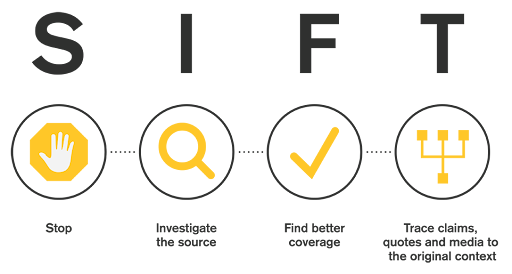
A classroom exercise could involve bringing in an example and asking students to discuss it in teams before sharing their thoughts with the class. To encourage metacognition during the activity, foreground students’ own perspectives and thought processes. This can be done by asking them to share their assessment of the source, rather than sharing the ‘answers’. Creating a dialogue gives learners the opportunity to take the lead in their learning. Dialogue between an expert and an audience has been shown to help with science communication. In disseminating COVID-19 information, epidemiologists found that communication was more successful when audiences were invited into a conversation, while “top-down” messaging eroded trust.[33] Asking meaningful questions will be important here for encouraging students to explore their thought process. Socratic questioning, for instance, can help foster metacognition.[34]
Dialogue amongst peers is also important in fostering metacognition. Active conversations amongst students in both teams and with the larger class will highlight the cognitive strategies of their peers, which in turn can help them better understand their own thought processes and expose them to the thought processes of others.
The first step of SIFT (Stop) is also a good opportunity to introduce mindfulness into source evaluation. Hannah et al. propose an IL framework that centers mindfulness by encouraging individuals to recognize their emotional responses and political biases while recognizing that information is political.[35] The purpose of Stop is to think about the source and its reputation before sharing it. An aspect that makes disinformation so compelling and so urgent to share with others is the emotions it elicits – anger, outrage, fear, to name a few. This doesn’t only need to apply to disinformation, however, but any kind of information intake. Recognizing these emotions is a step towards effectively evaluating a source. For instance, an element of Stop could incorporate deep breathing, recognizing negative emotions, and asking yourself why this response is emerging.[36] This is also an opportunity for empathy – by supporting the emotional needs of the learner, they can be open to absorbing new ideas.[37]
How has empathy played a role in your teaching? How would you like to incorporate empathy intentionally?
How do you build trust in the classroom? What has the response been from students?
What storytelling opportunities can you identify for your teaching?
Think about a time you fell for disinformation? How would you use this experience in the classroom?
- LaTiffany Davis et al., ”Authentic Connection: Engaging Students through Empathy,” portal: Libraries and the Academy 24, no. 4 (2024): 691. ↵
- Davis et al., “Authentic Connection,” 691. ↵
- Nicole Pagowsky, “The Contested One-Shot: Deconstructing Power Structures to Imagine New Futures,” College & Research Libraries 82, no. 3 (2021): 301. ↵
- Karen P. Nicholson and Maura Seale, “Information Literacy, Diversity, and One-Shot: Pedagogies of the Practical,” College & Research Libraries 83, no. 5 (2022): 766. ↵
- Barbara Fister, “Lizard People in the Library,” Project Information Literacy (2021): 3. ↵
- Davis et al., “Authentic Connection,” 692. ↵
- Carly M. Goldstein et al., “Science Communication in the Age of Misinformation,” Annals of Behavioral Medicine 54, no. 12 (2020): 988. ↵
- Goldstein et al., “Science Communication in the Age of Misinformation.” ↵
- Davis et al., “Authentic Connection,” 691. ↵
- Instructional Skills Workshop Network Executive, The Instructional Skills Workshop (ISW) Handbook Part One: Workshop Overview. ↵
- Davis et al., “Authentic Connection,” 692. ↵
- Goldstein, “Science Communication,” 989. ↵
- Davis et al., “Authentic Connection,” 695 (table) ↵
- For more on this, see above section “Building Trust Through Empathetic Listening.” ↵
- Davis et al., “Authentic Connection,” 696. ↵
- Goldstein, “Science Communication,” 987. ↵
- Davis et al., “Authentic Connection,” 698. ↵
- Davis et al., “Authentic Connection,” 690. ↵
- Davis et al., “Authentic Connection,” 690. ↵
- Davis et al., “Authentic Connection,” 690. ↵
- Kimberly D. Thompson et al., “Boundaries, Self-Care, and Empathy: Building an Empathetic Teaching Survival Kit,” Composition Studies 50, no. 2 (2022): 47. ↵
- Thompson et al., “Boundaries, Self-Care, and Empathy: Building an Empathetic Teaching Survival Kit,” 47. ↵
- Eamon Tewell, “Two decades of critical information literacy: a review and analysis of the literature,” Information Research 30 (2025): 448. ↵
- Emily Drabinski and Eamon Tewell, “Critical Information Literacy,” in The International Encyclopedia of Media Literacy, edited by Renee Hobbs and Paul Mihailidis (John Wiley & Sons, 2019), 1. ↵
- Anne Downey, Critical information literacy: Foundations, inspirations, and ideas (Library Juice Press, 2016), 42. ↵
- Matthew N. Hannah, “Information Literacy in the age of internet conspiracism," Journal of Information Literacy 17, no. 1 (2023): 215. ↵
- Ian O’Hara, “Epistemic Vaccination: Computational Disinformation, Inoculation Theory, and Critical Information Literacy,” Journal of New Librarianship 9, no. 4 (2024): 90. ↵
- O’Hara, “Epistemic Vaccination: Computational Disinformation, Inoculation Theory, and Critical Information Literacy,” 90. ↵
- Eamon Tewell, “Putting Critical Information Literacy into Context,” In The Library with the Lead Pipe (blog), October 12, 2016). ↵
- Paulo Freire, Pedagogy of the Oppressed (Continuum, 2005), 80. ↵
- Anna Cristina Brisola and Andrea Doyle, “Critical Information Literacy as a Path to Resist “Fake News”: Understanding Disinformation as the Root Problem,” Open Information Science 3 (2019): 282. ↵
- Mike Caulfield, “SIFT (The Four Moves),” Hapgood, June 19, 2019. ↵
- Goldstein, “Science Communication,” 988. ↵
- For a more detailed discussion of Socratic questioning and effective reflective questions, see 5.0 The Reference Interview section of this handbook. ↵
- Matthew N. Hannah, et al.,, “A Mindfulness-based information literacy framework for the current information environment,” Journal of Information Literacy 18, no. 2 (2024): 37. ↵
- Hannah et al., “A Mindfulness-based information literacy framework,” 55 (appendix). ↵
- Davis et al., “Authentic Connection,” 691. ↵