Main Content
2 Disinformation
Chapter Contents
2.1 What is “Disinformation” and Why Focus On It?
2.2 The Current Disinformation Context
2.3 Why Do People Use Disinformative Sources?
2.4 Library-Specific Issues Related to Disinformation
Reflective Questions
2.1 What is “Disinformation” and Why Focus On It?
Disinformation is information that is “deliberately created to mislead, harm, or manipulate.”[1]
Disinformation can be contextualised as one type of false information among several; this graphic from Deakin University Library differentiates between misinformation, disinformation, malinformation, and their level of harmful intent.
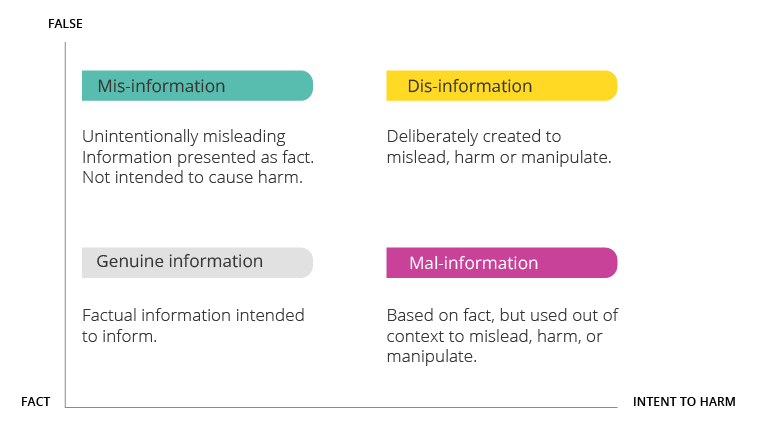
This graphic from Deakin University plots different types of information, including factual and false information and nonharmful and harmul.
As this chart shows, misinformation, disinformation, and malinformation are all types of false information, and in conversation, can sometimes be used interchangeably because it is challenging to know the intention behind why information was shared. This handbook focuses on disinformation because it is important to draw learners’ attention to the fact that some information is purposely, rather than inadvertently, false. While misinformation is a more commonly used term and remains a useful concept, it does not capture that false information can be spread by bad actors. By highlighting the harm that disinformation causes, we also connect to the idea of empathy for victims of disinformation, shifting blame that we might hold to disinformation agents. This handbook also describes the ways that information platforms elevate false information over genuine information, and how this situation can be exploited by bad actors.
Types of False Information: An Example
While it is useful to know about different types of false information, it can be challenging to differentiate between them in practice. For example, let’s consider the health claim that “blueberries are a superfood.” This claim could be both sincerely held by wellness enthusiasts and simultaneously pushed by health influencers who knowingly sell ineffective supplements. Intent is not always clear. This handbook focuses on disinformation because it highlights the presence of bad actors and the harmful impacts of false information. A focus on disinformation alerts us to the threats that exist in the information landscape, which, in this example, are health and wellness scammers, and enables us to cultivate empathy for those who are targeted. This shifts the blame from the person who believed false information (who wouldn’t like to live longer simply by eating blueberries?) to those that knowingly share harmful lies. It also enables us to consider the challenges inherent in the health information landscape: this is a very complex area with evolving research, and one that many people care deeply about, because it touches on their personal narratives of self. This in part explains why areas where there may be a modest amount of research on a topic (such as the health impact of blueberries) can be blown up disproportionately (as with the term “superfood.”). When faced with information that changes rapidly, it is easy for false information to proliferate and for bad actors to take advantage. Our current information landscape also favours short form content, such as social media posts and sensational news headlines (“blueberries are a superfood!”), and nuanced long form content, such as a research paper, often does not have the same popular impact.
2.2 The Current Disinformation Context
Disinformation has always been a part of the information landscape. From rulers who use political propaganda about their conquests to intimidate neighbouring civilizations[2], to politically motivated false news sources that existed before the idea of objectivity in reporting[3], to the longstanding American fascination with conspiracy theories,[4] disinformation is not new. The nature of truth has been debated for millenia, including among ancient Greek philosophers.[5] However, the current information landscape faces particular challenges. Specifically, the rise of populism coupled with political disenfranchisement,[6] the rise in anti-intellectualism demonstrated by a loss of trust in traditional institutions[7], and an increase in polarization[8] make this a fraught time for learners. According to Statistics Canada, “[i]n 2023, 59% of Canadians reported being very or extremely concerned about misinformation online and 43% of Canadians found it harder to distinguish between true and false news or information compared to three years prior.”[9] In this “post-truth” era, “tech companies, products (like AI), and platforms like X have chipped away at and undermined our confidence in the nature of ‘truth,’ and in the institutions once entrusted to arbitrate it, and left a vacuum in its place.”[10]
In the past several years there has also been a significant rise in conspiracism, which Hannah calls “arguably the most dangerous information crisis of our time.”[11] One reason that these alternative worldviews are appealing is because they replace complex, nuanced, and worrying sets of facts that have no clear narrative cohesion with a simple counternarrative. For example, in early 2020, very little was known about the COVID-19 virus, news reports were conflicting, and the death rates were very alarming – a conspiracy theory that was comforting for some was to believe that there was no virus and no death. Of course, beliefs like this had the effect of causing greater spread of the virus and have been called “infodemics” by the World Health Organization.[12] Conspiracy communities such as QAnon are also welcoming social spaces of shared knowledge production, where group and individual expertise is valued over that of traditional news media and higher education, with mottos such as “do the research”.[13] The appeal of spaces for QAnon research suggests the importance of affect to the nature of research, and the need to engage in literacy strategies which consider learners’ emotions and social needs.[14]
Post-Truth
It’s worth spending a little time defining and contextualising the term post-truth. This was Oxford Dictionaries’ Word of the Year in 2016, which they defined as an adjective: “relating to or denoting circumstances in which objective facts are less influential in shaping public opinion than appeals to emotion and personal belief.” The term had existed for decades before, but it was highlighted in that year because of the context of rising falsehoods in major political moments, such as Brexit and the election of Donald Trump, where the “new implication” was “that truth itself has become irrelevant.”[15] In this sense, a “post-truth” time is akin to other periods of time such as “The Enlightenment,” which describe the relative valuation of facts to emotion. In The Post-Truth Condition, Kattumana and Truwant provide an overview of the post-truth landscape drawing from a broad array of disciplines, focusing on changes in epistemology and how shifting attitudes towards the truth come to bear on our current political landscape.[16] While the term “post-truth” is sometimes used to describe a context in which truth is obsolete, this volume shows that current scholarship on this topic is more nuanced and complex than this, arguing for updates to conceptions of what we know and how we know it, but not rejecting the concept of objective reality outright. There are also scholars who argue that denials of objective reality are a tool of authoritarian governments, which is why we see the rise in post-truth today. For example, see Synder’s work On Tyranny where he argues that “post-truth is pre-fascism” (page 71)[17] and Finchelstein’s A Brief History of Fascist Lies.[18]
For a short introduction to the topic of post-truth, the article “Bruno Latour, the Post-Truth Philosopher, Mounts a Defense of Science” provides a useful entry-point. In it, Latour is described as having “had done more than that of any other living thinker to unsettle the traditional understanding of how we acquire knowledge of what’s real.”[19] He did so as a central figure in establishing the field of Science and Technology Studies, which examines the subjectivity that goes into scientific constructions of knowledge. Latour’s work argued that instead of facts existing “out there” as was commonly understood, “scientific facts should instead be seen as a product of scientific inquiry.” He argued that “there is no such thing as a view from nowhere and that we are always implicated in the creation of our view.” Despite this, as Latour’s work and the article make clear, Latour believed in reality and in the importance of establishing facts through science, dedicating the latter portion of his life to amplifying climate change research. Latour’s work did not cause “our current post-truth moment,” but rather, his work described a shift that was already underway from a “shared” view in a “common world.” This shift provides rich opportunities for disinformation actors to make political gains. They can discredit scientific research by claiming it is unsettled, point to the subjectivity of science as a negative, and claim the authority of their own poor quality “junk science.” Despite these challenges, Latour and other STS philosophers do not urge a return to the authority of “capital S-science,” but rather an embrace of the shift “from scientists appealing to transcendent, capital-T Truth to touting the robust networks through which truth is, and has always been, established.” In other words, for Latour and the other STS scholars, we should understand science and other forms of knowledge creation as situated, subjective, political, networked – and because of these characteristics, rather than in spite of them, capable of producing facts.
The impact of disinformation has been significant. According to the Council of Canadian Academies, which focused their research on science and health information, false information impacts us both individually and collectively: “On an individual level, it can leave us vulnerable to baseless fears, harm from preventable diseases, and exploitation by those who promote misinformation for profit or power. On a collective level, it erodes trust, fosters hate, undermines social cohesion, and diminishes our capacity for collective action.”[20] Trust has been eroded in news media, and in 2023, “fewer than half of Canadians (47%) reported high levels of trust in the media.”[21] As Hannah et. al. note, the contemporary media infrastructure “exacerbates outrage, mis/disinformation, and conspiracism,” and its combination with growing political partisanship “has produced a toxic environment in which democratic norms and processes are under increasing threat, not only from foreign adversaries, but from within the democratic institutions themselves.”[22] This level of disenfranchisement is a breeding ground for nihilism and disconnection amongst learners. This apathy itself can be used as a tool, as was the case with Cambridge Analytica who identified apathetic Facebook users and manipulated them not to vote in the 2016 USA election (201).[23] The Cambridge Analytica scandal is useful to consider because it was the first public anti-democratic disinformation campaign many had seen. Of course, there have been many others before and after, but it still exemplifies how disinformation targeted at individuals can have a global impact. From voter disenfranchisement, to climate change,[24] to the spread of pandemics, disinformation is shaping our world.
2.3 Why Do People Use Disinformative Sources?
If disinformation sources are harmful, why do educated and discerning people use them? To understand why this happens and to cultivate empathy for those that fall victim to disinformation, it can be useful to take stock of a few issues within our information ecosystem. First, information platform technologies capitalize on our attention through a model referred to as the “attention economy.”[25] The longer users remain glued to their devices and the more content they ingest, the more data that platforms are able to harvest and advertising they are able to sell.[26] This creates an asymmetric information environment where content that prompts high engagement, including emotional, controversial, and conspiratorial information, is naturally favoured by the platforms through recommendation algorithms.[27] This has been documented in phenomena such as radicalization through YouTube’s recommended videos algorithm, where users “consistently migrate from milder to more extreme content” (131).[28] The most popular online shows are currently right-leaning,[29] and many of those shows are promoters of conspiracism, which reflects asymmetric recommendations. Pathways to extreme content might be considered a byproduct of the platforms’ need to generate attention, but can certainly be exploited by bad actors who want to participate in the rising tide of conspiracism.
Disinformation and The Algorithm
The way that extremist content tends to rise to the top of recommendation algorithms can be exploited by bad actors. For example, if a conspiracy theorist YouTuber wanted to bring in more engagement for their extreme content channel, they might create videos on a popular topic to gain subscribers and placement on mainstream recommended video lists. This is why a busy home cook who is looking for a recipe for yogurt can end up inadvertently watching content from a white supremacist creator they are ideologically opposed to and then is recommended hateful disinformation in the future. White supremacists have long considered the internet a powerful tool for recruitment, being early operators of message boards and disinformation websites.[30]
The collection and sale of user data to advertisers as the basis for how technology platforms function is often considered a trade-off for convenience. Many enjoy being recommended content based on their past behaviour and preferences, such as Spotify’s algorithmically recommended music playlists. But not only does this open the door to extremist pipelines, it enables highly targeted advertising in a manner that can be considered exploitative. For example, Facebook has been accused of serving ads related to weight loss and beauty products to teen girls who had recently deleted a selfie, an indicator of low self-esteem.[31] Although capitalizing on girls and women’s self esteem issues in order to sell products is a longstanding practice of the beauty industry, online advertising that can be immediately delivered to a targeted audience is a characteristic of technology platforms. Indeed, when data brokers sell access to users for advertising, it is common practice to divide them into categories that reveal personal health, adversity, and sexual information. As Veliz states, “the most sensitive categories are very often the most valuable because if they know where you hurt, if they know what you’re scared of, then they can really kind of exploit that information”.[32] Presumably, hurt, scared, and vulnerable users make an easy target for exploitation.
Users also feel powerless in response to this sort of invasion of privacy. Leaving platforms has what Doctorow calls a high “switching cost,” as leaving a platform like Facebook would require either leaving all of your friends and communities there or requiring the coordination of a mass exodus.[33] As a result, users are locked in to platforms that no longer serve their needs. Knowing that users can’t leave has prompted many platforms to “enshittify,” or reduce the value they deliver to their users in order to boost their own profits.[34] For example, Google searches used to produce more relevant results, but Google has begun a deliberate strategy of reducing result relevancy in order to boost how many searches a user must run and, correspondingly, generate more advertising sales.[35] The artificial elevation of poor results can also be seen on other platforms, such as Facebook downgrading content from friends in favour of advertising and Amazon’s top results highlighting paid product placement.[36] As this is the trend with the big technology companies, other online platforms which might be more common sources of information have also followed suit. Poor relevancy information is thus being increasingly built into our information systems.
Technology platforms enshittify to better squeeze their users. Within the information landscape, we have also seen other sources of information become degraded for a variety of complex reasons. For instance, traditional news media has been on the decline for several decades and local news has been all but hollowed out;[37] once reputable government sources in the United States have been politicized;[38] and experts that once held authority are entangled in criminal scandals.[39] In other words, some traditional sources of authority are not as stable as they once were, and sources must be assessed individually. This evaluation is an exhausting process, which can lead to the dismissal of whole categories of information sources, as is normative in the far-right distrust of news media.[40] Disinformation agents capitalize on precisely this erosion in public trust.
Given the uphill battle that users must face to find good quality information when they are being directed towards radicalization pipelines, targeted by advertisements when vulnerable, fed low relevancy results on purpose, and the degradation of traditional information sources, it’s not surprising that people use disinformation. As a result of the asymmetric push platforms provide towards disinformation, it’s a statistical inevitability that a certain percentage of the population will be subject to it, including library workers and learners. Disinformation impacts everyone, because we all rely on information systems that are vulnerable to manipulation. Learning is an affective process that can be exploited by bad actors. Given this, it’s difficult not to feel empathetic for learners impacted by disinformation.
Disinformation and Uncertainty
Uncertainty can breed disinformation. For example, the uncertainty produced by the COVID-19 pandemic spawned many conspiracy theories, including about the origin of the virus, effective treatments, and government plots. In response, science educators and public health officials have revised their communications strategies to include more empathetic approaches, as these are thought to be effective at countering disinformation.[41]
In addition to these challenges, members of marginalized communities face additional hurdles in accessing reliable information sources. Campaigns against disinformation have often focused on vilifying alternative media and valorizing establishment sources. However, this messaging alienates communities who do not trust those sources due to historic and ongoing oppression. For example, Benjamin in Viral Justice describes examples of medicalized torture Black people in America have been subjected to, such as the U.S. Public Health Service Syphilis Study (in which Black men in Tuskegee were untreated for a treatable disease), the gynecological experiments of J. Marion Sims on unanesthetized enslaved women, and the medical establishment’s betrayal of Henrietta Lacks.[42] Mistrust of health institutions is a logical result of this history, but Benjamin states that “the problem is not simply a ‘lack of trust’ on the part of the downtrodden but a lack of trustworthiness on the part of dominant institutions” (227). Benjamin’s focus is on the experiences of Black Americans, but one could write similar descriptions of mistrust in other abusive contexts, focusing for instance on Indigenous people and the Canadian child welfare system or women’s experiences with law enforcement and sexual assault reporting. As library workers, the more that we can learn about the oppression of marginalized groups, the better our understanding of how the information sources we work with are perceived as trustworthy (or not) by these communities.
Alternative Information Avenues
Alternative sources of information outside of the mainstream can be more appealing to oppressed communities, who have not had a positive relationship with institutional sources. Benjamin writes how some salons and barbershops are partnering with public health researchers to deliver information more effectively. Due to their importance in Black life, these businesses are well positioned to share health information with the community. This is an example of community-based health information positioning and requires a high degree of empathy from the stylists and barbers to work effectively.[43]
2.4 Library-Specific Issues Related to Disinformation
While misinformation impacts everyone, as academic library workers our frequent interactions with younger people has given us a particular cause for concern in this area, and with good reason. While Gen Z are often referred to as digital natives, a recent study by YouGov found only 11% of 18-29 year olds received a high score on a task identifying fake news from real, while 36% received a low score, as compared to only 9% of those over 65.[44] Many students will not be as savvy with disinformation as we may assume, and the sheer volume of information they come across, the speed at which they view it, and the rapidity of its spread, makes it impossible for them to remain critical of everything.[45] With 74% of Gen Z getting news from social media daily,[46] source reliability and high exposure to poor news sources add to the concerns. Complicating this further, more information is available than anyone can reasonably evaluate critically, psychological factors such as confirmation bias, selective exposure, emotional appeals, social proof, cognitive laziness, and the overwhelming information environment, lead all of us to seek out, absorb, and recall information that reinforces our existing beliefs.[47] Finally, while learners are confident in their ability to identify disinformation, they often lack the critical evaluation skills to be effective.[48] All of this adds up to create an information system for learners that combines high risk of disinformation with low capacity for identifying it.
Age and Disinformation
The American Press Institute found that, though Gen Z do regularly check traditional news sources, they are still prone to getting their news from social media than any other source, consuming, on average “news from about four social media platforms at least weekly”.[49] Given the established prevalence of misinformation in social media, traditional methods or information literacy are inadequate.
Since the meteoric rise of disinformation around 2016, and the sharp increase in disinformation during the pandemic, librarians have been increasingly at the forefront of tackling the issue, particularly digital misinformation. Passion for the issue among library workers is unsurprising, as it is “in opposition to traditional library values and services”.[50] In academic libraries, this work often involves instruction sessions and the creation of library guides, both focused on information evaluation skills, which rely heavily on step by step processes like the CRAAP test.[51] The sheer volume of information students are presented with daily, however, make these processes impractical and unlikely to be employed consistently with every individual interaction with a suspect source. Librarians also face a number of additional obstacles in counteracting misinformation with students: methods of spreading misinformation are evolving extremely quickly; time and resources are short, institutional support is lacking, and the issue is complex.[52] So, how can library workers best assist learners with these limitations, if the tools we have relied on are not working? It might start with relationship building by addressing the shame that many students feel when reaching out for help or information.
Shame and library anxiety are linked and well documented.[53] Similar to general library anxiety, students may well have anxiety and shame around not understanding the impact of disinformation or how to identify it. In a study conducted in 2015, students used words like “scary, overpowering, lost, helpless, confused, and fear of the unknown”[54] in their reflections about research and using the library. The study further found that students feel shame around their incompetence in the library[55], a feeling that likely extends to their difficulty in navigating misinformation. If students feel judged or criticised when seeking help, this could increase shame and discourage students from using the library entirely. In fact, a validation scale developed by Bostick in 1992 identified interactions with staff as one of four factors contributing to library anxiety.[56] Each mishandled interaction with students at these vulnerable moments, including when they have a lack of understanding about misinformation, could serve to increase shame and reluctance to seek help.
To develop successful interventions for students, understanding how and why biases develop and when and how people fall victim to misinformation is key. It is dangerous to label people as lazy or uneducated if they are susceptible to misinformation. We are wired to believe information that is given to us, and without sustained focused attention on all information that comes in, it’s impossible to avoid.[57] Keeping these obstacles that students face everyday in mind during each interaction is key; we need to approach students with empathy.
What is the difference between misinformation, disinformation, and malinformation? When is it helpful to distinguish between them?
How often do you use recommendation algorithms to find content, such as the videos that are recommended after you finish watching a video on YouTube? Have you ever encountered disinformation through a recommendation algorithm?
Reflect on the marginalized communities that you work with. Have they experienced oppression which would lead them to be distrustful of institutional sources of information, such as government or academia? If you aren’t sure, how could you learn?
Have you ever fallen for disinformation? Consider how and when this occurred and the factors that influenced this occurrence.
How do online information systems fail information seekers? How do they tilt the playing field towards disinformation?
- “Misinformation,” Deakin University Libraries, last updated Apr 16, 2026. ↵
- Philip M. Taylor, Munitions of the Mind: A History of Propaganda from the Ancient World to the Present Day, 3rd ed. (Manchester University Press, 2003). ↵
- Jacob Soll, “The Long and Brutal History of Fake News,” POLITICO Magazine (2016). ↵
- Matthew N. Hannah, “Information Literacy in the Age of Internet Conspiracism,” Journal of Information Literacy 17, no.1 (2023): 207. ↵
- For example, see Plato’s works: Theaetetus, Gorgias, and The Republic, Books VI and VII. ↵
- Timothy Snyder, On Tyranny: Twenty Lessons from the Twentieth Century (Random House Publishing Group, 2017). ↵
- Alice E. Marwick and William Clyde Partin, “Constructing Alternative Facts: Populist Expertise and the QAnon Conspiracy.” New Media & Society 26, no. 5 (2024): 2540. ↵
- Justin Ling, Far and Widening: The Rise of Polarization in Canada (Public Policy Forum, 2023). ↵
- Helen Foran et al. Concern about Misinformation: Connections to Trust in Media, Confidence in Institutions, Civic Engagement, and Hopefulness. Statistics Canada, 2025. ↵
- Brian Merchant. “Abolish the Senses.” Blood in the Machine (blog). January 16, 2026. ↵
- Hannah, “Information Literacy in the Age of Internet Conspiracism,” 207. ↵
- For a definition of infodemic and related information, see: World Health Organization. n.d. “Infodemic.” ↵
- Marwick and Partin, “Constructing Alternative Facts: Populist Expertise and the QAnon Conspiracy,” 2547. ↵
- Matthew N. Hannah et al., “A Mindfulness-Based Information Literacy Framework for the Current Information Environment,” Journal of Information Literacy 18, no. 2 (2024): 37–55. ↵
- Oxford Languages, “Oxford Word of the Year 2016,” Archived. ↵
- Tarun Kattumana and Simon Truwant, The Post-Truth Condition: Philosophical Reflections (Lexington Books, 2024). ↵
- Timothy Snyder, On Tyranny. ↵
- Federico Finchelstein, A Brief History of Fascist Lies (University of California Press, 2022). ↵
- Ava Kofman, “Bruno Latour, the Post-Truth Philosopher, Mounts a Defense of Science,” The New York Times Magazine (October 25, 2018). ↵
- Council of Canadian Academies, Fault Lines: Expert Panel on the Socioeconomic Impacts of Science and Health Misinformation (CCA, 2022). ↵
- Foran et al. Concern about Misinformation. ↵
- Hannah et al., “A Mindfulness-Based Information Literacy Framework for the Current Information Environment,” 5. ↵
- Aram Sinnreich and Jesse Gilbert, The Secret Life of Data: Navigating Hype and Uncertainty in the Age of Algorithmic Surveillance (MIT Press, Information Society Series, 2024). ↵
- Kate Cell, “Disinformation Undermines Our Right to Science,” The Equation (blog), December 15, 2025. ↵
- Chris Hayes, The Sirens’ Call: How Attention Became the World’s Most Endangered Resource. (Random House, 2025). ↵
- Shoshana Zuboff, The Age of Surveillance Capitalism: The Fight for a Human Future at the New Frontier of Power, 1st ed. (PublicAffairs, 2019). ↵
- Mike Pepi, Against Platforms: Surviving Digital Utopia (Melville House Publishing, 2025). ↵
- Manoel Horta Ribeiro et al., “Auditing Radicalization Pathways on YouTube” (Conference paper, Proceedings of the 2020 Conference on Fairness, Accountability, and Transparency, New York, NY, USA, January 27, 2020), 131–41. ↵
- Kayla Gogarty, “The Right Dominates the Online Media Ecosystem, Seeping into Sports, Comedy, and Other Supposedly Nonpolitical Spaces,” Media Matters for America. March 14, 2025. ↵
- Christopher J. Lennings, “Grooming for Terror: The Internet and Young People,” Psychiatry, Psychology and Law 17, no. 3 (2010): 424–37. ↵
- Rounak Majumdar, “Meta Accused of Targeting Vulnerable Teens with Ads Based on Emotional States.” TechStory, April 10, 2025. ↵
- “Carissa Veliz: Exposing Big Tech, Privacy Threats & The Future of Artificial Intelligence,” podcast. Posted March 4, 2024, by Through Conversations Podcast, YouTube, 51 min., 8 sec. ↵
- Cory Doctorow, The Internet Con: How to Seize the Means of Computation (Verso, 2023), 26 ↵
- Cory Doctorow, Enshittification: Why Everything Suddenly Got Worse and What to Do about It (Verso, 2025). ↵
- Doctorow, Enshittification, 178 ↵
- Doctorow, Enshittification, 11-28. ↵
- April Lindgren et al., “Canada’s Local News ‘Poverty,’” Policy Options, January 23, 2017. ↵
- For example, Nicola Hawley describes the degradation of public health institutions in the USA in her article “Whose Health? Whose Truth? Navigating the ‘Make America Healthy Again’ – Public Health Divide.” Annals of Human Biology 52, no. 1. ↵
- For example, well known academics such as Noam Chomsky have been implicated in the Epstein Files; see Ramon Antonio Vargas, “Newly Released Files Shed New Light on Chomsky and Epstein Relationship,” The Guardian, February 3, 2026. ↵
- For example, X, formerly Twitter, autoreplied with the statement “Legacy Media Lies” to all enquiries about the conduct of its AI agent Grok producing non-consensual CSAM. See: Lora Kolodny and Samantha Subin, “Musk’s xAI Faces Backlash after Grok Generates Sexualized Images of Children on X,” CNBC, January 2, 2026. ↵
- Carly M. Goldstein et al., “Science Communication in the Age of Misinformation,” Annals of Behavioral Medicine 54, no. 12 (2020): 985–90. ↵
- Ruha Benjamin, Viral Justice : How We Grow the World We Want (Princeton University Press, 2022). ↵
- Benjamin, Viral Justice : How We Grow the World We Want, 251 ↵
- Conor Murray, “Gen Z And Millennials More Likely To Fall For Fake News Than Older People, Test Finds,” Forbes, June 28, 2023. ↵
- Jane Kelly, “Research Finds Gen Z, Millennials More Vulnerable to Fake News,” UVAToday, September 6, 2024. ↵
- Media Insight Project, “The news consumption habits of 16- to 40-year-olds,” American Press Institute, August 31, 2022. ↵
- Bolaji David Oladokun and Millie Nne Horsfall, Fake News and Misinformation on Social Media: The Role of Librarians in Fake News and Information Disorder in the Era of Advanced Information Technology (Walkter de Gruyter, 2025), 162-163. ↵
- Nicole Johnston, “The Impact and Management of Mis/Disinformation at University Libraries in Australia,” Journal of the Australian Library and Information Association 72, no.3 (2023): 253. ↵
- Media Insight Project, “The news consumption habits of 16- to 40-year-olds.” ↵
- M. Connor Sullivan, “Why Librarians Can’t Fight Fake News,” Journal of Librarianship and Information Science 51, no. 4 (2019): 1148. ↵
- Johnston, “Impact and Management," 252-253. ↵
- Johnston, “Impact and Management," 263. ↵
- Erin McAfee, “Shame: The Emotional Basis of Library Anxiety,” College & Research Libraries 79 no. 2 (2018): 237. ↵
- Constance Mellon, “Library Anxiety: A Grounded Theory and Its Development,” College & Research Libraries 76, no. 3 (1986): 162. ↵
- Mellon, “Library Anxiety”, 163. ↵
- Sharon Lee Bostick, “The Development and Validation of the Library Anxiety Scale,” PhD diss., (Wayne State University, 1992). ↵
- Sullivan, “Why Librarians Can’t,” 1152 ↵