Main Content
4 Implementing Empathy
Chapter Contents
4.1 What Does Implementing Empathy Look Like in Libraries?
4.2 Librarian / Patron Engagement Pathway
4.3 Ethics of Information and Moral Literacy
Reflective Questions
4.1 What Does Implementing Empathy Look Like in Libraries?
Recent world events and their corresponding impact on library patrons has led to recognition of the need for trauma-based approaches in our libraries. In particular, Dudek’s Library Journal article titled “Working Toward Wellness: Exploring Trauma-Informed Librarianship”, she invokes a call to action in libraries to prioritize more empathetic approaches to service delivery and student engagement; describing the main goal of trauma-informed librarianship as movement from “What is wrong with you?” to “What do you need?”[1]
Practically speaking, what does this look like in libraries? While many libraries and library workers may feel that their workplace is already empathetic in nature, it is the intentionality of focus on empathy that leads to truly trauma-informed spaces and services.
Davis, et. al. distinguish library worker empathy from sympathy and compassion, emphasizing the following:
Empathy enables a librarian to experience their users not as objects, but as holistic people with unique experiences and life circumstances. Recognizing a user as a whole person lets a librarian make space for the many roles the user plays – student, parent, employee, and more –and creates an understanding environment where the librarian can account for the unique needs that arise from the combination of roles a user plays in their own life. This discernment of others’ needs results in higher quality service by allowing librarians to thoughtfully design experiences to meet a user’s unique needs.[2]
In this paper, the authors describe typical interactions between users and library staff, and provide options for empathetic practice. The below section is excerpted as an example of these interactions:
A student makes an appointment with you to get help finding sources for their thesis literature review. They ask you about your time as a graduate student and whether you thought doing research projects was hard. What do you tell them?
- You tell them research is hard for everyone at first but reassure them that they’ll get the hang of it.
- You tell them that since you studied library and information science, the literature searching part of research wasn’t hard for you.
- You share a story about one of the research projects you struggled with during your time in school and tell them the strategies you used to get through it.
Davis, et. al. rank the responses and classify Response 1 as offering the highest level of empathy, due to its emphasis on collective experiences, and encouragement of overcoming challenges. Responses 2 and 3 could be considered dismissive of the user’s personal experience, and the offer of solutions that aren’t tailored to their unique needs.[3]
Research on effective debunking also references empathetic approaches as key; utilizing open questions, affirming and polite language, and perspective taking, while avoiding non-empathetic expressions such as summarizing, judgemental language and ignoring concerns.[4] Schmid further describes empathetic communication as an action that increases the perceived trustworthiness of the debunker, signaling aligned values and competence.
While established methods such as SIFT and lateral reading[5] have proven effective tools at identifying misinformation and fake news, effective debunking requires a different approach intentionally rooted in empathy. Useful frameworks can be found in other disciplinary research where there are similar concerns around misinformation and adapted to the academic library context.
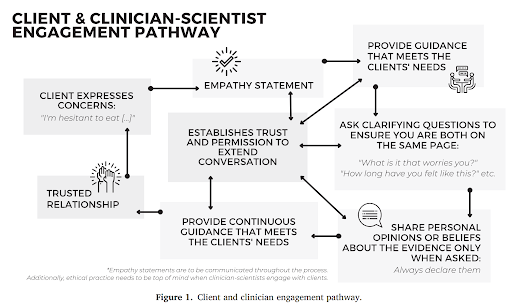
For example, dieticians are frequently confronted with misinformation and disinformation from clients regarding food, nutrition, and other diet related issues. Diekman et. al. discuss how clients can present information that is not grounded in the body of evidence, requiring nutrition practitioners and clinician scientists to assess their clients’ understanding and beliefs before providing additional information.[6] To do so effectively, the Client and Clinician-Scientist Engagement Pathway was developed to simulate an empathetic interaction with a client. The pathway, visualized below, and adapted to the library context prioritizes empathetic communication throughout the engagement process, listening, open questions, and exemplifies effective debunking as described in the research.
4.2 Librarian / Patron Engagement Pathway
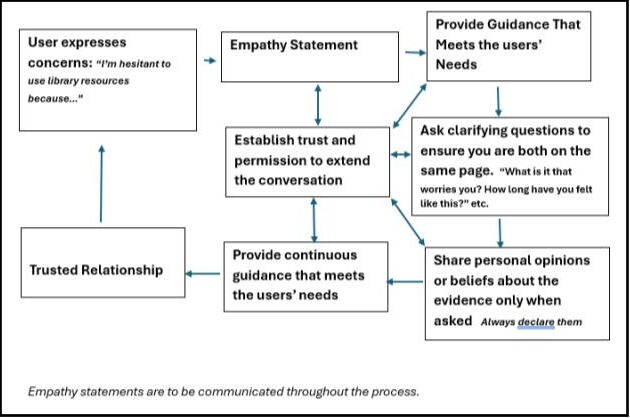
The following dialogue imagines an interaction between a librarian providing information literacy instruction and a student who has been impacted by their encounters with disinformation. It models the principles of the Librarian/Patron Engagement Pathway illustrated above, as well as demonstrating some of the techniques that will be laid out in the following chapters on applying an empathetic framework to the reference interview and teaching.
Librarian: For our upcoming workshop on reading and analyzing academic articles, I’d like you to read the following peer reviewed article: “Structure-guided design of a bivalent SARS-CoV-2 mRNA vaccine with NTD stabilizing mutations enhances broad immunity” and work through the provided “article anatomy steps.” Identify the parts of the paper including the research question, the conclusion, the results section, etc.
Student: Please assign me another paper to work with, I do not believe in vaccines.
Librarian: Before we do that, do you mind telling me a bit about yourself? Getting to know my students is important to me!
Student: Sure! I am a first year nursing student. I’m from Toronto.
Librarian: What is your experience with vaccines in your life?
Student: Well, my mom got the Covid vaccine and she got a blood clot and got very ill. She was also unable to work. So I started going online and reading about vaccines and I learned so much that my science classes definitely didn’t tell me. I won’t be getting any vaccines or recommending them to anyone when I become a nurse.
Librarian: I am so so sorry to hear about your mom. That must be super hard, I would be so sad if something like that happened to my mom. Can you tell me a bit about what you saw online about vaccines? What made you feel like you could trust what they were saying over what you have learned about in class?
Student: Well, I watched a lot of TikToks that really resonated with me because they said they knew people who had the same experience as me and my mom.
Librarian: Do you know what they based their information on, other than those experiences and hearing about others?
Student: No, not really. But I know they’re real stories from actual people and not “research” that has been funded by the people who make the vaccines.
Librarian: Do you think these actual people might have their own motivations behind their TikToks?
Student: No. I mean, I don’t know. Maybe. They’re just sharing their own stories too.
Librarian: Right, and other people’s stories can be really helpful to hear, especially when they reaffirm our own experiences. But do you think maybe you’re finding it easier to accept what they’re saying because they share the feelings you have? And that makes sense, but maybe there is other evidence out there that you could look at too. What do you think someone might gain by sharing only those types of stories?
Student: Maybe they want to warn people. And I guess they could just want views. But it does make me feel less alone.
Librarian: It can be really scary to be unsure about something, I know it makes me feel better to get those answers. It makes total sense that you went looking for answers. When something so sudden and devastating happens to someone you love, it’s completely natural to want to understand why and protect yourself and others from experiencing that same pain.
Student: Definitely!
Librarian: Do you feel scared a lot?
Student: Yeah sometimes. What happened to my mom was scary after we were told it was safe to take the vaccine. It can be really hard to know who to trust.
Librarian: It is really hard. When you are a nurse, you’re going to be a person people look to when they’re scared and trying to figure out what and who to trust. And if you base your medical advice on personal stories instead of clinical data, how might that impact the way you handle a patient who has a different experience from what you’ve heard about?
Student: I hadn’t thought about it that way. I just want to make sure my patients are safe, and protect them from what happened to my mom.
Librarian: That’s because you care, and that is what will help make you a great nurse. That’s why I would really like it if you read the same article as your classmates so you can see how your friends tackle the issue, it might even make you feel better about how to find answers in the future. In nursing, you’re going to encounter a lot of medical literature – some you’ll agree with, and some you’ll question. My goal for this workshop is to give you the tools to look at any medical paper, pull it apart, and use those tools to understand the evidence and how they came to their conclusions and to do that in a group so you can see how that process works and how your peers engage with the material. It’s just a first step. We can talk more about your approach to medical research if you want to make an appointment as well.
4.3 Ethics of Information and Moral Literacy
In addition to library worker empathy with learners, educating learners on ethics with respect to information can also be of assistance in countering the effects of disinformation. Both producers and users of information, ideally, are subject to ethical codes – making choices about how information is produced and disseminated, where one seeks it, and how one uses it, require an understanding of the consequences of those choices and an understanding of the moral implications thereof. Some examples of this moral choice landscape include keeping confidential information private, plagiarism, use of artificial intelligence, predatory journal fees, freedom of expression, censorship, etc. Many information scholars and organizations have proposed a specific information ethics i.e. “a system of moral values in the context of human information interactions.”[7] As we noted above with respect to IL frameworks, conspiracy groups may be able to use these information ethics frameworks to their own disinformed ends – helping learners understand ethics generally before tackling information ethics specifically may be useful.
Ethics, of course, is not a one size fits all framework – one can subscribe to utilitarianism, deontology, virtue ethics, rights-based ethics, or care ethics, among many others. In line with our empathy framework as described in this handbook, care ethics (based on relationships) would align neatly but is not a requirement. The ethics of care asks us to look at an issue and ask ourselves “Who, relationally, is this hurting, what does this do to the relationship, and how can that relationship be repaired?”[8] In an academic information context, a learner could use this ethical framework to decide whether to plagiarize or not – they may look to their relationship with the original creator and decide that this would harm the relationship by using their work without attribution, or it may harm their relationship with their professor, other colleagues, or their relationship with themselves. Or, if taking a deontological approach, reaching the conclusion that plagiarism is wrong not because it harms relationships but because we have a duty to always tell the truth.
Ethics education in the context of information literacy – so, adding a moral literacy component – may be a complement to the empathy approach to reduce conspiratorial thinking. We tend not to contemplate right and wrong when it comes to information, something that often comes across as apolitical, benign, or neutral. Everything has an ethical component and it is worth exploring that.
From an information professional perspective, we tend to have a general understanding of the ethics of our position – whether we are adhering to the ALA Code of Ethics[9] or a more personal understanding of the ethics of educators. The guidance these provide should be shaping our professional decision making, but information ethics may not be as obvious to those interacting with information from outside the profession. We understand that, for example, information can be produced with ill intent. Those who are victims of disinformation tactics may not have had this perspective going in. Many information professionals may be approaching their work from an angle of public responsibility as opposed to the philosophical field of ethics but “social responsibility is fundamentally an ethical concept…Social responsibility provides a way for the information profession to concern itself with the social dimensions of service and be aware of the social impact of that service.”[10] Do all information professionals agree on ethical frameworks or shared values? Certainly not; even two values most associated with our work – information privacy and freedom of expression – conflict in their mere existence. Some frameworks adopted by information workers will fall on one side or the other but having a commitment to one particular moral landscape or another can give us a way to explain why we chose a particular value. There is a tacit assumption that people are taught the differences between right and wrong at a very young age and we tend to assume others act ethically, but if we cannot count on this assumption, it would be important to both teach about ethics in our information education and reference interactions, as well as in our professional development.
It may seem counter intuitive to think about ethics when simply accessing information: ethics ask us to contemplate “What kind of person should I be and how ought I to live my life” – the big questions. But these questions also trickle down into our minute by minute, day to day functioning. Just like our assumptions about people using logic to approach information, humans also tend to assume “a stability of human nature [and] of choice.”[11] We assume an understanding of each other’s ethics, but this is not a safe assumption. In fact, it may be safer to assume that learners in our libraries may not have received any specific ethics education at all. Much like our suggestions about empathy, ethics need not be means tested in terms of its subject matter applicability: while an information-focused-ethics may be good to learn as information workers, a more general ethical education for learners who have been victims of disinformation may be an excellent complement. Learners who adhere to an ethical framework can use that in their approach to information as opposed to an emotional or reactive approach. If we discuss censorship ethics with someone who believes they are always being lied to, we may not make progress towards a more open world but if we discuss ethical decision making generally, we may not be undermining their falsely held beliefs directly and can make progress in the area. Ideally, learners would be engaged in what scholar Jela Steinerová has termed the “ethical information literacy experience”; this is comprised of four components (“ethical awareness and sensitivity; ethical imagination and ethical intuitions, including emotions; ethical reasoning, decision-making and problem solving; and ethical self-regulation, metacognition (more on this in subsequent chapters) and metaliteracy” which “[build] on an individual’s cognitive and affective states and considers cognitive and affective biases, influence of patterns of behavior social perception and social diffusion of information.”[12]
Consider a recent interaction you have had at your workplace. How well does it map onto the Librarian / Patron Engagement Pathway? How could this framework improve future interactions?
What ethical codes are embedded in your library? Consider personal, professional, and institutional ethical codes which might coexist or be in conflict.
How does the framing of information as neutral relate to the capacity for library workers to implement empathy?
Did the example of empathetic behaviour described by Davis et al. surprise you?
- Leah Dudak, “Working Toward Wellness: Exploring Trauma-Informed Librarianship,” Library Journal News, February 13, 2023. ↵
- LaTiffany Davis et al., “Authentic Connection: Engaging with Students through Empathy,” portal : Libraries and the Academy 24, no. 4 (2024): 691. ↵
- Davis et al., “Authentic Connection,” 700. ↵
- Philipp Schmid, “Debunking Health Misinformation with Empathy,” Current Opinion in Psychology 67 (2026). ↵
- Mike Caulfield and Samuel S. Wineburg, Verified: How to Think Straight, Get Duped Less, and Make Better Decisions about What to Believe Online (The University of Chicago Press, 2023). ↵
- Connie Diekman et al., “Misinformation and Disinformation in Food Science and Nutrition: Impact on Practice,” The Journal of Nutrition 153, no. 1 (2023): 3–9. ↵
- Jela Steinerová,“Ethical Issues of Human Information Behaviour and Human Information Interactions,” Open Information Science 7 (2023):3. For a brief history of information ethics scholarship, please see Kenneth Einar Himma, “Foundational Issues in Information Ethics,” Library Hi Tech 25, no. 1 (2007): 83-84. ↵
- For more on care ethics, see: Nel Noddings, Caring: A Relational Approach to Ethics and Moral Education, 2nd ed. (University of California Press, 2013); Joan C. Tronto, Moral Boundaries: A Political Argument for an Ethic of Care (Routledge, 1993); Michael Slote, The Ethics of Care and Empathy (Routledge/Taylor & Francis Group, 2007). ↵
- American Library Association, "ALA Code of Ethics," last updated May 19, 2017. ↵
- Rosemary Ruhig Du Mont, “Ethics in Librarianship: A Management Model,” Library Trends 40, no. 2 (1991): 203. ↵
- John M. Budd, “Toward a Practical Normative Ethics for Librarianship,” Library Quarterly 76, no. 3 (2006): 253. ↵
- Jela Steinerová, “Information Literacy as an Ethical Experience,” in Information Experience and Information Literacy, ECIL 2023. Communications in Computer and Information Science, 2043, Kurbanoğlu, S., et al. (Springer, Cham, 2024), 124. ↵