Main Body
Unit 2: Indefinite Integrals: Antiderivatives
In integral calculus, indefinite integrals play a fundamental role in finding antiderivatives and understanding the accumulated change of a function over an interval. Let’s delve into the concept of indefinite integrals, their connection to antiderivatives, and how to utilize a table of indefinite integrals effectively for problem-solving.
- What are Indefinite Integrals?
Indefinite integrals, denoted by [latex]\int f(x) dx[/latex], represent a family of functions rather than a single numerical value. They are expressed using the integral symbol without specified upper and lower limits. From a mathematical perspective, an indefinite integral represents all possible antiderivatives of a given function [latex]f(x)[/latex]. In simpler terms, it answers the question: “What function has a derivative equal to [latex]f(x)[/latex]?” For instance, a set of functions, [latex]x^2-100, ..., x^2, ..., x^2+100[/latex]) all share the derivative [latex]2x[/latex], hence [latex]\int 2x dx=x^2+C[/latex] where C is any real number.
- Relationship with Antiderivatives
Indefinite integrals are closely related to antiderivatives. An antiderivative of a function [latex]f(x)[/latex] is any function [latex]F(x)[/latex] whose derivative equals [latex]f(x)[/latex]. Therefore, an indefinite integral [latex]\int f(x) dx[/latex] represents the general antiderivative of [latex]f(x)[/latex]. Symbolically, if [latex]F(x)[/latex] is an antiderivative of f(x), then[latex]\int f(x) dx = F(x) + C[/latex], where [latex]C[/latex] is the constant of integration.
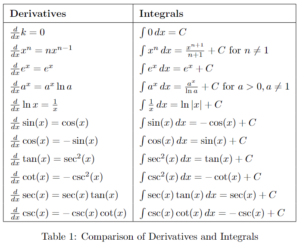
- Table of Indefinite Integrals:
A table of indefinite integrals provides a comprehensive list of common functions and their corresponding antiderivatives. Some essential entries in this table include: