Module 5: Accessing Care
Care and the Community
Independent Living Movement
The Independent Living Movement (ILM), a philosophy that emphasizes the right of disabled people to live independently in their chosen community, emerged in the 1960s as a challenge to institutionalized care and “voluntary” care (such as care by relatives and friends). The ILM grew alongside the civil rights movement and the push for deinstitutionalization.
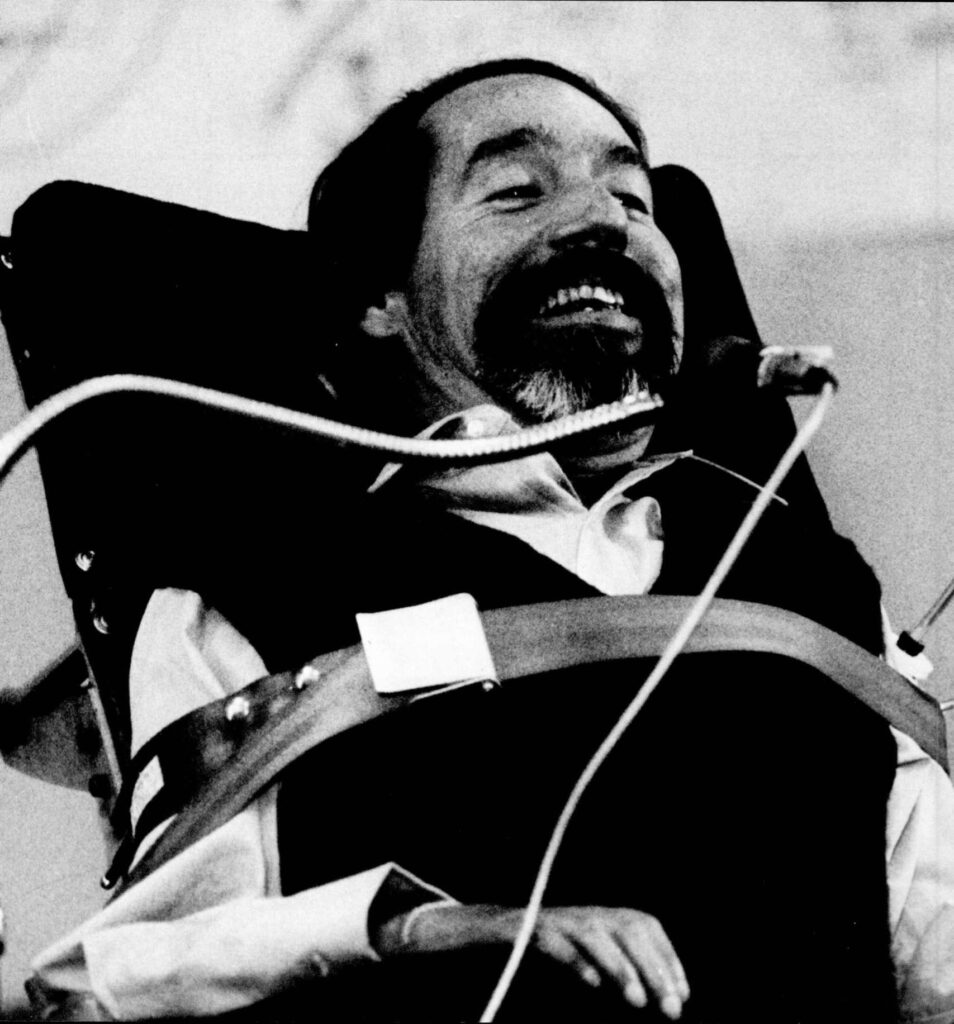
Photo by William Bronston for the California Department of Rehabilitation. Public domain (California government record).
A key figure in the ILM was Ed Roberts, a polio survivor who attended the University of California at Berkeley in the 1960s. At first, he lived in the university’s hospital and was denied the freedoms that his classmates took for granted. However, his admission drew other disabled students to the university, and it became a site of disability activism. This activism inspired the Center for Independent Living, which used peer support systems to help disabled people live independently, and continues to be a site of activism.

From the Community
Listen to Alessia and Kirk talk about the care they receive at home in an independent living environment:
Alessia
Kirk
Independent Living Models
The ILM advocates the use of personal attendants to support daily tasks such as getting dressed, cooking meals, or taking a bath. This support enables disabled people to live independently, make decisions about their own lives, and participate in their communities.
There are several models through which people can access attendant care. One is the direct funding model, where individuals receive funds to hire their own attendants. This approach offers greater flexibility and control, but access to direct funding is limited. It also requires individuals to manage employer-employee relationships, which can be time-consuming and labour-intensive.
Other models include supported living arrangements, in which attendants are hired by housing providers or external agencies to support residents. There are also programs like the Attendant Care Program through March of Dimes, which provide support in settings such as workplaces or schools. All of these models remain under-resourced and typically require medical confirmation of eligibility from a physician.
One consequence of these fragmented models is that the affective dimension of care—emotional connection, trust, and relational interdependence—can be overlooked. These care arrangements can also create precarious working conditions for attendants, sometimes with negative impacts on their health and wellbeing.
More recently, the ILM has taken seriously Eva Kittay’s critique of total independence as “a mere fiction” (Kittay, p. 51). Independent Living Centres are increasingly reflecting on the interdependence that underlies all care relationships, recognizing our shared need for connection, support, and survival.
For a poetic expression of this evolving philosophy, visit the Centre for Independent Living in Toronto’s website to read “Independence, Interdependence”.
Mutual Aid and Collective Care
Because everyone gives and/or receives care at some point in their life, a society structured around care ensures, in the words of philosopher Eva Kittay, “a dignified, flourishing life—both for the cared for, and for the carer” (Kittay, 2011, p. 54).
Think back to the model of care presented at the start of this module in the TED Talk by Janey Starling and Seyi Falodun-Liburd, “How Collective Care Can Change Society.” Collective care refers to communities organizing themselves to meet each other’s needs—not out of charity, but through solidarity. This approach is grounded in a critical awareness that state institutions and the market often fall short of meeting community needs—or exclude them altogether.
Collective care emphasizes interdependence and treats accessibility as a shared responsibility. At the heart of this practice is mutual aid, where care is reciprocal and community-driven, rather than top-down or conditional. This kind of care challenges the limitations of institutional systems and envisions a more connected, responsive way of supporting one another.
An example of collective care is the concept of ‘aging in place,’ where older adults continue living in their own homes as they age. These individuals may need support with daily activities such as chores, errands, meals, medication, or transportation to medical appointments. Often, this care is provided by informal networks of family, friends, and neighbours.
Another example is Loree Erickson’s Care Collective, which centers queer, disabled, and mad community members in practices of interdependent care. You can learn more on Loree’s Care Collective website or through her recorded talk, Cultivating Cultures of Care.
Here are a few more examples of mutual aid networks and collective care initiatives:
-
Substance Overdose Prevention and Education Network (SOPEN) – a peer-led initiative supporting harm reduction and overdose prevention.
-
Community Fridges TO – a city-wide mutual aid network that maintains accessible fridges stocked with free food.
-
NABORS (Neighbours Allied for Better Opportunities in Residential Support) – a non-profit that fosters inclusive living for disabled people through co-operative housing and community-building.
From the Community
Alessia
In addition to receiving care, many disabled people also provide care for others. Listen to Alessia describe how she supports her own care workers and other disabled community members:
Crystal
As a healthcare worker, it’s important to remember that not every disabled person is a patient. Sometimes, a disabled person might be at the hospital or doctor’s office to support or care for a loved one. Listen to Crystal describe the surprise of healthcare workers when they realized she was accompanying a family member to an appointment:

Media Moment
Let’s close with a poem written by Rebecca Wood, called Care Team, featured in Wordgathering: A Journal of Disability Poetry and Literature. The poem includes a recording of the author reading it aloud.