Module 6: Cripping Health Promotion
Health Promotion

Review and Reflect
If you are working through this Pressbook sequentially, you might want to revisit your responses to
this set of questions from Module 2, also listed below.
Do your responses still resonate with you? How have you changed?
If you are engaging with the questions for the first time, take a moment to reflect on your relationship to healthcare and medicine.
Consider the following:
- Describe your health routine.
- What technologies does this include (e.g., fitness trackers, diet apps)?
- Where have you sought information about health and well-being?
- Do you feel you have appropriate access to healthcare? What barriers do you navigate, and how do these impact your sense of well-being?
- How do you make decisions around medical treatments and interventions for yourself and loved ones?
- What concerns do you have about medicine and medical interventions, personally and more broadly?
One of the ways that ideas about health are disseminated is through public health promotion. Health promotion is the effort of to improve well-being by supporting governments, communities, and individuals to address health challenges through policies and resources that support the creation of healthy environments and encourage healthy behaviours (Public Health Ontario, 2024). The guiding aim of health promotion is to strengthen people’s capacity to take control over and improve their health (Public Health Ontario, 2024; World Health Organization, 2024).
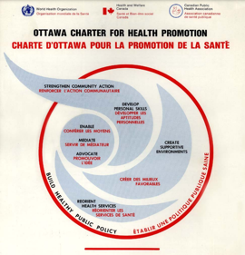
Health promotion as a concept entered the world stage from Canada, through a 1974 government report, A New Perspective on the Health of Canadians (Lalonde, 1974). Considered the first modern government document in the Western world to extend the field of health beyond the biomedical healthcare system, the Lalonde report aimed at equipping individuals and organizations with the information and support needed for the development of healthy lifestyles and community environments (Hancock, 1985). In Ottawa, November 1986, the (WHO) held its First International Conference on Health Promotion, which led to the signing of the Ottawa Charter for Health Promotion (1986). The charter committed to a range of efforts by international organizations, governments, and local communities toward the improvement of health promotion with the goal of “health for all” by the year 2000 (WHO, 1986). The charter urged action in the following areas:
- build healthy public policy
- create supportive environments
- strengthen community action
- develop personal skills
- reorient health services
Access the charter here: Ottawa Charter for Health Promotion
This international commitment emerged from a shift in public consciousness that had been taking place in the Western world throughout the 1970s. More people were coming to understand health management as being governed by a broader sphere of day-to-day choices and conditions rather than something that happens only within doctors’ offices or other medical settings (Crawford, 1980). A “new health consciousness” was emerging at the time. It recognized health as an outcome of a range of personal, social, cultural, environmental, and occupational factors that are a product of individual and broader civic choices, attitudes, and behaviours. This consciousness manifested in a number of health movements, such as the and the .
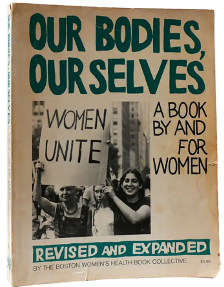
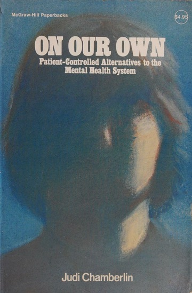
Book covers: Our Bodies, Ourselves: A Book By and For Women, Revised and Expanded Edition (1979), by the Boston Women’s Health Book Collective; and On Our Own: Patient-Controlled Alternatives to the Mental Health System, by Judi Chamberlin. Used under fair dealing for the purposes of research and education.
These health movements expanded the jurisdiction of health to a widening array of functions governed by personal and public life, and placed people at the centre of lifestyle choices and habits to manage their health. Individuals were tasked with making health choices in the face of broader cultural conditions and considerations, such as advertising, food availability, environmental factors, disease agents, and more.

Reflection Moment
Take a moment to reflect on these developments in global health promotion. Consider the following questions:
- How did the Ottawa Charter for Health Promotion understand or expand the concept of health? How does it situate the role of the public in administering health management?
- What do you see as some of the potential positive and negative impacts of the “new health consciousness”?
- What do you think were the impacts of these public health movements on people with disabilities?
Organizations responsible for promoting and protecting public health through policies, programs, and services aimed at improving the overall health of the community.
The United Nations agency that connects nations, partners and people to promote health so that everybody can attain the highest level of health.
A social movement that aims to improve the health and well-being of women through advocacy for healthcare reforms and awareness of gender-specific health issues
A social movement that advocates for the rights of individuals who have experienced psychiatric treatment and challenges the stigma of mental illness