Part 3. Community Action and Representation
9. Towards Food Sovereignty for Black Communities in Toronto: Rights, Self-Determination, and the Pursuit of Justice
Mayet Zegeye; Anan Lololi; Queen Zawditu Selassie; and Winston Husbands
Abstract
Black communities in Canada experience exceptionally high rates of food insecurity, yet their experiences are often marginalized within mainstream discourses about food policy and research. This chapter argues that food insecurity among Black communities is not merely a problem of insufficient income. Instead, grossly insecure access to food is embedded within a social system that undermines Black people’s wellbeing broadly. Systemic anti-Blackness imposes a crisis of wellbeing on Black communities when, for example, Black people and their livelihoods are effectively excluded from land ownership, food production, and decision-making about food access and Canadian food systems. Drawing on the history of the Afri-Can FoodBasket (AFB), the chapter traces the evolution of Black-led responses to food insecurity in Toronto from emergency food access initiatives to a broader movement for food sovereignty. It documents how the AFB’s work in promoting access to food through urban agriculture, the food basket program, leadership development, food policy advocacy, and community organizing laid the foundation for the Toronto Black Food Sovereignty Plan and the subsequent establishment of the Black Food Sovereignty Alliance. The chapter positions food sovereignty as both a strategy and a process through which Black communities challenge structural inequities to assert stewardship over food systems for community wellbeing. It concludes that achieving Black food sovereignty requires dismantling systemic barriers, strengthening Black leadership in food governance, supporting Black farmers and food entrepreneurs, and ensuring community leadership of policy development and implementation. The Toronto experience demonstrates how community-led food sovereignty can advance racial justice, self-determination, and more equitable food systems while offering lessons for broader efforts to address structural inequities.
I – Introduction
Black families and households are far more likely than white Canadians, or even people from other ethno-racial groups in Canada, to experience insecure access to food. Latest estimates suggest that almost half of Canada’s Black population lives in food-insecure households, the highest rate among households in Canada classified by “racial/cultural identity and Indigenous status” and twice the rate of the white population (PROOF, 2025). Indeed, the problem has persisted for many years and appears to be growing. Yet, among the institutions and individuals aware of this situation and considered experts on food insecurity, there is a notable lack of informed discussion and urgency to address the problem. Most often, Black people’s struggles to acquire food of sufficient quantity and quality are discussed as an adjunct of a general problem of food insecurity, and Black communities are typically excluded from discussions about the issue. The people and organizations that have taken up the challenge of responding meaningfully to food insecurity among Black communities are unheralded, unknown, and written out of the narratives about research, policy, and action.
In reality, there is little evidence of a persistent, systemically entrenched problem of food insecurity among Canada’s population as a whole. There is, instead, clear evidence of exceptionally insecure access to food among certain structurally disadvantaged populations, which represents a crisis among Black communities in particular. Black communities, largely on their own and with meagre resources, have begun to champion food sovereignty as a process, strategy and goal to fundamentally overturn the challenge of food access and address their exclusion from any meaningful role in Canadian food systems or discourses about those systems. Black communities have been articulating a movement to exercise stewardship over food systems for their benefit (Garth & Reese, 2020), which also disrupts the power that private and public institutions and allied elites exert over Black livelihoods and wellbeing (Husbands et al., 2026).
In this chapter, we first problematize food insecurity among Black communities in Canada (Section II). Then, drawing on the experience and leadership of the Afri-Can FoodBasket, we discuss the evolution of ideas, community-based initiatives, and institutional structures that have informed the goal and strategy of food sovereignty for Black communities in Toronto (Section III). Finally, in Section IV, we outline strategic considerations to inform how ideas and initiatives related to food sovereignty remain centred among Black communities.
II – Anti-Blackness, Systemic Inequity, and Access to Food
Food Insecurity – A Crisis Imposed on Black Communities
In Canada, standard measures of health and wellbeing indicate that Black communities are severely disadvantaged. The depth and persistence of this disadvantage confirm that it is systemic and institutional, rather than a temporary disruption of otherwise equitable outcomes (Husbands et al., 2026). Credible data clearly illustrate this systemic disadvantage. For example:
- Black people earn significantly lower incomes than their white counterparts with similar levels of education, which does not diminish with age (Banerjee et al., 2024).
- Black people experience exceptionally high rates of poverty, which persists across generations (Banting & Thompson, 2021).
- Black people are more likely to experience insecure housing (Lewis & Moriah, 2024; Lewis et al., 2026).
- Black people account for about three of every ten new HIV diagnoses in Canada, and four of every ten new diagnoses in Ontario, though Black peoples make up just 5% and 7% of respective national and provincial populations; for the past 20 years, the share of diagnoses among white Canadians has been falling steadily, while the burden of the epidemic increases among Black communities. Black women make up almost half of all diagnoses among women in Canada (Ontario HIV and Epidemiologic Surveillance Initiative, 2025; Public Health Agency of Canada, 2025).
Canadian policymakers have been largely impervious to calls for transformative action to strengthen Black people’s health and wellbeing. This means that the Canadian state, through its network of institutions, has imposed a crisis in health and wellbeing on Black communities. Why else would insecure access to food among Black individuals and families, which is already excessive compared to other ethno-racial groups (but especially compared to white Canadians), be getting worse? Canadian intellectual elites and decision-makers have normalized hunger among Black communities by citing it in various publications, but without a sense of urgency to address it. At the same time, Black communities and stakeholders have to struggle for attention from the same intellectual leaders and decision-makers who have the capacity to shift the discourse and mobilize resources in favour of transformative action.
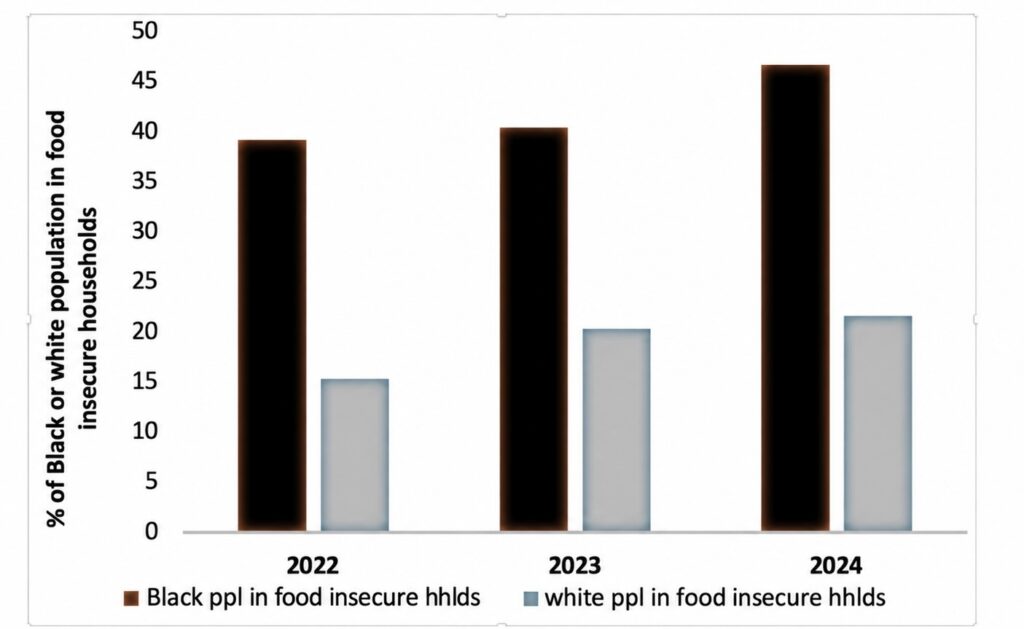
So, what does the data about food insecurity say? As Figure 1 demonstrates, the rate of food insecurity among Black people is about twice the rate for white people, and access to food is becoming even more inequitable. Food insecurity is particularly widespread among lone mother families but, here too, the difference between Black and white families is extraordinary: six of every ten Black lone mother families were food insecure in 2021, versus 40% of similar white families (Uppal, 2023). The same pattern holds among high-income persons: close to one-fifth of high-income Black families were food insecure in 2021, compared to just 5% of non-racialized non-Indigenous families (Uppal, 2023). In 2022, almost half (46%) of Black children lived in food-insecure households, compared to 19% of white children (Li et al., 2023). In Toronto, one in five people who received emergency food assistance from the Daily Bread Food Bank (the largest in Toronto) identified as Black, though Black people make up less than 10% of the city’s population (Murphy et al., 2025).
For decades, especially since the expansion of food banks 50 years ago, experts have proposed conventional remedies to address hunger and food insecurity in Canada. These proposals, designed to ensure that food will be accessible and affordable, include: access to stable employment at ‘decent’ wages (i.e., food insecurity is an income problem); affordable housing; better access to healthcare; and reform of social assistance, employment insurance, and other programs that constitute the so-called social safety net. Over the years, federal and provincial governments, backed and encouraged by the favoured intellectual elite, have implemented a patchwork of policies to address insecure access to food and have proposed more of the same (PROOF, 2022; Saul & Rezaee, 2026; Tarasuk & McIntyre, 2025). However, by refusing to engage the structural disadvantage that anti-Black racism produces, the proposals and reforms have not troubled the entrenched forces and institutions that exacerbate food insecurity among Black communities and generally work against Black people’s health and wellbeing.
Figure 1: Share of Black and White Population in Food Insecure Households (Li et al., 2023; PROOF 2024, 2025)
Anti-Black racism undercuts the popular idea that food insecurity is mainly a symptom of low income, bad social assistance, and other ‘variables’ that constitute liberal orthodoxy. In fact, “being racialized as Black appears to be an overriding factor shaping vulnerability to food insecurity for the Black population in Canada” (Dhunna & Tarasuk, 2021, p. 1). Therefore, in opposition to orthodox interpretations of food insecurity, we propose that the intersecting inequities undermining Black livelihoods and wellbeing (e.g., food insecurity, unemployment, low income, and so on) emerge from systemic anti-Blackness. How else would food insecurity be significantly more widespread among high-income Black families than their white counterparts? For Black communities, food insecurity and related inequities constitute an enduring system of race-based harm or injustice rather than a side effect of economic trends.
At the end of the day, conventional approaches to managing food insecurity that are not calibrated to address anti-Blackness will reproduce injustice and inequity. Refusing to seriously acknowledge and address anti-Black racism suggests complicity in reproducing the forces that undermine Black livelihoods.
Black Farmers and Systemic Injustice
Black people have a long history of farming as independent farmers in Canada. Although it is poorly documented, evidence suggests Black farmers were active in Ontario since the early 19th century (Ecological Farmers Association of Ontario [EFAO], 2026). For example, Black veterans of the War of 1812 were granted land in Oro Township (near Barrie); however, in keeping with racist policy and practice, the land was poorly suited for farming. The EFAO (2026) further states that close to 2,000 Black farming families already lived in what was called Queen’s Bush, present-day Waterloo and Wellington Counties, in the 1820s.
Despite the long history, Black farmers constituted less than 0.1% of Canadian farm operators in 2021 (The Enough Initiative [TEI], 2025). This extreme underrepresentation indicates systemic exclusion of Black people from owning or operating farms in Canada. This unfortunate circumstance should be understood in the context of “settler-colonial land regimes, anti-Black racism in financial institutions, and the lack of culturally specific agricultural education” (Future Farmers, n.d.; Pitch Better Inc., 2024; TEI, 2025).
Currently, Black farmers and farming organizations are collectively increasing Black representation in farming. Many of them are engaged in urban farming, such as the Toronto Black Farmers and Food Growers Collective, Afri-Can FoodBasket Ujamaa Farm, Ubuntu Community Farm, Agape Farms (Farmgates), Akachi Farms, Deeper Roots Farm, Eager Bee Gardens, and Sarn Farm, among others [see Ontario Farmland Trust (2025) for a list of such farms]. According to a recent report (Pitch Better Inc., 2024), about 58% of Black farmers in Canada are found in Ontario, followed by 11% in Alberta. The same source notes that 54% of Black farmers owned their farms, but their plots were small.
Opportunities for Black farmers to make their produce available to Black communities are limited. Few Black-led or Black-oriented outdoor produce markets exist in Canada. According to its organizers, the Afro-Caribbean Farmers’ Market in Toronto’s Little Jamaica may be the first market organized by an ethno-cultural group in Toronto. The market began in 2017 in the Jane Street/Wilson Avenue area and relaunched in Little Jamaica in 2021 (Callan, 2022). By then, 18 vendors participated, selling fresh produce and cultural foods grown by local Black farmers, as well as fruits and vegetables imported from the Caribbean (Callan, 2022). Markets matter not only for buying and selling produce, but also as sites of cultural expression and integration into wider society.
Over the generations, many immigrants from Africa and the Caribbean come from cultures and families with a long history of food production, either for trade or household consumption. However, many Black immigrants lack the financial resources or access to capital to acquire land and become farmers. They may also lack the skills and networks needed to enter or succeed in farming in Canada. Prospective Black farmers have been disadvantaged in accessing formal and experiential knowledge about agriculture. Systemic anti-Black racism has historically excluded and marginalized Black communities in the Canadian education system and thus has limited their opportunities for formal education, including in agricultural professions (Pitch Better Inc., 2024). On the other hand, traditional African and diasporic systems of knowledge exchange have been devalued and marginalized. On the whole, prospective Black farmers have always faced interlocking inequities that severely restricted their ability to acquire land and produce food. Ironically, though Black people have been effectively prohibited from owning or operating farms, the Canadian farm economy has thrived through the generational exploitation of Black farmworkers (Allahdua, 2023; Elsharkawy, 2023).
III – Community Responses: From food Security to Food Sovereignty
The Afri-Can FoodBasket (AFB) is a pioneering non-profit organization that has worked on urban agriculture and food security for Black communities in Toronto since 1995. Because this work has not been extensively documented, this section draws in part on semi-structured interviews with Anan Lololi, a co-founder of the AFB and a pioneer in mobilizing Black communities in response to chronic food insecurity. He co-founded the AFB in 1995 and held a leadership role until 2022. Anan was also one of the first food movement leaders in Toronto to articulate and advocate for food sovereignty as a policy and community-based strategy to address chronic food insecurity among Black communities in Toronto and throughout Canada. Indeed, Toronto’s Black Food Sovereignty Plan resulted from Anan’s leadership of the AFB and the Black Food Sovereignty Working Group (BFSWG) in organizing a series of community conversations among Black communities in Toronto that raised awareness of food sovereignty, and his advocacy for food sovereignty among the Confronting Anti-Black Racism Unit at the City of Toronto.
The Afri-Can FoodBasket
In the early 1990s, in response to serious food insecurity among Black communities in Toronto, Anan and Anyika Tafari secured provincial funding to launch the AFB. With volunteers from their community, they established the AFB to address food insecurity and the high import costs of fresh, culturally appropriate foods for Black communities in Toronto. It was established as a Community Food Cooperative, a bulk-buying, community-based service to lower costs for members of the Black community. The high cost and uncertain availability of nutritious, culturally appropriate foods were critical challenges to Black communities, as staple foods were imported from the Caribbean, Central and South America, and Africa, which placed a heavy financial burden on low-income Black households. In its early years, the AFB had a single staff member (Anan) responsible for administration, purchasing, distribution, and warehousing. However, the emerging community-based agency benefited from a robust network of volunteers, including the board of directors, drivers, and packers, among other roles. Since its establishment, the AFB has functioned as a non-profit organization while also operating in line with cooperative principles. Thus, members purchased shares through monthly basket subscriptions, originally choosing between a small basket at $15 or a large basket at $25, with some members paying for annual subscriptions. Despite the commitment of the founders and volunteers, funding was a major challenge during the AFB’s formative years. The organization faced a formidable challenge in attracting funding from private institutions and governments that doubted the viability of Black-led non-profit organizations at the time. At times in the early years, the organization operated solely through volunteers.
Evolution and Expansion of the AFB
At its inception, the AFB was most likely the first Black food systems organization in Toronto. Before the AFB, responses to Black food insecurity took the form of general food assistance programs that emerged whenever food insecurity affected communities, such as food banks, community kitchens, and food buying clubs that emerged in the 1980s. Organizations like FoodShare and Daily Bread Food Bank (along with its network of local organization members) worked in this model. This approach was (and remains) problematic for several reasons. Food banks and related agencies represent a charitable response to a systemic and structural problem. They lump together all food-insecure communities as though food insecurity across diverse communities is amenable to a single response. Food charities, which continue to dominate the response to hunger and food insecurity, generally are disengaged from the systemic and institutional process of anti-Blackness. Moreover, affected communities generally have no leadership or decision-making role in the networks or organizations that sustain the food charity response (Regnier-Davies & Edge, 2025). Food charities may also be incapable of the culturally nuanced response that Black communities deserve. The AFB was, therefore, intended to address food insecurity in the context of the systemic and institutional forces that precipitate food insecurity among Black communities.
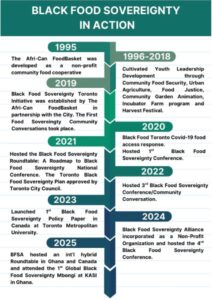
Initially, discussions about community food security at the Center for Studies in Food Security (CSFS) at Toronto Metropolitan University in the late 1990s triggered the AFB’s evolution and diversification beyond its original limited mandate (see Figure 2). As a concept, community food security promoted access to culturally appropriate, healthy, and nutritious food as a right, and emphasized food policy and community-engaged responses (e.g., community gardening, farming, nutrition programs, community kitchens, and cooking programs). This suite of ideas provided important lessons for the AFB to diversify its activities and programs.
Figure 2: Afri-Can FoodBasket Timeline
Apart from the spark provided by discussions in the CSFS, the diversification of the AFB’s interests and programs was also dictated by the breadth and scale of food insecurity among Black people in Toronto (as discussed earlier). This meant that the organization had to stretch its limited resources to expand and diversify across different activities, including backyard and school garden initiatives, urban farming, food policy advocacy, food justice, cooking, and youth and adult leadership development. The intention was that Black communities needed representation among decision-makers at all levels in conversations about food security. This context also shaped the AFB’s leadership in articulating and advocating for food sovereignty.
Subsequently, the AFB expanded its focus to include urban agriculture and community gardens, under the Afuye Food Program (named after the Akan word for gardening or farming), which engaged young people in urban agriculture. The name was intended to mark the AFB as African-centred, provide a historical perspective for people of African descent, and be rooted in broad Pan-Africanism. While gaining experience with the Afuye program, the organization launched its inaugural strategic development initiative – a training program called Roots to Fruits. This program brought together key people who would shape the organization’s course for many years. As a team demonstrating complementary expertise and experience, they established the four pillars of the AFB: food policy, food systems and urban agriculture, African-centred programming, and environmental sustainability. These remained the AFB’s main pillars for the next three decades.
In implementing the Roots to Fruits program, the AFB expanded into urban farming, beginning with the Ujamaa Learning Farm, where it trained youth and adults in farming and leadership. The AFB made backyard, schoolyard, churchyard and urban farming its main activities. The Ujamaa Farm farmers’ collective, started around 2000, has run to the present as an incubator farm program engaging prospective Black urban farmers. Several people who graduated from the program are still farming; some have purchased their own farms, while others work with other farmers.
Making Food Sovereignty a Community Priority
We understand food sovereignty as a process and strategy through which communities exercise stewardship of the food system in their own interests and to meet their needs for access to food of appropriate quality and quantity, in socially and ecologically sustainable ways (Elsharkawy, 2023; Food Secure Canada, n.d.; La Via Campesina, 2008; Nyéléni International Steering Committee, 2007).
Communities that pursue food sovereignty are concerned with understanding how they are disadvantaged by the food system, and taking steps to ensure that the food system works in their interest (i.e., exercising stewardship over the food system to meet their needs) (Elsharkawy, 2023, p. 4).
Food sovereignty among Black communities establishes Black people’s leadership in the processes and strategies for achieving and managing food sovereignty.
The food cultures of Africa and African diasporas in the Americas and elsewhere have centuries of knowledge and practice embedded within them, but in North America they are systematically marginalized in the dominant capitalist food system. In this context, Black food sovereignty is to some extent a recuperation of African foodways that predate colonization. This perspective suggests that food sovereignty is not a new idea to African and African-descended peoples. So, the AFB’s transition from an exclusive focus on food security to institutionalizing food sovereignty was intentional.
Though the AFB took up the challenge of exploring food sovereignty after 2010, the organization may have been moving in that direction since the late 1990s. The organization intentionally designed and promoted its programs by and for people of African descent. Therefore, the principle of food sovereignty, which places responsibility as well as authority on communities to define and ensure their own food security, became the central framework for the AFB to engage people of African descent about collective food security.
In 2019, FoodShare, in partnership with PROOF, released a fact sheet that publicized a glaring inequity in access to food among Black people, especially Black children (FoodShare, 2019). This marked a turning point for the AFB, strengthening its focus on food sovereignty as an urgent community priority under Black leadership. The report and sharper focus on food sovereignty also created an opportunity for the AFB to engage the City of Toronto in conversations about the possibilities for a food sovereignty plan for Black communities. The City of Toronto had recently established the Confronting Anti-Black Racism (CABR) Unit and issued an Action Plan to confront anti-Black racism (City of Toronto, 2017). It was a five-year plan designed to leverage the talents, knowledge, experiences and capacities of Black people and Black organizations as partners in strengthening the quality of life of Black Torontonians. The action plan included 22 recommendations and 80 actions across five themes: children and youth development, health and community services, job opportunities and income support, policing and the justice system, and community engagement and Black leadership.
In 2019, the AFB was invited to meet with CABR to explore how it could help implement the Action Plan. Attention was drawn to Recommendation 8 in the Action Plan, which called for improved food access for low-income Black Torontonians and for anti-Black racism analysis to improve the programming of the Toronto food strategy and agricultural program. That particular recommendation further encouraged the AFB to sharpen its advocacy on food sovereignty, which the AFB had already been exploring as the viable strategy for substantively addressing the crisis of food insecurity among Black communities. The AFB proposed holding consultations with Black communities to discuss the food insecurity crisis and the possibilities for food sovereignty as a community-driven policy response, and the City agreed. Subsequently, consultations were held in the east and west ends of Toronto in 2019, but others were suspended because of the COVID-19 outbreak. Nonetheless, the AFB delivered a report to the City on its conversations with Black stakeholders and community members. The BFSWG emerged from that community consultation process and brought together stakeholders from different but complementary areas of interest – food policy, farming, gardening, cooking, nutrition, and academia – to engage Black communities, CABR and policymakers about the potential for food sovereignty to address chronically insecure access to food. Overall, the AFB played a critical leadership role in engaging Black communities about the meaning and possibilities of food sovereignty, and in harnessing community interest and enthusiasm to advocate for and lobby for the City of Toronto’s Black Food Sovereignty Plan.
The City of Toronto officially adopted the Black Food Sovereignty Plan in 2021 and launched it as a City initiative in 2022 (City of Toronto, 2021a, 2021b, 2023). A year later (in November 2023), the BFSWG collaborated with the Faculty of Arts and the Centre for Studies in Food Security at Toronto Metropolitan University to introduce Black and academic communities to the BFSWG’s recently published policy-oriented paper on food sovereignty (Elsharkawy, 2023) and, by extension, the Black Food Sovereignty Plan.
The Plan is billed as a “community-led Confronting Anti-Black Racism Unit Plan to address chronic food insecurity, anti-Black racism and structural inequity in Toronto’s local food system to create immediate and long-term change to improve the health, wellbeing and capacity of Black Torontonians” (City of Toronto, 2021b, p. 15). The Plan has also been described in previous CABR communications as “community-led, municipally supported.”
In 2024, the BFSWG transitioned to the Black Food Sovereignty Alliance (BFSA) to promote food sovereignty in dialogue with, but independent from, the City’s Confronting Anti-Black Racism Unit. The BFSA is envisioned as an independent community voice, working on behalf of community interests collectively, to advocate for the Plan’s implementation, and food sovereignty more generally, in ways that benefit Black communities, and enable continued and substantive Black community involvement in the Plan and related initiatives (Black Food Sovereignty Alliance, 2024). In short, the BFSA will help ensure the Plan does not become another government program severed from the communities that advocated for it and whose interests are supposed to be paramount.
IV – What Difference will Food Sovereignty Make for Black Communities
As demonstrated above, Black families, households, and individuals are way more likely than their white counterparts to experience insecure access to food – food insecurity is a chronic problem for Black communities. The standard toolbox of policy options to reduce food insecurity may help Black people to some extent, but will not close the glaring inequity that separates Black and white families. In other words, though the standard policies to improve incomes, jobs and social assistance may bring some relief, these will be insufficient for eliminating the intersecting inequities that undermine Black livelihoods and well-being. Anti-Blackness is rooted in the social structure that was engineered to reproduce it. Therefore, food sovereignty should be understood as a strategy and goal for Black communities to disrupt anti-Black racism and incubate a food system that eliminates persistently insecure access to food. We are suggesting that a process for pursuing and institutionalizing food sovereignty for Black communities must be part of a wider strategy to disrupt anti-Blackness and cut through the intersecting inequities that have always undermined Black life in Canada.
Food sovereignty will probably remain merely aspirational unless Black communities design and implement a progressive agenda to understand and confront the societal forces that thwart Black aspirations. While food constitutes an urgent and important dimension of our struggle for Black wellbeing, our future is not reducible to conventional arguments about access to food. Black communities should be wary of dissipating our enthusiasm and energy over issues that others prioritize while they sidestep the race-based harm that arises from systemic and institutional anti-Blackness.
The Canadian social structure privileges whiteness and undervalues Blackness. The legion of conventional disparities suggests that, in relative terms, whiteness attracts a reward while Blackness incurs a cost. Food sovereignty encapsulates this basic understanding – that poor access to food is not merely an income problem or an unemployment problem, because Black people already have chronically low income and high unemployment compared to white Canadians. Therefore, food sovereignty entails a reordering of the food system to meet Black people’s needs. How far food sovereignty can deliver on its promise depends on conceptual and strategic clarity about its potential and the challenges it entails (Elsharkawy, 2023).
Several strategic considerations may be necessary to secure the foundations of food sovereignty for Black communities. First, leading stakeholders and scholars must provide intellectual support by critically reviewing the concept and process. This will clarify understanding and inform the process as it unfolds. Second, Black communities are primary constituents in achieving food sovereignty. A process that is captured by Black elites or allies to advance their own narrow interests will fail. No substitute exists for intentionally engaging communities to drive food sovereignty for the collective good. Third, Black stakeholders must insist on a leadership role in all areas of public policy that affect Black people’s access to food and their investment in food sovereignty. Fourth, Black scholars must be mobilized to develop, test, implement and monitor interventions that will inform and support the movement toward food sovereignty.
V – Conclusion – A Renewed Beginning
“Achieving Black Food Sovereignty is contingent on dismantling systemic barriers” that undermine Black livelihoods and wellbeing (Elsharkawy, 2023, p. 23). But achieving food sovereignty and dismantling systemic barriers to Black wellbeing require inspired community-oriented leadership from Black communities to engage their constituents and constructively challenge the public and private institutions that mobilize their authority and resources to regulate health and wellbeing in Canada.
Acknowledgements
A special thanks to all the people whose efforts over many years helped develop a combined 3B awareness (i.e., Black-led, Black serving, and Black-mandated) to articulate, defend, and promote food sovereignty for Black communities.
References
Allahdua, G. (2023). Harvesting freedom: The life of a migrant worker in Canada. Between the Lines.
Banerjee, R., Adjetey, W., & Reitz, J. (2024, April 11). Here’s how to fix Black Canadians’ worsening economic disadvantage. The Globe and Mail.
Banting, K., & Thompson, D. (2021). The puzzling persistence of racial inequality in Canada. Canadian Journal of Political Science/Revue canadienne de science politique, 54, 870–891.
Black Food Sovereignty Alliance. (2024). Black Food Sovereignty Alliance strategic plan.
Elsharkawy, O. (2023). Food sovereignty for Black communities in Toronto: Challenges and policy opportunities [PDF]. Black Food Sovereignty Working Group.
Callan, I. (2022, July 3). Afro-Caribbean farmers’ market opens in Toronto’s Little Jamaica. Global News.
City of Toronto. (2017). Toronto action plan to confront anti-Black racism [PDF].
City of Toronto. (2021a). Toronto Black Food Sovereignty Plan: Report for action [PDF].
City of Toronto. (2021b). Appendix A: Toronto Black Food Sovereignty Plan [PDF].
City of Toronto. (2023). City of Toronto Black Food Sovereignty Plan year 1 update [PDF].
Dhunna, S., & Tarasuk, V. (2021). Black–white racial disparities in household food insecurity from 2005 to 2014, Canada. Canadian Journal of Public Health, 112(5), 888–902.
Ecological Farmers Association of Ontario. (2026). Rooted in resistance: Honouring Black farming communities in Ontario.
Food Secure Canada. (n.d.). What is food sovereignty?
FoodShare. (2019). Race and food security. PROOF.
Future Farmers. (n.d.). The challenge of food sovereignty for Black farmers in the Greater Toronto Area [PDF].
Garth, H., & Reese, A. (Eds.). (2020). Black food matters: Racial justice in the wake of food justice. University of Minnesota Press.
Husbands, W., Antabe, R., & James, C. (2026). Black emancipation and the burden of Canada’s HIV epidemic among Black communities. Journal of Racial and Ethnic Health Disparities.
La Via Campesina. (2008). Food sovereignty for Africa: A challenge at fingertips.
Lewis, N., & Moriah, A. (2024). Barriers to Black homeownership in the Greater Toronto and Hamilton Area. Canada Mortgage and Housing Corporation.
Lewis, N., Panou, D., & Maaranen, R. (2026). Financialized violence in Toronto’s rental market: Eviction rates in majority Black renter communities. International Journal of Urban and Regional Research, 50, 667–690.
Li, T., Fafard St-Germain, A. A., & Tarasuk, V. (2023). Household food insecurity in Canada, 2022. PROOF.
Murphy, L., Jhamb, B., Butler, R., & Shuvra, M. (2025). Who’s Hungry Report, 2025 [PDF]. Daily Bread Food Bank & North York Harvest Food Bank.
Nyéléni International Steering Committee. (2007). Forum for food sovereignty.
Ontario Farmland Trust. (2025). Celebrating Black farms and farming organizations in Ontario.
Ontario HIV Epidemiology and Surveillance Initiative. (2025). HIV diagnoses in Ontario 2023.
Pitch Better Inc. (2024). Africulture: A national study on Black farmers.
PROOF. (2022). Food insecurity: A problem of inadequate income, not solved by food.
PROOF. (2024). New data on household food insecurity in 2023.
PROOF. (2025). New data on household food insecurity in 2024.
Public Health Agency of Canada. (2025). HIV in Canada: Surveillance report to December 31, 2023. https://www.publications.gc.ca/site/eng/9.928773/publication.html [PDF]
Regnier-Davies, J., & Edge, S. (2025). Harnessing food system equity from the ground up: Shifting co-governance practices in the funding of food security responses during the pandemic crisis in Toronto, Canada. Food, Culture & Society, 28(4), 1012–1034.
Saul, N., & Rezaee, J. (2026, August 3). Canada’s new food security strategy won’t end food insecurity: The strategy largely overlooks the single biggest contributing factor: Inadequate incomes. The Globe and Mail.
Tarasuk, V., & McIntyre, L. (2025). The evidence is in: Accountability needs to be injected into the policy-making process for household food insecurity reduction. Health Promotion and Chronic Disease Prevention in Canada, 45(9), 386–390.
The Enough Initiative. (2025). Advancing food sovereignty for the Black community in Canada—Towards equitable, sustainable, and culturally rooted agrifood systems.
Uppal, S. (2023). Food insecurity among Canadian families. Statistics Canada.