Part 2. Policy and Practice
5. From Charity to Justice: Using Arts-Based Knowledge Mobilization and Research Creation for Effective Food Insecurity Solutions
Elaine Power; Amanda White; Jennifer Brady; Jennifer Black; and Dian Day
Abstract
Despite decades of evidence demonstrating that household food insecurity is fundamentally a consequence of inadequate income, Canadian governments continue to rely on charitable food assistance rather than structural policy solutions. This chapter argues that advancing more effective responses requires not only strong evidence, but new approaches to public engagement capable of shifting political will and policy. Drawing on theories of policy change, political economy, and knowledge mobilization, the chapter examines why food charity has become entrenched as the dominant response to food insecurity despite its well-documented limitations. It proposes arts-based knowledge mobilization (ABKM) and research-creation as innovative strategies for reframing public understandings of appropriate responses to food insecurity from charity to justice. Through the Hungry Stories project—a collaborative initiative involving scholars, artists, and writers that centres on a graphic novel for young readers—the chapter illustrates how creative storytelling can challenge dominant narratives, foster empathy, stimulate critical reflection, and encourage civic engagement around income-based solutions, including a guaranteed livable basic income. Reflections on the project’s development also highlight the opportunities and challenges of interdisciplinary collaboration between researchers and creative practitioners. The chapter concludes that arts-based knowledge mobilization can complement traditional research dissemination by expanding public imagination, cultivating political engagement, and strengthening advocacy for structural policy responses that address the root causes of food insecurity rather than its symptoms.
I – Introduction
Food insecurity in Canada worsened for the third year in a row in 2024, setting another record and increasing by almost 70% since 2021 (PROOF, 2025). In 2024, 25.5% of the population, or almost 10 million Canadians, and 1 in 3 children lived in food-insecure households, compared to 15.9% or 5.8 million in 2021 (PROOF, 2025). Despite a significant accumulation of scientific evidence that food insecurity is a symptom of material deprivation, responsive to increases in household income, the rising rates of food insecurity show that the federal and provincial governments are not using that evidence to inform public policy to promote public health Rather, governments have relied on and supported charitable responses, notably food banks, which evidence shows are patently inadequate and ineffective (Loopstra, 2018). Most Canadians who are food insecure never visit a food bank, and even those who do are still food insecure (Tarasuk et al., 2020). Visits to food banks have soared as food insecurity has risen, and food banks have been unable to keep up with demand (Food Banks Canada, 2024). Food Banks Canada’s 2024 Hunger Report declared that the need for their services is “spiralling out of control,” with almost 30% of food banks reporting that they have run out of food. Others are restricting the amounts of food they give to clients and how often clients can visit (Food Banks Canada, 2024). A recent Maclean’s article asked, “Why are Canada’s food banks collapsing?” (Cameron, 2025). Food banks themselves are increasingly joining public health scholars, advocates, and practitioners in calling for governments to address low household incomes in response to this public health emergency (Food Banks Canada, 2024).
In this chapter, we lay out a theory of political change adapted from Baumgartner and Jones (2009) that identifies pressure points that could support a radical public policy shift in responses to food insecurity, from food charity to enhanced income security. We focus on income as a root cause of food insecurity that cuts across all 5As—availability, accessibility, adequacy, acceptability, agency—of the Centre for Studies in Food Security’s (CSFS) framework for food security (Centre for Studies in Food Security, n.d.). We recognize that reducing food insecurity by addressing the adequacy of household income is just one dimension of promoting food security (McIntyre, 2011), a multi-faceted condition, which is the broader goal of the CSFS. We then describe a case study from our collaborative research project, Hungry Stories, that is using arts-based knowledge mobilization (ABKM) to increase public awareness and engagement about food insecurity and effective policy solutions, foster capacities for leadership and advocacy among the public, and envision new scholarly approaches for increasing public and political will for change.
II – Background
A direct import from the United States, Canada’s first food bank was established in Edmonton in 1981 (Riches, 1986). Food banks spread quickly across the country in the 1980s. Early Canadian food banks were intended as a short-term “emergency” response to an acute economic downturn. Their founders expected them to disappear once the economy recovered and shifting political currents saw governments recommit to supporting citizens’ well-being (Riches, 1986). Unlike the US, where food has been seen as the primary solution to hunger for almost a century (Poppendieck, 1995), Canada historically understood hunger primarily as a symptom of the larger problem of poverty (Power, 2017). For example, during the Great Depression, the Canadian federal government addressed hunger by mounting relief programs to increase household incomes (Power, 2017). In contrast, the US government set up its first food stamp program during the Great Depression, primarily to support agricultural producers, with the secondary benefit of feeding hungry Americans (Poppendieck, 1995).
Contrary to founders’ expectations, the political and cultural context for discussions of hunger and food insecurity began to shift in Canada during the 1980s with the arrival of neoliberal[1] political ideology (Riches, 1986). The entrenchment of neoliberalism and the spread of food banks across the country coincided as governments reoriented to serve business rather than citizens’ interests, while driving down tax rates, shredding the social safety net, and passing responsibility for formerly public services to individuals, families, and community organizations (Bryant, 2015). By the 1990s, food banks had become institutionalized (Tarasuk & Maclean, 1992) and the default or “common sense” response to hunger and food insecurity (Riches, 2018). Despite decades of data showing that food banks do little to redress food insecurity, the idea that they might—or should—close in favour of effective and equitable public policy had become almost unimaginable (Mendly-Zambo & Raphael, 2025; Power, 2017).
The founders of food banks may have been well-intentioned in the face of an economic downturn in the 1980s, when many Canadians were thrown out of work, and the cost of living was very high. Still, the persistence of food banks has had many unintended consequences (Hetherington & Power, 2025). By their very existence, food banks have inadvertently lulled the public into believing that hunger is being taken care of, taking the pressure off governments to implement public policies that address the root causes of food insecurity, namely inadequate income. In contrast, as a volunteer- and donation-driven community response to reduced government spending on social supports, food banks are emblematic of neoliberal social policy (Mendly-Zambo & Raphael, 2025; Riches, 2018). Food banks have also become a convenient outlet for the capitalist, industrial food system to dump its deliberate overproduction, while giving the appearance of addressing environmental goals and reducing hunger (Power, 2025). Ubiquitous food drives, from CBC Radio’s “Sounds of the Seasons” to school-based food drives, to numerous corporate food bank philanthropy campaigns (e.g., Purolator’s “Tackle HungerTM,” Walmart’s “Fight Hunger, Spark ChangeTM”), seek to convince us that if we toss a few more tins into the donation bin, we can “help hunger disappear.” These campaigns give corporations opportunities to use philanthropy to demonstrate that they are “good citizens,” distracting us from more effective solutions that would involve tax reform and income redistribution (Livingstone & Natarajan, 2025). Perhaps even more insidiously, these campaigns help shape individuals into neoliberal citizens who take responsibility for the problem and no longer expect governments to address the root causes of food insecurity (Riches, 2002).
Scholars have become more vocal in condemning corporate involvement in food charity, including their roles in framing the issue of hunger and food charity as a response, influencing public policy, and contributing to food insecurity through low-wages, part-time precarious employment, and anti-union activities (Azadian et al., 2022; Caraher & Furey, 2022; Lambie-Mumford & Kennedy, 2025a, 2025b; Mendly-Zambo et al., 2023). But the idea that food banks are the solution to food insecurity is pervasive, strongly held, and pernicious. The widespread integration of food banks into public conversations about addressing hunger, ranging from children’s early education to all forms of media, is an example of structural violence. Structural violence is defined as the invisible ways in which social inequality comes to seem “natural,” hiding the social and political origins of structural problems such as poverty, hunger, racism, and sexism (Farmer, 2004; Scheper-Hughes, 2004). The existence of food banks, and the idea that food is the solution to hunger, has hidden poverty as the cause of food insecurity, choking off the possibility of other solutions, and constricting our political imaginations (Power, 2017).
Many scholars, public health advocates, and food banks agree: a basic income guarantee [2] that covers the costs of basic needs would effectively reduce poverty and thus food insecurity in Canada (Food Banks Canada, 2023; Ontario Dietitians in Public Health, 2020; Tarasuk & McIntyre, 2025). Public awareness of and support for a basic income guarantee has become widespread, particularly since a short-term form of basic income, the Canada Emergency Response Benefit (CERB), was implemented during the early years of the COVID-19 pandemic, providing economic support for millions of Canadians (Swift & Power, 2021a). Although the Ontario Basic Income Pilot (OBIP) was prematurely cancelled [3] in 2018, by a newly elected Conservative provincial government prevented the planned robust evaluation, including measurements of food insecurity. The project’s careful design and the available evidence of its success have informed other basic income activities (Ammar & Laurin, 2025; Boadway et al., 2023; Ferdosi et al., 2023). These include a fully costed proposal to implement a basic income demonstration project in Prince Edward Island (Boadway et al., 2023) and a recent report from the federal Parliamentary Budget Office outlining the affordability of basic income (Ammar & Laurin, 2025). Though there is currently no sign that the federal or any provincial governments are planning to trial (again) or implement a broad-based basic income program, the national debate about its ability to reduce poverty and income insecurity (and thus food insecurity) remains lively (see, for example, the Coalition Canada basic income/revenu de base). The visibility of long lines of people waiting for food bank services, increasing strain on food banks’ ability to meet demand, media critiques of food banks (including Brown et al., 2022; Khaki et al., 2023), the call from food banks themselves for government action (Food Banks Canada, 2023), dramatically high rates of food insecurity, and Canadians’ interest in a permanent basic income (Swift & Power, 2021a) are among the signs leading us to believe that there may be an opportunity to shift public conversations about food insecurity solutions from charity to justice. For more information about a basic income guarantee in Canada and how to get involved in advocacy to support it, visit Basic Income Canada Network or the Basic Income Youth Collective.
Knowledge Mobilization for Healthy Public Policy
Public health practitioners and scholars have been criticized for “naïve” ideas of knowledge mobilization (KM) for policy change to promote social determinants of health (SDOH) and healthy public policy (Clavier et al., 2022). Following the widespread adoption of evidence-based practice in clinical medicine, many in public health assumed that providing high-quality evidence would be sufficient to inform and shift public policy for population health. Over the 21st century, Canada has seen “vigorous and sustained” scholarly activity showing the ineffectiveness of food charity in addressing food insecurity and supporting income-based policy interventions instead (Mendly-Zambo & Raphael, 2019, p. 535).
Public health academics and practitioners tend to favour consensus models of policy change, which assume that policy change is based on rational cost/benefit analyses (Bryant & Raphael, 2016; Clavier et al., 2022). Given the well-documented ill-health effects of food insecurity and the demonstrated costs to the health care system, an economic analysis of the costs of food insecurity, especially for children, suggests more attention should be given to reducing it. A political economy approach, which considers the power of different sectors to influence the state and takes account of how neoliberalism and power operate through the political system, makes more sense of the current stagnation in policy change for social determinants of health (Bryant, 2015; Coburn, 2010; Lambie-Mumford & Kennedy, 2025a; Raphael et al., 2022).
Taking neoliberal political ideology into account, a political economy analysis suggests that governments put powerful corporate and business interests ahead of promoting the public good. In the case of food insecurity, this includes undermining the tax base that would fund robust income security programs and keeping minimum wage rates below a liveable wage (Lambie-Mumford & Kennedy, 2025a, 2025b). In this analysis, public health is ineffective at influencing government policy because it has aimed its knowledge mobilization efforts at policymakers. In the policymaking arena, evidence that population health would improve with increased government funding for adequate household income runs counter to the dominant political ideology that governments are problematic and should make way for “market solutions” to social problems like poverty and food insecurity. But since there are no market solutions to the problems of poverty and food insecurity, because companies can’t sell goods and services to people without enough money, what used to be considered the responsibility of governments has been downloaded to community groups and individuals and their families. Activist public health scholars are increasingly recommending the mobilization of the public in democratic processes as the key to action on the social determinants of health (i.e., to put pressure on government to change public policy, counteracting the influence of the corporate sector) (Mendly-Zambo & Raphael, 2019; Raphael et al, 2022). Without an educated and mobilized public, governments can “avoid acting upon this evidence [supporting government action on the social determinants of health] since there are no political repercussions for doing so from an uninformed public” (Bryant & Raphael, 2016, p. 34).
A Theory of Policy Change
In their longitudinal studies of how public policies change, political scientists Baumgartner and Jones (2009) observed that political processes are usually characterized by stability and incrementalism, or very gradual change that does not disrupt the underlying model. Significant or dramatic change is less common but occurs when certain conditions are met (see Figure 1). These conditions include fundamentally questioning the current approach to an issue; the issue becoming more salient and attracting increased media and public attention; and new actors, such as the public, getting involved. Baumgartner and Jones (2009) add that major public policy changes are unlikely without public mobilization. Their research suggests that the public is best mobilized using stories that include both facts and emotional appeals.
Figure 1: “Large leaps” theory of change (Adapted from Baumgartner & Jones, 2009)
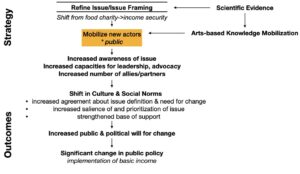
In shifting public policy for food insecurity solutions, we have observed an ongoing shift in the media’s presentation of the issue and policy solutions, a substantial advocacy movement for basic income, and increased public awareness. A key missing piece is a deeper understanding of the roots of the problem and mobilizing the public to advocate for change.
Shifting the dominant discourse about food insecurity to mobilize the public may be best accomplished using arts-based factual appeals to Canadians’ sense of compassion, decency, and fairness. As political philosopher Martha Nussbaum (2013) explains, liberal societies that aspire to justice must inspire and sustain their citizens’ commitment to difficult collective projects, including income redistribution, through the cultivation of appropriate public emotions—compassion, anger at injustice, hope for a better future—fostering “the ability to see full and equal humanity in another person, perhaps one of humanity’s most difficult and fragile accomplishments” (p. 3). As we are currently witnessing in our own country and others, the related challenge is to keep in check more destructive collective emotions, such as fear and hatred of others, which lead to their denigration and subordination.
The prevailing charitable response to food insecurity plays to people’s emotions by framing individual and corporate donors as “heroes” and “good citizens” who do “good works,” especially during sentimental holidays that many Canadians celebrate, such as Christmas and Thanksgiving. Moreover, food drives typically frame donating to food banks as fun, community-based initiatives that provide easy, tangible ways to help others in need. However, this framing obscures the structural causes of food insecurity and offers little incentive for the public to engage in the harder, longer-term work of advocating for policy change. Following Nussbaum (2010), who recommends the arts and humanities to evoke public emotions for the public good, we expect arts-based knowledge mobilization will help inspire emotions such as compassion, anger, and hope. We expect those emotions, combined with factual information about food insecurity and its solutions, will help create positive change for justice so everyone in our society has the resources they need to feed themselves and their families.
Arts-Based Knowledge Mobilization (ABKM) for the Public
“Of course art cannot change the world alone, but it is a worthy ally to those challenging power with unconventional solutions” (Lippard, 2014).
We concur with activist scholars that it is time to focus on new knowledge mobilization (KM) strategies, to activate and engage the public in new conversations, to shift culture, and to support people in political advocacy for democratic change to address food insecurity. In our “post-truth” era of (mis)information overload, when “the simple presentation of facts falls upon deaf ears” (Duncombe et al., 2018, p. 2), effective KM activities geared to the public must be creative (Kukkonen & Cooper, 2019). As Parr and Zabala (2023) state, we “might begin simply by reactivating the human imagination, starting to envision alternatives that are more inclusive, compassionate, generous, and equitable” (p. 5). First, however, we seek to make strange or “defamiliarize” (Shklovskiĭ, 2021) the entrenched, taken-for-granted idea that food charity is an effective response to food insecurity. No better tool exists for this than art and literature (Greene, 2000). The arts “offer modes of sensuous, aesthetic attunement, and work as a conduit to focus attention, elicit public discourse, and shape cultural imaginaries” … to help us consider the urgent question of “‘how might the world be organized differently?’” (Loveless, 2019, p. 16).
Art can counter structural violence by exposing “the norms and hierarchies of the existing social order … [and] can give us the conceptual means to invent another, making what had once seemed utterly impossible, entirely realistic” (Hardt & Negri, 2009, p. 179). The arts can promote public engagement with social issues by “evoking emotions, provoking wonder, critical reflection, and reflective action” (Stammen & Meissner, 2022), and can facilitate individual, collective, and community capacity building (Dwyer et al., 2008). Activism that uses artistic approaches (aka “artivism”) has been found to be more effective in generating awareness, engagement, and receptiveness than conventional approaches, and is also more likely to be memorable and result in action on issues (Duncombe & Harrebye, 2022).
ABKM (or arts-based knowledge translation, ABKT) for the public is similar to art-based activism in its goal of “catalyzing dialogue, awareness, engagement, and advocacy to provide a foundation for social change on important societal issues” (Kukkonen & Cooper, 2019). ABKM has become an important tool for translating research on health and urgent social issues (Boydell et al., 2012; Kukkonen & Cooper, 2019), though to date, no documentation shows its use for food insecurity policy change.
ABKM is one of four sub-categories under a broader umbrella of “research-creation” (Chapman & Sawchuk, 2012). “Research-creation” is the Canadian academic terminology for a concept similar to those recognized in other nations and contexts by different names, such as arts-based research, creative research, and practice-based research. Here it is defined by the Social Sciences and Humanities Research Council, the primary research funding agency for the humanities and social sciences, as “an approach to research that combines creative and academic research practices, and supports the development of knowledge and innovation through artistic expression, scholarly investigation, and experimentation” (SSHRC, 2025). SSHRC’s definition suggests that research-creation is “a hybrid formation, part research, part creation, part experiment” (Loveless, 2019, p. 6).
In the case study that follows, we share our ABKM project, Hungry Stories. Our aim with this project is to contribute to policy change to address food insecurity. Although we cannot directly shift policy, we aim to support a range of actions to defamiliarize food charity as an effective response to food insecurity and catalyze policy change by increasing public awareness, leadership capacity, and advocacy. We hope to add to the growing momentum to reduce poverty and thus, food insecurity, namely through a permanent national guaranteed livable basic income program.
III – ‘Hungry Stories’ Case Study: History of the ‘Stuffing the Bus’ Graphic Novel and the ‘Hungry Stories’ Project
Back in 2019, Jennifer Black took note when her two elementary school-aged children came home with yet another announcement of a school food drive for a local food bank. Although her children attended a community-oriented school known for its social action initiatives, the school food drives were presented unproblematically as an unqualified “good thing” to do that would presumably redress food insecurity in the community while teaching students about benevolence and charitable giving. Jennifer emailed Elaine to ask whether she knew of any resources to help children, teachers, and parents think more critically about food drives and the roots of food insecurity. Knowing that Elaine has been an advocate for basic income, Jennifer exclaimed in her email, “There’s not yet a ‘basic income guarantee’ advocacy day associated with the canned goods collection!”
Jennifer’s email struck a chord with Elaine, whose own child had also been invited to participate in multiple school food drives. Elaine was dismayed by a new children’s book, Emma and the Food Bank, a picture book about a blonde, blue-eyed, six-year-old girl who accompanies her mother to the grocery store to buy food for a food drive. The book promised to be a “fun,” “educational” way to help “children understand how food banks work and why giving is important,” oblivious to its white, middle-class saviour ethos and ignoring the structural origins of food insecurity. Elaine proposed to Jennifer that they try to write their own children’s book. How hard could it be to write something better than Emma and the Food Bank?
Adding Jennifer Brady to the team, the three professors, all with nutrition and food studies backgrounds and an interest in critical research, but no experience of publishing creative writing, soon found that writing a children’s book that would engage young people in issues about food insecurity was a LOT harder than they imagined! After a few false starts, they decided they needed someone with creative writing expertise. Elaine reached out to Dian Day, a published novelist, mother, grandmother, and, at the time, doctoral student in Cultural Studies at Queen’s University in Kingston, Ontario, who shared the team’s critique about food banks. Taking a few seeds of ideas from the original project, Dian started over, imagining a heartfelt story about a friendship between Kit and Mila, two middle-school friends, one of whom is hungry. Dian then reached out to artist Amanda White, a graduate of the Queen’s University Cultural Studies doctoral program, whose artistic and scholarly work lies at the intersection of art, environmental and cultural studies, with a focus on plants and food. Together, the two creatives brought the narrative to life as a graphic novel, a form with a unique visual language that combines text and image to tell stories differently. Graphic storytelling has a long history in activist visual culture and offers a form that is appealing to young readers.
Unlike the professors’ original story, which was laden with facts, Dian and Amanda’s graphic novel doesn’t lecture or preach. Instead, it was crafted to touch hearts and minds, and to foster kids’ innate sense of fairness and justice. Unlike Emma and the Food Bank, no “hero” or “saviour” makes everything right with an act of kindness. Dian and Amanda want us to think about what it might be like to be a middle school kid who is food insecure, facing food drives at their school with dented tins and castaway food long past its best-before date. Early in the story, Mila is taken aback when her new friend, Kit, comes to visit and gobbles down three bananas in quick succession. Mia thinks her friend is rude and is puzzled that her mom, who clearly understands Kit’s behaviour differently, simply offers Kit more food. Over the course of the novel, as Mila and Kit play together and feed the neighbourhood stray cats, Mila begins to understand Kit, learns about the limitations of food banks, and together, the two friends consider how to create systemic change. Emotionally sophisticated and sensitively rendered, Dian and Amanda’s story gently invites the reader to ask questions.
To our knowledge, the graphic novel has no precedent in English-language children’s books about poverty and hunger. Dian’s recent content analysis of 22 books for middle school readers (Day, 2024) finds that, almost without exception, the child’s hunger is presented as the result of a parent’s bad choices or unlucky life circumstances. In most cases, the parent, almost always the mother, demonstrates “bad parenting” by engaging in a variety of activities that reproduce harmful stereotypes of people living in poverty. The food-insecure child protagonist, by contrast, is presented as having “superhero” characteristics: looking after the family and finding food for them, while keeping up their grades at school and demonstrating special talents. The solutions presented to resolve hunger always include charity and kind strangers; sometimes community charitable resources (such as food banks); rarely government services (such as food stamps, in the US context); and never systemic or structural reform. While there is increasing emphasis on publishing children’s books with long-neglected content such as race and ethnicity, sexuality, disability, and neurodiversity, it appears that children’s literature about class, poverty, and food insecurity is stuck in the past and largely formulaic. Dian’s analysis shows an emphasis on middle-class values of respectability and hard work, and a reproduction of stereotypes and neoliberal tropes about personal responsibility for poverty and its solutions. The messages that these stories convey about poverty, food insecurity, and its solutions are highly problematic and deeply concerning (Day, 2024).
In crafting the graphic novel, Dian and Amanda carefully considered issues of representation and social justice. They consulted with the team about these issues, which could potentially affect the book’s distribution given the political climate and alarming stories from the United States, particularly around conservative censorship of children’s books. However, given the book’s purpose to challenge how social inequalities have been denied in dominant narratives around food security, it is crucial that we do not self-censor on other inequalities. We are keenly aware of the need to redress other gaps in children’s publishing, including the lack of diverse representation of all kinds, and are committed to centring the principles of social justice in our decision-making. We were thrilled in the fall of 2024 when Second Story Press, a Toronto-based press that describes itself as publishing “feminist, inclusive, and empowering” books for adults and young readers, decided that they loved the story too, and would publish it in spring 2026.
Over years of working together to support the graphic novel’s development, the group began to imagine additional activities and to think of the larger work as the “Hungry Stories” project. Other components of Hungry Stories include educational resources and other kinds of arts-based knowledge mobilization around food insecurity, such as an art exhibit and arts-based activities in schools, potentially in conjunction with food drives. We also plan to evaluate the impact of the graphic novel and to write more about our experiences of working as a team of feminist scholars, artists, and activists, including the opportunities and challenges of working across academia and the arts. Reactions to public presentations about the work-in-progress have been overwhelmingly supportive, and the book is eagerly anticipated.
Reflections
While the team always believed in the power of the graphic novel to tell a new story about food insecurity, finding a publisher who saw its potential and was willing to break with the typical approach to children’s stories about poverty and food insecurity took time. We never had any guarantees that we would find a publisher. We considered self-publishing, but preferred an established publisher who would handle marketing and sales, ensure editorial care, and help us achieve our goal of widespread distribution and social impact.
None of us had any previous experience publishing a children’s book. Along the way, we learned that children’s books are a particular specialty in the publishing world, and graphic novels are another. After Dian developed the story, with its quirky and lovable characters, and Amanda drew the exquisite illustrations, we simply had to trust that this graphic novel, which we all love, would eventually find the right publishing home. Second Story Press accepted the manuscript about five years after Jennifer Black originally reached out to Elaine. During those five years, we met regularly, but the professors had little “output” to put on our annual reviews, other than a few small grants and conference presentations. All through the pandemic and myriad life events, the team members supported each other through ups and downs, and stuck with the project, feeling our way along, a “slow feminist” effort to resist the dominant trends of the “individualist, careerist, and bibliometric” neoliberal university (Loveless, 2019, p. 9). Although we embraced a slow feminist approach for this project and cannot imagine a shorter time frame for its development, the time involved may impede some researchers.
Along with finding a publisher, another challenge was overcoming the cultural divide between the social sciences and the creative arts in recognizing different team members’ contributions to the project. The concept of “authorship” differs in the health and social sciences, and academia more broadly, from that in professional creative fields. While Jennifer’s initial email sparked the idea for a children’s book and led to a collective desire to create a justice-oriented food insecurity resource for children, the team commissioned an artistic team to create it. Dian is the author of the graphic novel, and Amanda is the artist whose images combine with the text to make the story. The academics supported the creation of the work in multiple ways, primarily through funding, research support, and cheerleading; they cannot own or claim credit for Dian and Amanda’s creative processes or the results. The Hungry Stories Team’s contributions will be featured in the back matter of the graphic novel, but this is a different model of recognition than in much (though not all) of the academic world. It is very common to have five co-authors on an academic manuscript, such as this book chapter, even though individual roles and the extent of individual contributions may differ. This model doesn’t hold in creative work, and we wrestled with this cultural difference for a while. Ultimately, we recognized that the book is a creative product; since the academic team members were not part of the creative process, we needed to follow the norms of the creative arts and literary publishing.
Arts-based knowledge mobilization and research-creation require working with professional creatives to generate outputs for wider audiences. Crucially, academics undertaking ABKM must communicate openly and understand how creative fields operate, each with its own professional standards, best practices, and payment schedules. For example, researchers who want to engage with visual artists in Canada can consult the CARFAC (Canadian Artists Representation/Le Front Des Artistes Canadiens) schedule for minimum fees, copyright information, and more. Similar organizations exist in the literary arts, theatre, and other artistic fields. When collaborating across disciplines, we recommend discussing authorship, recognition, intellectual property, disciplinary conventions, workload, and member contributions early on and in writing. It may also help to check in often throughout the project to ensure everyone’s needs and expectations are clearly articulated and understood by the team.
IV – Conclusion
Given the demonstrated failure of scientific evidence to inform public policy change to reduce poverty and food insecurity, scholars and activists who care about food insecurity and other health inequities might consider new ways to influence public policy. Using research-creation and arts-based knowledge mobilization strategies, we aim to defamiliarize food charity as the “automatic” response to food insecurity, shift culture and social norms, and support the development of critical, upstream thinking about food insecurity and poverty, beginning with children and youth. We hope our efforts will help implement effective income-based solutions for food insecurity. We also aim to contribute to a growing movement of collaboration between artists and health and social scientists for more effective knowledge mobilization, to help create a more just society.
References
Ammar, N., & Laurin, M. (2025). A distributional analysis of a national guaranteed basic income: Update. Office of the Parliamentary Budget Officer.
Azadian, A., Masciangelo, M. C., Mendly-Zambo, Z., Taman, A., & Raphael, D. (2022). Corporate and business domination of food banks and food diversion schemes in Canada. Capital & Class, 47(2), 291–317.
Baumgartner, F. R., & Jones, B. D. (2009). Agendas and instability in American politics (2nd ed.). University of Chicago Press.
Boadway, R., Corak, M., David, K., Emery, H., Forget, E., Halpenny, C., Koebel, K., Robidoux, B., Simpson, W., & Stevens, H. (2023). A proposal for a guaranteed basic income benefit in Prince Edward Island.
Boydell, K. M., Gladstone, B. M., Volpe, T., Allemang, B., & Stasiulis, E. (2012). The production and dissemination of knowledge: A scoping review of arts-based health research. Forum Qualitative Sozialforschung / Forum: Qualitative Social Research, 13(1), Article 32.
Brown, J., Seucharan, C., Capacchione, T., & Villebrun-Buracas, C. (2022). The food bank industrial complex. Canadaland.
Bryant, T. (2015). Implications of public policy change models for addressing income-related health inequalities. Canadian Public Policy, 41(S2), S10–S16.
Bryant, T., & Raphael, D. (2016). Opening policy windows with evidence and citizen engagement: Addressing the social determinants of health inequalities. In G. Carey, K. Landvogt, & J. Barraket (Eds.), Creating and implementing public policy: Cross-sectoral debates (pp. 25–40). Routledge.
Cameron, L. (2025, January 13). Why are Canada’s food banks collapsing? Maclean’s.
Caraher, M., & Furey, S. (2022). The corporate influence on food charity and aid: The “hunger industrial complex” and the death of welfare. Frontiers in Public Health, 10, 950955.
Centre for Studies in Food Security. (n.d.). 5As of food security. Toronto Metropolitan University.
Chapman, O. B., & Sawchuk, K. (2012). Research-creation: Intervention, analysis and “family resemblances.” Canadian Journal of Communication, 37(1), 5–26.
Clavier, C., Gagnon, F., & Poland, B. (2022). Sidestepping the stalemate: The strategies of public health actors for circulating evidence into the policy process. In P. Fafard, A. Cassola, & E. de Leeuw (Eds.), Integrating science and politics for public health (pp. 103–126). Palgrave Macmillan.
Coburn, D. (2010). Inequality and health. In L. Panitch & C. Leys (Eds.), Morbid symptoms: Health under capitalism (Vol. 46, pp. 39–58). Monthly Review Press.
Day, D. (2024). Food insecurity in books for children: A qualitative content analysis. Canadian Food Studies / La Revue canadienne des études sur l’alimentation, 11(1).
Duncombe, S., & Harrebye, S. (2022). The Copenhagen experiment: Testing the effectiveness of creative vs. conventional forms of activism. Social Movement Studies, 21(6), 741–765.
Duncombe, S., Perlov, G., Lambert, S., & Halford, S. J. (2018). Assessing the impact of artistic activism. Center for Artistic Activism.
Dwyer, M. C., Korza, P., & Schaffer Bacon, B. (2008). Arts and civic engagement: Briefing paper for working group of the Arts & Civic Engagement Impact Initiative [PDF]. Americans for the Arts.
Farmer, P. (2004). An anthropology of structural violence. Current Anthropology, 45(3), 305–325.
Ferdosi, M., McDowell, T., Ma, A., David, K., Ederer, R., & Martin, B. (2023, October). Life on basic income: Stories from southern Ontario [Research report] Carleton University.
Food Banks Canada. (2023). HungerCount 2023: When is it enough? [PDF]
Food Banks Canada. (2024). HungerCount 2024: Buckling under the strain.
Greene, M. (2000). Releasing the imagination: Essays on education, the arts, and social change. Jossey-Bass.
Halpenny, C., Kirkpatrick, L., Power, E., & Smith-Carrier, T. (2026). A seat at the (dinner) table: Food and eating practices in the Ontario Basic Income Pilot. Sociology of Health & Illness.
Hardt, M., & Negri, A. (2009). Commonwealth. Harvard University Press.
Hetherington, N., & Power, E. (2025, October). Dialogue: Should we have food banks? Neil Hetherington says yes. Elaine Power says no. Alberta Views, 30–33.
Khaki, A., Moroz, J., & Srivastava, V. (2023). Dear politicians: To solve our food bank crisis, curb corporate greed and implement a basic income. The Conversation.
Kukkonen, T., & Cooper, A. (2019). An arts-based knowledge translation (ABKT) planning framework for researchers. Evidence & Policy, 15(2), 293–311.
Lambie-Mumford, H., & Kennedy, K. (2025a). Commercial determinants of health: A new framework for studying relationships between food corporations and food charities in the UK. Social Science & Medicine, 366, 117590.
Lambie-Mumford, H., & Kennedy, K. (2025b). Corporations and the cost of living crisis: Corporate involvement in UK food charity. Social Policy & Administration, 59(2), 252–264.
Lippard, L. R. (2014). Undermining: A wild ride through land use, politics, and art in the changing West. The New Press.
Livingstone, N., & Natarajan, L. (2025). Charity and capitalism. In Z. Mendly-Zambo & D. Raphael (Eds.), The politics of food insecurity in Canada and the United Kingdom (pp. 116–150). Policy Press.
Loopstra, R. (2018). Interventions to address household food insecurity in high-income countries. Proceedings of the Nutrition Society, 77, 270–281.
Loveless, N. (2019). How to make art at the end of the world: A manifesto for research-creation. Duke University Press.
McIntyre, L. (2011). Food insecurity policy is not the flip side of food security policy. Policy Options.
Mendly-Zambo, Z., & Raphael, D. (2025). The politics of food insecurity in Canada and the United Kingdom. Policy Press.
Mendly-Zambo, Z., Raphael, D., & Taman, A. (2023). Take the money and run: How food banks became complicit with Walmart Canada’s hunger-producing employment practices. Critical Public Health, 33(1), 60–71.
Nussbaum, M. C. (2010). Not for profit : Why democracy needs the humanities. Princeton University Press.
Nussbaum, M. C. (2013). Political emotions. Harvard University Press.
Ontario Dietitians in Public Health. (2020). Position statement and recommendations on responses to food insecurity [PDF].
Parr, A., & Zabala, S. (2023). Introduction. In A. Parr & S. Zabala (Eds.), Outspoken: A manifesto for the twenty-first century (pp. 3–9). McGill-Queen’s University Press.
Poppendieck, J. (1995). Hunger in America: Typification and response. In D. Maurer & J. Sobal (Eds.), Eating agendas: Food and nutrition as social problems (pp. 11–34). Aldine de Gruyter.
Power, E. (2017). Hunger and poverty. In P. Tortell, M. Young, & P. Nemetz (Eds.), Reflections of Canada: Illuminating our opportunities and challenges at 150+ years (pp. 176–181). Peter Wall Institute for Advanced Studies.
Power, E. (2025). Consuming food. In M. Hird (Ed.), Consuming the environment (pp. 79–91). Routledge.
PROOF. (2025). Identifying policy options to reduce household food insecurity in Canada.
Raphael, D., Bryant, T., Govender, P., Medvedyuk, S., & Mendly-Zambo, Z. (2022). Desperately seeking reductions in health inequalities in Canada: Polemics and anger mobilization as the way forward? Sociology of Health & Illness, 44(1), 130–146.
Riches, G. (1986). Food banks and the welfare crisis. James Lorimer & Company.
Riches, G. (2002). Food banks and food security: Welfare reform, human rights and social policy. Lessons from Canada? Social Policy & Administration, 36, 648–663.
Riches, G. (2018). Food bank nations: Poverty, corporate charity and the right to food. Routledge.
Scheper-Hughes, N. (2004). Dangerous and endangered youth: Social structures and determinants of violence. Annals of the New York Academy of Sciences, 1036(1), 13–46.
Shklovskiĭ, V. (2021). On the theory of prose (S. Avagyan, Trans.; First Dalkey Archive ed.). Dalkey Archive Press.
Social Sciences and Humanities Research Council. (2025). Definitions of terms.
Stammen, L., & Meissner, M. (2022). Social movements’ transformative climate change communication: Extinction Rebellion’s artivism. Social Movement Studies, 1–20.
Swift, J., & Power, E. (2021a). How COVID-19 and CERB proved that basic income is not only possible—it works. Canadian Dimension.
Swift, J., & Power, E. (2021b). The case for basic income: Freedom, security, justice. Between the Lines Press.
Tarasuk, V., Fafard St-Germain, A.-A., & Loopstra, R. (2020). The relationship between food banks and food insecurity: Insights from Canada. VOLUNTAS: International Journal of Voluntary and Nonprofit Organizations, 31(5), 841–852.
Tarasuk, V., & Maclean, H. (1992). The institutionalization of food banks in Canada: A public health concern. Canadian Journal of Public Health, 81, 331–332.
Tarasuk, V., & McIntyre, L. (2025). The evidence is in: Accountability needs to be injected into the policy-making process for household food insecurity reduction. Health Promotion and Chronic Disease Prevention in Canada: Research, Policy and Practice, 45, 386–390.
- Neoliberalism is the underlying ideology behind contemporary economic and social policy, which deemphasizes the role of governments in ensuring the social and economic welfare of its citizens and reducing inequities, while emphasizing the responsibility of individuals to navigate the marketplace to meet their day-to-day needs ↵
- Basic income guarantee is also commonly referred to as guaranteed livable income, minimum income, universal basic income (UBI), and more. These should not be confused with minimum wage, which is an hourly minimum wage set by provinces ↵
- See the UNESCO Inclusive Policy Lab for a brief overview of the OBIP. For more detail about the OBIP, see Swift & Power (2021b). For a qualitative assessment of OBIP’s impact on food insecurity and food and eating practices, see Halpenny et al. (under review) and Ferdosi et al. (2023) ↵