Module 2 – Beginning with Crip Wisdom and Lived Experience
Lecture: Access Frameworks and Crip Wisdom

Lecture Link and Transcript
Slides for Access to what and for whom: module 2 – access definitions
Slides for Access Frameworks: Access Frameworks Slides
Link to Class Recording: Class Two Recording
Transcript from Class Recording: Zoom Transcript
Live Captioning Notes from Class: Live Caption Notes
Chat Log from Class: Class Two chat log
Catching Up from Last Week: Access to what and for whom?
Alright, let’s pick up where we left off: in a conversation about the ways that disability and the way we tend to disability in the settler white disability studies necessarily and opportunistically elides, erases, subdues, undignifies, and gamefies the bodymind lands of our global southern crips and communities. One of the primary tools that power-allegiant institutions and agents operationalize these elisions is through access, something we would be remiss not to discuss as students of decolonial access and as incoming access activators.
Access Washing
The co-optation and absorbing of access by imperial systems and dictates has wrought about terrains of “access-washing,” a term that the late disability justice activist Stacey Park Milbern (2019) describes as “leveraging ‘accessibility’ as justification to harm communities of color and poor & working-class communities.“ She also terms it as the antithesis to disability justice and thus is something that we must name and learn in order to unlearn. “If accessibility is made at people’s expense,” Milbern asks, “we have to question and challenge that as access. Access for whom?” Because if access is about turning towards each other, and getting us all free, then what does it say about this iteration of access that neglects, that abandons, that offshores and sidelines those already disenfranchised and displaced into societal faultlines.
In their dissertation, Access Washing at the Imperial University: Militarism, Occupation, and Struggles Toward Disability Justice, Jaffee (2020) accents, through transnational crip frameworks, the ways that this practice and logic is deployed systematically by Zioamerican and western hegemony, with universities acting as their tool and trojan horse, to “conceal imperial and settler-colonial complicities in the U.S. and Israel.” In naming higher education institutions as ecosystems of disability injustice, Jaffee necessarily implicates us too.
Can folks think of an example of this within our own campus? How has anyone witnessed toronto metropolitan university leverage disability or accessibility in order to harm Black, Indigenous, and Working Class communities?
- Milbern (2019)’s example: “City government implementing anti-homeless measures under the guise of making streets more accessible to people with disabilities, with no consideration that those most harmed by this — houseless community members losing access to public space without alternative safety nets — are people w disabilities themselves. Sue Schweik, who penned a book on Ugly Laws, recently named a City of Berkeley policy for what it is — an ugly law, or ordinances that make it illegal for people considered “unsightly” to be in public space.”
- Platforming zionist writers, authors, and letting people know that ASL interpreters will be available (as if we need to hear zionist talking points and propaganda signed and spoken to us in another language?) Access—as “indexed by the provision of ASL and CART — was a mechanism to recruit a larger audience
- From Sheehi and Jafee’s 2023 interview: In 2016, Syracuse University built a 6 million dollar promenade (a walkway of sorts) through the middle of their campus purporting itself to comply with the ADA (Americans with Disabilities Act) and making campus more accessible for disabled students. The project however, was a privatized one that constructed itself on a city road that public buses could drive on and that students could get to using public transit. It had been privatized and corporatized, cordoning off this wealthy white university further from the broader population.
As access activators, we are implicated in erecting a movement that sprouts from, is invested in, is indebted to the periphery. It is not merely a duty, but a necessity for southern crip narratives and access attunements and cravings to penetrate this hegemonic core (Kelly, 2013) if a desire for fulsome justice is really the lighthouse of our praxis. As Theri A Pickens (2023) writes in the forward of Crip Genealogies, citing the text’s editorial inquiry of aim: “[W]ho is left out of a field that champions itself as the most marginalized?” How do we remedy this with cultural and collective access instead of reaffirming it with access washing (Milbern, 2020)) or access exceptionalism (Chen, Kafer, Kim, Minich, 2023)?.
Access Exceptionalism
Access Exceptionalism, as named and defined by Mel Y. Chen. Alison Kafer, Eunjung Kim, and Julie Avril Minich, anticipates and indexes the ways access is weaponized to exert whiteness, “severing disability access from broader social justice.” This happens, these thinkers argue, when access is understood in atomistic or individualized ways, “as something with which to comply” instead of as something that demands us to be non-compliant (against euro-american paradigm, against world orders, against reform, against deathmaking, against coloniality and colonial ablenationalism…,,,) This results opportunistically and intentionally in aggressions against BIPOC crips who are then forced to carry the purported burdens of access failures.
Our purposes come into a fully and politically sharp view at these junctures and playgrounds of dreaming accesses and accessibilities of alterity—as in a cultural accessibility buttressed and scaffolded by and steeped in anti-empire modalities, feelings, justifications, and futures.
What if the milieu we inhabit as access activators becomes radically re(dis)organized? What would access (and our activations of it) look, feel, sound, like if it obviated a rehabilitative regime, which in the words of Sony Coranez Bolton “silences the realities of the colonial, repackaging them as abstract freedoms”? When we demand access, what would it take for us to first and foremost demand access to life?
AI is a good case study of the way individual access for the privileged comes at bloody and lifely the cost of the subaltern and the marginal. As you might have read in our syllabus, this is zero-AI commons. We don’t just discourage AI, we disavow it because it runs count to life and the disability justice rubrics we’re wanting to forget together. From diverting water away from communities to power ecologically-pernicious data centres, to making deadly decisions that criminalize, maim, or kill overwhelmingly Black, Indigenous, migrant communities en masse in both the Global South and North, AI puts our collective presents and futurities in a state of irreconcilable peril. As only one example, OpenAI, the parent company of ChatGPT, engages in digital enslaves practices in its outsourcing of Kenyan labourers to parse through (stolen and mined) data, paying them between 1.32 to 2 dollars an hour. This work is both maddening and disabling with contractors in Kenya saying they were left traumatized by “effort to screen out descriptions of violence and sexual abuse during run-up to OpenAI’s hit chatbot”
While some in (settler-white) disability spaces feel that generative AI acts as an individual accessibility aid, this space calls on us to a) question what individuated access is worth if it comes at the cost of life b) re-currency every gravitational pull we feel towards AI as an invitation for communal alterity. Said differently, what if we sacrificed comfort and facility and replaced it with interdependent forms of access-making?
Cultural Accessibility Landing Page
This brings us to the cultural accessibility landing page. Let’s take a look it together. This page offers a home-grown and experientially-driven database of access practices. We borrow from the Open Access Foundation of the Arts’ definition of cultural accessibility which names it as a responsive and relational organizing practice expressed through the “a commitment to the messy and often imperfect work of showing up for, anticipating, and responding to the individual and collective needs of the people and communities involved in our projects, movements, and dreams.” Cultural accessibility is already practiced vibrantly and recursively in our crip spaces. While practices can organically emerge between us, in naming, defining, and documenting them in this digital repository, we
- Forge a digestible and changeable community apparatus that can be tapped into by crips and non-crips alike to promote ease of access in our politico-cultural spaces
- Learn and let learn all the infrastructural and intentional ways we can tend to the physical, emotional, cultural and spiritual well-being of one
- Archive the ways disabled, d/Deaf, and mad creatives and life-makers have ensured the safety and survivance of each other. This is particularly important within
- Fray the colonial project of individuation by committing to caring for one another’s bodymindlands instead of leaning only on ourselves or the state
You, as community members with a wealth of crip and access knowledge, can and are encouraged to contribute to it. These practices can (and are encouraged to) change over time to tend and respond to our communities’ ever-growing conditions, contexts, needs, and realities.
Access Frameworks Lecture: Access as a Thinking and a Doing
Throughout this work, and when we are working with our community partners especially, we want to focus on the connection between how we understand access and how we practice access. Oftentimes we treat access strictly as a “doing” – what do I need to do to make this accessible? This approach often leads us to take up access through a standardized, checkbook approach that understands access to be a one-time solution to the so-called “problem” of disability. The goal of this approach to access is often to include (some) disabled people into normative culture, leaving these norms intact. This approach to access is informed by a few assumptions and beliefs: it assumes that normative culture (which is also a racist, settler-colonial, misogynistic, queer and transphobic, and unsustainable culture) should be maintained (should not be disrupted) and any efforts towards diversity should be aimed at including people into this system. This approach also assumes that access can facilitate the inclusion of disabled people into normative culture, when in my experience, not all disabled people can be included into this system, and many do not want to be included. Moreover, conceptions of flexibility, which are often instruments of standardization, normalization, and fit, are inseparable from capitalism’s exalt of the so-called “productive” bodymind (Hamraie). In short, this approach to access is invested in maintaining normative culture over centring disability, even (or especially) when disability is disruptive to this system. As disability justice activist Mia Mingus (2011) says: “We must understand and practice an accessibility that moves us closer to justice, not just inclusion or diversity.” She also says, “We don’t simply want to join the ranks of the privileged, we want to dismantle those ranks and the systems that maintain them.”
Critical Frameworks for Understanding and Practicing Access
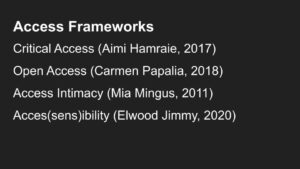
Image description: black slide with white text reading: Critical Access (Aimi Hamraie, 2017), Open Access (Carmen Papalia, 2018), Access Intimacy (Mia Mingus, 2011), and Acces(sens)ibility (Elwood Jimmy, 2020)
In this work, we are going to begin practicing, or doing, access by first conceptualizing it. We have already started this work with our research with the organizations and the access texts that you’ve been given outlines how the organization conceptualizes, understands, and discursively represents access. We are going to do this by introducing for frameworks through which we can think about and practice access: critical access (Aimi Hamraie, 2017), open access (Carmen Papalia, 2018), access intimacy (Mia Mingus, 2011), and acces(sens)ibility (Elwood Jimmy).
Discussion Questions
Does anyone want to discuss how the organization they are working with understands access? Or ask a question about how their organization understands access?
Does anyone want to talk about your experiences of encountering different conceptualizations of access in culture? How did this make you feel?
We can avoid using access to approve of and entrench the status quo in order to use the opportunity that access provides – which is to rethink how people use space and engage with systems – to transform our culture to more just ends. We will do this by introducing three different but interrelated “access frameworks”: critical access, open access, and acces(sens)ibility. We will demonstrate how these frameworks can inform different access practices by focusing on artwork and exhibitions. These practices work towards cultural transformation rather than inclusion through an acknowledgement that access, when practiced through a commitment to social justice, has the potential to re-make the world through the creation of more welcoming and hospitable built environments.
Reflection – Typical Gallery
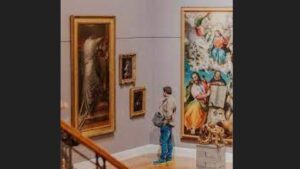
Can anyone describe this image?
How would you feel in this space?
Who might you find in this space?
Who might be excluded from this space?
Image description: A person stands in an art gallery, closely observing a group of framed paintings displayed on a neutral-toned wall. The person is dressed casually in a gray jacket, blue jeans, and neon green sneakers, and is carrying a gray bag. The paintings include a large portrait of a figure in motion on the left, two small dark-toned pieces in the center, and a vibrant, colorful religious or mythological scene on the right featuring multiple figures and dynamic movement. In front of the large colorful painting is a contemporary sculpture composed of golden shapes stacked atop a cinderblock pedestal. A wooden staircase with a black handrail descends into the frame from the left side, adding depth to the space. The gallery has polished wooden floors and an atmosphere of quiet contemplation.
Reflection – Tangled Gallery
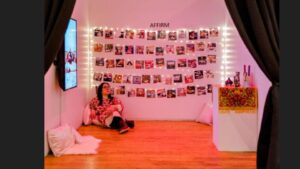
Can anyone describe this image?
How would you feel in this space?
Who might you find in this space?
Who might be excluded from this space?
Image description: A cozy, softly lit gallery space features an intimate installation titled “AFFIRM.” The back wall is adorned with five rows of small photographs clipped to horizontal strings of warm fairy lights, creating a glowing, inviting atmosphere. A person with long dark hair, glasses, and wearing a red-and-white patterned top sits on the wooden floor, leaning against a wall lined with plush white pillows. They appear relaxed and contemplative. To the left, a vertical screen displays a portrait of another person, adding a digital element to the space. On the right, a small pedestal draped with a vibrant floral textile holds decorative objects, including candles and vases. The entire scene is framed by dark curtains, giving the space a sense of intimacy and intention, evoking themes of reflection, community, and care.
What are disability arts?
What is “disability arts”? Any ideas of definitions or examples?
Disability arts:
- Art created by disabled people about their experience of disability (but it doesn’t have to)
- Disability art asks us to think differently about how we create art and experience culture
- Disability art is about gaining control over how we are represented
Engaging with disability arts: Micah Bazant/Sins Invalid and Persimmon Blackbridge

Let’s begin by engaging a piece of disability art. Does anyone want to offer an image description?
This is a piece by Micah Bazant, an artist working with Sins Invalid, a leading disability justice arts-based activist organization operating out of Oakland, California. Can someone describe this artwork by offering a visual description, describing what the piece is about, and/or connecting it to a broader politic.
How is this piece of disability art political?
Any other thoughts about this piece? How does it promote an understanding of disability as an intersectional issue?
How might understanding disability as an intersectional issue change the way we understand and practice access? Take bathrooms for example.
Image description from Sins Invalid: Watercolor painting of a young Black man’s face and shoulders. He wears a black beanie and a black sweatshirt and has a goatee. He is gazing intensely at the viewer. Large handwritten text above him says “Justice for Mario Woods.” Handwritten text to his left says “Over 50% of people killed by police are disabled.” Handwritten text to his right says “No comprehensive federal data is collected, but available reports show at least half of those killed by police have psych disabilities. These statistics do not include people with mobility, sensory, or developmental impairments or people who are otherwise neurodivergent or sick/ chronically ill.“ Handwritten text on his sweatshirt says “Disability Justice Now” and “#BlackDisabledLivesMatter.” Art by Sins Invalid and Micah Bazant.
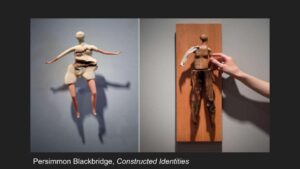
This is a piece of artwork by Persimmon Blackbridge that demonstrates how disability arts can prompt us to make art in different ways anticipating that there are many ways to experience art. Does anyone want to offer an image description?
Any other thoughts about this piece?
How does it offer a different perspective of disability from the way disability is typically represented in normative culture?
Image description: Note from Finn – I was unable to find an image description from the artist for these two sculptures. So this is my own description, and I’m including the link to the really beautiful artists’ statement: Artist Statement here. This slide shows two pieces by Persimmon Blackbridge. On the left, the form of a person is crafted in smooth, light beige wood pieces: the form has a small, spherical head, arms outstretched with hands open upwards, a wide torso with small lumps like two breasts and pieces shifting to the right of its body through its chest and stomach area, two wide thighs with hips slanting downwards, and two legs which, like the forearms, are a reddish-pink hue of wood. The piece is mounted against a grey wall and the form casts a shadow directly behind itself. The piece to the right is another human like wood sculpture. This time there is also a person’s hand, with light skin, reaching in from off screen to gently hold the figure’s wooden arm. This figure is crafted in mostly darker brown wood, though one of its two arms is a bone-like white colour. The figure has a round, smooth spherical head, narrow shoulders and a narrow torso with two lumps like breasts, one arm reaching slightly outwards and the other angled behind them, which the real person’s arm is holding between their fingers. This form’s hips are wider than their torso, jutting out slightly at a right angle on both sides. Their legs are
Critical Access
Image description: Black slide with white text reading: Critical access, Aimi Hamraie. Three bullet points are listed: 1) access is always political, 2) access and access barriers are experienced along an axis of power and privilege, 3) access should be led by disabled people through their experiential knowledge and anti-assimilationist politics.
Critical access is a framework for thinking about access introduced by disability scholar Aimi Hamraie. Critical access begins with the assumption that access is, and always has been, political. As Hamraie writes about in their book, Building Access: Universal Design and the Politics of Disability, in the early days of disability rights movements, disabled people were engaging in acts of civil disobedience – chaining themselves to inaccessible buses, etc. – to protest the immense lack of accessible infrastructure. These disruptive acts, and others like it, are what led to legislation such as the AODA. Following this thread, critical access recognizes that disabled people experience barriers through interlocking forces of oppression and acknowledges that the assessment of whether disabled people are deserving of inclusion is often mediated through other aspects of our identity. Critical access asserts that access must always be carried out through critical disability, critical race, decolonial, queer, and feminist perspectives as it confronts interlocking forms of oppression (Hamraie, 2017). Drawing from Tactical Biopolitics, Hamraie (2017) quotes Beatriz Da Costa and Kavita Phillip, “The difficult intersectional, interdisciplinary work to be done includes within one frame the space of the political economic and the ontological, the battles of the activist and the epistemologist, the tracings of the historian and the artist” (p. 2). Critical access leads us to understand that because of the ways that normative culture is exclusive to so many, we must use access to work towards cultural transformation over inclusion. And finally, Hamraie says, critical access must be led by disabled people through experiential knowledge and anti-assimilationist politics.
Access as political work with a mutualistic relationship with itself and its human/non-human counterparts—as in access offers critiques of the ways the world operates and, in productive simultaneity, can be critiqued when it is inoperational to/for new world orders. Put differently, because everything is about liberation, when access fails this imperative, our role as access workers and activators then must become about this failure. Afterall, if to “wield craft responsibly is to take responsibility for absence,” as Matthew Salesse proffers in Craft in the Real World, and if our jobs as cultural workers of an oppressed peoples is “to make revolution irresistible” as Toni Cade Bambara whispers to us from her afterworlds, then even in the negative space, in the interregnums, in the transparency or even translucency of liberationist presence, art ought to be a protractor recursively in search of a sovereign angle.
How might critical access shape the way we understand and practice access?
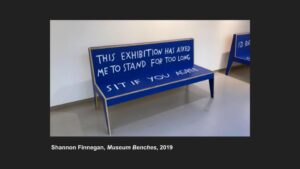
Image description: Finnegan Shannon’s Benches. A simple blue bench sitting in a gallery. Inscribed on the back of the bench are the words, ‘This exhibition has asked me to sit for too long.’ And on the seat, ‘Sit if you agree.’
This is an image of artwork by disability artist Finnigan Shannon’s Museum Benches, in which they installed benches inscribed with phrases like, ‘This gallery has asked me to stand for too long. Sit if you agree’ in various galleries and cultural spaces, including the Ottawa Art Gallery and at the Vessel in Hudson Yards in New York City. Museum Benches “recuperates accessibility from its current depoliticized positioning” (Hamraie, 2017, p. 18) and resists forms of access that are only provided when they are “better for all.” It would be interesting to know if these benches, body-based acts of protests became permanent fixtures in these spaces.
Any thoughts about this piece?
Open Access
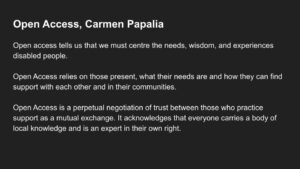
Carmen Papalia is a disability-identified (non-visual learner) artist and curator working out of Vancouver. In a 2018 issue of Canadian Art, Papalia put forth his framework of open access. Open access tells us that we must centre the needs, wisdom, and experiences disabled people, understanding that these needs and experiences are multiple and ever-changing and therefore cannot be standardized. Open Access tells us that access is relational, iterative, and emergent. Open Access relies on those present, what their needs are and how they can find support with each other and in their communities. It is a perpetual negotiation of trust between those who practice support as a mutual exchange. It acknowledges that everyone carries a body of local knowledge and is an expert in their own right.
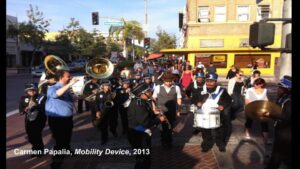
Image description: In this image, we see artist Carmen Papalia, wearing a white shirt, black vest, and brown fedora walking down a sunny city street surrounded by a high school marching band.
In this image, we see artist Carmen Papalia, wearing a white shirt, black vest, and brown fedora walking down a sunny city street surrounded by a high school marching band.
Papalia talks a lot about how his use of the white cane, though necessary, functions as a tool that allows him to access normative culture, a culture that wasn’t built for him, leaving this culture undisrupted. As an artist, he is skilled at imagining the possibility of a different world which centre him and his access needs. For him, this would be a world built around his needs wherein he would walk around freely, uninhibited. In this world, he wouldn’t need a white cane to help direct him within an inaccessible world; rather he would be joyfully led through the world with the assistance of audio cues played for him by a marching band! And so, he joined up with a high school marching band in Portland Oregon. The band developed audio cues as directions, like turn left, step up, step down, stop abruptly, etc.
Let’s watch this performance here: https://www.youtube.com/watch?v=c687G5ZdRxw. It’s quite beautiful and joyful!
Any thoughts about this piece or questions about how we can think about and practice open access? How does this connect to earlier discussions of crip wisdom?
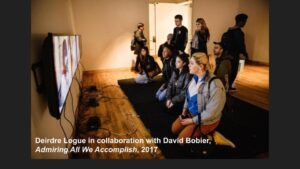
Image description: Deirdre Logue, Admiring all we accomplish. A group of high school students kneel on a vibrating stage in front of a wall of monitors.
Our next example of open access in practice demonstrates why access must be iterative. When I worked at the Tangled Art Gallery, I was quite pleased with the audio description tracks that I had created for an exhibition. Working with the artists, I had uploaded a multi-track description on iPods with headsets and began handing them out to low-vision and Blind people as they came into the gallery, with the sense of satisfaction that comes with the feeling of doing accessibility “really well.” Thankfully, my friend and blind artist Alex Bulmer generously came over to talk to me about how this practice didn’t work for her as it individualized access and, thus, the experience of an opening, which is meant to be a time for gathering with community, socializing, and exchanging ideas. Wearing a headset would exclude her from these experiences. Differently, she requested that I go with her around the gallery, describing the pieces in the show, pausing when she bumped into someone she knew, etc.
Access Intimacy
“Access intimacy” is a term coined by Mia Mingus to describe “that elusive, hard to describe feeling when someone else ‘gets’ your access needs” (2011, para. 4). It is not access that is provided out of obligation, rather, as Mingus notes, “Access intimacy is not just the action of access or “helping” someone . . . Sometimes access intimacy doesn’t even mean that everything is 100% accessible” (2011, para. 8-9). Access intimacy occurs when we approach access as a relational practice, as something that can be shared between people and attuned to together, in relationship and in community. When access is framed through the lens of compliance or obligation, or when it is positioned as a checklist of tasks to complete, it does not open the possibility for access intimacy. We cannot always predict when access intimacy will emerge. Mingus observes that it can be built over time and it can emerge suddenly with someone you have just met. However, by engaging access as a critical and political practice, we set the conditions that can allow access intimacy to flourish.
Acces(sens)ibility
The last framework we are going to consider is Cree curator Elwood Jimmy’s concept of ‘access(sens)ibility.’ Jimmy takes interest in how, “we very seldom question what this accessibility gives access to” (2020), which speaks to how we were using access as an opportunity to critically engage and critique normative culture. He continues, “accessibility often just facilitates a problematic form of inclusion into a naturalized colonial habit of being.” Thinking about how this plays out in cultural institutions, Jimmy observes (and this quote is written on the slide):
“Engagements and conversations about accessibility and disability mirror many of the problems we find when organizations attempt to include Indigenous and racialized bodies into modern-colonial spaces. Efforts to decolonize and Indigenize often address methodological and epistemological issues (i.e. ways of doing and knowing) without really tackling ontological issues (related to habits of being), where the issue of separability lies. Unless we are prepared to be differently, rather than just do or know things differently, colonial habits of being will remain unchallenged.”
Any questions about this framework?
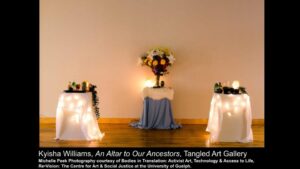
Image description: Kyisha Williams, An Altar to Our Ancestors, features three low plinths covered in white and blue cloth on top of which sit altars of flowers, spirits, plants, and small lights.
In 2020, Gloria Swain, who identifies as a mad, Black, aging artist, curated a group exhibition called Hidden for Tangled Art + Disability, a disability art gallery in Toronto Canada called Hidden. This show featured Black artists with hidden disabilities. One of the artists selected for this group exhibition wasn’t able to attend the meetings and prep sessions. But instead of removing the artist from the exhibit, Swain held space for them by including an empty plinth in the exhibition beside which hung a statement on how neoliberal, capitalist, and colonial systems exclude some artists, particularly Black mad and disabled artists, from cultural institutions. Swain extended access to this artist in a way that did not maintain the normative order of things, but instead broke from “colonial habits” (Jimmy, 2020) by disrupting neoliberal expectations of productivity and institutional expectations for a participating artist and a complete exhibition. These access practices drew attention to and interrupted the ways that colonialism assigns value to some bodies over others (e.g., the gallery is hospitable to some while being a violent space for others).
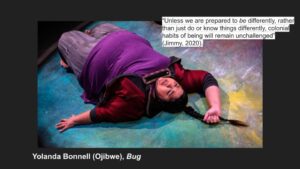
Ojibwe playwright Yolanda Bonnell created a one-woman play, bug, to tell the story of an Indigenous woman grappling with the emotional impacts of intergenerational colonial violence while making difficult decisions about how to survive ongoing colonization. Bonnell worked with the disability cultural practice of relaxed performance— a way of mounting a performance that lets disabled people, particularly neurodivergent people, be comfortable by moving around and making noise. Bonnell created her relaxed performance through an Indigenous perspective by briefing the audience about the play’s content and inviting Indigenous women/Two Spirit people to identify themselves before the performance; she noted that this call out was intentional given the ways that colonial cultural spaces have not always welcomed Indigenous people. She also brought in an Indigenous healer with traditional medicines to provide support. In the Q&A session, Bonnell again invited Indigenous women and Two-Spirit people to share their questions/experiences first, centralizing their often-marginalized perspectives. This was a critically important move as it allowed some of the intersections between Indigeneity and disability to surface, leading to rich conversation.
Bonnell was able to use disability curatorial practices to challenge colonial practices within theatre by relaxing the space and centring Indigenous people. And the space felt differently. Such a disruption is necessary for, as Jimmy says, “unless we are prepared to be differently, rather than just do or know things differently, colonial habits of being will remain unchallenged.”
Aislinn Thomas: Ongoing Collective Effort
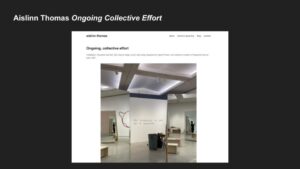
Image description: A contemporary gallery space features a conceptual art installation in progress. At the center of the back wall, text in handwritten-style black letters reads: “THE POSSIBILITIES OF CARE AS A SCULPTURE.” The room contains several large, freestanding mirrored panels that reflect various parts of the space, including visitors, light fixtures, and artworks. Scattered throughout the gallery are simple wooden benches, a gray trash bin on wheels, and tools suggesting the installation is still underway. The reflections and open layout create a layered, almost disorienting visual experience that invites viewers to consider care, presence, and process as integral parts of the work itself.
Aislinn Thomas’ Ongoing Collective Effort piece architectured a metaphysical and collaborative artifact that imagines and co-creates toxicant free access and fragrance freedom. The invisible structure invites and propels a terrain of scent and chemical-lessness, from both workers and volunteers within its visitors. This means avoiding perfumes, colognes, heavily scented body products and laundry detergents, as well as contact with incense, cigarettes and other things that create smoke. At Tangled, this invisible sculpture was referenced by a moveable wall featuring the text: The possibilities of care as sculpture. This piece asks “what personal values do you draw on to help make the labour of creating access meaningful and sustainable?” As Leah Lakshmi Piepzna-Samarasinha (2018) reminds us: making space accessible is an act of love for our communities, one that requires a commitment founded on disruption and resistance against normalized modalities of moving about the world. Embedded in such a stark paradigm shift, is our habitual use of scents which may act as liabilities for our kin.
Fragrance-free spaces ensure that people with Multiple Chemical Sensitivity (MSC), asthma, others with chemical disabilities, and those whose bodyminds react to fragrances are able to safely attend spaces without flare ups or harm.
It’s important to consider, as Leah Lakshimi Piepzna-Samarsina reminds us in their re-chronicling of Sins Invalid crip gatherings of art and world-making, community members with cultural ties to fragrance and scents. Can we think about/consider how we can hold the tension of this access friction. Leah suggests the following script: “Hey you smell great! There are some folks sitting here who are allergic/have cancer, would you mind sitting over there instead?”
How can galleries practice fragrant freedom?
How might Activators introduce this idea and why it is important to access and work with galleries to achieve fragrance freedom?
To conclude, exploring the meanings of access is, fundamentally, the exploration of the meaning of our lives together – who is together with whom, how, where, when, and why? Once we recognize this, we can begin to regard disability as a valuable interpretive space for denaturalizing our existence and complicating singular or totalizing ways of making meaning as bodied beings. Denaturalizing existence does not require us to deny the materiality of the body, nor that of social space but it certainly does make the relation between people and places a significant, historical, material fact, worthy of concerted critical reflection” (Titchkosky, The Question of Access p.6.)
Concluding Questions
- How do you understand and practice access?
- How might you introduce access frameworks to the organizations you are working with? Let’s brainstorm how access frameworks can inform access practices?
- How have you experienced access intimacy in cultural spaces? How did this change the way this space felt? How can we support organizations to create the conditions in which access intimacy can be enacted and felt?
- Why do we make things accessible? What can access do?
- How does understanding disability as an intersectional identity change how we understand and practice access?
- How is access political? How can we practice access in ways that acknowledge, disrupt, and transform the status quo? How could this relate to equity, diversity, and inclusion priorities?
- Many of these examples feature galleries working with disabled, crip, neurodivergent, Mad, and Deaf artists. How does working with these artists affect the ways galleries/organizations practice access and build and sustain meaningful and reciprocal relationships with community. Does the organization you are working with program disabled, crip, neurodivergent, Mad, and Deaf artists? If not, how can you support them to build access in order to allow for these community connections?
- What is the difference between access as disruption and access as inclusion. How does one facilitate normalcy and one facilitate insurgency?