
Studio Class Two
Workshop Notes and Slide Show: Working with Access Texts
Links and Materials
Workshop: Working with Access Texts
Slide reads: Working with access texts, November 10th 2025
Free School Events
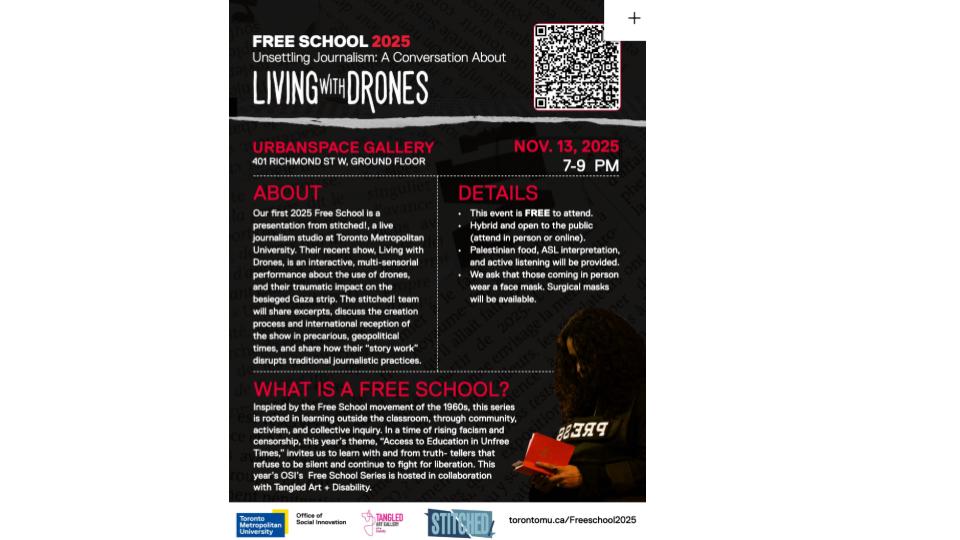
Slide Description: Event poster with a black background and white and red text, a QR code in the top right corner, and the logos of TMU Office of Social Innovation, Tangled Art + Disability, Stitched, and torontomu.ca/Freeschool2025 along the bottom. The poster includes the information written out below, as well as a description of the Free School: “What is a Free School? Inspired by the Free School movement of the 1960s, this series is rooted in learning outside the classroom, through community, activism, and collective inquiry. In a time of rising fascism and censorship, this year’s theme, “Access to Education in Unfree Times,” invites us to learn with and from truth-tellers that refuse to be silent and continue to fight for liberation. This year’s OSI Free School Series is hosted in collaboration with Tangled Art + Disability.” And a longer list of details: “This event is FREE to attend; hybrid and open to the public (attend in public or online); Palestinian food, ASL interpretation, and active listening will be provided; We ask that those coming in person wear a face mask. Surgical masks will be available.”
First Event
You are invited to Unsettling Journalism: A conversation about Living with Drones, the first event of the Free School Series presented by the Office of Social Innovation at Toronto Metropolitan University and co-presented by Tangled Art + Disability.
Our first 2025 Free School event is a presentation from stitched!, a live journalism studio at Toronto Metropolitan University. Their recent show, Living with Drones, is an interactive, multi-sensorial performance about the use of drones, and their traumatic impact on the besieged Gaza strip. During this hybrid event, the stitched! team will share excerpts, discuss the creation process and international reception of the show in precarious, geopolitical times, and share how their “story work” disrupts traditional journalistic practices.
When: Thursday, November 13th, 7-9pm
Where: Urbanspace Gallery, ground floor of the 401 Richmond Building, 401 Richmond Street and on Zoom
Access: ASL interpretation and an active listener. This is a mask-mandatory event. Please wear a mask and we will have surgical masks available
This event is free and open to the public. To register for in-person or online attendance, please visit:
Second Event
Please join TMU’s Office of Social Innovation for our second Free School event “From Turtle Island To Palestine: Cross Movement Solidarity in Action” is a conversation with two pairs of activists working together within and across labour and Indigenous solidarity movements towards liberation in the face of genocide.
Anishinaabe artist, activist, and educator Quill Christie-Peters and Maysam Ghani, a Palestinian educator, poet, and organizer, have a rich history of collaboration, building deep practices of joint struggle and responsibility between Anishinaabe and Palestinian communities. Palestinian Canadian social justice activist and professor Ala’ Qadi and Elizabeth Ha, a Chinese-Canadian labour and community activist are Vice-Chairs of OPSEU’s Coalition of Racialized Workers, organizing within the labour movement to dismantle systemic racism and highlight the Palestinian struggle. With facilitation by Dr. Lamya Amleh of Faculty for Palestine, this discussion will explore the power of collective resistance to restore hope and build resilience in the face of increased surveillance and state violence. Panelists and attendees are invited to reflect on the idea that landback and labour are both local and global movements.
This event is free, hybrid, and open to the public. Attendees can participate in person or through Zoom. Food, ASL and interpretation will be provided. We ask that those coming in person wear a face mask. Surgical masks will be available.
What is a Free School?
Inspired by the Free School movement of the 1960s, this series is rooted in learning outside the classroom, through community, activism, and collective inquiry. In a time of rising facism and censorship, this year’s theme, “Access to Education in Unfree Times,” invites us to learn with and from truth- tellers that refuse to be silent and continue to fight for liberation.
This year’s OSI’s Free School series is hosted in collaboration with Tangled Art + Disability.
When: Thursday, November 20th, 7-9pm with doors at 6:30pm
Where: Urbanspace Gallery, ground floor of the 401 Richmond Building, 401 Richmond Street and on Zoom
Access: ASL interpretation. This is a mask-mandatory event. Please wear a mask and we will have surgical masks available
This event is free and open to the public. To register for in-person or online attendance, please visit: https://www.eventbrite.ca/e/from-turtle-island-to-palestine-cross-movement-solidarity-tickets-1965572351816?aff=oddtdtcreator
Group Updates
How’s it going?
Has your focus changed?
How have your meetings with your organizations gone?
Lessons from your mentors to share?
Do you need anything from us?
Feel free to answer any questions or reach out for support on the discord!
Disability Justice and Cultural Accessibility
- When you hear disability justice, what principles come to mind (e.g., collective access, intersectionality, interdependence, leadership of those most impacted)? Which ones feel most urgent in your org context, and why?
- When you think about the access practices in your org, do they follow disability rights (/legislative compliance) or disability justice frameworks? Eg how is disability identified/reported, how are access needs controlled/policed, who is responsible for accessibility, etc.?
- How are power and resources organized to centre people most impacted (paid roles, decision authority over timelines/budgets, accountability to community)? What would shift if disability justice rather than compliance set the bar for decision-making and evaluation?
- What makes cultural accessibility different from generic “inclusion” or “accommodations upon request” in arts/culture settings?
- Whose risks (harms, losses, liability, etc) are centred in your org’s current access decisions (audience, artists, staff, funders, landlords)? Where do those priorities show up in writing?
- Whose access needs are centred in your org’s current access decisions? Where do those priorities show up in writing?
Ableism
Ableism (working definition): From Fiona Kumari-Campbell (2009): A system of beliefs, structures, and practices that privilege normative body–mind expectations (speed, stamina, sensory tolerance, productivity, presence) and treat disabled people and ways of doing as deviations to be managed, hidden, or exceptionalized rather than redesigning conditions with and for disabled people.
How ableism shows up in arts/workplace culture (examples and alternatives):
| Attendance = commitment. | Instead we can value outcomes and contributions and offer hybrid/a-sync options by default. |
| Speed = excellence. | Instead we can value outcomes and contributions and offer hybrid/a-sync options by default. |
| Documentation burden (required doctors’ notes). | Instead, we can have trust-based leaves that don’t require medical disclosure |
Questions to Ask
- Whose body‑mind is centred? What assumptions about spoons/stamina, ability to be in public spaces (public transit, maskless spaces, etc.) access needs, and care responsibilities are baked in?
- Where are burdens placed? Identify disclosure/documentation demands; power concentration (manager discretion); vague language like “reasonable” and “excessive” accommodation.
- What risks are prioritized? Continuity of show vs community health; productivity optics vs sustainable workplaces/paces.
- What’s missing? Communicable illness guidance; mask/ventilation norms; remote hand‑off; role‑based flexibility; privacy safeguards.
- Equity check: How could this differentially harm Deaf/disabled/mad/neurodivergent, immunocompromised, precariously employed, or low‑income staff?
Where to look for ableism in workplace/organizational policies
- Hiring policies
- Work from home policies
- Sick day policies
- Public health policies
- Workplace accommodation policies
- Accessibility policies
- Policies around developing partnership
- Any others?
Prompts for Commenting on Policies
- Name the barrier: Clearly identifying the barriers created by policies, e.g., “Requiring a doctor’s note for sick days creates a cost barrier…”
- Explain the impact on people most affected and on org risk “…requiring people to come into work on a set number of days a week rather than when they are required to for an event reduces people’s capacity for in person work.”
- Offer a better practice aligned with disability justice, e.g., “Adopt trust‑based sick time up to seven days over requiring documentation.”
- Add implementation details (roles, timelines, budget, privacy) e.g., “HR updates policy by Jan 31; add paid COVID leave; mask mandatory rehearsals; supervisors trained; template hand‑off scripts, etc.
Quick Tips
- Replace manager discretion with clear, published pathways.
- Replace punitive language with care‑ and safety‑first language.
- Convert values into roles/resources/timelines.
- Provide multiple options (e.g., remote check‑ins, rescheduling, understudy plans).
- Reduce documentation to what is strictly necessary, if any.
Sick Day Policy
Employees receive five paid sick days per calendar year. Unused days do not carry over. Sick days must be approved by your supervisor prior to the start of your shift where possible. A doctor’s note is required for any absence beyond one day. The note must specify dates and confirm inability to work. Remote work is generally not available for production staff unless they are severely ill. Excessive absences may result in disciplinary action, up to and including termination. The company follows public health guidance. Masking is optional unless mandated by law. Medical information may be requested by HR and will be kept on file.
Alternative Sick Day Policy
Staff have unlimited no‑fault paid health days annually (physical/mental health; illness; disability‑related flare‑ups, menstruation symptoms, etc.). No documentation is required. If documentation is provided for long-term leaves, it will be securely stored and deleted by HR after resolution. Stay‑home norms: If you have cold or flu symptoms or test positive for COVID, stay home. COVID‑conscious practices: Mask‑positive rehearsals and audience‑facing shifts; portable HEPA in rooms; remote or reassigned tasks when feasible. Supervisors may not discipline staff for using health days.
Writing Access Statements: What should access statements do?
- State purpose and who it’s for (artists, staff, audiences).
- List specific supports offered by default (ASL/CART schedule, relaxed shows, low-stim rooms, sensory info, companion tickets).
- Make supports findable (links to maps and access guides, seat measurements, door widths, elevator/bathroom info, routes). You might not have this info, but your org can fill it in.
- Provide multiple contact options (text/phone/email/DM) and a response timeframe.
- Shift the burden to the organization (proactive offers, not “accommodations upon request” only).
- Minimize documentation (state when it’s not required; if ever needed, explain why and how data is protected and deleted).
- Name roles/owners (e.g., Access Producer/FOH lead) and the access budget or funding source.
- Include COVID-conscious basics where relevant (mask-positive practices, ventilation/HEPA, stay-home norms).
- Use plain language and avoid euphemisms; provide alt text and readable formatting.
- Offer choices and alternatives (multiple ways to attend/participate; remote/low-stim options).
- Explain how to request something else and what the process looks like (simple steps, timelines).
- Build feedback and accountability (anonymous form, contact for concerns, how decisions get made, public change-log).
- Commit to review cadence (e.g., quarterly) with paid input from Deaf/disabled/mad/neurodivergent community members.
- Address affordability and ticketing (companion tickets, sliding scale, fee-free access lines).
- Signal a justice-based stance (collective access, commitment to community, interdependence, leadership of those most impacted) rather than compliance optics.
National Ballet Example
“The National Ballet of Canada is committed to providing a barrier-free environment for all persons including patrons/customers, employees, contractors, job applicants, volunteers, suppliers, and any visitors who may enter our premises, access our information, or use our services. As an organization, we will meet and support the needs of persons with disabilities in a timely manner, and as set forth in the Accessibility for Ontarians with Disabilities Act (2005) and all associated standards and regulations. The National Ballet of Canada will strive to ensure that all policies, practices, and procedures are consistent with the core principles outlined in the Act.”
Prompts for Re-writing
- What is this page for and who is it written to (artists, staff, audiences)? Is that explicit in the first sentence?
- Does it name concrete supports (ASL/CART schedules, relaxed shows, low-stim room, sensory map), or just say “inclusive/accessible”?
- Can a first-time disabled visitor decide if they can attend from this page alone (maps, door widths, elevators, seat details, routes, photos/audio tours)?
- Are there multiple contact options (text/phone/email/DM) and a guaranteed response time? Who replies?
- Who is doing the planning labor: the org or the person? Is “accommodations upon request” the only pathway?
- If you need something not listed, are the steps simple (2–3 steps) with clear timelines and what happens next?
- Are companion tickets/sliding scale/fee-free booking clearly explained?
Covid-consciousness Statements: What should they do?
- State the purpose in plain language: keep people safe and events running without sacrificing health.
- Name stay-home norms for symptoms, positive tests, and known exposures, with paid isolation where applicable.
- Specify mask-positive expectations for close-contact work, rehearsals, backstage, and crowded indoor settings; say when/where masks are expected and provided.
- Describe ventilation measures: HEPA units, outdoor/door-open practices, and how often filters are changed.
- Outline testing practices: when rapid tests are used (e.g., close-contact work, outbreaks) and how they’re provided.
- Offer alternatives: remote or reassigned tasks, flexible deadlines, and easy hand-off protocols.
- Centre high-risk people: name how immunocompromised and disabled workers’ needs shape decisions.
- Provide clear contact channels (text/phone/email/DM) and response times for health/access questions.
- Define roles and ownership (e.g., Access Producer and Production Manager), and where the budget lives.
- Include privacy limits for any health data collected: what, why, who sees it, retention, deletion.
- State audience-facing practices (if relevant): masking guidance, CO₂/ventilation notes, late entry/low-stim options.
- Commit to material supports: free high-quality masks, rapid tests, HEPA units, outdoor options when feasible.
- Add non-retaliation language for using sick/isolation days or raising safety concerns.
- Set measurable targets: availability of masks/tests, ventilation benchmarks, outbreak response timelines.
- Include a feedback loop (anonymous OK) and a public change-log of updates.
- Specify review process and triggers (e.g., quarterly or when case trends/outbreaks change).
- Use accessible formatting and plain language; avoid medical gatekeeping or punitive tone.
Does anyone want to write one? (Feel free to add it to the discord if you’d like!)