Module 6 – Intersectional Justice
Intersectional Justice Lecture: freedom-making as place-making

Class Recording and Transcripts
Freedom-making as place-making: mad cartographies and finding/making elsewhere
Lecture outline:
- – Reviewing the work we’ve done as decolonial access activators through the discursive filter of place/space
- – The geographical imperative of freedom work (Ruth Wilson Gilmore)
- – Examining the role of madness is liberationist place-making
- – Mad Mapping Freedom in togetherness activity
- – A note on the means
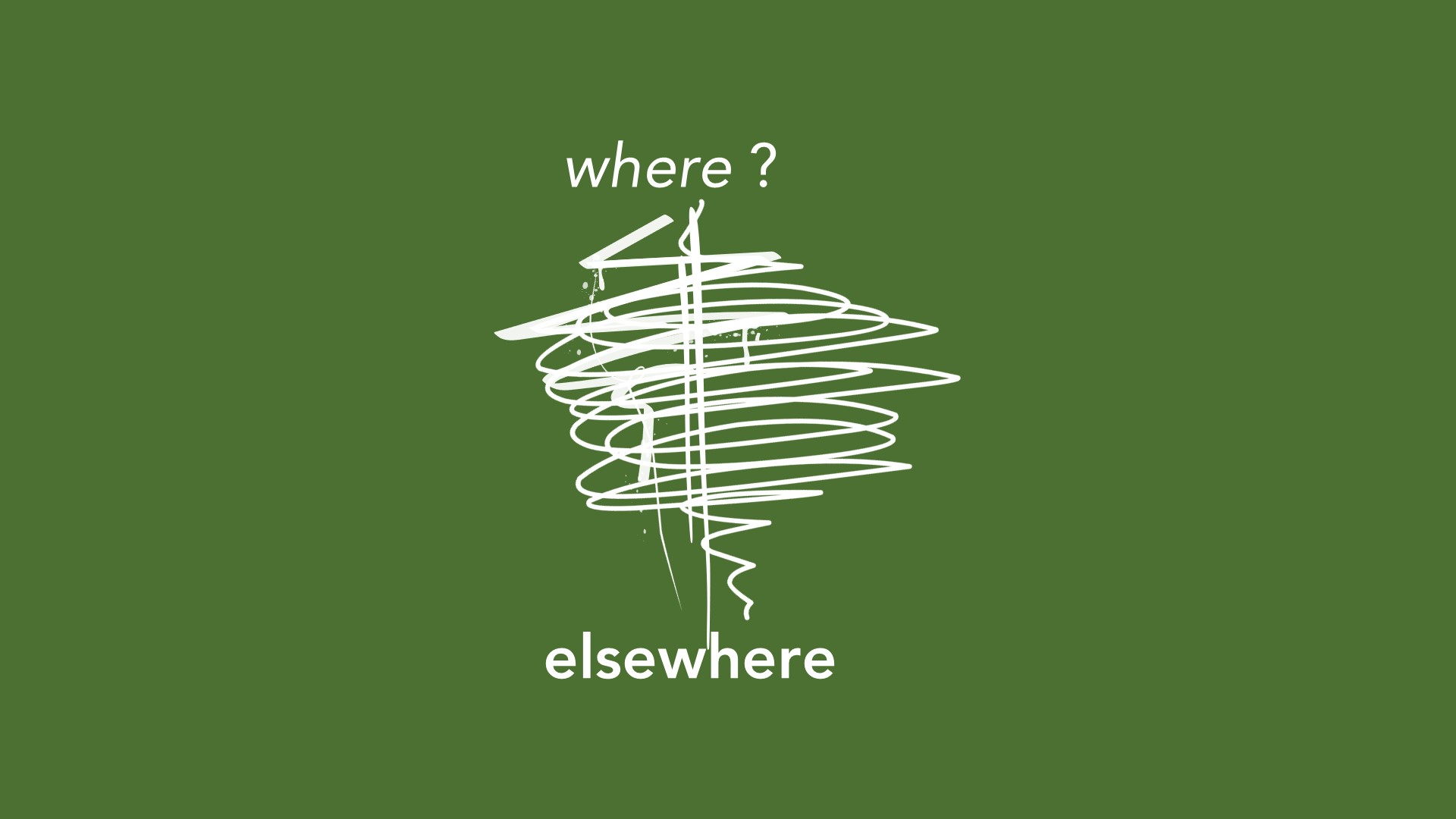
Image description: a forest green slide with a scribble drawn in white in the middle. The scribble is made of mostly loose horizontal lines with two straight vertical ones. Text on the top of the scribble reads “where?” and below it reads “elsewhere”
We’ve spoken the past few weeks—in both an explicit and tacit sense— about the phenomenally relational, mutable, occult, politically vulgar, and transformative role that space and place play in our decolonial comings to access and disability. Not just from the standpoint of making a physical space (a building, a room, a gallery, the internet) accessible, which we’ve reiterated is an always incomplete, tenuous, iterative, and even decolonially incompatible process, but also from our insistence that mobilizations of crip access are intercorporeal and inextricable from land. Land as kin (Simplson, 2017). Flora as siblings in struggle. Fungi as teachers. We’ve spoken to what happens when we refuse a crip politic that elides land relations, spatiality, and geography from its syllabus and agendas.
We’ve asked:
- What do “accessible” spatialities look like?
- What are accessible terrains worth on stolen land?
- How are cultural geographies as they are today incommensurate with the horizons of futurity that disability justice dreams, limns, and melodizes about?
- How is land expropriation a twinned mutation of bodymind expropriation?
- What connects white settler-hood with crip settler-hood? White nationalism to homonationalism to crip nationalism?
- How do imperial governances, variegated supremacies, asymmetrical wealth accumulations and transfers contrive and maintain the ethos of the rooms we’re in? How do these soils and subsoils make impossible a reform-gained-liberation and inevitable a sovereignty-by-travesty abolition geography?
Ruth Wilson Gilmore, in Fatal Couplings of Power and Difference, offers us this in response to our fascination with liberationist spatiality: “A geographical imperative lies at the heart of every struggle for social justice: if justice is embodied, it is then therefore always spatial, which is to say, part of a process of making a place”
If we make deed of Gilmore’s words, that justice is embodied and therefore spatial, then every conversation we’ve had about liberationist modalities was really a conversation about space, about geographies, about the expansive project that is re-territorializing justice through our everyday “spatial struggles.” In Demonic Grounds: Black Women and the Cartographies of Struggle, Katherine McKittrick (2006) carries us deeper and further into this thoughtspace: “The real and imaginary geographic processes important to Black women are not just about limitations, captivities, and erasures; they are also about everyday contestations, philosophical demands, and the possibilities the production of space can engender for subaltern subjects” (p. 121)
So if this world order of captivity is made flesh in borders, cages, prisons, if it is embodied and made known through the territorial—through the place-centred violence of settler institutions and infrastructures, then the question becomes this: how do we forge its geographical antipodes?
If freedom is a place, how do we find it, and how do we, as Ruth Wilsom Gilmore asks, make such a place over and over again?
In a differential but congruent vein, in How to Go Mad without Losing Your Mind, La Mar Jurelle Bruce observes the ways in which Madness, linguistically then in turn metaphysically, is often framed as a place, a terrain one can inhabit
“Within Anglophone idiom, subjects go crazy, as though mad is a place or constellation of places. The ship of fools, the insane asylum, the psychiatric hospital, the carnival, the wrong side of the supposed line between genius and madness, and even the continent of Africa are frequently mapped as mad places within Western discourse…. It seems to me that madness, like diaspora, is both location and locomotion. Madness, like diaspora, is both place and process. Madness and diaspora transgress normative arrangements—of the sane and sovereign, in turn. (16–17)”
The ship of fools that Bruce names here speaks to a fifteenth-century watercraft carrying mad occupants deemed nuisances to their communities and exiled from their homes to be forever consigned to mapless waters. The fool in the ship of fools, Foucault declares, has “his truth and his homeland only in that fruitless expanse between two countries that cannot belong to him”
So the fool and the madman and political deviant and dissident, the disabled and debilitated writer and fighter who defies the grammars of Rightness and Reason cultivates a mad diaspora: a scattering “of captives… an emergence of emergence of unprecedented diasporic subjectivities, ontologies and possibilities that transgress national and rational norms” (3)
There is a spatiality of psychosis that is required then to make place into freedom, or to make freedom a place. Bruce dances with us into a demand that we submit ourselves wholly/holy to the psychosocial milieu of unruly wills “that perplexes and vexes the psycho-normative status quo”, a call to militate against the “gentrified precincts and patrolled borders of [capital R] Reason” and Rightness (17).
Madness plays an indispensable role then in imagining Elsewhere: I think back again to Thomas Sankara’s revolutionary words: “You cannot carry out fundamental change without a certain amount of madness. In this case, it comes from nonconformity, the courage to turn your back on the old formulas, the courage to invent the future. It took the madmen of yesterday for us to be able to act with extreme clarity today. I want to be one of those madmen. We must dare to invent the future.”
Mad Mapping Freedom
To my knowledge, Mad Mapping was first conceived of by the Icarus Project, which has now evolved into the Fireweed Collective, as a less carceral and diagnostic alternative to crisis plans for mad and suicidal peoples. To me Mad Mapping is an expansive, tactile process of outlining, archiving and animating that non-sensical, non-chronological, untraceable ways that crips and mad marginalized peoples think and dreams beyond borders. It is necessarily non-definitional and erratic so I will not spend time defining it.
But I think together now, I want us to dream with me for a moment in an unruly way that deceives and despises a concept like a limitation, or one like an impossibility on the question we posed earlier alongside Gilmore:
What would a free(d) place look/feel like? What would be present? What would be absent?
Note: I think how a place is made free is part and parcel with the existence of the place itself (i.e. the place is the process, the goals are the means). Cello Pfeil and Bruno Pfeil remind us as such in their paper An Anarchist Historical Analysis of Body Inscriptions. “If anarchism takes freedom as its primary ideal,” they write, “the means to achieve it do not deviate from this principle…Freedom cannot be defended by suppressing it even partially.” The methodologies, modalities, means in which we achieve freedom, in which we build a freed place “ultimately become the goal” (Goldman, 2007 cited in Pfeil & Pfeil, 2024)
Note: Though as Gilmore’s book Abolition Geographies reminds us, and as we’ve made known through our transnationalist and internationalist dimensions of dialoguing disability throughout the course, while “our political struggle is in part defined by the task of creating shared meanings of a particular place,” this work equally takes up the intentional and actional consolidation of connections “across space, from not-in-my-backyard to not-in-anyone’s-backyard.”