Module 5 – Community, Accountability and Covid-19
Collectivizing Lifeworlds and Access Futurities: Lecture and Discussion
Lecture Materials
Collectivizing Lifeworlds Lecture Powerpoint (PDF)
Activity Material: Strategy Planner & Organizer
Mutual Aid Campaign Update
Muhammad and Mahmoud’s campaign
Muhammad and Mahmoud’s Campaign Link
Text from their campaign:
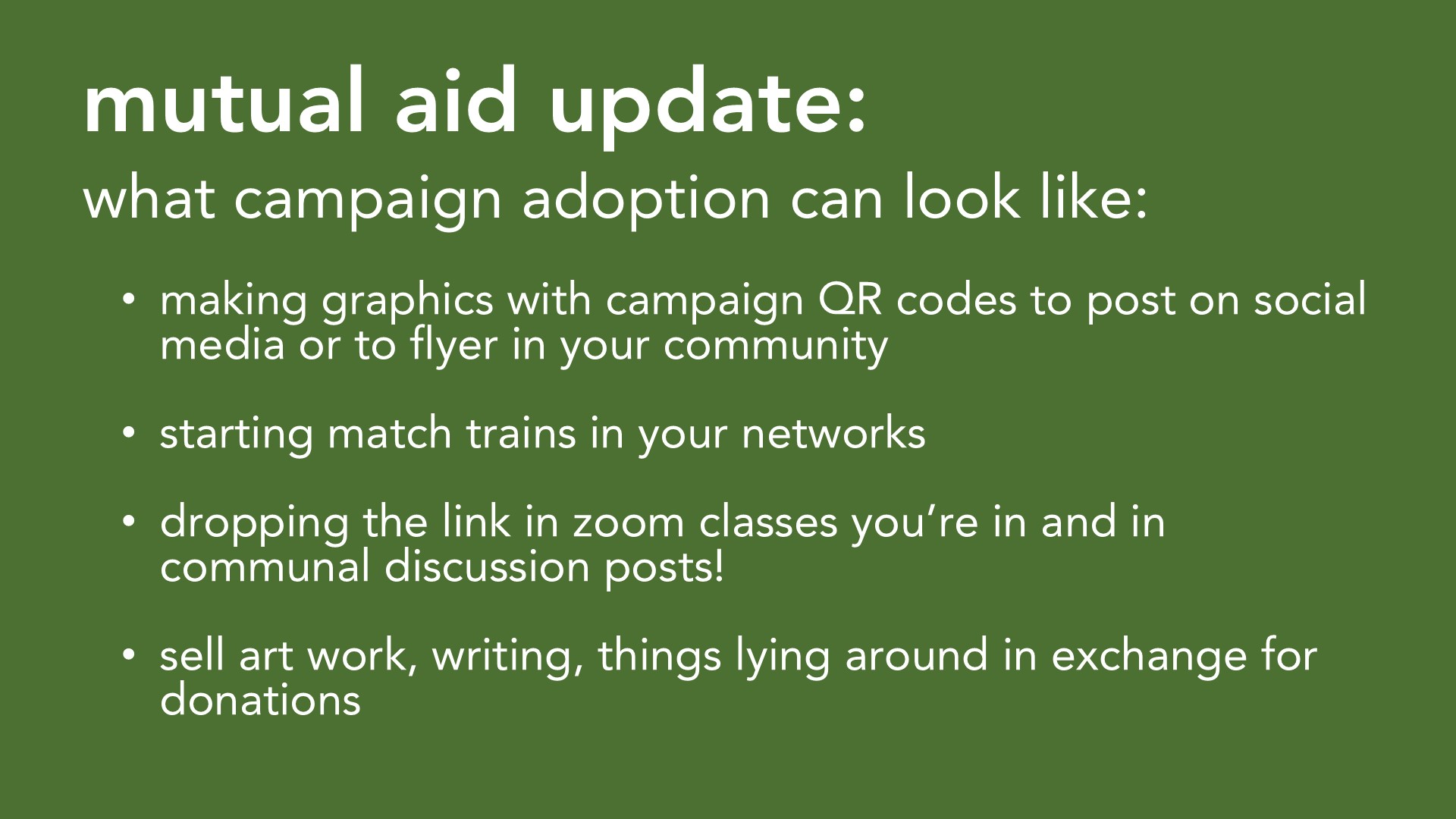
What Campaign Adoption Can Look Like:
- making graphics with campaign QR codes to post on social media or to flyer in your community
- starting match trains in your networks
- dropping the link in zoom classes you’re in and in communal discussion posts
- selling artwork, writing, things lying around in exchange for donations
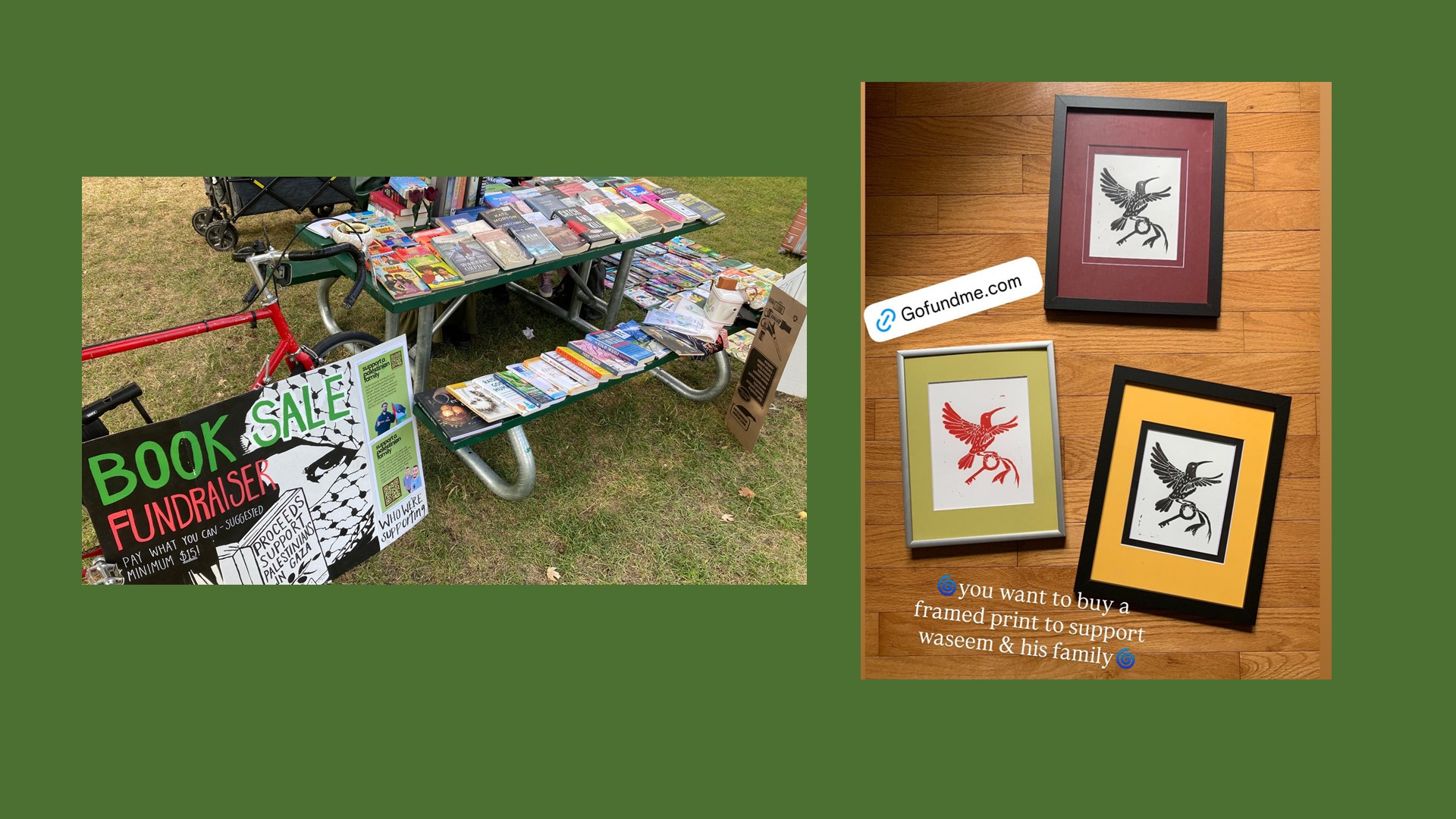
Image description: On the left, a park bench covered in books with a handmade sign reading Book Sale Fundraiser, Pay What you Can, Proceeds Support Palestinians in Gaza. On the left, a social media post picturing three framed prints of a humming bird grasping a key in its claws. A gofundme is linked, with the text “you want to buy a framed print to support waseem and his family” framed with spirall-y emojis.
Lecture: Collectivizing Lifeworlds
“At the limits of the self, we find all other: other people, other species, and other forms of vibrant matter”
—Fritsch (2010)
“From our conversations we learned that war injuries in the camps are considered a form of punishment and thus markers of anticolonial resistance, suggesting that disability is an onto-epistemological facet of Palestinian resistance, an unexceptional state of becoming that informs the compartments of many Palestinian refugees.. Disability is lived, as much if not more so, as a communal process of coming to terms with and resisting the conditions of occupation than an individual condition”
—Critical Disability Studies and the Question of Palestine, Jasbir Puar (2023)
Part and parcel with our established mission to hijack thought and being from the hands and realms of colonial annals is calling on our liberationist ancestors and educators past to inform us on the “modes of being, thinking, knowing, sensing, and living” that will consolidate our paths towards decoloniality, epistemic freedom and transnational disability justice futures (Mignolo and Walsh, 2018).
This fundamental constituent of our work, in and of itself, is an appeal and affirmation of community and collectivity’s role in our re-worlding projects of otherwise. If every writer is an amalgamation of other writers, as Doreen St. Felix puts it in On Writing Good Criticism, then each one of our lectures is a fertility; the offspring of learnings, lessons, experiences, letters, touches, vibrations, thoughts, stories, essays, books, knowledges, that have made and birthed and shaped and made flesh not just the knowledge we disseminate but the people we are.
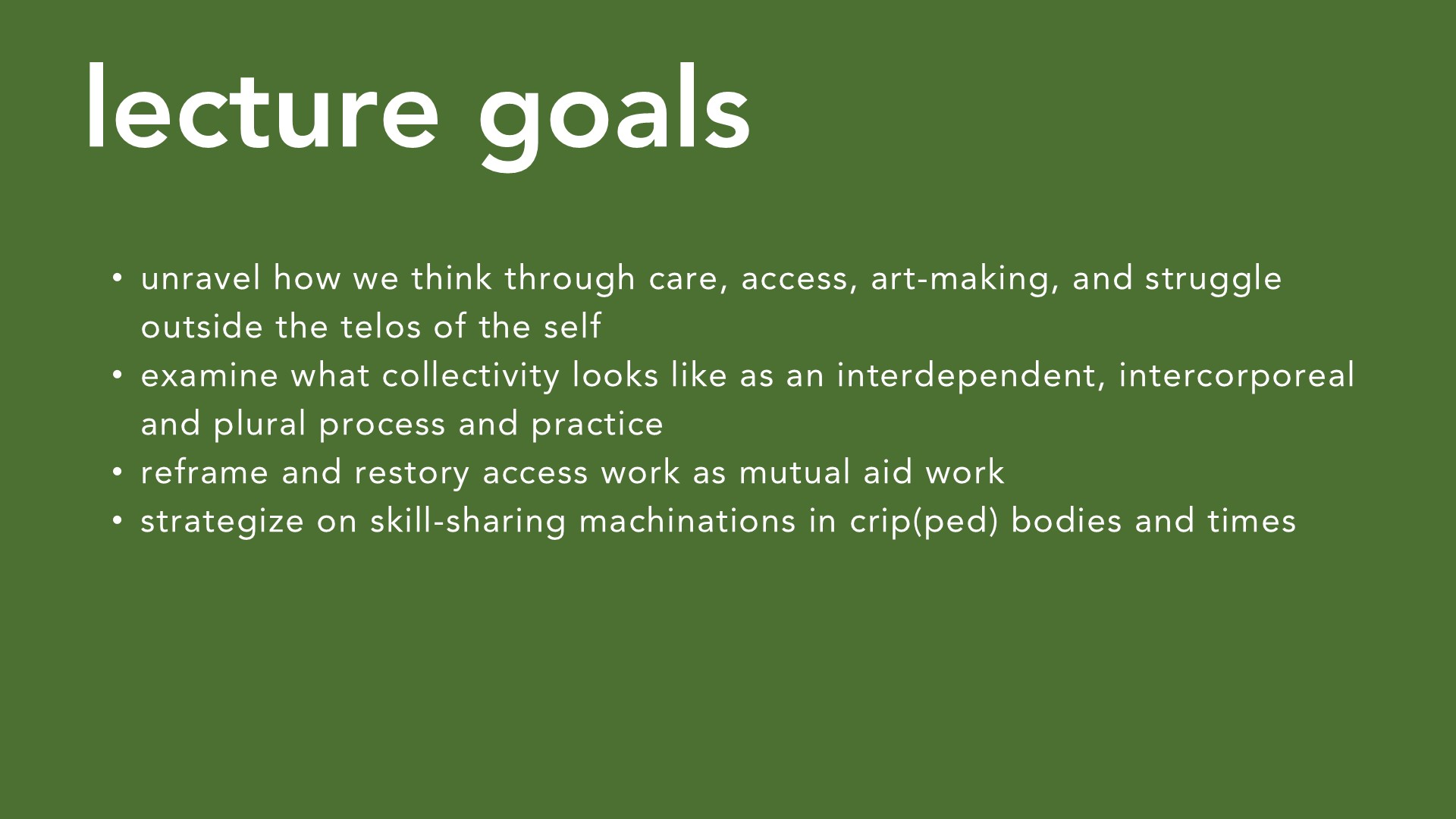
Slide Reads:
Lecture Goals
Said differently, am one, insofar as I am many which is why, our class today and hopefully every single moment forward from it, will engage us on the decisive mandate of collectivizing access and our lifeworlds or how we become-in-the-world-with-others (Price & Shildrick, 2002). How do we think through care, access, art-making, and struggle outside of the telos of the self? And I think and hope that what we will find is that when we lose self-definition, what we gain in its stead is is an assembled and collective meaning, a sense of purpose that cannot be actualized in solitary.
Drucilla Cornell (2014) captures the innateness of this relational conception of community by describing it as something ‘… that is not outside us, something “over there”, but is inscribed in us’ (Cornell, 2014, p. 161).
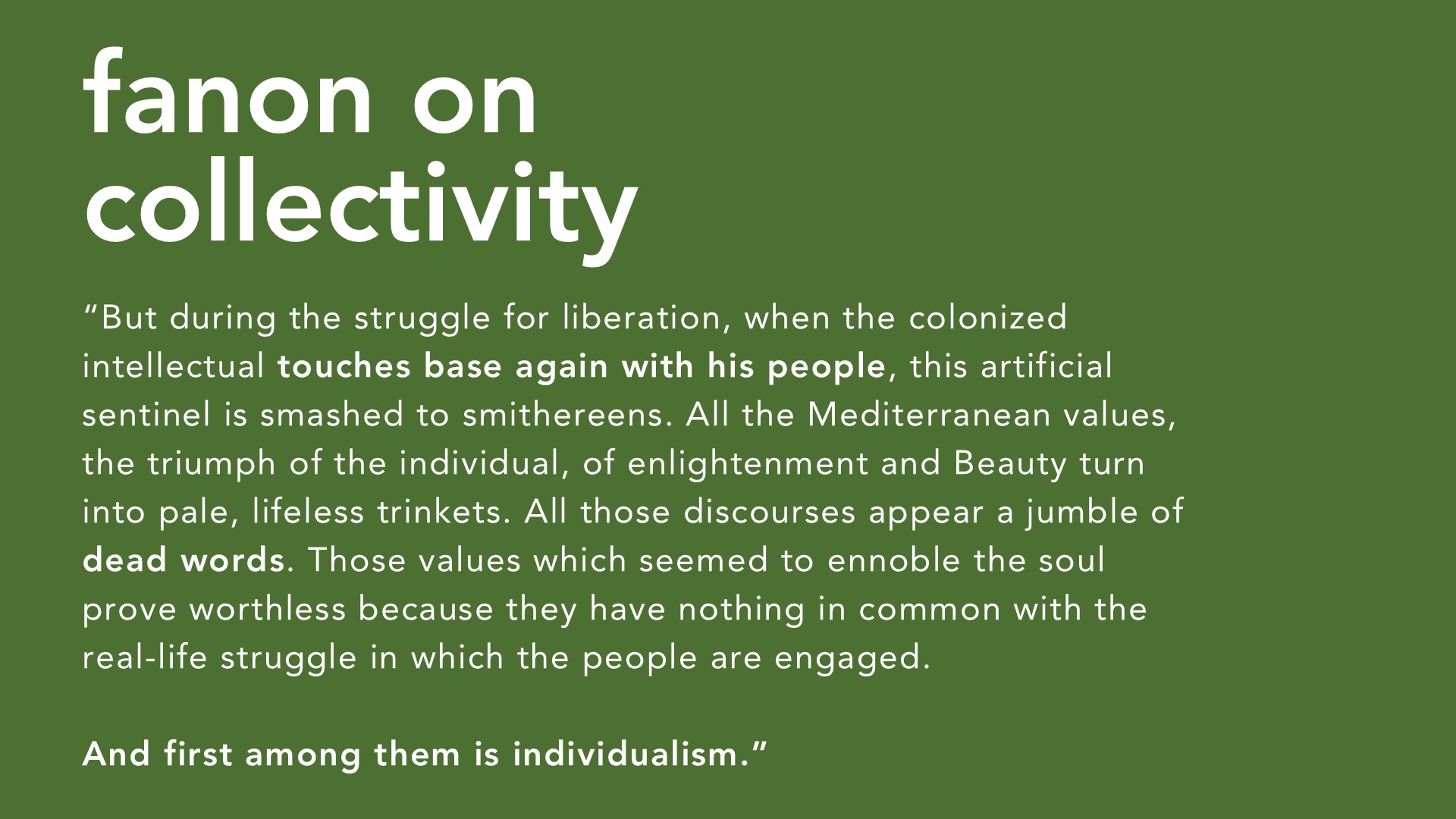
Slide reads: Fanon on Collectivity: “But during the struggle for liberation, when the colonized intellectual touches base again with his people, this artificial sentinel is smashed to smithereens. All the Mediterranean values, the triumph of the individual, of enlightenment and Beauty turn into pale, lifeless trinkets. All those discourses appear a jumble of dead words. Those values which seemed to ennoble the soul prove worthless because they have nothing in common with the real-life struggle in which the people are engaged. And first among them is individualism.”
This idea was first transported and enraptured into and unto me by anti-colonial thinker and Black liberationist psycho-analyst Franz Fanon. I think the way that we usually hear about community is as a confectionery, milquetoast, and toothless platitude. But in Wretched of the Earth, Fanon designates collectivity as an insurrectionary modality of existence, simultaneously consigning individualism resolutely as one of the first of colonial-capitalist values that must be smashed to smithereens in order for us to take back our lifeways and reinvent ourselves as persuaders of liberation.
He writes: “the colonized intellectual learned from his masters that the individual must assert himself. The colonialist bourgeoisie hammered into the colonized mind the notion of a society of individuals where each is locked in his subjectivity, where wealth lies in thought. But the colonized intellectual who is lucky enough to bunker down with the people during the liberation struggle, will soon discover the falsity of this theory. Involvement in the organization of the struggle will already introduce him to a different vocabulary. “Brother,” “sister,” “comrade” are words outlawed by the colonialist bourgeoisie because in their thinking my brother is my wallet and my comrade, my scheming.”
Slide reads the same quote above!
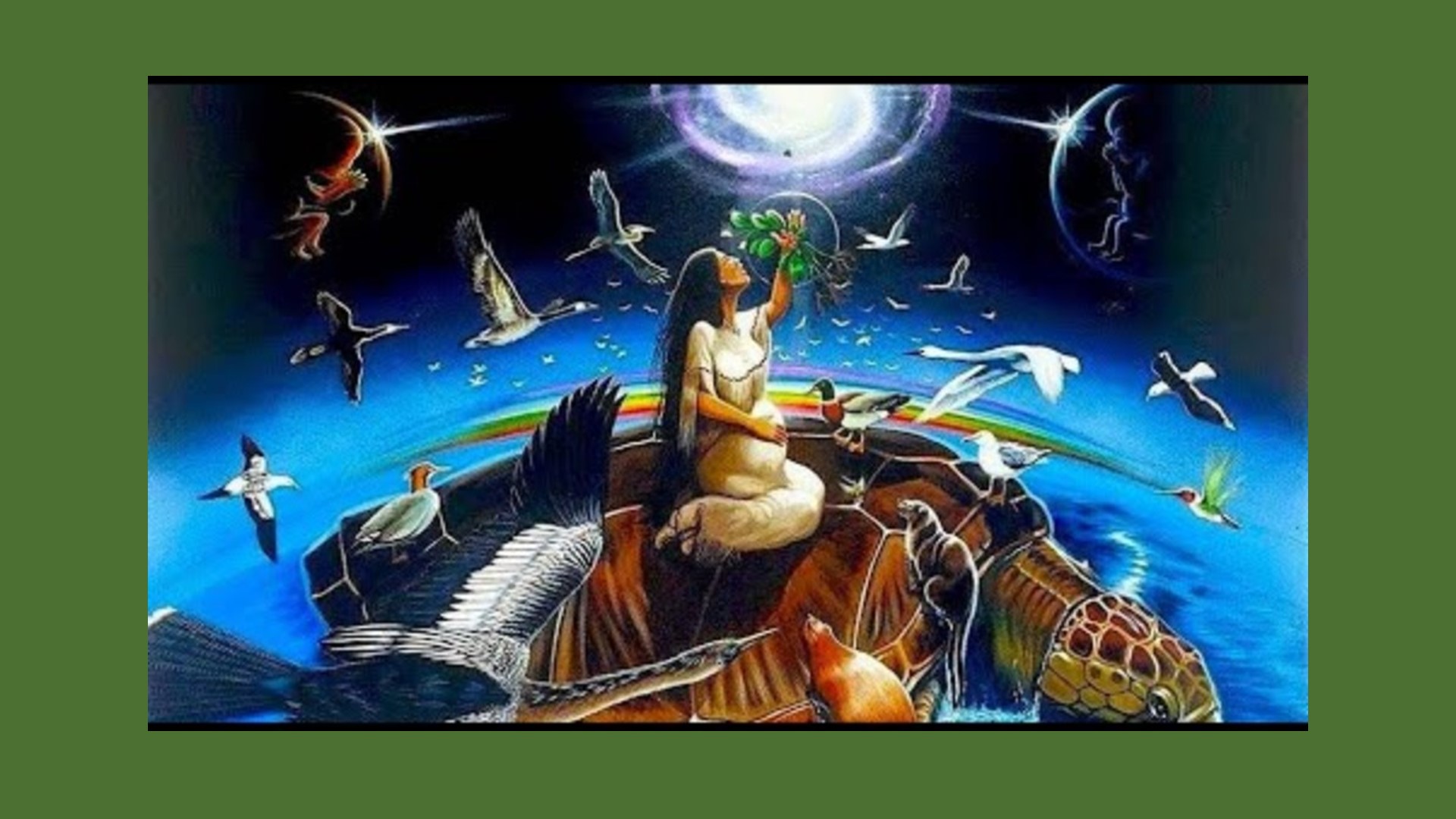
Slide description: painting of the Creation Story. Looking for an artist’s description! Will update.
Slide reads: Haudenosaunee Creation Story
- creation as a collective project borne out of the (idio)synchronicities of every being
- community begets (and perpetuates) existence
- how does this contrast with euro-western creation stories like Genesis
- canonized individualism
- one entity is consecrated as being above all as an omnipotent and omnipresent force
- dominion is granted to humans over all beings on Earth
- anchored in punitive doctrines [Adam and Eve’s misstep becomes the end of the joyous garden
- the lens through we which understand our making matters, determining the lens through which we build our lifeworlds and futures, as either “marked by competition” or “marked by co-operation”
Core to Indigenous epistemologies and ways of being is an immutable collectivity (Mendoza, 2020). The question of what we owe one another in and beyond this lifetime sustains me as it does Indigenous conceptualizations of (and relationships to) the world. In the Haudenosaunee Creation story, which was first narrated to me by Dr. Brandon Tehanyatarí:ya’ks Martin of Six Nations Grand River Territory (Kanyenkehá:ka nation), Skywoman and an ecosystem of animals work coalitionally to terraform a featureless world into a rich, multifarious one. Here, creation is a collective project that comes about only from the (idio)synchronicities and labours of every being (King, 2003). Community begets (and perpetuates) existence. In stark contrast, the colonial Western world is funded and fueled by a canonized individualism that convinces us we’re more valuable when we can exist in solitary. Violating this innate need for kinship and connectedness also makes inevitable ruptures in our cultural identity, our body-mind wholeness, and our situatedness in the larger universe (Carriere & Richardson, 2009). Said differently, an abandoning of community is an abandonment of the self. “We need each other,” writes transformative justice educator Mia Mingus (2010) on her blog Leave Evidence. “And everytime we turn away from each other, we turn away from ourselves.”
Discussion:
Who/what do you turn to in order to turn back to yourself? Who makes up your community?
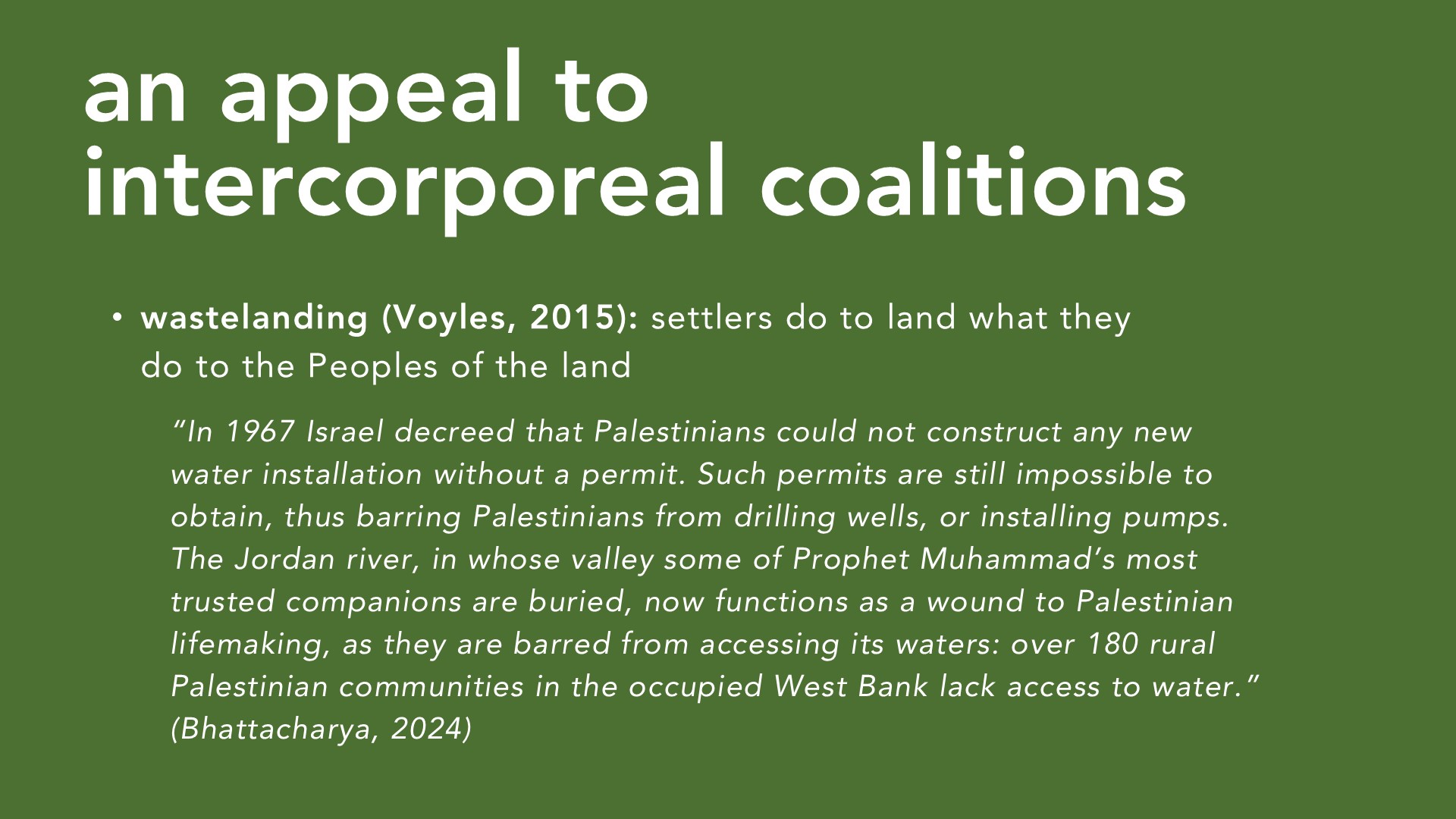
I’m grateful that a lot of us integrate non-human beings into our community constituents. In the white Western imaginary, the human is coded (and consequently treated as) the proverbial king of the biosphere. When humans are positioned as formidable by deistic or hegemonic powers, any life that is not our own is subordinated, misused, and mistreated. As Mohawk writer Beth Brant puts it, Indigenous Peoples “do not worship nature. We are part of it.” Because there is no inherent separation between the human and their environment in Indigenous knowledge systems, an assault on the land, an assault on a tree, on flora and fauna, on the soils and subsoils of an ecosystem, is an assault on its caretakers. In learning from and applying Voyles’s (2015) ‘wastelanding’ framework, settlers do to the land what they do to the Peoples of the land. It’s why resource extraction, land expropriation, livestock devastation have all wreaked havoc not merely on the terra firma, the seas, and the air, but equally on the spirits and body-minds of Indigenous Peoples globally (Jaffee & John, 2018). Indigenous epistemes, then, offer us a precious value for imagining solidarity that recognizes the inextricable ties between person and land while “foregrounding Indigenous sovereignty as sine qua non in imagining futures which to struggle” (p. 1415).
Sticky Note Example
“In 1967 Israel decreed that Palestinians could not construct any new water installation without a permit. Such permits are still impossible to obtain, thus barring Palestinians from drilling wells, or installing pumps. The Jordan river, in whose valley some of Prophet Muhammad’s most trusted companions are buried, now functions as a wound to Palestinian lifemaking, as they are barred from accessing its waters: over 180 rural Palestinian communities in the occupied West Bank lack access to water.” (Bhattacharya, 2024)
In intimate assemblages, disability intercorporeality and the labour of attendant care, Kelly Fritsch writes: at the limits of the self, we find all others: other people, other species, and other forms of vibrant matter. The ―I‖ cracks into an-other and risks the autonomy it could never fully claim. In rethinking disability and the body in terms of becoming, assemblages, and relational connections of non-ordered organisms, we begin the work of imagining livable worlds.
It is important that our appeal to collectivity as a path of reckoning be an intercorporeal one. Intercorporeality signals that the “experience of being embodied is never a private affair, but is always already mediated by our continual interactions with other human and nonhuman bodies” (Weiss, 1999, p. 5).
To put this another way and to reiterate our initial appeal to collectivity, our struggle have to be interconnected and communalized because our lives already are. We ought to discard this descartian idea of I think therefore I am and replace it instead with I am because We are.
The edifices of disability justice lend itself to a politics of alliance because disability justice understands that we have no other choice.
In his book on the praxistisical arena of life-making, Dean Spade describes mutual aid is the “collective coordination to meet each other’s needs, usually from an awareness that the systems we have in place are not going to meet them.” Akin and in tandem with cultural access work, mutual aid is part and parcel with the fabric of what social-reproduction feminists and scholars have termed lifemaking, describing the ways in which we “labor to transform nature to maintain ourselves and satisfy our needs” (Bhattacharya, 2024)
and there is nothing new about mutual aid—peple have worked together to survive for not just all of history, but everyday contemporarily. Mutual aid is the part of movement work that keeps alive, as in the work we do in our communities to meet immediate survival needs separate from the state. It also charts the ways we shape and make material infrastructure of care autonomous from the soils and subsoils of colonial-capitalism: prying us loose from it and tethering us to each other.
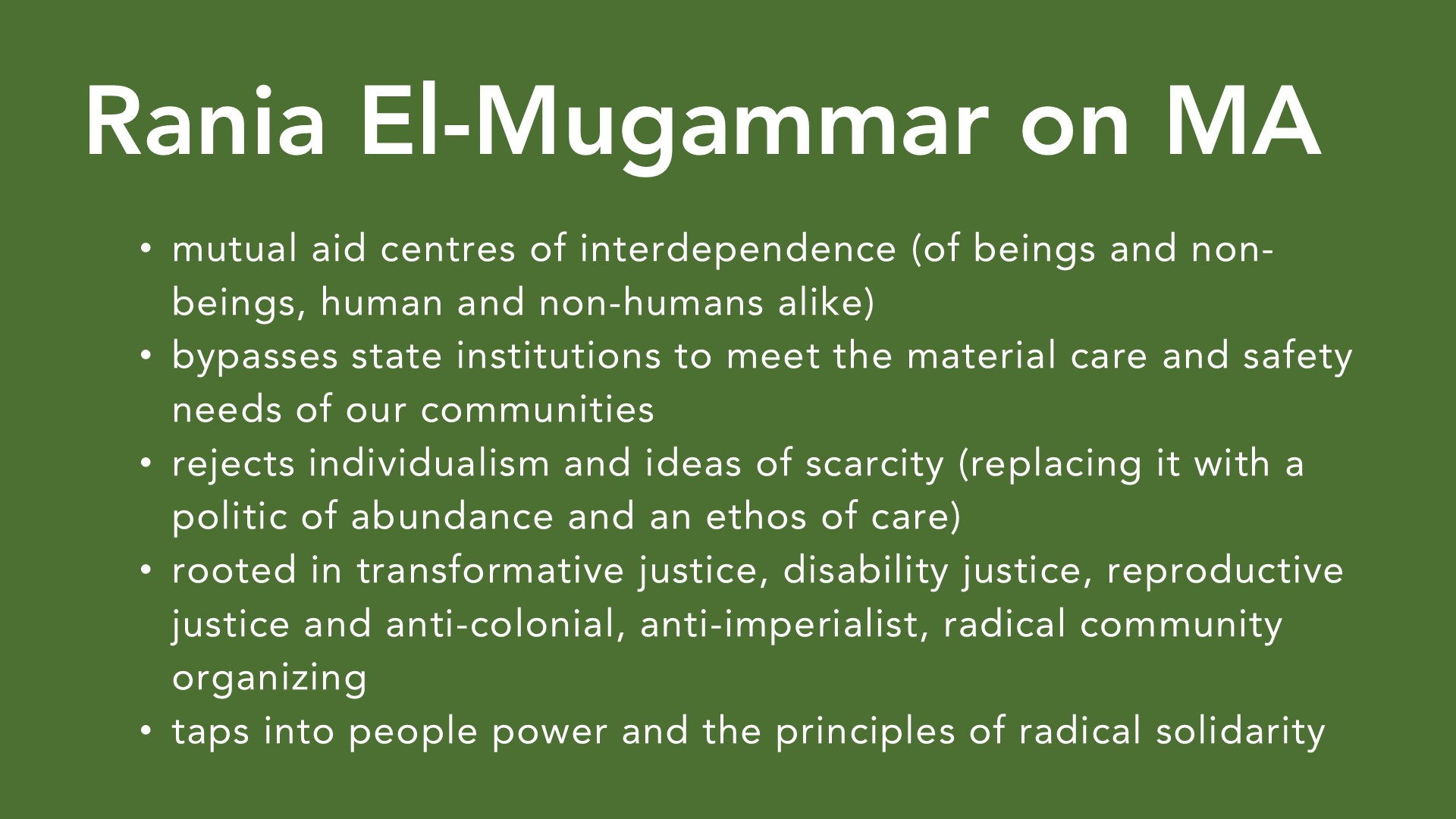
Here are some key tenets of mutual aid as outlined by toronto-based transformative justice worker, Rania El-Mugammar:
- Mutual aid centres of interdependence (of beings and non-beings, human and non-humans alike)
- Bypasses state institutions to meet the material care and safety needs of our communities
- Rejects individualism and ideas of scarcity (replacing it with a politic of abundance and an ethos of care)
- Rooted in transformative justice, disability justice, reproductive justice and anti-colonial, anti-imperialist, radical community organizing
- Taps into people power and the principles of radical solidarity
Discussion:
Where do you see mutual aid show up in your lives? In what ways is this also a form of decolonial cultural access work?
Think to the ways, for example, that disabled people kept and continue to keep each other alive during the ongoing COVID-19 pandemic. In their narration of the early years of the pandemic, Leah Lakshimi recalls the strategies of mutual aid invented by crip survivance: “We stayed up late researching what scientists were saying, reading every article and sharing them. We spread the word about when Vogmask and other N95s equivalents went on sale, and bought them for each other in the ten minutes they were available before they sold out. Crips found medical fabric, sewed and mailed out masks to crips in other cities.” Think also to how disabled people this world over have been raising funds to get as many eSims as possible in Gaza through cripsforesims for Gaza, siphoning and constructing capacitating systems of communication directly into Falasteen as the apartheid state of Israel attacks wifi and cellular service over and over and over again, throttling abilities for folks to get information and contact their families and their friends. Fully-masked mutual aid markets that marshall money directly to survival funds for Palestinian, Sudanese and Congolese families.
Access and disability justice access work in the examples above are not just outgrowths of mutual aid or inspired by mutual aid but are in and of themselves mutual aid work, that is work where we “choose to help each other out, share things, and put time and resources into caring for” another instead of waiting for a state-ordained saviour to rescue us. We know, as disabled and so-called surplus people, we know that rescue is but a mirage that renders most of our our lives disposable and all of our deaths tangential. As Spade writes,“our ability to build mutual aid will determine whether we win the world we long for or dive deeper into crisis.”
Slide reads:
obligation-based approach to DJ
mutual reciprocal obligations are what “makes us human, according to Cornell, “not just the reality of our social connectedness, but the way in which each of us lives up to the obligations to those who have supported us, and to the broader community in which we live. But this living up to the obligation is not altruism or sacrifice, because the other side of it is that others must live up to their obligation to us […] (Cornell, 2014, p. 69)
Mutual Aid called for what African decolonial disability studies thinker Oche Onazi names as an obligation-based approach to disability justice. In their paper Decolonizing Disability Studies, Onazi (2024) calls on the African concept of ubuntu. Although it is hard if not impossible to translate into English, Drucialla Cornell (2005) defines ubuntu as ‘an interactive ethic, or ontic orientation in which who and how we can be as human beings is always shaped in our interaction with each other.’ This is achieved, Onazi argues, through mutual reciprocal obligations. This is what makes us human, according to Cornell, “not just the reality of our social connectedness, but the way in which each of us lives up to the obligations to those who have supported us, and to the broader community in which we live. But this living up to the obligation is not altruism or sacrifice, because the other side of it is that others must live up to their obligation to us […] (Cornell, 2014, p. 69)
Sticky Note Case Study
Sticky Note Case Study: Obligation, Accountability and COVID-19. What does COVID-19 teach us about what we owe to one another and our DJ tenet to leave no one behind. The state, its institutions, media systems, stenographers and council of elites (really, anyone in alignment with the values and currents of cultural hegemony) have spent the last four years engaging in a violent and active disinformation campaign around the COVID-19 pandemic—its existence, its virality, its impacts and costs, and the people power necessary to principally and concertedly tackle and resist its mass disablement. This wholesale eugenic abandonment of the (mostly BIPOC) disabled communities sounded like news media proclamations that everyone else needn’t worry: only “the disabled and elderly are the most likely to die from the virus.” (This is both genocidal and untrue: as disability advocate and communications expert Imani Barbarin wrote in 2021, “In believing that only the disabled and elderly would be affected, the (currently) non-disabled unwittingly drew themselves closer to the cliff’s edge.”
“Disability doesn’t care whether you’re healthy or not, nor what your goals are,” she continues. “It can happen to anyone, moment by moment, breath, by breath, word by word. The only way to guarantee that all people can be safe is in a world where the needs of the disabled are centered.” Centering the needs of disabled people, particularly ones who occupy multiplicative and simultaneous identities of Otherhood and who are more acutely impacted by the effects of COVID, means acknowledging the existence and persistence of the COVID-19 pandemic and (more importantly) acting accordingly. If we know that mutual aid is about ensuring one another’s survival in the immediate in order to ensure our survival in the longterm, then masking can and must be framed as inseparable from mutual aid. COVID-19 has also taught us that state does not keep us safe because its allegiance is to power, because they are steward of landtheft and of capital. We, on the other hand, pay allegiance to ubuntu. We pay allegiance only to one another
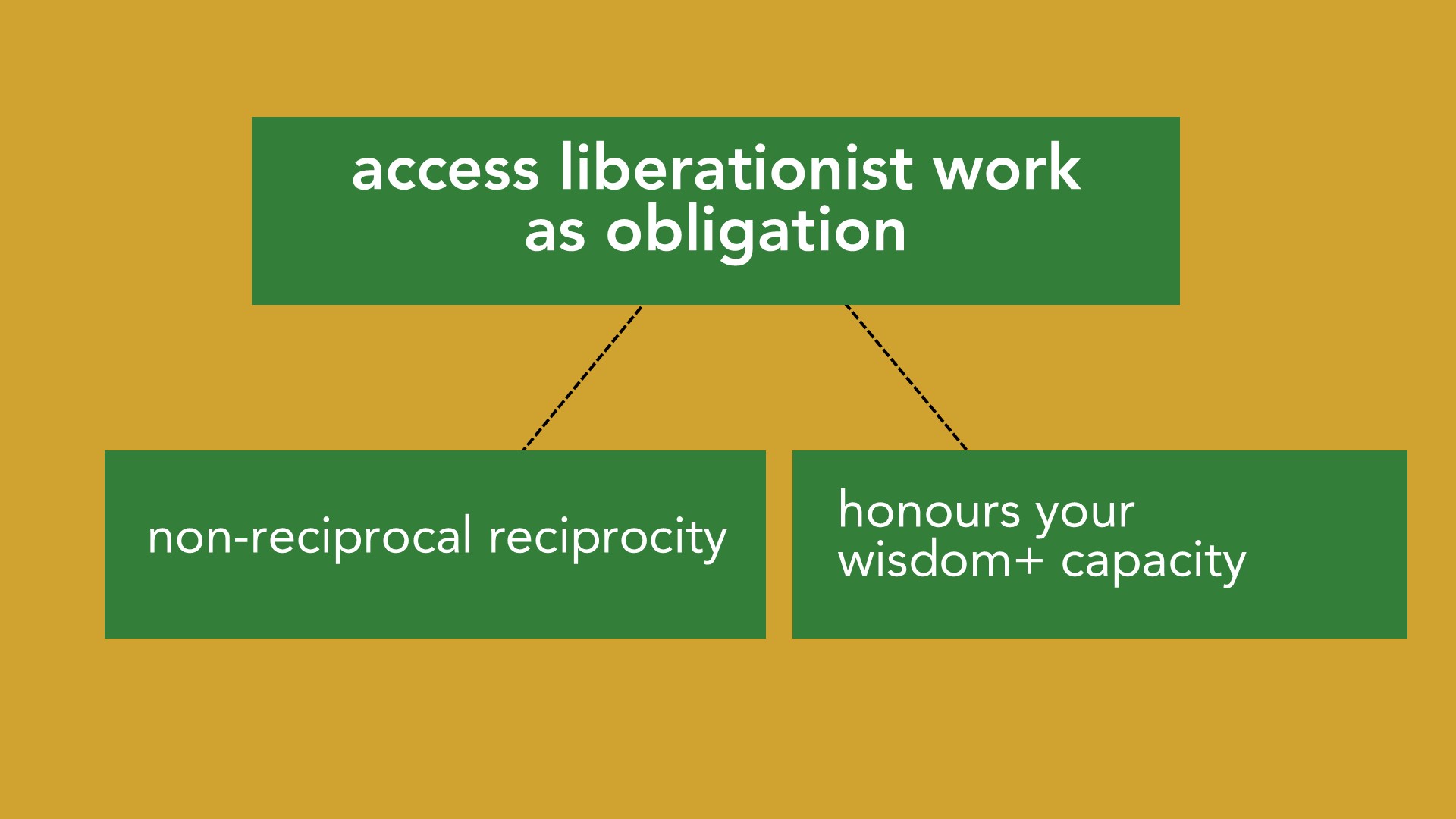
Slide reads: A diagram with one big box on the top, and two smaller boxes branching out below it. The big box reads access liberation work as obligation, with the two branching boxes reading “non-reciprocal reciprocity” and “honours your wisdom + capacity”
Onazi asks, well what happens when communities are disabled? When obligations are hard to tend to because we operate on crip time, because our bodyminds and their biomes are fickle and precarious and arrhythmic? When we are sick more often than we are not, when we don’t have the financial or economic or material resources to show up for our communities in the ways our communities deserve. The response to this is twofold:
First: Obligations and their reciprocal nature is not by definition a transactional or even symmetrical engagement. We’ve been led to believe that mutual aid work is ratioed labour. It is a 1 for 1 give and take. African communitarian philosophy, though, contends that to “to help, give, from this perspective, is thus not based on the assumption that the person giving will be reciprocated but emphatically hinges on the possibility of non-reciprocity…if reciprocity does not occur, the system will still work, in a literal sense, for those who need it” (Stuit, 2016). If we take collective liberation seriously, we have to take seriously how we treat each other in the daily work of sustaining our community and of sustaining struggle
Second: What you bring to collective consciousness and liberationist access work cannot, will not, and should not look the same as what the person next you brings. We learn from disability justice teachings in knowing that there is no one right way to be or show up and disrupt and be. And that these variances in embodiments and enmindments are in fact charting new collective ways of struggle.While our shared visions and values should be rooted in the same or similar tenets of struggle, there will always be something that you can do and be as part of affective/effective assemblage of solidarity. This is why skill and information sharing is a HUGE part of both crip access work and of mutual aid. Because alone we know some things but together we know A LOT.
Question:
What skills can you specifically bring into the community spaces that you are in?
I want to end with a quote from Tracy Rosenthal and Leonardo Vilchis’ Abolish Rent: “We work upon the world, and we ourselves are changed by doing so. We experiment with strategies that intervene in our material reality and find communion with a movement of tenants, a purpose to our work greater than the sum of its parts, in intergenerational commitment for building a future unlike our present, a future worthy of us and our love. We see that collective organization can transform structures that we inherit as natural and think will be internal. We find that our reality is plastic. On a daily basis, we consent to its making and being remade. In other words, its transformation is in our hands; its up to us to work together to make the reality we want real.
Additional Notes to consider:
Case Study: Wingspan and Flourishing + Refusing Realities of Atomization and Individuation (or: Criphood as inherently and necessarily Collective Lifeworld)
Flourishing reflects a series of exhibitions and performances that comprise a multi-partnered collaboration to venture into the plural meanings and interpretations of the value of human life. Flourishing explores and expands the concept of human flourishing to include the diverse experiences of frailty, disability, and suffering. The project was sparked by questions arising from the legislation of MAID (Medical Assistance in Dying), “reconciling co-opted narratives” of what it means live in body-minds deemed fraught, tenuous, unviable, untenable and futureless.
In their reflection of the project, Sean Lee names the exhibition as being informed by the collectivity and mutualism of disability. “It wasn’t until these artists came together, met, and found organic moments to desire disability differently that flourishing could embody anything more than idea. Communal-ness and communalism as both access work and as a prerequisite to creative crip worldmaking project (Adom Getachew) is cemented and fomented within the projects aims, contours, and outputs. Flourishing thus challenged a socially indoctrinated seduction to individuality as central, as King. Curator Yousef Abdullah Kadoura was anchored by a collaborative iteration of curation, guided by doctrines of co-creation, radical knowledge and idea sharing, and a decentralized artistic vision brought up dialogically to honour the multimodal forms of making and communication within crip, Mad, deaf, and disabled life ways.