
Studio Class Three
Workshop Notes and Slideshow: Funding and Covid Consciousness
Workshop Three: Funding and Covid Consciousness
Honouring Alice Wong
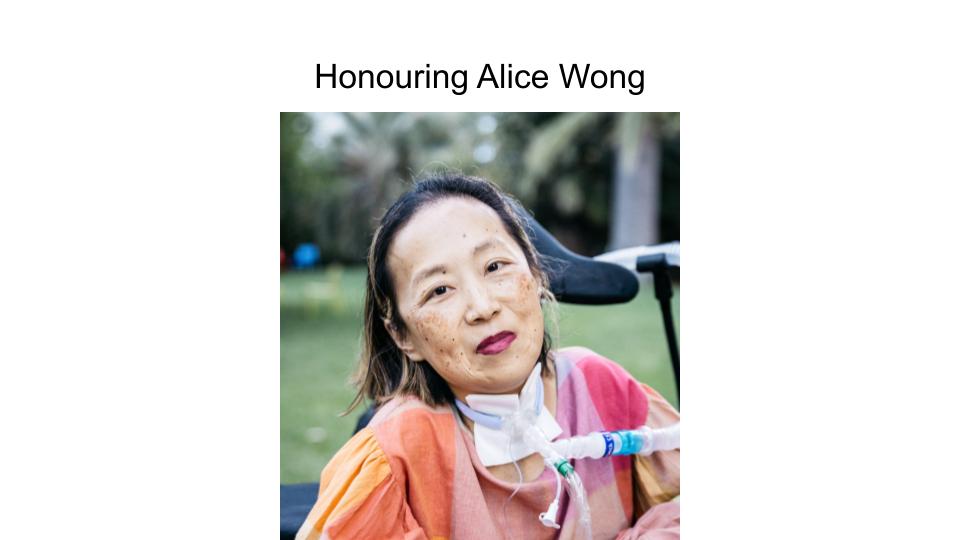
Image description: Alice Wong, an East Asian woman, sits outdoors in a power wheelchair, looking directly at the camera. She has shoulder-length dark hair with lighter ends, a face marked with visible freckles and age spots, and wears dark pink lipstick. A white tracheostomy tube with clear ventilator tubing runs from her neck toward the right side of the frame, supported by the headrest of her chair. She is dressed in a loose, flowing top with wide sleeves in warm blocks of colour of pinks, oranges, and yellows. The background is slightly blurred, showing green grass, trees, and soft natural light.
Alice Wong (1974–2025) was a disabled activist, writer, community organizer, and a disability justice leader whose work reshaped how many of us think about access, liberation for disabled people, disability culture, and political organizing. She founded the Disability Visibility Project, an online community and oral-history initiative created to record and share stories by disabled people and build a living archive of disability culture. Alice published several books that have shaped disability studies, disability culture, and disability justice, including Disability Visibility, Disability Intimacy, and Year of the Tiger: An Activist’s Life. I’d encourage you to check these out if you haven’t already! Alice was also a co-founder of digital campaigns like #CripTheVote – an online disability justice campaign that centres disabled people in online politics – and Access Is Love – a campaign invites people to treat access as a shared, everyday responsibility something we practice in relationships, events, and movements rather than something handled by one “access person” or required only by law, and, more recently, helped launch Crips for eSIMs for Gaza, a disabled-led effort to fund internet access for Palestinians in Gaza.
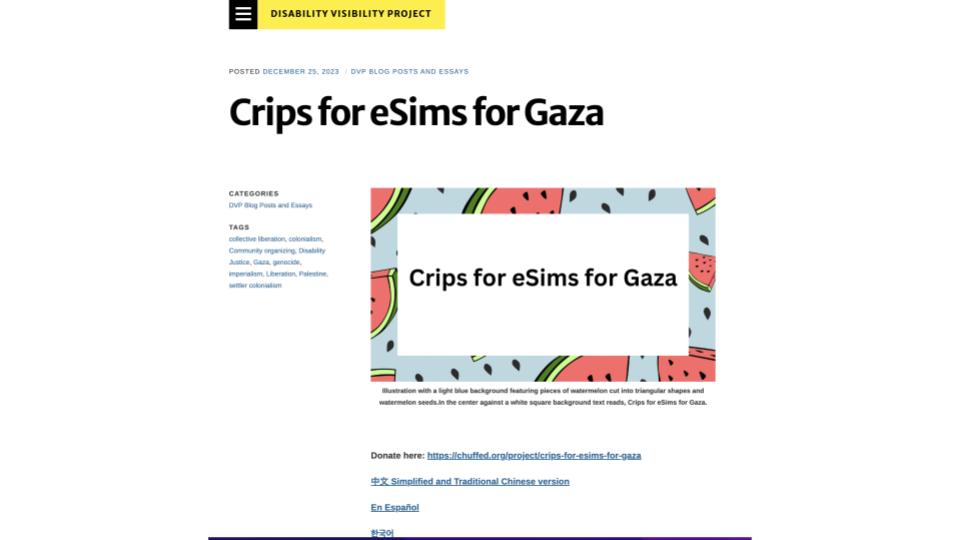
Image Description: This slide shows a screenshot of the Disability Visibility Project page describing Crips for eSims for Gaza. The words Crips for eSims for Gaza are surrounded by a light blue border with illustrated watermelons and watermelon seeds.
In honour of Alice, I invite you to join the eSIMs for Gaza by donating and/or amplifying this campaign.
In a post paying tribute to Alice, disability justice activists Jane Shi and Leah Lakshmi Piezna-Samarasinha write, “She was the framework, the bulwark, the person with big dreams and a big life who built a big framework for disabled people and organizing.”
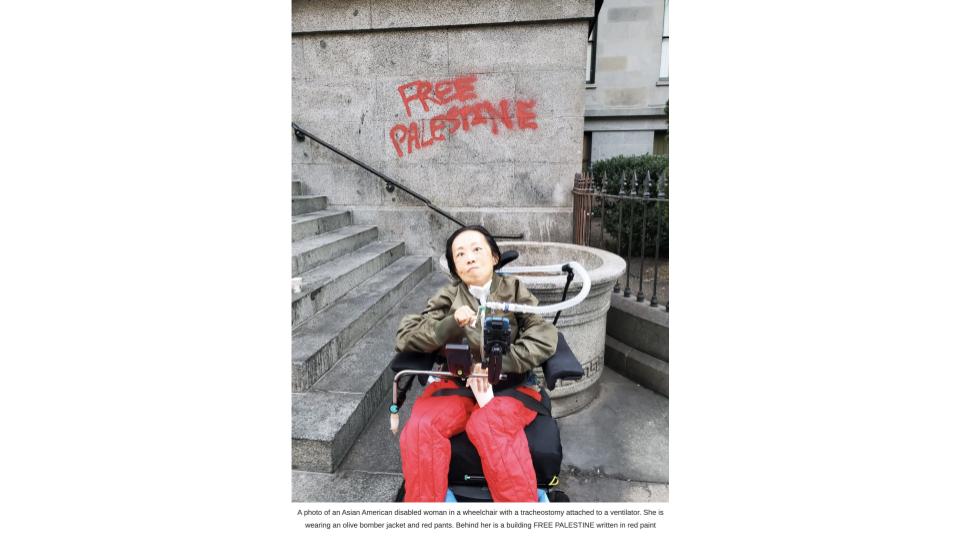
Image description:
A photo of an Asian American disabled woman in a wheelchair with a tracheostomy attached to a ventilator. She is wearing an olive bomber jacket and red pants. Behind her is a building FREE PALESTINE written in red paint
In this class, we read Alice’s article, Why Palestinian Liberation is a Disability Issue? I’d like to read a little bit from this article:
Several years ago I organized an event at a local Jewish organization and planned another collaboration when some close friends told me it receives funding from the state of Israel and why that is problematic. My friends, Jews from the disability community, didn’t pressure me to do anything and offered me more information about Zionism and the BDS movement. It was the first time I started to educate myself on this issue. In my conversations with them, I expressed fears of being called an anti Semite and discomfort at not being Jewish, Arab, or Muslim from the region or the diaspora who have a deeper understanding of the politics, history, and cultures involved. It took years of growth and reflection to realize I was totally wrong. Everyone has a stake in defending humanity and dignity and Palestinian liberation is tied to disability justice.
From the Abolition and Disability Justice Collective, “Disability justice cannot exist under settler colonialism, military occupation, imprisonment, and apartheid. We write this in support of the Palestinian struggle for freedom, dignity, and self-determination… Disability justice requires solidarity with Palestine.” Outlined by Patty Berne, one principle of disability justice is collective liberation and it is about being in solidarity with others and realizing our liberation is tied to the liberation of others.
A report by Human Rights Watch documented the disproportionate impact on disabled Palestinians from hospital bombings, power and Internet outages, the trauma and mental health toll, and forced evacuations without access to transport, healthcare, communication, food, water, shelter or electricity. It was painful and distressing when I saw images of older people in wheelchairs pushed by family members as they fled, children and adults going through surgeries without anesthesia, and babies in ICUs left behind bombed hospitals. As a person dependent on electricity for my ventilator and numerous machines to keep me alive, it was particularly triggering when I saw a photo of a nurse manually ventilating a child because Israel cut off electricity and targeted attacks on entire regions in Gaza including numerous hospitals.
Solidarity isn’t transactional or conditional. While it’s clear that approximately 50,000 disabled Gazans face great danger, disabled people shouldn’t care because they can relate to what is happening. Cross-movement solidarity is another disability justice principle that I deeply believe in. We need to build relationships and show up for other movements because that’s a way to build power and it’s just the right thing to do.
Does anyone want to share a story about Alice? What they’ve learned from Alice? If you’d like to share on the Discord please do!
Funding Discussion
What We Expanded on in Class – covered in collective notes and class recording
- Thinking critically about where funding comes from
- Practical tips for finding funding
- Tips for working through “access roadblocks”
Funding Resources – Three Local Funding Opportunities (and one to avoid)
Enabling Accessibility Fund
https://www.canada.ca/en/employment-social-development/programs/enabling-accessibility-fund.html
Purpose: provides grant funding for small-scale construction and communication technology projects, up to 200,000 per project; can also provide “contribution” funding up to 3 million for larger scale projects serving disabled people in their communities or labour market
o Examples given:
- Building ramps, accessible doors & washrooms
- Installing screen reader devices and hearing loop systems
- Constructing universally designed office
- Creating accessible playground
o EAF has flat rates they will calculate funding for specific access tools like ramps, accessible washrooms, elevators, etc
Two streams:
o One aimed at access projects which target participants, users of organization’s programs & services: Community Accessibility Project
o One aimed at “employees with disabilities” in organization: Workplace Accessibility Project
Toronto Arts Council Grants
Note: we heard about these grants as a potential option, but upon further research found it was connected to Toronto Arts Foundation, which receives donations from zionist organization the Azrieli Foundation. I (Finn) found this out from this super helpful website:
https://www.justpeaceadvocates.ca/the-azrieli-foundation-is-more-than-it-seems/#recipients
But you can also usually find info about a grant or organization’s funders, as Sama discussed in class, from their Yearly Reports or Budget information that they make public usually on their website.
Ontario Arts Council – Deaf and Disability Arts Projects & Deaf and Disability Arts: Materials for Visual Artists
https://www.arts.on.ca/grants/deaf-and-disability-arts-projects
Deaf and Disability Arts Projects
Supports:
- Ontario based disabled and/or Deaf artists and arts professionals
- Ad hoc groups, collectives, and arts orgs mandated to serve and led by artists or arts professionals who are Deaf and/or disabled
- “The application must demonstrate that the artistic process is led by artists and/or arts professionals who are Deaf and/or have a disability.”
3 categories of program:
Creation – help cover costs of research and development, exploration and experimentation, creation of new work
- Up to 10,000
Production – help cover costs of production and/or creation of artworks
- Up to 10,000
Professional development – help cover costs of study or training, mentorship, internship or apprenticeship, and/or documentation of artwork
- Up to 10,000
Note:
- Applicants may only apply to one category per deadline (was Oct. 15, 2025)
- Grant amount can be less than what was requested
Deaf and Disability Arts: materials for Visual Artists
Supports:
- Deaf and/or disabled artists working in visual art or craft practices to purchase materials
o Amount: $500
- (partial grants not awarded – must have 500$ worth of expenses)
o What it funds:
- Materials and supplies
- Small tools
- Small scale equipment, software, electronics, and similar materials required to carry out project
- Shipping and delivery costs
- Childcare and other dependant care fees enabling individuals to take part in the project
Expenses related to making project accessible to audience members and project participants (other than the applicant)
Doesn’t fund
- Student projects
- Studio set up
- Major capital expenditures
- Business and promotional expenses
- Cost of producing commercial production line
- Materials and supplies for workshop activities
Canada Council for the Arts Strategic Funds – Access Support
https://canadacouncil.ca/funding/strategic-funds/access-support
This grant is added onto another CCA grant to contribute towards cost of “Deaf and disability related supports and services required by the applicant, artistic team, and any invited participants to carry out the funded activities laid out in an associated funding application”
Supports: recipients of another CCA grant that have access related costs
Covid Consciousness
Let’s start with bringing in the wisdom of the group:
What are your own Covid consciousness practices?
What have you learned from your group mates/collaborators and mentors?
Do you have any questions about Covid consciousness in relation to your access plan that we can work through as a group?
Are you running into any tensions with your organization?
Learnings from Katie Babcock’s Interview
Tips for Masking Policy
- Communicate masking/covid policy clearly on all platforms (ticketing websites, social media)
- Communicate the reason behind it – “describing Covid in the present tense”
- Recognition that not everyone can mask
- Requiring higher quality masks (kn95 and above) when possible for people and noting the reasons why higher quality masks are necessary/important
- Training staff how to talk about covid (see above)
- Offering refunds or transfers for attendees who feel sick
- Discourage people from going into a space if they’re ill
- Announcing masking reminders at the start of an event and at intermission
Cleaning air
- HEPA filters
- Can be accessed through Clean Air Collective
- Even opening windows
- Offering outdoor spaces for people to unmask and eat and drink rather than indoors
- Co2 monitors
- (measuring carbon dioxide levels can serve as a proxy for measuring the potential amount of covid in the air)
- Offering mask mandatory shows/events
- If not every one, picking a certain amount per month
- Survey audience to understand how many might want to mask
Tips for dealing with push back
- Communicating covid as an “ongoing risk”
- “untimely”/”excess deaths” ongoing
- note: not just number of deaths but the number of people who are being debilitated, becoming disabled through long Covid – being reminded of this and making people aware of collective responsibility to one another
- Masking as a key safety tool that also protects from other airborne illnesses and pollutants
- Providing education about covid
- communicating masking as part of “access and inclusion”
- “So we want, we want everyone to be able to access the arts, to be able to have joy. A lot of the community has faced a lot of grief and abandonment over the last, I want to say at least 3 years, or maybe 5, but there’s been a ton of that so losing friends, losing family over masking or over choosing safety over relationships.”
- It doesn’t have to be all or nothing
- Sliding scale of covid safety tools
- Linking masking and covid safety to organizational values
- Linking to existing values and adding it to mission/vision/values
Expanding on Katie’s Suggestions
- Articulating masking as a part of solidarity, love for each other, resistance
- Considering covid within socio-political context, colonial death-making, neoliberalism
- Considering masking/individual covid measures as a way of protecting people who also cannot mask
- Consider people who are negatively racialized and cannot risk potential for increased surveillance/policing; people whose access needs conflict with masking, etc – ppl should not have to be exposed just because they individually cannot mask
- For theatres/events/performances – consider actors, musicians, speakers, who may not be masking during their performance – they should be protected
Communicating accessible information about covid
- Long covid, what covid does to the body, what covid safety measures are proven to be helpful
- Communicating accessible information about safety measures
- That are not just relevant to white people, rich people
- Leaving room for the guilt, defensiveness, fear people have about long term illness & masking (being careful about shame and policing of people about masking and their covid measures)
- As well as making space for anger, grief, fear that debilitated & sick ppl have about not seeing others mask/take covid safety measures
Think of mask mandatory events not purely as a negative/reductory thing
- Maybe this masked event offers people a moment to connect to an access tool they needed but hadn’t seen elsewhere; maybe it offers people a moment to access grief they have around covid or health & neoliberal doom
- Mask mandatory events might seem harsh or stressful to organizers but I think they can actually take a mental load off for the decision making around masking or not masking at an event (for people who don’t regularly mask)
- Making individual decisions about masking can get caught up with people’s fear of being rejected socially – if everyone is masking and it’s the ‘rule’ I think this can sometimes save people the mental load of deciding if they ‘should’?
o Creates opportunities for connection amongst disabled, debilitated & sick ppl
If you have a masking policy, have free masks available
- Organizations (and individuals!) can get free masks through Donate a Mask, Mask Blocs
- The cost of masking is really inaccessible & if an org can’t take this cost on, ultimately that’s the govt’s fault, not theirs – but orgs have more access to funding than individuals and should make sure to employ this rather than expecting people to buy masks themselves
And ultimately – Covid policies should be context specific, flexible, creative
We talked about this and expanded on ideas of collective responsibility, moral injury, the “great forgetting” of Covid in class if you’d like to check out the collective notes:
Or the class recording.
Hope everyone is doing alright and able to access some rest and ease these days!