Part 1 – Public Policies and Participation: Institutionalizing Agency for Food Security
Chapter 2 – Exercise in Democracy: Social Participation in Public Policies for Food Security in Brazil
Andhressa Fagundes*, Clara Cecília Ribeiro de Sá, Tatiana Canuto Silva, Flávia Fabrina Santos, Elisabetta Recine
*Corresponding author: afagundes16@gmail.com
1. Introduction
In Brazil, social participation (also referred to as popular participation or social control) is a constitutional right in policymaking in many areas, such as health and social assistance. (Pinheiro, 2009). It combines the principles of participatory democracy and representative democracy, ensuring the population’s involvement in the drafting, implementation, and monitoring of public policies in the three spheres of government: municipal, state, and federal (Mereles, 2016). Social participation is one of the pillars of Brazilian democracy (Andreassa, 2021), and it builds on the assumption that the Brazilian state recognizes that popular participation contributes to improving the performance of public administration (FNDE, 2023).
The Brazilian Constitution highlights the importance of social participation based on the understanding that society has multiple interests and needs and that the potential for solving problems is more significant with fairer, more participatory, and democratic decisions (Miwa & Ventura, 2020). Article 198 of Brazil’s Federal Constitution of 1988 mentions the provision for “community participation in health-related actions and services”. Article 204 mentions the population’s participation in formulating policies and controlling social assistance actions at all levels; and Article 29 mentions municipalities’ attributions, recommending the cooperation of representative associations in municipal planning (Brasil, 1988).
Although it is a right guaranteed by the Constitution, the effectiveness of social participation often depends on the political will of the governments in power. In Brazil, there have been periods when dialogue between the state and society has been interrupted, with negative consequences for the most vulnerable groups (see Rocha et al., 2026, in this volume). Thus, civil society’s involvement in public policy can be limited, in part, by government initiatives, which may or may not create the conditions for its realization. The political history in the country shows that, although constitutional, social participation is not always guaranteed (FNDE, 2023).
The focus of this chapter is the dynamic of social participation in public policies for Food Security in Brazil: from post-democratization institutionalization, through periods of threat and setback, to moments of resistance and the pursuit of reconstruction led by the force of civil society. It is possible to visualize the trajectory of social participation and understand how its institutionalization, based on the 1988 Constitution, was tested and resisted periods of political dismantling. The chapter also focuses on highlighting that Brazilian democracy is not a static system, but a continuous process of construction and reconstruction, in which social participation acts as a driving force.
This chapter provides an overview of the forms and functioning of social participation in policy-making in Brazil (Section II) and analyzes the institutionalization of social participation in food and nutrition security policy after the 1988 Constitution (Section III). We consider how this institutionalization served as the basis for much resistance during periods when social participation was undermined, as well as the basis for the reconstruction of spaces for social participation since 2023 under the new administration of President Lula. The Conclusion (Section IV) is a brief reflection on the “lessons learned” along this trajectory.
2. Institutionalization of Social Participation in Brazil
Social participation in policy-making in Brazil first came to prominence in the area of health, promoted by the sanitation movement in the mid-1970s. Social movements fighting for civil and political rights in the country under a military dictatorship gave priority to health rights (Kujawa, 2022). This movement included various interest groups such as academic researchers, health professionals, and regular users of the health system.
The 8th National Health Conference, held in 1986, was an important political and social milestone in the development of the principles of social participation in policy-making in Brazil. This conference demonstrated the urgent need for significant reform of the Brazilian public health system, supporting the creation of the Unified Health System (Sistema Único de Saúde – SUS) as a constitutional right and reinforcing the importance of social participation in this debate (Carvalho, 2014).
The 1988 Constitution established the SUS and the obligation of municipal, state, and federal governments to create institutional spaces for social participation in the development, implementation, and monitoring of public policies. After that, new legislation for specific policies incorporated civil society participation based on the concept of “active citizenship” (Gohn, 2019). It is believed that social participation in public management brings about a qualitative leap in actions, with the design of public policies, which better express the diversity of needs and ways of addressing problems and gain legitimacy in their implementation (Andreassa, 2021). The institutionalization of spaces for social participation was consolidated mostly in the form of “Councils” and “Conferences” in Law No. 8,142 of 1990 (Andreassa, 2021; Avritzer & Souza, 2013; Brasil, 1990; Moura, 2010; Valla, 2000).
2.1 Councils
Councils are institutionalized spaces for dialogue between organized civil society and government representatives. As council members, ordinary citizens can play an active role in shaping public policy, influencing improvements in laws, programs, and actions that directly impact their lives. Brazil has councils in different areas, such as education, health, the environment, social assistance, and food and nutritional security (FNS). In the Brazilian public policy system, there must be consistency and complementarity between the roles and responsibilities of councils at different levels of government: municipal, state, and federal (Gurgel & Justen, 2013; Pires et al., 2024).
Councils can be “consultative/advisory” or “deliberative.” Consultative councils offer guidance and suggestions to government bodies. Deliberative councils have the power to make decisions, guide, and transform debates into actions, determining the occurrence of public initiatives (Pires et al., 2024; Kujawa, 2022).
Councils are composed of representatives from the state and civil society who discuss the direction and development of public policies. They provide greater transparency to the state’s actions and impact the distribution of public resources, resulting in less waste and greater efficiency in the services provided, while taking into account the particularities and experiences of civil society. Councils debate and make political decisions, intervening in the implementation of public policies, questioning their functioning, and proposing changes and improvements (Almeida & Emmendoerfer, 2024). Council members do not receive extra remuneration for that activity.
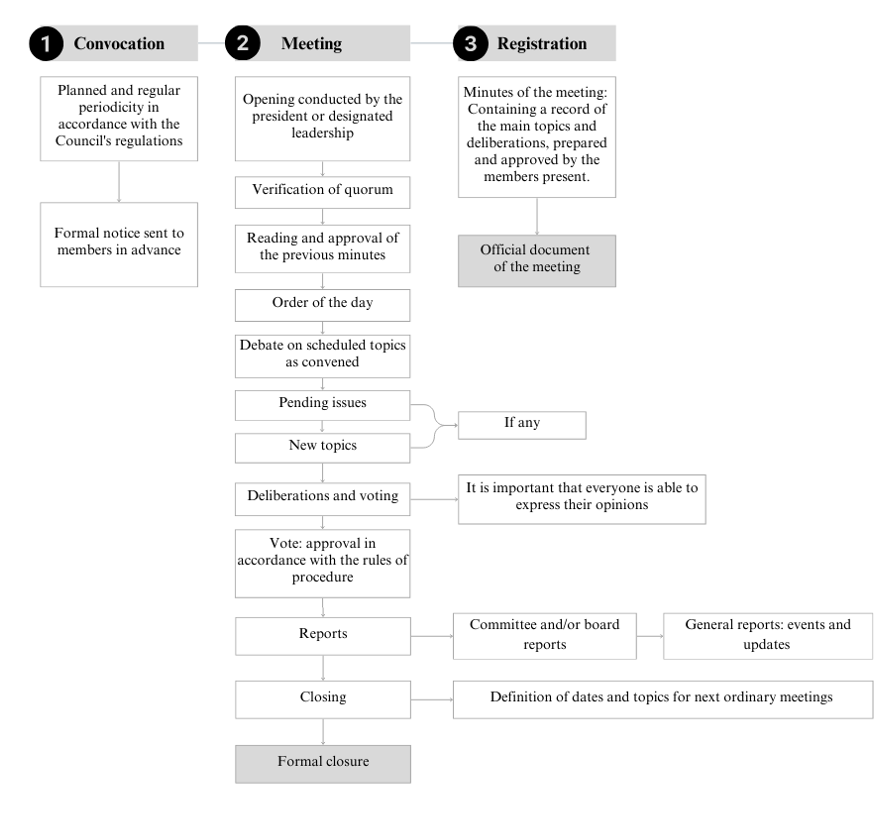
The different councils work through meetings that follow a basic operational structure illustrated in Figure 1. It is recommended that a council meeting be held in a place that is easily accessible to the participants involved, with the date, time, and agenda announced in advance. Meetings are considered permanent spaces for debating public policy and are, for the most part, open to attendance by the general public as listeners. Council meetings follow a structure defined in the council’s internal regulations to ensure that decision-making processes are ethical, legal, democratic, and transparent (Mereles, 2016).
2.2 Conferences
Conferences are convened by the councils every four years, but may be convened at shorter intervals if necessary. They represent an opportunity to broaden debate and dialogue, in which elected delegates, respecting the public sphere to which they belong (municipal, state, or federal), propose ideas, defend needs and interests, and negotiate to achieve, in the best possible way, the will of the community.
Conferences evaluate public policies and improve their guidelines and actions through broad consultation with the population. They bring together different actors, such as experts, civil society organizations, citizens, and government officials, to define and reinforce political commitments. They evaluate issues, monitor plans/actions, identify priorities, assess future needs, and develop proposals (Carvalho, 2014; Lemos, 2018). Preparatory meetings, known as pre-conferences, help align the main demands of civil society. Delegates discuss the conference theme, so they must understand the demands of the population they represent (farmers, indigenous peoples, etc.) and the challenges and deliberations of previous conferences.
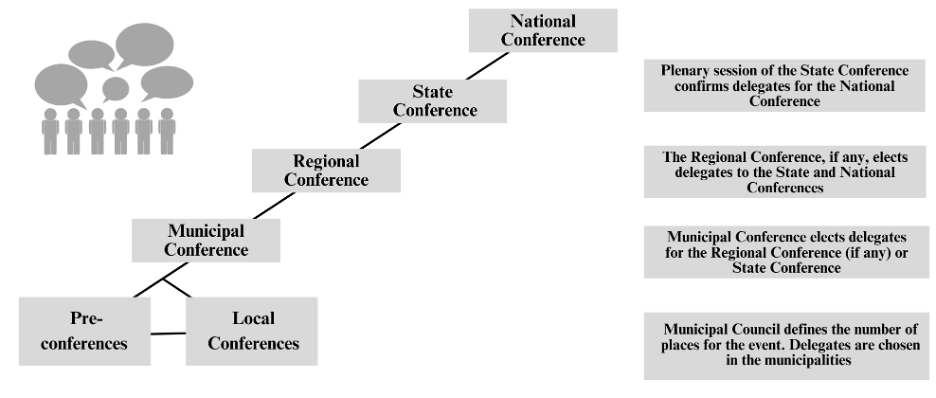
Municipal councilors participate in municipal conferences, and a few are elected as delegates representing the municipality at state conferences. From the state conferences, some delegates will also be selected to participate in national conferences. At each stage, conference programs should set aside time to elect delegates for the next stages. Delegates elected to the national conference must have been active in the previous stages, representing local demands. This process begins at the local level, i.e., in the municipality, and goes up to the national level. The link between these levels follows the so-called “principle of ascendancy” (Figure 2).
Conferences in Brazil, as much as or even more than other forms of civil society participation—including participatory budgeting—have great potential for fostering democratic practices and creating alternative spaces for representation. The State is responsible for convening and funding councils and conferences; however, it is important to note that, despite this, the outcomes of these conferences are not controlled by the State (Maluf & Nascimento, 2009; Pinto, 2009). Funding challenges, however, remain in practice, given that the budget for many conferences spreads out across various ministries, with different priorities (Nascimento, 2012).
3. Social Participation in Food and Nutrition Security Policy: Institutionalization, Setbacks and Resistance
In Brazil, Food and Nutrition Security (FNS) is defined as “the realization of everyone’s right to regular and permanent access to quality food, in sufficient quantity, without compromising access to other essential needs, based on health-promoting dietary practices that respect cultural diversity and are environmentally, culturally, economically and socially sustainable” (Casa Civil, 2006). Following the Brazilian Constitution, policymaking in this area provides for the inclusion of social participation, from the planning to the execution, monitoring, and evaluation of public policies (Casa Civil, 2006; Oliveira, 2017). Participatory governance in FNS encourages the sharing of experiences and knowledge, helps synthesize collective reflections that direct responses to food crises, and promotes the guarantee of the Human Right to Adequate Food (HRAF) and Food Sovereignty of the population (Burity, 2022).
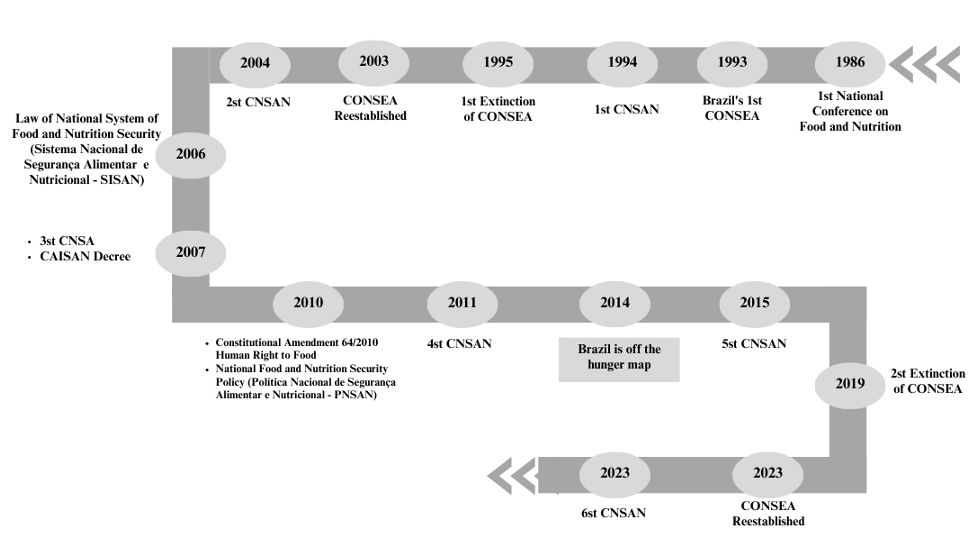
The basic structure developed for the participation of civil society in policymaking through Councils and Conferences (described in section II) is also present in the area of Food and Nutrition Security. Here we describe the advances and setbacks in the consolidation of this structure (summarized in Figure 3), which culminates with the creation of a National System for Food and Nutrition Security (SISAN) in Brazil.
3.1 CONSEA’s Trajectory
Prior to the creation of the National Council for Food and Nutrition Security (CONSEA), the First National Conference on Food and Nutrition held in 1986 was a landmark in raising awareness of FNS issues in the country (Abrandh, 2013). That conference highlighted the importance of the Human Right to Adequate Food and reinforced the need of integrating issues related to inadequate nutrition, such as malnutrition, overweight, obesity, and chronic non-communicable diseases. In the 1980s and the 1990s, these issues were not yet widely debated, but they gained momentum and became the focus of many conversations since then (Moraes et al., 2021a).
In 1993, under the leadership of Herbert (Betinho) de Souza and his very successful and popular movement (Ação da Cidadania Contra a Fome e a Miséria e pela Vida – Citizenship Action Against Hunger and Poverty and for Life), the National Council for Food and Nutrition Security (CONSEA) was created. CONSEA was the first institutionalized space for government-civil society interaction for debating FNS issues at a national level. CONSEA is a collegiate body with an advisory and deliberative nature that seeks to promote FNS in the country, ensuring the population’s Right to Adequate Food. CONSEA is directly linked to the Presidency of the Republic as an immediate advisory body, influencing in the formulation of FNS policies and in the definition of strategies to guarantee the Right to Adequate Food (Casa Civil, 2006).
CONSEA’s work seeks to expand social participation and promote intersectoral action, especially in Health, Education, Social Development, and Family Farming (Oliveira, 2017; Faria et al., 2009; Moraes et al., 2021b). Social participation is achieved mainly by appointing ⅔ of council members from civil society and ⅓ from state representatives, requiring the council chair to be a civil society representative. In the selection of council members, attention is paid to diversity in terms of gender, ethnicity, religion, and geographic region of participants, seeking broad representation (Machado et al., 2024; Pinheiro, 2009). In 2025, CONSEA had 80 councilors, including full and alternate members.
Since its conception, there were two periods under which CONSEA did not function: from 1995 and 2003, and from 2019 to 2023. CONSEA was first abolished in 1995, during the presidency of Fernando Henrique Cardoso, who did not see the value of FNS as a separate area of social policy (Abrandh, 2013). At the time, despite CONSEA’s abolition, civil society intensified its activism in food security through the Brazilian Forum for Food and Nutrition Security and Sovereignty (FBSSAN) in the following years. The Forum served as a central reference for social mobilization, advocating for the FNS agenda, and promoting the development of laws, guidelines, and policies in this area. FBSSAN also fought for the return of CONSEA and the creation of other spaces for civil society’s participation in monitoring and evaluation of public policies. This activism resulted in the reactivation of CONSEA in 2003 (under President Luis Inácio Lula da Silva) in a more structured and institutionalized way (Abrandh, 2013; Freitas, 2021; Oliveira, 2017). As part of a great public policy effort, CONSEA contributed to having the country out of the United Nations Food and Agriculture Organization (FAO) Hunger Map in 2014.
In 2019, on the first day of President Bolsonaro’s administration, CONSEA was abolished a second time, through a presidential decree (Castro, 2019; Oliveira et al., 2022; Recine et al., 2020). This dissolution resulted in a significant loss of institutionalized space for debate and the fight for the right to adequate food in the country, drastically reducing social participation in FNS-related policy issues in the following four years. The Bolsonaro government neglected or completely dismantled many FNS policies and programs. As a result, there was an increase in food insecurity and hunger, further aggravated by the COVID-19 pandemic. Brazil had returned to the Hunger Map (Rede Penssan, 2022).
Once again, civil society resisted and mobilized. In 2019, civil society convened the People’s Conference on Food and Nutrition Security and Sovereignty, which had the participation of many of the organizations that were previously composing CONSEA. The main goal of the People’s Conference was to build up resistance and develop strategies aimed at protecting FNS public policies (Nagib, 2020). The Conference also served as an opportunity for collective reflection on the importance of more robust institutionalization for full and continuous social participation in policy-making as envisioned in the Federal Constitution. In a context where social participation was officially undermined (under the Bolsonaro government), the important role of FNS activists became clear. FNS activists were there to strengthen social participation, contribute to the creation of spaces for articulation on the issue, and promote the development of skills through technical training and the dissemination of knowledge in different instances and territories (Ribeiro & Bógus, 2021).
Many councils at state and municipal levels maintained their activities and supported public protests and actions such as the Banquetaço (“Big Banquet”), a civil society mobilization for the free distribution of meals prepared with food produced by family farming, raising awareness in society about the importance of real food and social participation. The Banquetaço events, which took place in public spaces all over the country, brought together producers, farmers, cooks, nutritionists, chefs, social movements, agronomists, activists, and FNS scholars (Dória & Azevedo, 2019). Banquetaço also appeared at strategic moments and commemorative dates, such as World Food Day.
CONSEA returned once again in 2023 with the election of President Lula, reaffirming the federal government’s commitment to ending hunger in Brazil. That same year, the 6th National Conference on Food and Nutrition Security was held, with the theme “Eradicating hunger and guaranteeing rights with real food, democracy, and equity”. The Conference highlighted the importance of the commitment to mobilizing society, defending democracy, confronting hunger, and guaranteeing the Right to Adequate Food for all (CONSEA, 2023).
In his inauguration speech in 2023, President Lula emphasized that the main mission of his new term was, once again, to remove Brazil from the Hunger Map. The first year of the new government was dedicated to the recovery of essential programs, which had been previously undermined, such as the Family Grant Program (Bolsa Família), the National School Food Program (PNAE), and the Food Acquisition Program (PAA). The Brazil without Hunger Plan, coordinated by the Ministry of Development and Social Assistance, Family, and Fight against Hunger, reflected the new government efforts in advancing FNS public policies. Its main goal was to remove the country from the Hunger Map by 2030 and to ensure the human right to adequate food (MDS, 2024). The resumption of structural and emergency policies to combat hunger resulted in Brazil’s exit from the Hunger Map ahead of the target year, in 2025.
3.2 SISAN – the National System for Food and Nutrition Security
Between 2003 and 2016, the fight against hunger and malnutrition gained centrality in the Brazilian federal government’s political agenda. Civil society had an essential role in public policies during that period (Burity, 2022; Casa Civil, 2006; Maluf et al., 2021). The coordinated strategy of policies and programs and the implementation of participatory governance contributed to Brazil leaving the FAO’s Hunger Map in 2014, and being recognized worldwide as an example for the set of programs and policies that produced this concrete result (Castro, 2019).
CONSEA significantly contributed to the development of new programs (such as the Food Acquisition Program – PAA in 2003, as part of the Lula’s government Zero Hunger strategy), and the improvement of old ones (such as the redesign of the School Food Program – PNAE in 2009). Its main accomplishments to date, however, have been leading the successful campaign to add the Right to Adequate Food to the Constitution in 2010 and, before that, the approval of the Law on Food and Nutrition Security (LOSAN) of 2006.
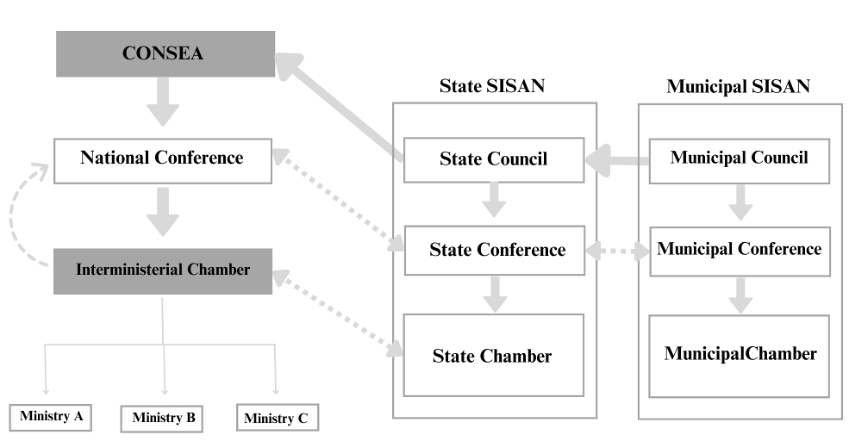
LOSAN launched the creation of a National System for Food and Nutrition Security (SISAN), further institutionalizing the participation of civil society in the governance of FNS at all levels of government (Casa Civil, 2006; Oliveira, 2017). It established three institutional components for SISAN at the national level: (1) the National Council for Food and Nutritional Security (CONSEA), (2) the Conferences on Food and Nutrition Security (CNSAN); and (3) the Inter-ministerial Chamber for Food and Nutrition Security (CAISAN). The law also establishes that these bodies – Councils, Conferences, and Chambers – be set up similarly at the state and municipal levels (Martins et al., 2023; Oliveira, 2017; Vasconcellos & Moura, 2018).
Four years after LOSAN’s approval, a Constitutional Amendment included food as a social right in Article 6 of the Federal Constitution. This was a fundamental development, as it institutionalized food as a constitutional human right and, consequently, strengthened food and nutrition security measures (Casa Civil, 1988; Senado Federal, 2010). In the same year (2010), the government launched the National Food and Nutrition Security Policy (PNSAN), defining the guidelines for drawing up Food and Nutrition Security Plans (PlanSAN) (Casa Civil, 2010; Oliveira, 2017). The formulation and consolidation of all these components were only possible with the creation of legal structures, instruments, and mechanisms for social participation, made possible by the strengthening of Councils and Conferences over the years (Maluf et al., 2021).
SISAN is a public, intersectoral, and participatory system that coordinates the three levels of government, different sectors, and organized civil society. It coordinates the interaction of these various sectors that facilitate access to adequate food, in addition to monitoring and evaluating the implementation and execution of FNS policies. Each component of SISAN has its own objective, but responsibilities are shared and complementary with the others, namely (Casa Civil, 2006):
CONSEA (National Council for Food and Nutritional Security): body responsible for the articulation between the government and civil society. It mobilizes civil society in the process of social participation.
CNSAN (Conferences on Food and Nutrition Security): space that brings civil society and government sectors together to debate and establish guidelines and priorities for the FNS agenda.
CAISAN (Inter-ministerial Chamber for Food and Nutrition Security): an advisory board that articulates and integrates actions of different federal ministries related to the FNS area. Its main objective is to coordinate the implementation of the National Policy and the FNS Plan, and prepare and monitor the Plan with goals, sources of resources, and monitoring and evaluation instruments (Brazil, 2024a; 2006).
National Conferences aim to monitor progress, discuss emerging needs, and assess previously established public policies. Over the years, they have adopted different angles of eradicating hunger, promoting the human right to adequate food, and organizing the FNS agenda as a State policy (Table 1). The policy governing national conferences ensures the participation of various actors and guarantees quotas for the representation of segments in situations of greater vulnerability. The organizing committee defines the number of participants and the distribution of vacancies among delegates, guests, and observers, according to legislation and the available budget. Delegates have the right to speak and vote, while guests and observers are guaranteed the right to speak but cannot vote.
Table 1. National Conferences on Food and Nutrition Security held in Brazil, 1994-2024
| Edition | Year | Location | Themes | Total Participants | Total approved proposals |
|---|---|---|---|---|---|
| 1ª CNSAN | 1994 | Brasília (DF) | Hunger: a national issue | – | 117 |
| 2ª CNSAN | 2004 | Olinda (PE) | The construction of the National Policy for Food and Nutrition Security | 1.400 | 153 |
| 3ª CNSAN | 2007 | Fortaleza (CE) | For Sustainable Development, with Food and Nutritional Sovereignty and Security | 2100 | 145 |
| 4ª CNSAN | 2011 | Salvador (BA) | Adequate and Healthy Food: Everyone is right | 1.996 | 166 |
| 5ª CNSAN | 2015 | Brasília (DF) | Real food in the countryside and the city: for rights and food sovereignty | 2.107 | 384 |
| 6ª CNSAN | 2023 | Brasília (DF) | Eradicating hunger and guaranteeing rights with real food, democracy, and equity | 2.187 | 248 |
Source: Update from Ramos et al. (2022).
When convening the CNSAN, the national CONSEA publishes the agenda to be followed throughout the country: (i) local stage; (ii) period of municipal conferences; (iii) period of conferences in the states; and (iv) National Conference, which will bring together all the proposals. In addition to the calendars of the stages, CONSEA publishes the criteria for the election of delegates, the objectives, and the agendas of the thematic axes, and structures for the debate on food and nutrition sovereignty and security, as well as for sustainable, supportive and fair socioeconomic development. Each state is responsible for monitoring the process of overseeing regional and/or municipal stages. For the conference’s deliberations to be legitimate, the composition of delegates must be according to the representation of the segments on the councils (2/3 from civil society and 1/3 from the government). Specific regulations define the number of representatives. Civil society representatives are chosen by their peers, and managers from the respective sector/government agency appoint government representatives.
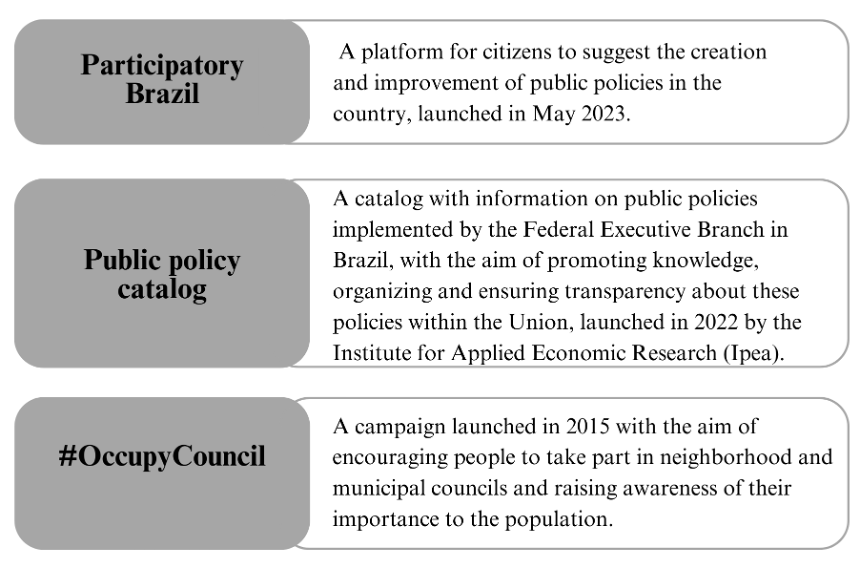
While SISAN guarantees institutional spaces for social participation in FNS policymaking through Councils and Conferences, a constant challenge is the relative low interest of civil society members to participate in those spaces (Almeida & Emmendoerfer, 2024; Balieiro & Macedo, 2022; Castro, 2019; Maluf et al., 2014). Some of the reasons for this include the heavy agenda of council members (Miwa & Ventura, 2020), but also the very lack of information about such opportunities and what they involve. A number of government-sponsored campaigns (Figure 5) attempts to encourage the participation of civil society.
4. Conclusion
Brazil has a long history of mobilization of civil society in policy-making. Following the 1988 Constitution, many mechanisms for social participation in developing, implementing, and monitoring diverse policies in health and social assistance were developed. In the area of Food and Nutrition Security, a major landmark was the creation of the National Council for Food and Nutrition Security (CONSEA) in 1993. Institutionalized spaces for social participation, such as Councils and Conferences, and the construction of a National System for Food and Nutrition Security (SISAN) are concrete examples of how the democracy envisioned in the Constitution have become functional.
However, the participation of civil society in policy-making and the very progress of FNS programs have not followed a smooth pathway. On the contrary, the history of Brazil shows the need for constant vigilance and hard work to fight setbacks, maintain gains, and build for further improvements. CONSEA has been abolished twice since its creation, successful FNS programs have been undermined, and Brazil went back to the Hunger Map just a few years after the great accomplishment of getting out of it. Nothing can be taken for granted, even when social participation is celebrated in the country’s Constitution. Still, after the return of CONSEA in 2023 and a government more committed to food and nutrition security, Brazil has once again managed to escape the Hunger Map.
A lesson learned has been that the type of democracy envisioned in the 1988 Constitution requires much resistance against forces challenging it, constant reconstruction, and continuous incentives for popular participation. The participation and mobilization of civil society are needed when institutionalized spaces are available, but are especially important in times when FNS policies and programs are undermined and formal spaces for participation are threatened or destroyed. Policies such as SISAN encourage and enable social participation in policymaking, therefore strengthening civil society. In turn, a strong civil society is needed to continuously defend its gains in democratic participation.
References
Abrandh (Associação Brasileira pela Nutrição e Direitos Humanos). (2013). Direito humano à alimentação adequada e o Sistema Nacional de Segurança Alimentar. Abrandh.
Andreassa, L. (2021). O que é cidadania e o que falta no Brasil? Politize.
Almeida, T. C. & Emmendoerfer, M. L. (2024). Conexões entre a interação de atores em conselhos gestores e a coprodução de serviços públicos. Revista Estudos Institucionais, 10(3), 948–970.
Aranha. A. (Org.) (2010). Fome Zero: Uma História Brasileira. Brasília/DF: Ministério do Desenvolvimento Social e Combate à Fome, Assessoria Fome Zero, (1).
Avritzer, L. & Souza, C. H. L. (2013). Conferências nacionais: Atores, dinâmicas participativas e efetividade. Ipea.
Balieiro, E. O. B. & Macedo, R. M. (2022). Gestão participativa democrática, impasses, conquistas e desafios: Uma análise realizada no município de Espinosa/MG. Barbarói, 61, 34–52.
Brasil. (1990). Lei nº 8.142, de 28 de dezembro de 1990. Dispõe sobre a participação da comunidade na gestão do Sistema Único de Saúde (SUS) e sobre as transferências intergovernamentais de recursos financeiros na área da saúde e dá outras providências.
Burity, V. (2022). Fortalecimento da participação social na construção de políticas para a alimentação é tema de seminário internacional – FIAN Brasil.
Carvalho, G. D. C. M. D. (2014). Participação da comunidade na saúde. Campinas: Saberes.
Casa Civil. (1988). Constituição da República Federativa do Brasil de 1988. Brasil.
Casa Civil. (2006). Lei nº 11.346, de 15 de setembro de 2006. Cria o Sistema Nacional de Segurança Alimentar e Nutricional (Sisan) com vistas a assegurar o Direito Humano à Alimentação Adequada e outras providências. Diário Oficial da União.
Casa Civil. (2010). Decreto nº 7.272, de 25 de agosto de 2010. Brasil.
Castro, I. R. R. (2019). A extinção do Conselho Nacional de Segurança Alimentar e Nutricional e a agenda de alimentação e nutrição. Cadernos de Saúde Pública, 35.
CONSEA – Conselho Nacional de Segurança Alimentar e Nutricional (2023). Relatório final: 6ª Conferência de Segurança Alimentar e Nutricional – Erradicar a fome e garantir direitos com comida de verdade, democracia e equidade. [PDF] Brasília.
Dória, C. A. & Azevedo, E. (2019, março 19). Banquetaço: ativismo alimentar e novas formas de expressão política. Le Monde Diplomatique Brasil.
Faria, C. F., Silva, V. P.,& Lins, I. L. (2009). Conferências de políticas públicas: um sistema integrado de participação e deliberação? Revista Brasileira de Ciência Política, (2), 125–143.
FAO, FIDA, UNICEF, PMA, & OMS. (2025). The State of Food Security and Nutrition in the World 2025 – Addressing high food price inflation for food security and nutrition. Rome.
FNDE – Fundo Nacional de Desenvolvimento da Educação (FNDE). (2023). Participação social.
Freitas, G. C. (2021). Nada a temer senão o correr da luta: a trajetória do Fórum Brasileiro de Soberania e Segurança Alimentar e Nutricional (FBSSAN) (Tese de doutorado). Universidade do Estado do Rio de Janeiro, Rio de Janeiro.
Gohn, M. da G. (2019). Teorias sobre a participação social: desafios para a compreensão das desigualdades sociais. Caderno CRH, 32, 63–81.
Gurgel, C. & Justen, A. (2013). Controle social e políticas públicas: a experiência dos Conselhos Gestores. Revista de Administração Pública, 47, 357–378.
Kujawa, H. A. (2022). Vozes, olhares e sentidos da participação social no SUS. Editora Rede Unida.
Lemos, R. A. (2018). Conferências Nacionais de Saúde e a construção do Sistema Único de Saúde – SUS: uma revisão. Revista de APS, 21(4)
Machado, M. L., Gabriel, C. G. & Vasconcelos, F. A. G. (2024). Findings of evaluative research on the Brazilian Food and Nutritional Security System: A scoping review from 2006 to 2022. Revista de Nutrição, 37.
Maluf, R., Nascimento, R. C. (2009) Construção do Sistema e da Política Nacional de Segurança Alimentar e Nutricional: a experiência brasileira. Brasília: FAO; IICA; Consea.
Maluf, R. S., Santarelli, M. & Prado, V. (2014). A cooperação brasileira em segurança alimentar e nutricional: determinantes e desafios presentes na construção da agenda internacional [The Brazilian cooperation in food and nutritional security: determinants and challenges presents in the building of the international agenda]. Ceresan – Texto para Discussão, (3).
Maluf, R. S., Zimmermann, S. A. & Jomalinis, E. (2021). Emergência e evolução da Política Nacional de Segurança Alimentar e Nutricional no Brasil (2003–2015). Estudos Sociedade e Agricultura, 29(3), 517–544.
Martins, M. C., Ferreira, M. A. S. & Silva, L. F. (2023). Brazilian National Food and Nutritional Security System: What are the similarities in the decentralization process? Cadernos de Saúde Pública, 39.
Mereles, C. (2016). Fatos importantes sobre conselhos municipais. Politize.
MDS – Ministério do Desenvolvimento e Assistência Social, Família e Combate à Fome. (2024). Retomada das políticas sociais interrompe trajetória de aumento da fome.
Miwa, M. & Ventura, C. O. (2020). (Des)engajamento social na modernidade líquida: sobre participação social em saúde. Saúde em Debate, 44, 123–135.
Moraes, V. D., Machado, C. V. & Magalhães, R. (2021a). Governance and intersectoral coordination of public policies: the Intersectoral Chamber for Food and Nutritional Security. Saúde em Debate, 45, 575–589.
Moraes, V. D., Machado, C. V. & Magalhães, R. (2021b). O Conselho Nacional de Segurança Alimentar e Nutricional: dinâmica de atuação e agenda (2006–2016). Ciência & Saúde Coletiva, 26, 6175–6187.
Moura, A. (2010). Democracia, participação e controle social nos conselhos municipais de educação (Dissertação de mestrado). Universidade Federal da Paraíba, João Pessoa.
Nagib, G. (2020). O espaço da agricultura urbana como ativismo: alternativas e contradições em Paris e São Paulo (Tese de doutorado). Universidade de São Paulo, São Paulo.
Nascimento, R. C. D. O. (2012). O papel do CONSEA na construção da Política e do Sistema Nacional de Segurança Alimentar e Nutricional [Tese de doutorado]. Rio de Janeiro: Universidade Federal Rural do Rio de Janeiro.
Oliveira, A. R. (2017). A Lei Orgânica de Segurança Alimentar e Nutricional (LOSAN) 2006: relatos, fatos históricos e processo de elaboração. Tempus – Actas de Saúde Coletiva, 11(4), 59–75.
Oliveira, A. da S. B. de, Lima, E. C. & Santos, R.P. (2022). Monitoramento e avaliação da segurança alimentar e nutricional: um olhar sobre as publicações oficiais. Ciência & Saúde Coletiva, 27, 631–640.
Pinheiro, A. R. (2009). Análise histórica do processo de formulação da Política Nacional de Segurança Alimentar e Nutricional (2003–2006): atores, ideias, interesses e instituições na construção de consenso político [Tese de doutorado]. Universidade de Brasília, Brasília.
Pires, E., Ávila, H. D., & Nascimento, J. (2024). Conselhos gestores e políticas públicas: notas preliminares de desafios teóricos e analíticos. Serviço Social & Sociedade, 147(2).
Pinto, C. R. J. (2009). As Conferências Nacionais no Brasil: uma experiência de esfera pública de médio alcance? Revista Interseções (UERJ), Rio de Janeiro, 2, 195-214.
Ramos, F. P., Sousa, S. S. & Santos, S. M. C. D. (2022). A experiência brasileira na realização de Conferências Nacionais de Segurança Alimentar e Nutricional. Segurança Alimentar e Nutricional, 29.
Recine, E., Fagundes, A. A., Silva, B. L., Garcia, G. S., Ribeiro, R. C. L., Gabriel, C. G. (2020). Reflections on the extinction of the National Council for Food and Nutrition Security and the confrontation of Covid-19 in Brazil. Revista de Nutrição. 33.
Rede PENSSAN – Rede Brasileira de Pesquisa em Soberania e Segurança Alimentar. (2022). II Inquérito Nacional sobre Insegurança Alimentar no Contexto da Pandemia da Covid-19 no Brasil. São Paulo.
Ribeiro, S. M., & Bógus, C. M. (2021). Participação e ativismo do grupo de interesse da segurança alimentar e nutricional em São Paulo/SP. Revista Planejamento e Políticas Públicas, 57, 119–148.
Rocha, C., Bezerra, M., Pequeno, N., Pinheiro, A., Lima, S., & Lyra, C. (2026). Moving Forward in Guaranteeing the Right to Food: Timeline on Food Security Policy in Brazil. In Rocha, C. & Moraes, A. (Eds), Agency for Food Security in Brazil: Social Mobilization, Participation, and Public Policies. Toronto: TMU Pressbooks.
Senado Federal. (2010). Emenda Constitucional nº 64, que altera o art. 6º da Constituição Federal, para introduzir a alimentação como direito social. Brasil. Diário do Senado Federal, 2.
Valla, V. V. (Org.). (2000). Educação e participação popular: revendo o debate em torno da participação popular: ampliando sua concepção em uma nova conjuntura. Rio de Janeiro, RJ: Editora Fiocruz.
Vasconcellos, A. B. P. de A. & Moura, L. B. A. (2018). Segurança alimentar e nutricional: uma análise da situação da descentralização de sua política pública nacional. Cadernos de Saúde Pública, 34.