Part 1 – Public Policies and Participation: Institutionalizing Agency for Food Security
Chapter 5 – Challenges Implementing the School Food Program in Rio Grande do Norte: Local Micronutrient Supplementation and Full-Time Schooling Expansion
Wendjilla Fortunato de Medeiros, Ricardo Andrade Bezerra, Joana Yasmin Melo de Araújo, Laura Brito Porciuncula, Antonio Teofilo Pinheiro Neto, Dinara Leslye Macedo Silva Calazans & Fábio Resende de Araújo*
*Corresponding author: fabio.resende@ufrn.br
1. Introduction
The human right to adequate food, guaranteed in the Brazilian Constitution, is granted when Food and Nutritional Security (FNS) is ensured. Since the early 2000s, Brazil has made significant progress in reducing Food and Nutrition Insecurity (FNI), although not without periods of major setbacks (see Fagundes et al., 2026, and Rocha et al., 2026a, in this volume; Neves et al., 2021). In 2014, the country was declared out of the Hunger Map by the Food and Agriculture Organization (FAO). However, a few years later, a survey conducted in 2021/2022 showed that more than half of Brazilians (58.7%) experienced some degree of Food and Nutrition Insecurity. In Brazil’s Northeast region, the survey showed even more alarming results, with FNI affecting 68.1% of the population (PENSSAN, 2022). Fortunately, after a change in government in 2023 that restored a number of previously neglected social programs, the country was out of the Hunger Map again in 2025, with less than 2.5% of its population experiencing hunger (FAO/IFAD/UNICEF, 2025).
Brazil’s School Food Program (PNAE) has played a central role in combating FNI in the country (Rocha et al., 2026b; Vasconcelos, 2013). Launched in 1955, through the years the program has been substantially modified and expanded, both in terms of budget and population coverage. PNAE is a nationwide and universal program, implemented in all public schools and childcare centres in the 5,570 municipalities in Brazil’s 26 states and the Federal District (Nogueira et al. 2016). It covered more than 40 million students in 2023, spread out over the three levels of publicly funded schools that compose the educational system: federal, state, and municipal.
Under PNAE, the federal government transfers funds to cover most of the cost of food on a student per-capita basis, while state and municipal governments are responsible for covering all other costs associated with providing school meals according to specifications detailed in the legislation of 2009 and modifications thereafter. Table 1 indicates the funds transferred in 2023 by the federal government to cover the number of meals and nutritional requirements in different modalities.
Table 1. Funds transferred by the Brazilian federal government per student
| Level/Modality | Value per Student (R$) | Meals | Nutritional Needs |
|---|---|---|---|
| Nursery School (Creches) | 1.37 | 2 small meals | 30% |
| Elementary and High School | 0.5 | 1 small meal | 30% |
| Youth and Adult Education (EJA) | 0.41 | 1 small meal | 30% |
| Elementary School (Indigenous and Quilombola*) | 0.86 | 1 small meal | 30% |
| Elementary Education (Full-Time) | 1.37 | 2 small meals and 1 lunch | 70% |
| High School (Full-Time) | 2.56 | 2 small meals and 1 lunch | 70% |
Source: Prepared by the authors based on PNAE/FNDE Resolution No. 02/2023 (FNDE, 2023).
(*) According to Art. 2 of Brazil (2003), the remaining quilombo communities are considered ethnic-racial groups that refer to themselves as having their own historical trajectory, with specific territorial relations, a presumption of black ancestry, and a history of resistance to oppression.
The implementation of a nationwide public policy such as PNAE may have some different local characteristics depending on how subnational partners choose to participate. In federalism, there is a particular relationship between the central government and subnational governments, which affects the design of public policies such as PNAE.
Monteiro Neto (2014) points out that in the theory of federalism, the concept of decentralization of government is a fundamental idea. One of the main aspects is the so-called vertical decentralization, that is, one in which a central government shares power with subnational governments. According to Bonduki and Palotti (2021), in federative countries, nationalized social policies may face the challenge of striking a balance between vertical coordination seeking to promote some level of unity of actions and their compatibility with a wide range of state capabilities at the local/regional level. Traditional mechanisms, such as policy standardization, can ensure consistent provision of services in programs, but they must be combined with efficient arrangements of inter-sectoral and intergovernmental coordination.
In Brazil, after the Federal Constitution of 1988, state governments have taken on important roles in the provision (and, hence, co-funding) of services (Licio et al., 2021). For decentralization to be feasible, subnational governments must be endowed with not only economic and financial resources, but also with institutional capacities (Gomides and Pires, 2014; Monteiro Neto, 2014). It is this challenge that may sometimes lead to failures of implementation, because subnational governments have fewer financial and human resources to keep up with the proposals of a central government.
The National Fund for the Development of Education (FNDE) under the Ministry of Education (MEC) is responsible for PNAE’s legislation and monitoring, while states and municipalities oversee its local execution (Bonduki and Palotti, 2021). There is the centralization of the main financial resource for the program, provided by the federal government, but variations in its implementation depend on the local capacity of states and municipalities.
In this chapter, we report on two studies looking at local attempts to complement the basic services provided by the National School Food Program in the Northeastern state of Rio Grande do Norte (RN). In section 2, we report on a research project concerned with identifying barriers to the successful implementation of NutriSUS (a micronutrient supplementation strategy) through the School Food Program in a small town. The study proposed to highlight key behavioural problems during the implementation of the program, which could compromise its effectiveness.
In section 3, we look at how the state of Rio Grande do Norte attempted to address the challenge of keeping up PNAE’s national standards with the increase of full-time education in the state through the creation of a new program, the Pague Mais Alimentação (Pay More Food) in 2022. Under the State Department of Education, Culture, Sport, and Leisure (SEEC/RN), the new program proposed an increase in state funding for PNAE in the public schools implementing full-time periods. The study identifies the main local groups which lobbied the state government in developing this new program.
2. Behavioural Barriers for the Implementation of a School-based Micronutrient Supplementation Program in Brazil
Malnutrition, including micronutrient deficiencies, is driven by inequality and poverty, and there is not necessarily a technical solution capable of solving these problems in isolation. In this context, nutritional supplements and micronutrient fortification are emergency strategies that aim to mitigate the effects of nutritional deficiencies (Coutsoudis et al. 2019). According to the World Health Organization (WHO) (2016), there should be coordination of actions aimed at the prevention and control of micronutrient malnutrition. There is a variety of interventions in this area: fortification at the point of use with Multiple Micronutrient Powder (MNP), fortified foods, supplementation with isolated nutrients (Iron, Vitamin A, Vitamin D…), and lipid-based nutritional supplements (LNS). In choosing an intervention, issues such as cost, effectiveness, feasibility, and acceptability must be considered in the implementation of actions.
MNP supplementation is usually carried out through a strategy of home fortification, but it can also be done through fortification at the point of use, where the supplement is added to meals in service networks such as schools, for example. This type of fortification differs from industrial fortification, where the addition is done by the industry, and processed foods are used as vehicles for fortification. WHO’s recommendation (WHO, 2016) indicates the use of MNP as a preventive measure against micronutrient deficiencies, targeting early childhood populations. The program is recommended where anemia has been identified as a public health problem, prioritizing children aged 6 to 23 months with the aim of improving iron levels and reducing iron-deficiency anemia, though the age group of 2 to 12 years can also be included as a target audience.
The use of MNP globally is high. Data from the United Nations International Children’s Emergency Fund’s (UNICEF) NutriDash report (UNICEF, 2024a) show that in 2020, around 10 million children received supplementation. While significant, this number reflected a decrease in MNP supplementation during the COVID pandemic. In 2022, for instance, over 14 million children received MNP supplementation across 36 countries. (UNICEF, 2024b)
In Brazil, the high prevalence of anemia and other nutritional deficiencies among children aged 6 to 23 months led to the creation of a Multiple Micronutrient Powder program (NutriSUS) in 2015 (Freitas et al. 2023). NutriSUS was originally developed as a point-of-use fortification program to be implemented in the school environment. That seemed to be a good strategy given PNAE’s reach throughout the country. While a mandated and funded federal program, NutriSUS was to be implemented at the municipal level, through the collaboration between primary health care units and local public schools and daycare centers.
2.1 Study location, research subjects, and methodology
Our study was carried out in the city of Currais Novos, a small municipality in the state of Rio Grande do Norte. The city of Currais Novos was chosen because it experienced a decline in the number of children reached by NutriSUS between 2018 and 2019. According to data from the Currais Novos Health Department, in 2018, 81.9% of the 628 children eligible to participate in the program actually received the MNP supplements. The coverage dropped to only 70.2% in 2019, prompting calls for an evaluation of the program. We worked with eight daycare centres, out of the 10 in the city. The data generated were collected during the development of a strategic plan to improve the implementation of NutriSUS from July to November 2019.
The research subjects were participants in the preparation of the strategic planning to improve the implementation of NutriSUS in Currais Novos. They included school principals and teachers, cafeteria workers, managers from the education department and education professionals, and children’s caregivers (parents, grandparents, and others). All participants gave consent through the Free and Informed Consent Form and signed the Voice Recording Authorization Form. The research project received ethical approval from the Research Ethics Committee at the Federal University of Rio Grande do Norte.
In the methodology of our study, we followed four phases of an action research process (Nascimento et al. 2020): 1. Planning; 2. Focus groups with the school community; 3. Presentation of the partial plan, and 4. Public consultation of the plan with the community. The main product of this project was a strategic plan to improve the implementation of NutriSUS in Currais Novos.
Conversations in the focus group meetings at the daycare centres and conversations with managers at the secretariat level were recorded and transcribed. In the data analysis, a decision map was constructed following the Practitioner’s Guide to Getting Started with Behavioural Science Applications to United Nations Policies, Programs and Administration (United Nations Innovation Network , 2022) and the BASIC behavioural insights tool of the Organization for Economic Co-operation and Development (OECD, 2019). The main behavioural problems at the tactical-operational level were identified according to the decision stage in which they were analyzed using the ABCD framework for analyzing behavioural problems from the BASIC tool
This map focused on designing choices that occurred in the daycare centres. The analysis of this study concentrated on behavioural problems, and the diagnosis was comprehensive, examining both structural and behavioural issues. At the management level, the emphasis was on the tactical-operational level of implementation, since strategic planning for NutriSUS is carried out at the federal level.
The theory that anchored our analysis is found in Behavioural Science. Behavioural Science can contribute to public planning, through analyses leading to better choices in the design of public policies, making them more effective. The behavioural approach in public policies allows for the analysis of unintentional attitudes of those involved, which impact public programs. Through this understanding, it is possible to arrive at Behaviour Insights (BI) and propose changes that can lead to better results (United Nations Network, 2022). The application of BI requires an understanding of the context in which the public policy is applied, as behavioural traps may occur if the same solution is applied to different realities. Moreover, the use of BI must undergo a robust democratic debate regarding public permissions and ethics (TOPS, 2017).
Social policies and programs, which prioritize individuals in social vulnerability, must take particular care. The cognitive load of poorer individuals tends to be higher due to the large number of decisions they need to make due to scarcity (Lichand et al. 2022). As theorized by Banerjee and Duflo (2012), there are a series of decisions that most individuals in more developed countries do not need to make because their environment already takes care of them (such as access to clean piped water and reliable health services). These decisions are barely noticed as they are deeply embedded in the system, allowing people to take better care of themselves and be free from such concerns.
Understanding how the contexts of social and economic vulnerability affect individuals’ behaviours in the implementation of public policies is an expanding agenda. Complex problems, like widespread nutritional deficiencies, demand public policies formulated with attention to structural issues (financial, human, technological, logistical and scarcity of resources), and behavioural attitudes of users and implementing bureaucrats.
2.2 Results
In total, 97 members of the school community and program management in the health sector participated in the various stages of the project, with some members attending more than one meeting. Preschool teachers (43.3%) and caregivers (19.6%) were the most prevalent participants throughout the stages of the project. It is noteworthy that daycare centre directors had low participation throughout the research, revealing a low level of engagement from the tactical management level in the development of the planning.
In data analysis, we built a decision map (Figure 1). This map focused on the choices that took place in daycare centres. Rectangles represent the flow of action and diamonds represent the decision behaviours. The map revealed five main behavioural problems, further discussed below:
- The school does not communicate effectively with caregivers
- Caregivers do not attend the meeting at the daycare centre
- Caregivers do not authorize the child to participate in the program
- Cafeteria workers fail to administer the supplement
- Children do not accept supplemented preparation
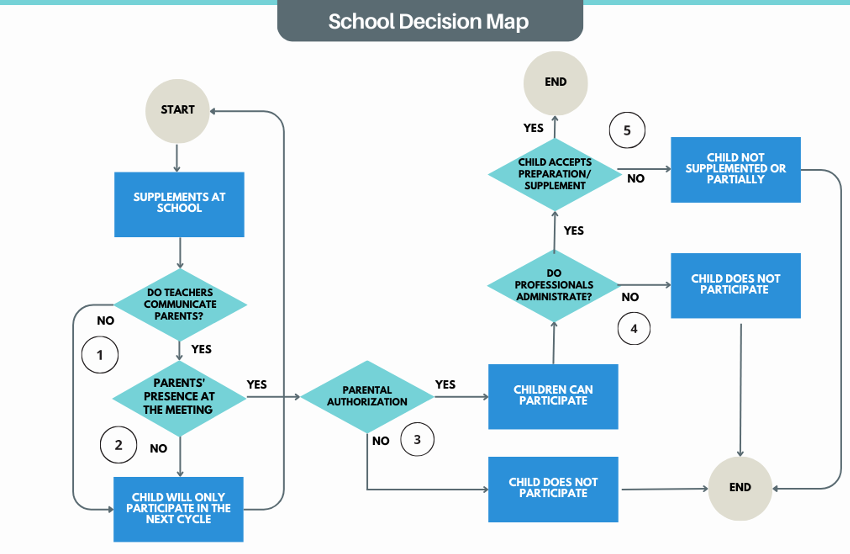
The school does not communicate effectively with caregivers about the program and scheduling meetings for authorization
The invitation to caregivers to a meeting is the first stage of contact between the school and family members. Participants reported little flexibility in the meeting days suggested by the health program coordinator. Supplementation cycles last two months with intervals of 3 or 4 months. If the caregiver does not attend the first meeting, the child does not participate in the initiated cycle.
The behaviour of school personnel is also influenced by their interactions with each other and with the population (Hopkins & Lawlor, 2023). Within their routine, directors and teachers sometimes struggle to maintain engagement in program activities due to their existing workload. Procrastination or forgetfulness in communication may have affected the number of notified caregivers. The fragmented management of health and education exacerbated this difficulty, as Community Health Agents in the areas where the daycares are located could assist in the communication process, as outlined in the program’s technical manuals.
Caregivers do not attend the project meeting
Non-attendance at the meeting, even after being notified by the school, limits the possibility of clarification that these meetings intend to provide. The target audience, coming from public daycares where children are from households with greater social vulnerability, may be a factor explaining such behaviours. Unavailability to attend the meeting at the suggested time might result from task juggling or even forgetting the date and time. Mental overload, resulting from a significant number of decisions, particularly among female caregivers, and lack of support networks, can exacerbate unavailability. Banerjee and Duflo (2012) clarify that people in poverty tend to make decisions differently as they are involved in complex issues in the present time, while health care or a meeting that can happen at another time is a future concern. Present needs are more pressing. Non-participation may also reflect a lack of recognition of supplementation as something important with real impacts on the child’s health (Banerjee & Duflo, 2012).
Caregivers do not authorize the child’s participation in the program
The formation of beliefs can result in behaviours that are not always rational; there may be misguided predictions based on prejudices and falsehoods (OECD, 2019). Parental refusal to authorize participation, despite attending meetings, indicates conflicting information from various sources in explaining supplementation and its possible results. During the study, caregivers reported myths (mistaken beliefs) associating supplement consumption with obesity or diarrhea.
The fact that micronutrient deficiencies do not have immediate physical manifestations can lead to the perception that they are not important. In a study in Vietnam, health professionals identified the lack of rapid and visible benefit from fortifiers as a barrier to parent adherence (Nguyen et al., 2016). To prevent these beliefs from leading to inappropriate behaviours, it is crucial for the strategy adopted to be closely aligned with the community dynamics of families. Involving local leaders in the persuasion strategy can be a key point for spreading accurate knowledge.
Cafeteria workers cannot manage the supplement during meals
With the introduction of NutriSUS in their schools, cafeteria workers and assistants faced a new demand that needed to be balanced with the requirements of regular school feeding. During focus groups, cafeteria workers reported a high number of children to manage with fortification. Difficulties related to dividing subgroups within classes due to family authorizations were noted. Transferred children from other daycares, who were not identified as having already received the supplement, were also cited as a complicating factor. Dias et al. (2022) point out that micronutrient supplementation programs like NutriSUS are targeted policies, requiring family authorization, and participation must also consider if the child receives supplements from other sources. This can create additional challenges for frontline workers.
Additional services in the health system can overload professionals, as these services are often added to their work routine without additional incentives (Palmer et al. 2013; Korenromp et al. 2016). In a study conducted in Nigeria with MNP distribution, health professionals showed low initial motivation to participate, as it was an additional task to their health unit routines. Complaints about work overload and inadequate compensation were reported (Korenromp et al. 2016).
Children do not accept the supplemented preparation
There is an adaptation of usual menus to appropriate preparations for fortification, which, according to the Brazilian Ministry of Health (2022), include solids like rice or beans and semi-solids like porridge and purees. Reports indicate that to include these preparations, traditional items were removed from the daycare menus, leading to changes in the meals offered to children. Rejection of school meals by children is a multifactorial issue and cannot be attributed solely to the supplement, but study participants noted that the supplement leaves a residual taste perceived by the children. Some food handlers reported using the strategy of adding the supplement without the child seeing it, but noted that in very clear preparations, the color of the supplement is noticeable.
The per capita funds transferred for school meals in Brazil is low, which may affect the quality of the preparations and, ultimately, their acceptability. An evaluation of a policy implemented by the Polish government to address childhood obesity found that immediate pleasure from food overshadowed rational decisions, such as avoiding processed foods, as health problems associated with their consumption were seen as distant concerns (Olejniczak et al. 2019).
3. The Pague Mais Alimentação Program
Many observers have been concerned that the funds transferred by the federal government (see Table 1) are not adequate to meet all the requirements under the PNAE legislation. According to data from the School Food Observatory PNAE had lost half of its purchasing power in the previous 14 years owing to inflation. Brazil’s National Education Plan 2014-2024 had proposed a 10% increase in government expenditure on education, but that budget increased by only 5.5% (OAE, 2024).
At the same time, the public school system in Brazil is undergoing a revolution, with plans to implement full-time (rather than half-day) periods (Agência Senado, 2025). This brings significant implications for PNAE. While it is required under legislation to meet 30% of the daily nutritional needs of students in school for half-day periods, it must now meet at least 70% of the daily nutritional needs of full-time students, significantly increasing the cost of the program (FNDE, 2020). Thus, the transition to full-time schooling presents many challenges for the implementation of PNAE at the local level (Carvalho et al., 2017).
In 2016, the federal government launched the Program for Promotion of Full-time Secondary Education. This program was created to assist in achieving the target of 50% of full-time enrollment, as provided for in the National Education Plan (Secretaria de Educação e Cultura do Estado do RN, 2018).
In Rio Grande do Norte, implementation began in February 2016 in 10 schools under different Regional Boards. The expansion of schools was intensive between 2016 and 2019, a pre-pandemic period. By 2025, 607 public schools in RN were implementing full-time periods (Secretaria de Educação e Cultura do Estado do RN, 2025). The number of students in this new modality has been increasing in recent years, with 10,589 students in 2019, 28,882 in 2024, and 36,882 in 2025 (Rio Grande do Norte, 2025). The ordinance guiding this implementation explicitly establishes that full-time schools shall be granted all educational, administrative, and financial conditions required to plan and implement educational activities.
The second study reported here looks at how the state of Rio Grande do Norte attempted to supplement PNAE resources coming from the federal government in the adoption of full-time schooling. The study was conducted in collaboration with two coordination offices of the Department of Education, Culture, Sports, and Leisure (SEEC/RN): the Office of the Under-Secretary for Student Support (SUASE), and the Office of Secondary Education (SUEM), in charge of managing and implementing political-pedagogical projects in secondary schools. Data were collected from management reports produced by the above-mentioned offices; documentary research on ordinances made by the state government of RN; and the conduction of two focus groups, in August and December 2019, respectively: one with managers from SUASE, and one with managers from SUEM, with a total of 16 participants. The participants signed an Informed Consent Form. The study was approved by the Research Ethics Committee of the Federal University of Rio Grande do Norte
3.1 Main findings
Analyses made by the Office of Secondary Education (SUEM) between 2017 and 2018 showed the main weaknesses in the implementation of PNAE in the full-time modality of education: inadequate infrastructure (such as insufficient utensils and equipment, as well as inappropriate kitchens and cafeterias), and difficulty in offering a menu which would meet 70% of students’ nutritional needs. The need to offer students a greater number of more complex meals presented a significant challenge for the schools moving to full-day schedules. In most cases, the meals were prepared in smaller kitchens with little capacity for serving them. In some schools, the rooms in cafeterias did not meet students’ increased demand. While school cafeterias previously produced and offered students one snack, they now resembled small or medium-sized restaurants that produce three meals per day.
SUEM and SUASE took a series of actions to mitigate these difficulties, for example, bidding for the purchase of stoves, refrigerators, and freezers – expenses greatly offset by new federal transfers for the implementation of the full-time modality. However, the funding transferred by the federal government for purchasing food under PNAE was considered inadequate to meet the required 70% of nutritional needs of students in full-time schooling. The Pague Mais Alimentação program was created to supplement the federal funding (see Table 2).
Table 2. Distribution of funding allocations for school meal budgets in public state schools in Rio Grande do Norte, Brazil.
| Level of education –
Modality |
Value per student
PNAE/FNDE (R$) |
Value per
student PMA/RN (R$) |
Total (R$) | Meals |
|---|---|---|---|---|
| Elementary and secondary School | 0.50 | 0.46 | 0.96 | 1 small meal (30% of nutritional requirements/day) |
| Youth and adult education | 0.41 | 0.46 | 0.87 | 1 small meal (30% of nutritional needs/day) |
| Elementary Education (Full-Time) | 1.37 | 3.00 | 4.37 | 2 small meals and 1 lunch (70% of nutritional needs/day) |
| Secondary Education (Full-Time) | 2.56 | 3.00 | 5.56 | 2 small meals and 1 lunch (70% of nutritional needs/day) |
Source: Prepared by the authors based on FNDE Resolution No. 02/2023 and Pague Resolution No. 05/2022.
Two groups were essential in lobbying the state government for greater funds through the Pague Mais Alimentação program. The first was the group of professionals directly involved in the implementation of the PNAE (school principals, nutritionists, kitchen and cafeteria personnel, and managers from the government departments linked to the program). This group was particularly critical of the top-down approach of the federal government in launching the full-time schooling project without proper local consultations. It pointed out that the increased resources made available for the implementation of the project were not sufficient for the needed infrastructure transformation or the hiring of the extra personnel required.
The second group engaged in lobbying the government was composed of members from the councils responsible for the monitoring of PNAE: the School Food Councils and the state Food and Nutrition Security Council (see Fagundes et al., 2026, in this volume, on the importance of councils in the implementation of food security policies in Brazil). This group was particularly important in pointing out the insufficiency of the resources transferred by the federal government in meeting the nutritional requirements of PNAE in a full-time school schedule. Year after year, discretionary decisions to increase federal transfers to PNAE did not keep up with the rate of food inflation in the country. With the adoption of full-day schooling, it became even harder to meet PNAE’s requirements to have at least 30% of food purchased from family farmers, less than 20% of food classified as ultra-processed, and still supply 70% of students’ daily nutritional needs (Rocha et al., 2026b).
4. Final Remarks
Given the capillarity of the School Food Program in Brazil (it is present in all public schools throughout the country), it is often seen as potential ground for the implementation of other policies targeting children. That was the case in the failed attempt to implement NutriSUS as a pilot program in Rio Grande do Norte. The first study reported here (section 2) identified five behavioural problems that contributed to that experiment’s failure. It is, thus, not surprising that the NutriSUS program has undergone changes and will no longer be administered as point fortification in schools.
The second study reported here (section 3) shows how subnational federative entities play a significant role in funding and operationalizing programs such as PNAE. In full-time education, the implementation of PNAE faces greater limitations because the program needs to supply more than twice as many calories per student and serve a meal (lunch) with a higher degree of preparation complexity. The study highlighted the inadequacy of federal funding and its year-to-year discretionary adjustments (not automatically adjusted for inflation).
Common to both studies is the suggestion of failures of top-down decision-making in a federative context. Much of the behaviour problems identified in the NutriSUS project could be anticipated, and possibly avoided, with proper previous consultation and conversations with local managers and implementers of PNAE. While those local groups were not able to prevent the failure of the NutriSUS project in schools, they have been central in lobbying the state government for the supplemental resources needed for PNAE under full-time schooling.
References
Agência Senado. (2025) Novo Plano Nacional de Educação será foco do Senado em 2025.
Agora RN. (2016). Portaria define escolas beneficiadas com Educação em Tempo Integral no RN.
Banerjee, A., & Duflo, E. (2012). Poor Economics: A radical rethinking of the way to fight global poverty. Public Affairs.
Bonduki, M., & Palotti, P.. (2021). Entre Chicotes e Cenouras Orgânicas: Coerção e Cooperação na Implementação das Compras da Agricultura Familiar no Âmbito do Pnae . Dados, 64(4), e20190209.
Brasil (2003). Decreto nº 4.887 de 20 de novembro de 2003. Regulamenta o procedimento para identificação, reconhecimento, delimitação, demarcação e titulação das terras ocupadas por remanescentes das comunidades dos quilombos de que trata o art. 68 do Ato das Disposições Constitucionais Transitórias.
Brasil (2009). Lei nº 11.947, de 16 de junho de 2009. Dispõe sobre o atendimento da alimentação escolar e do Programa Dinheiro Direto na Escola aos alunos da educação básica.
Brasil. Ministério da Saúde. (2022). Caderno dos programas nacionais de suplementação de micronutrientes [PDF](Manual of national micronutrient supplementation programs).
Carvalho, N. A. de ., Martins, K. A., Sousa, L. M. de ., & Díaz, M. E. P.. (2017). Feeding in full-time public schools: Do students adhere and accept? Revista de Nutrição, 30(3), 357–368.
Coutsoudis, A., Sanders, D., Dhansay, M. A., Van Stuijvenberg, M. E., & Benn, C. S. (2019). Is it time for South Africa to end the routine high-dose vitamin A supplementation programme?. South African medical journal, 109(12), 907–910.
Dias, P. C., Teles, C. G., Mendonça, D. F., Sampaio, R. M., Henriques, P., Soares, D. S. B., Pereira, S., & Burlandy, L. (2022). Concepções em disputa no uso da suplementação e/ou fortificação de micronutrientes na alimentação escolar para prevenção da anemia (Conceptions in dispute in the use of micronutrient supplementation and/or fortification in school programs for prevention of anemia). Cadernos de Saúde Pública, 38(5), e00001321.
Fagundes, A., Ribeiro de Sá, C.C., Silva, T.C., Santos, F.F., & Recine, E. (2026). Exercise in Democracy: Social participation in public policies for food security in Brazil. In Rocha, C. & Moraes, A. (Eds.) Agency for Food Security in Brazil: Social Mobilization, Participation, and Public Policies. Toronto: TMU Pressbooks.
FAO/IFAD/UNICEF (2025) The State of Food Security and Nutrition in the World 2025 – Addressing high food price inflation for food security and nutrition. Rome.
FNDE – Fundo Nacional de Desenvolvimento da Educação (2020). Resolução Nº 06, de 08 de maio de 2020. Dispõe sobre o atendimento da alimentação escolar aos alunos da educação básica no âmbito do Programa Nacional de Alimentação Escolar – PNAE.
FNDE- Fundo Nacional de Desenvolvimento da Educação (2023). Resolução Nº 02, de 10 de março de 2023. Altera a Resolução CD/FNDE nº 6, de 8 de maio de 2020, que dispõe sobre o atendimento da alimentação escolar aos alunos da educação básica no âmbito do Programa Nacional de Alimentação Escolar – PNAE.
Freitas, M. B., Castro, I. R. R., Schincaglia, R. M., Carneiro, L. B. V., Alves-Santos, N. H., Normando, P., Andrade, P. G., Kac, G., & Brazilian Consortium on Child Nutrition (2023). Characterization of micronutrient supplements use by Brazilian children 6-59 months of age: Brazilian National Survey on Child Nutrition (ENANI-2019). Cadernos de saúde pública, 39(Suppl 2), e00085222.
Gomide, A.A; & Pires, R. R. C. (2014) Capacidades estatais e democracia: a abordagem dos arranjos institucionais para análise de políticas públicas. In A.A. Gomide, & R.R.C.Pires (Org.) Capacidades estatais e democracia: arranjos institucionais de políticas públicas. Instituto de Pesquisa Econômica Aplicada.
Governo do Rio Grande do Norte (2022). Resolução nº 04, de 19 de julho de 2022.[PDF] Dispõe sobre as orientações para o apoio técnico e financeiro, fiscalização e monitoramento na execução do Programa de Autogerenciamento das Unidades Escolares – PAGUE, Programa de Autogerenciamento das Diretorias Regionais – PAGD, Programa Nacional de Alimentação Escolar – PNAE, Programa Estadual de Alimentação Escolar – Pague Mais Alimentacao e Pague Mais Predial em cumprimento ao disposto na Lei nº 8.398, de 17 de outubro de 2003.
Hopkins, V., & Lawlor, A. (2023). Behavioural Insights and Public Policy in Canada. Canadian Journal of Political Science, 56(2), 435–450.
Korenromp, E. L., Adeosun, O., Adegoke, F., Akerele, A., Anger, C., Ohajinwa, C., Hotz, C., Umunna, L., & Aminu, F. (2016). Micronutrient powder distribution through Maternal, Neonatal and Child Health Weeks in Nigeria: Process evaluation of feasibility and use. Public Health Nutrition, 19(10), 1882–1892.
Lichand G; Serdeira AP & Rizardi B. (2022). Insights comportamentais para o diagnóstico e desenho de políticas públicas (Behavioral insights for the diagnosis and design of public policies.). Enap.
Lício, E.C., Paiotti, L.M., Meneses, A.F.P., & Pontes, P.A.M.M.. (2021) O Que Fazem – Ou Deveriam Fazer – Os Governos Estaduais Na Gestão Das Políticas Sociais. Texto para discussão. Instituto de Pesquisa Econômica Aplicada.
Monteiro Neto, A. (2014). Governos estaduais no federalismo brasileiro: Capacidades e limitações no cenário atual. In: A. Monteiro Neto. A. (org.) Governos estaduais no federalismo brasileiro : capacidades e limitações governativas em debate. Instituto de Pesquisa Econômica Aplicada.
Nascimento, S. H. P. ; Lima, K. A. ; Araújo, F.R. ; Calazans, D. L. M. E. S. ; Fayh, A. P. T.; Araujo, D. F. S. ; Bezerra, R. A. (2020). Plano Estratégico de combate às Doenças Crônicas Não-Transmissíveis em escolares: o processo de construção coletiva em uma rede municipal de ensino. [PDF] (Strategic Plan to combat Chronic Non-Communicable Diseases in schoolchildren: the process of collective construction in a municipal education network). In: Caldas, E.L.; Rapallo, R.; Vuitrago, Y.M.O. (Eds.) Cuaderno del Grupo Especial FAO/CLACSO Innovación en políticas públicas de seguridad alimentaria y nutricional. (pp.46-72) Food and Agriculture Organization of United Nations.
Neves, J. A., Machado, M. L., Oliveira, L. D. de A., Moreno, Y. M. F., Medeiros, M. A. T. de ., & Vasconcelos, F. de A. G. de . (2021). Unemployment, poverty, and hunger in Brazil in Covid-19 pandemic times. Revista de Nutrição, 34, e200170.
Nguyen, M., Poonawala, A., Leyvraz, M., Berger, J., Schofield, D., Nga, T. T., Van, T. K., Hoa do, T. B., & Wieringa, F. T. (2016). A delivery model for home fortification of complementary foods with micronutrient powders: Innovation in the context of Vietnamese health system strengthening. Nutrients, 8(5), 259.
Nogueira, RM, Barone, B., Barros, TT de ., Guimarães, KRLSL de Q., Rodrigues, NSS, & Behrens, JH. (2016). Sessenta anos do Programa Nacional de Alimentação no Brasil. Revista de Nutrição , 29 (2), 253–267.
OAE – Observatório da Alimentação Escolar (2024). Nota Técnica 02/2024 – Em defesa de Projetos de Lei que estabelecem regras para a definição de reajustes anuais dos valores per capita do PNAE: Como assegurar o poder de compra e proteger a alimentação escolar da flutuação do preço dos alimentos.
Olejniczak, K., Śliwowski, P., & Roszczyńska-Kurasińska, M. (2019). Behaviour architects: a framework for employing behavioural insights in public policy practice. Journal of Public Governance, 47(1), 18-32.
OECD – Organization for Economic Co-Operation and Development. (2019). Tools and Ethics for Applied Behavioural Insights: The BASIC Toolkit.
Palmer, A. C., Diaz, T., Noordam, A. C., & Dalmiya, N. (2013). Evolution of the child health day strategy for the integrated delivery of child health and nutrition services. Food and Nutrition Bulletin, 34(4), 412–419.
PENSSAN – Rede Brasileira de Pesquisa em Soberania e Segurança Alimentar e Nutricional (2021). Inquérito Nacional sobre Insegurança Alimentar no Contexto da Pandemia da Covid-19 no Brasil: I VIGISAN.[PDF]
PENSSAN – Rede Brasileira de Pesquisa em Soberania e Segurança Alimentar e Nutricional (2022). II VIGISAN – Inquérito Nacional sobre Insegurança Alimentar no Contexto da Pandemia da Covid-19 no Brasil. Suplemento I Insegurança Alimentar nos estados.
Rio Grande do Norte. (2025) Educação do RN inicia matrículas para o Ensino Médio em Tempo Integral e Educação Profissional.
Rocha, C., Bezerra, M., Pequeno, N., Pinheiro, A., Lima, S., & Lyra, C. (2026a). Moving Forward in Guaranteeing the Right to Food: Timeline on Food Security Policy in Brazil. In Rocha, C. & Moraes, A. (Eds), Agency for Food Security in Brazil: Social Mobilization, Participation, and Public Policies. Toronto: TMU Pressbooks.
Rocha, C., Burlandy, L., Sampaio, R., Dias, P.C. (2026b) How Brazil’s National School Food Programme meets the six principles announced in Canada’s first National School Food Policy. In Regnier-Davies, J., Koc, M., Rocha, C. & Edge, S. (Eds.) Rethinking Food Security for the 21st Century. Toronto: TMU Pressbooks
Secretaria de Estado da Educação e da Cultura do Rio Grande do Norte (2016). Portaria 211/2016 SEE/GS. Dispõe sobre a implantação, organização e funcionamento do Ensino Fundamental em Tempo Integral, oferecido na Rede Pública Estadual.
Secretaria de Estado de Educação do Rio Grande do Norte. (2017). Resolução nº 005/2017. Aprova o Manual de Operacionalização dos Programas de Autogerenciamentos (PAGUE e PAGD) das Unidades Escolares e DIREC.
Secretaria de Educação e Cultura do Rio Grande do Norte (2018) RN recebe R$ 21 milhões para escolas em tempo integral.
Secretaria de Estado de Educação do Rio Grande do Norte (2025). Monitoramento da Educação.
TOPS – Technical and Operational Performance Support (2017). Designing for Behavior Change: A Practical Field Guide.[PDF]
Tribuna do Norte. (2018) Rede estadual vai ofertar 12 mil vagas de tempo integral em 2018.
UNICEF – United Nations International Children’s Emergency Fund (2024a). Global Nutrition Programme Monitoring; NutriDash Interactive Report.
UNICEF – United Nations International Children’s Emergency Fund (2024b). Child Food Poverty. Nutrition Deprivation in Early Childhood [PDF] Data Tables. Child Nutrition Report.
United Nations Innovation Network. (2022). Practitioner’s Guide to Getting Started with Behavioural Science Applications to UN Policies, Programmes and Administration.
Vasconcelos, F. de A. G. de .. (2013). Programa Nacional de Alimentação Escolar: limites e possibilidades para a garantia do direito humano à alimentação adequada, saudável e sustentável. Ciência & Saúde Coletiva, 18(4), 906–906.
World Health Organization. (2016). WHO guideline: use of multiple micronutrient powders for point-of-use fortification of foods consumed by infants and young children aged 6–23 months and children aged 2–12 years.