Part 2 – Agency and Social Mobilization: Anti-Racism and Food Sovereignty
Chapter 9 – Lifewritings on Food Security and Sovereignty: Trajectories of Anti-Racist Activism and Resistance
Andrea Ferreira Jacques de Moraes*, Janete Santos Ribeiro, Gaio Jorge Araújo Baptista de Paiva, Verônica Maria Corrêa da Silva (Omobirin Verônica d’Odé), Roberta Rafaela Mendes Costa (Iyalorixá Roberta Costa de Yemonja), Itanajara Dione Nascimento de Almeida (Iya Itanajara de Oxum), Maria Aparecida da Silva Lessa (Olamidê Lessa)
*Corresponding author: amoraes@torontomu.ca
1.Introduction
“Our lifewriting brings the experience, the lived reality of our condition as Brazilian people of African origin—a hyphenated nationality—through which I position and express myself to affirm my African roots, to celebrate my ancestry, and to connect with African peoples, as well as with the African diaspora” (Evaristo, 2020).
The concept of lifewriting (escrevivência), developed by Brazilian Black writer Conceição Evaristo, inspires this chapter, which presents fragments of six trajectories of anti-racist activism and resistance, as well as commitment to food security and sovereignty in Brazil. These narratives blend personal and collective experiences with global and local events and contexts.
According to Evaristo (2020), lifewritings aim to bring writing as close as possible to oral speech (p. 37). Thus, the accounts presented here are either personal writings or fragments of transcribed conversations expressing lived experiences in the fight against racism and for social justice. What all these lifewritings bring to light are affirmations of experiences in food security or sovereignty that “go beyond mere contemplative action, becoming a deep discomfort with the state of things” (Evaristo, 2020: p.34).
Four of the co-authors of this chapter have included their Orunkó, the sacred name bestowed upon an individual during their initiation into Candomblé. Candomblé is an Afro-Brazilian religion that connects practitioners with deities called orixás, voduns, and inquices, representing natural forces and human experiences. It emphasizes harmony between the physical and spiritual worlds, belief in reincarnation, and the vital energy axé, nurtured through rituals. These ceremonies, led by religious leaders in terreiros[1], involve dance, chants, and offerings, celebrating key events and welcoming new members (Campos, 2025). Thus, sacred names signify their spiritual identity and reflect their bond with the Orixá (Fortaleza, 2025).
Born out of the resistance of enslaved Africans, Afro-Brazilian religions, such as Canbomblé and Umbanda, have in the past and continue to have a vital role in the preservation and celebration of Afro-Brazilian lives, culture and heritage, including cuisine and food security. Members of Afro-Brazilian religions in Brazil claim their identity beyond religion, as Traditional People of African Matrix (POTMA).
In Brazilian law, Traditional Peoples and Communities, are defined “as culturally distinct groups that recognize themselves as such, possessing their own forms of social organization, occupying and using territory and natural resources as a condition for their cultural, social, religious, ancestral, and economic reproduction, utilizing knowledge, innovations, and practices generated and transmitted through traditions” (Brasil, 2007 as cited by Almeida, 2019, p.35).
The cultural centrality of food within the POTMA and the daily practice of food distribution in terreiros have prompted leadership to seek institutional support. They mobilized the Brazilian government to implement public policies to address food insecurity among both practitioners and the vulnerable populations in their immediate vicinities (Brasil, 2011). POTMA members then created FONSANPOTMA, the National Forum for Food and Nutrition Security of the People of African Matrix in 2011 (Almeida, 2019).
Although initially concerned with the criminalization of sacred animal slaughter in terreiros in Rio Grande do Sul state, FONTANPOTMA became a national organization dedicated to preserving and restoring the cultural, social, and territorial values of African-descended traditions. Centred on the goal of food sovereignty, the forum works to combat food insecurity by protecting traditional food systems from modern destruction. A core principle of the organization is the right to self-identification as Traditional Peoples of African Matrix. While they respect various historical or imposed names, they emphasize that ancestral diversity serves as a vital unifying force for their communities[2] (Morais & Jayme, 2017).
We begin this chapter with the lifewritings of educator Janete Ribeiro and the Caruru da Gratidão (Caruru of Gratitude), an event of gathering, education, and celebration of Afro-Brazilian and Indigenous culture within the Brazilian diaspora, centred around caruru, a sacred and traditional Afro-Brazilian dish. All the contributors in this chapter share a connection with the Caruru da Gratidão.
Gaio Jorge and the Coletivo Criação (Collective Creation) describe the inspiration and initiative of youth from the outskirts of Rio de Janeiro in the fight for life in their territory through programs such as Saberes e Fazeres de Cria (Knowledge and Doings from the Territory’s Child), which promote food security, education, and sustainability.
Omobirim[3] Veronica Corrêa’s writing reflects on her path of activism and resistance from Guaratiba, Rio de Janeiro, highlighting the importance of youth occupying decision-making spaces and resisting structural racism. Veronica is also a coordinator of public policies for youth at FONSANPOTMA.
Next is the account of Iyalorixá[4] Roberta from the Instituto Águas do Amanhã (Waters of Tomorrow Institute) based in Sepetiba, Rio de Janeiro, who discusses the significance of food and the role of terreiro kitchens in the ongoing struggle against hunger and food insecurity.
Iya [5] Itanajara de Oxum[6] speaks about her territorial and national journey as a member of POTMA in the context of Porto Alegre, a city in southern Brazil. She emphasizes the dynamic engagement with events such as the World Social Forum, the Banquetaço, the Covid-19 pandemic, and the floods in the state of Rio Grande do Sul in 2024.
Finally, the lifewriting of Olamidê[7] Lessa interweaves a passion for education with the history of resistance of the POTMA through the creation of FONSANPOTMA and their ongoing fight for food security and sovereignty.
In presenting these lifewritings, we argue that the POTMA are not merely beneficiaries of public policies, but active agents in the development of truly sustainable solutions. These practices challenge the State’s exclusionary structure and point toward a form of development that respects diversity, strengthens community bonds, and ensures a full life for future generations. To educate, to nourish, to preserve, and to resist—these are the pillars of sustainability rooted in ancestry and projected toward the future. That is why narratives like these are not just life stories, but seeds of transformation that help bring global commitments to the Sustainable Development Goals (United Nations, n.d) to life.
-
Janete Santos Ribeiro and the Caruru da Gratidão
2.1 Janete’s Introduction
My name is Janete Santos Ribeiro. I’m a history teacher in the public education system at FAETEC – the Foundation for the Support of Technical Schools – where I work with elementary education and training of new teachers. I define myself as a woman of the triad: academia, education, and activism, being involved in projects that bring together these three elements.
For the past twenty-five years, my teaching practice has been centred on a transgressive approach to history. For example, since 2023 we have been doing a systematic reading of the book A Colour Defect (Um Defeito de Cor) by Ana Maria Gonçalves (2006), which blends literature and history, and helps expand the racial literacy of young people. We are not born Black—we become Black, even though we are seen as Black. To confront the structural historical injustice of racism, we need to know who we are, where we come from, and what legacy we carry from our ancestors. So, through reading this classic book, we work on empowering youth from vulnerable communities.
In Brazil, the place of Black people is not traditionally a place of power. We are changing that through many struggles—and that’s where my activism comes in. I believe that this activism needs to happen inside the classroom, with young people who are paid to study, to become professionals[8]. Because what often happens with our youth is that they study just enough to enter the job market. They study to work, not to gain knowledge that can transform them. The act of transgression is when they study to strengthen who they are and the communities they come from—in short, to be who they want to be, not what society imposes on them. This has shaped my life deeply, and it’s through these lived experiences that I move into the field of education.
2.2 Antiracist Activism and Education
In education, I crossed paths with Professor Azoilda Loretto da Trindade, and I became involved with issues of self-esteem and mental health of Black women. In this context of Black women’s health, I participate in two key initiatives. One of them is the annual Rainhas Magas (Wise Queens) gathering, which takes place on January 6th—a day of care and empowerment for Black women, so they can begin the year with confidence and self-worth. I also support a group of Black women university students who came from public schools, called PodPretas (Black Women Podcast). They engage in dialogue and give back in ways that empower other girls like themselves once were.
In my classroom, I never leave out the Afro-Indigenous perspective—it is always discussed through the lens of human rights and the enforcement of Article 6 of the Brazilian Constitution of 1988 that establishes social rights (Brasil, 2010). My projects are deeply tied to this perspective of building networks—powerful networks within the school community that can act on many fronts. In this sense, I see myself as a woman who brings people together, someone who creates opportunities for shared knowledge. On top of that, every September, I’m actively involved with the Caruru da Gratidão.
2.3. Caruru da Gratidão/ Caruru of Gratitude
The Caruru da Gratidão takes place on September 27, a day dedicated to honoring Ibeji, the orixá connected to childhood in Afro-Brazilian based religions like Candomblé and Umbanda. Ibeji is symbolized by twin figures who embody joy and see the world with the wonder and innocence of children. Also known as “the child orixá,” this divinity represents the miracle of birth and the beginning of life. Ibeji’s energy is present in everything that marks a new beginning—such as a river’s source, a seed sprouting, the spark of happiness, or a renewed zest for life—reflecting purity, innocence, and the sacred essence of fresh starts (Barbosa, 2023). Thus, the Caruru da Gratidão carries an emotional dimension but also serves as a space for connection and mobilization.
The first Caruru was organized in 2015 to raise funds for the palliative care of the professor Azoilda Loretto da Trindade[9]. Sadly, she didn’t live to see it—it became her gurufinho[10] – farewell offering. Two years later, the Caruru was transformed into an act of gratitude. It became a gesture among friends and admirers of Azoilda, meant to celebrate not only her memory but also the memory of other women who contributed to anti racist education and culture.
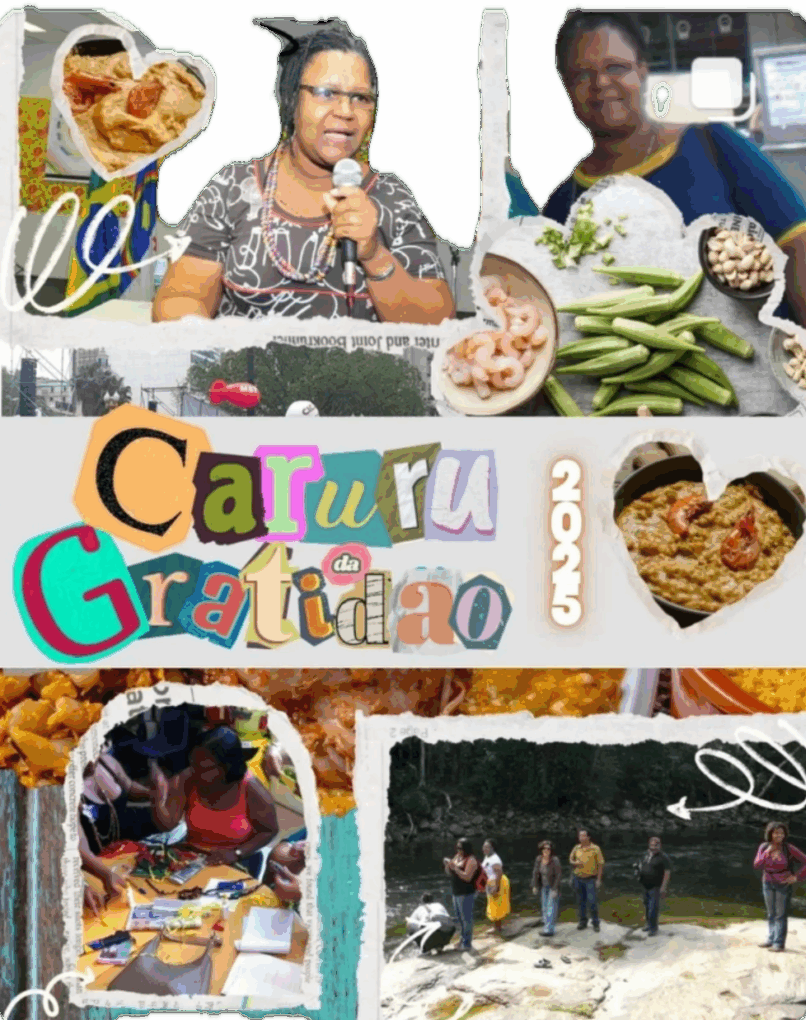
Caruru is a sacred dish, officially recognized in the Recôncavo Baiano, a region of Bahia state known for its strong historical and cultural significance (Governo do Estado Bahia, n.d.). It’s also connected to resistance against religious racism, as it is a food offering to the orixás, deities worshipped in terreiros, Afro-Brazilian religious temples, that refer to the gods of the Ketu nation and the Angola nation, where they are known as Inquice (Alves & Pinheiro, 2013). Specifically, the dish caruru is dedicated to the Ibejis (divine twins), which also ties it to Nigeria, the country with the highest twin birth rate in the world, the second being Brazil. This Rio-Bahia-Africa connection is central to the Caruru.
In Bahia, caruru is a traditional offering to children. It begins by serving seven children first, the Seven Boys[11]. This tradition brings to light the importance of working in partnership with schools. As such, Caruru da Gratidão in Rio became a tool to strengthen the implementation of Law 10.639, which mandates the teaching of African and Afro-Brazilian history and culture in schools. In this sense, the Caruru has become the culmination of a broader school-based process—one that works through a range of topics to support not just anti-racist education, but also the affirmation of different identities within the school space, promoting respect for diversity.
The Caruru da Gratidão is a celebration intertwined with the complex history of racial and cultural mixing in Brazil. In Rio de Janeiro, the Ibejis are syncretized as Saints Cosme and Damião, and in Afro-Carioca religiosity, the tradition is to give sweets to children. In Bahia, the caruru is offered in gratitude for life, and the Caruru da Gratidão forms a powerful cultural bridge between Rio and Bahia—strengthening, here in Rio, a food tradition that has been under attack.
The caruru dish is often served with acarajé—a sacred bean fritter associated with Iansã, an orixá from the Yoruba pantheon. Some Christian Pentecostal churches, through their demonization of Black and Afro-Brazilian culture, have appropriated elements of these traditions. For instance, they’ve tried to rebrand acarajé as “Jesus fritters,” stripping away or attempting to erase its cultural and spiritual roots.
2.4. The Caruru da Gratidão as Spiritual Reconnection
The Caruru da Gratidão is an act of resistance against the erasure of Black Brazilian heritage. Rooted in the memory of Azoilda, we build the Caruru based on the Mandala of Afro-Brazilian Civilizational Values[12] (Trindade, 2005), which Azoilda developed and mapped. These values include orality, memory, communitarianism/cooperativism, religiosity, musicality, corporeality, playfulness, ancestry, circularity, and vital energy (axé). All of this is guided by the element of affection, which is a powerful, vital force. These values are guided by the concept of axé, a powerful vital energy and are not exclusive to Brazil; they are present throughout the African diaspora in the Americas.
These values are infused into the Caruru not only through the preparation of food, but also through the act of bringing people together. It’s never just about the food—it’s also about affection and gathering, calling people to connect through their bodies and their memories. Our bodies hold memory, and the Caruru allows this ancestral memory to surface through interactive activities and workshops. In this way, the Caruru becomes an act of reconnection.
2.5. The Caruru da Gratidão Celebration
The Caruru da Gratidão has been held every two years since 2018. The vision is for it to remain itinerant, with no fixed location, able to travel across different neighbourhoods in Rio de Janeiro. These are territories where Afro-Brazilian religions are practised, making the sacred preparation of this food deeply rooted in African traditions. The celebration nourishes not only the body but also the spirit and mind. Alongside the food, there are dance workshops, storytelling sessions, turban wrapping for Afro-aesthetic expression, and great care given to transforming the venue—be it a club, street, community centre, or museum—into a sacred space, a spiritual terreiro. Another important dimension of the Caruru is a six-hour-long program that supports local entrepreneurship and the solidarity economy. It promotes small local businesses, artisans, and cultural workers.
The event is entirely community-driven, built through donations and volunteerism. There are no sponsors or owners. It is a space of action, responsibility, and commitment from people and institutions aligned with its purpose: celebrating life. Not just human life, but also nature, in an ecological activity that brings together the material and spiritual worlds. We leave the Caruru filled with axé—energized and empowered to continue honouring and revitalizing our ancestral heritage. Because of this, it draws on a deeply Afro-Indigenous ancestral force and embodies a form of popular resistance—especially against religious racism. The Caruru affirms this power not only within schools but also within community spaces, uplifting and strengthening the community as a whole.
2.6. Caruru, Terreiro, and Resistance
We have territories of resistance. The terreiro is one of them. Much of what we know today about ancestry and Afro-Brazilian civilizational values—their materiality—was preserved in the terreiros (Afro-Brazilian religious spaces). Thus, when we fight for the preservation of these spaces of knowledge, we are defending our wisdom, even if we don’t personally practise the religion. Terreiros have generated essential knowledge for survival.
Today, especially with the implementation of affirmative action policies, there is an emergence of a Black intellectual class—challenging academic norms and confronting the epistemicide once perpetuated by universities when they dismissed or erased other cultures, and denied others the agency to speak for themselves. In this meeting of forces, there is no turning back. We have made significant progress, and that progress is tied to this movement to reclaim our narrative.
Caruru is also about strengthening what we feel, about giving visibility to what lives in us. Our focus is on the joy of holding the celebration. Because otherwise, you end up a prisoner to a world that doesn’t welcome you. As we are not focused on confrontation, Caruru becomes a celebration that attracts a wide range of ways of being in the world. It is a space for differences to meet, where we intentionally avoid sponsorship to preserve the autonomy of the event and keep it free from commodification.
As a work based in exchange, the words “abundance” and “prosperity” must be part of it because they are also deeply rooted in Afro and Indigenous cultures in Brazil. Collaboration creates abundance, and abundance brings sharing, and from sharing comes prosperity. A body, a spirit, and a mind that are well-nourished are far less likely to succumb to the oppressions imposed on them. That is what we believe in.
-
Gaio Jorge and the Coletivo Criação
3.1 Gaio’s Introduction
My name is Gaio Jorge Araújo Baptista de Paiva. I am twenty-five years old, and I am a cria[13] (child) of Guadalupe. This is a peripheral neighbourhood in Rio de Janeiro that faces several challenges in meeting basic Human Development Index (HDI) standards and the right to the city, such as public safety, urban mobility, access to cultural goods, health, and education. I was born in the Muquiço favela and, at the age of six, moved in with my mother to the main street in Guadalupe. Around the age of fifteen, I moved to Honório Gurgel, a neighbourhood in the city’s North Zone. At that time, my family was able to benefit from a national public housing policy program under President Lula’s government, through which they acquired a home via popular financing.
3.2 Education
In high school, I completed a Technical Course in Environmental Studies through SENAI (technical school), made possible by PRONATEC—the National Program for Access to Technical Education and Employment, a Federal Government initiative that promoted access to professional and technological education during President Dilma Rousseff’s administration. Later, I earned a degree in Food Engineering from CEFET, Valença Campus, in the interior of Rio de Janeiro state. While pursuing studies in Environment and Food, I became deeply interested in the intersection of these fields and their importance in finding solutions for human dignity. Before I knew it, the pursuit of knowledge had become a passion, and I continued engaging in courses on solid waste management, waste handling, hazardous waste disposal, fruit and vegetable technology, digital technology training, among others.
3.3 Ancestrality
I grew up in a matriarchal household, led by my maternal grandmother, mother, and aunts. My mother is a social activist who has taken part in many struggles and achievements; she and her peers—whom I call uncles and aunts—helped pave the way for people like me to carry on today. She is my greatest inspiration, the person from whom I have learned everything, my first example of someone dedicated to creating change. Over time, I came to understand that my mother is the way she is because she learned from my grandmother, who in turn learned from my great-grandmother, whom I never got to meet. I feel this ancestral inheritance. My aunts are also involved in transformative work, each with their own expertise and capabilities, engaged in cultural, social, recreational, and even religious activities. Raised by these constantly moving women, I was introduced to the culture of the periphery, but also to a wide range of possibilities beyond my immediate territory.
3.4 The Emergence of Coletivo Criação (Collective Creation)
The Coletivo Criação (Collective Creation) emerged from the sharp awareness of a group of young residents of Honório Gurgel, who already had notable backgrounds in other surrounding peripheral territories. At that time, none of us was even 20 years old. We were youth with strong community ties, who understood that we could operate more effectively in Honório Gurgel and neighbouring favelas than the State itself. Our friendship was born within the Geração que Move (Generation That Moves) project, part of the Agência de Redes para a Juventude[14] (Youth Network Agency). Initially, the project had a welfare approach, aimed at distributing food baskets to peripheral populations during the Covid-19 pandemic. It is important to note that our collective emerged in the context of a global crisis during the pandemic.
We began by organizing food donation and basket preparation actions, but quickly expanded the work of Geração que Move far beyond expectations. If the initial goal was to distribute five meals, we delivered twenty. The impact of our work soon became visible, and we formed various partnerships with local businesses. It became clear that we could not limit ourselves to Geração que Move. We were a group, a collective, and in April 2020, the Coletivo Criação was officially born.
3.5 Coletivo Criação
The creation of Coletivo Criação was driven by a humanitarian emergency. In Honório Gurgel, many families lacked even basic access to food. A symbolic image from that period was the line at a butcher shop in Rocha Miranda, where people waited to collect bones because they could not afford meat. The reality in the outskirts of Rio’s North Zone was harsh: workers could not stop working during the pandemic, and by continuing their activities, they contracted the virus and lost loved ones. It was a brutal dilemma. How to survive under these conditions? Who could help? It should have been the responsibility of the State, but we realized that we had the tools, the connections, and the organization to act effectively. And we did so with excellence; our work from that time is still remembered today.
Since then, the Collective has not stopped. We have engaged in both relief actions, like distributing basic food baskets to 250 families for eight months in 2020, and cultural and solidarity initiatives, such as Solidarity Christmas, which served 150 children in 2020 and 2021, and Solidarity Easter. We also organized several editions of community soup kitchens for people living in street situations. We successfully applied for and received some grants, including from Casa Fluminense, a local Non-Government Organization (Casa Fluminense, 2025). The name Coletivo Criação carries three core meanings:
- Cria (Child of the Community) – Represents our identity as young people from Rio de Janeiro’s peripheries, with territorial experience and deep knowledge of our community’s needs.
- Criação (Creation) – Reflects our ability to develop creative solutions, even with limited resources, to generate real impact.
- Inovação (Innovation) – We combine territorial and technical knowledge, always infused with care and commitment, to think of effective solutions for the challenges we face.
Over time, we have solidified these solutions through new training, trips, and collaborations. That is how Sabores e Saberes de Cria was born.
3.6 Sabores e Saberes de Cria (Flavours and Knowledge of the Cria)
The Sabores e Saberes de Cria project began as a workshop, was later carried out as a course, and is now becoming consolidated as a full-fledged program. In practice, it is built on two fundamental pillars: the economic empowerment of people from marginalized communities and their technical training in food handling best practices. The goal is to qualify participants to work in restaurants and markets, equipping them with technical knowledge and offering an income-generating alternative through the production and sale of their own goods.
The first workshop was held in November 2024, when we offered a 10-hour course that included digital training on best practices in food production and handling, as well as instruction on personal hygiene, food hygiene, and an introduction to food microbiology. Additionally, we conducted a hands-on session in an industrial kitchen located in Rocha Miranda, where participants learned to prepare recipes using food sourced from street markets in Rio de Janeiro. By the end of the course, participants had gained the skills to prepare cookies, cakes, jams, and a variety of other recipes for products sold in these venues.
A key feature of the project is the adaptation of recipes to seasonal ingredients. For example, if the course is offered in November, we use fruits like pineapple and oranges. If it happens in July, we use strawberries and papaya. This ensures the course remains aligned with the availability of ingredients at the time. Over seventy people enrolled in the first workshop.
A crucial characteristic of the course is that participants were paid for their time, ensuring that everyone involved receives financial compensation for their dedication. Participation was selective, with priority given to Black women from the peripheries and LGBTQIA individuals. This decision was based on a clear understanding of social inequality. Black women, especially those living in favelas and peripheral neighbourhoods, are often the ones who suffer most from socio-economic hardships. We offered childcare spaces where participants could leave their children during the course, with supervised activities for the kids. This allowed women to focus on learning without additional stress. Our mission is rooted in an anti-racist commitment that values the leadership of Black women, acknowledging the urgent need to expand opportunities and foster equity.
3.7 Challenges
Among the main challenges we face is the lack of financial resources. Our team is made up of young people from peripheral areas, many of whom face economic struggles, which makes funding essential to keeping the project alive. Another challenge lies in building trust with the local population. Many residents of Rio de Janeiro’s favelas and marginalized neighbourhoods are tired of broken promises and media exploitation. For example, when we distributed food baskets, many people refused to be photographed or have their images shared due to fear of having their vulnerabilities exploited. We handle this challenge with respect and understanding.
Our strong ties to the community allowed us to move freely through various favelas, as people trusted our work. Each action we take reinforces the belief that we are on the right path. We continue forward, firmly committed to contributing to a more just, dignified future with greater opportunities for our community.
-
Verônica Corrêa, Youth Occupation in Decision-Making Spaces and the Fight Against Structural Racism
4.1 Veronica’s Introduction
My name is Verônica Corrêa. I am a young dark-skinned Black woman. I am 27 years old, originally from Duque de Caxias, but I have been living and working in the city of Rio de Janeiro for the past four years. Currently, I am the Coordinator of Public Policies for Youth at the National Forum for Food and Nutritional Security of Traditional Peoples of African Matrix (FONSANPOTMA). I also hold the seat for traditional peoples and communities on the National Youth Council (CONJUVE) and serve as a Territorial Culture Agent, as part of the National Plan of Culture Committees (PNCC). In addition, I act as a link in the Web of Peoples for Agroecology (TEIA) in the state of Rio de Janeiro, strengthening connections between traditional knowledge, youth, culture, and agroecological practices in our territories.
4.2 The Importance of Youth Occupation in Decision-Making Spaces and the Fight Against Structural Racism
I consider it extremely important for young people to occupy spaces, whether in social participation councils, debate forums, or government projects like the PNCC – National Plan of Culture Committees. It is from these places that we can bring up specific youth-related issues, considering that youth have unique needs and particularities. When we talk about the youth of Traditional Peoples of African Matrix (POTMA), many additional factors come into play. The challenges we face, such as racism, knock on our doors every day, disguising themselves under countless different names. However, we all know that, at its core, it is structural and systemic racism that abhors everything that comes from Africa.
I believe that simply existing as a Black woman born in the community is, in itself, a political act—especially being of African matrix and bisexual. That said, I would like to share a little about my political awakening. As I previously mentioned, I am an activist within organized civil society movements, and today I have enough clarity to affirm how difficult it is to develop political awareness when, from childhood, we are taught that politics is not to be discussed. This process turns a fundamental concept into a taboo, although politics permeates every human being’s life, not just in Brazil, but worldwide. Betinho[15] once said that “the soul of hunger is political” (Stutz, 2021), and to this day, we suffer under governments that lack the will to change our devastating reality.
4.3 Political Awakening
My political awakening occurred during the pre-election period of 2018, when the rise of the far-right in Brazil began to gain media attention. Today, I recognize that this process began much earlier, lurking in the shadows. However, like most Brazilians, I only became aware of this so-called polarization at that time. It was a period of unease, as no one knew what would happen. I even feared a new military dictatorship—not only for my own life, but for the lives of those around me—since the system oppresses minorities, even if in veiled ways. As a result of the 2018 election, we faced a government that did not end with a military coup but caused countless setbacks, including historical ones for the country. Brazil, once a diplomatic reference and internationally recognized as an exceptional negotiator, became a global laughingstock. Worse yet, after years of progress, we shamefully returned to the hunger map (see also Rocha et al, 2026, in this volume). The first act of the ill-prepared right-wing government was to dismantle the National Food Security Council (CONSEA), which ceased to exist as a public policy between 2019 and 2022. Council members remained mobilized, striving to ensure the bare minimum within the chaos.
However, amid this completely regressive and disorganized government, we faced the scourge of the century: the COVID-19 pandemic, a disease that emerged unexpectedly and claimed the lives of over 700,000 Brazilians, marking a devastating chapter in our history. Many Brazilians lost their jobs, their loved ones, and had no choice but to start over.
It was in 2022 that my journey as an activist truly began. I joined FONSANPOTMA in May 2022, becoming part of the executive team in the municipality of Rio de Janeiro and taking on the coordination of youth policies. I confess that, at that time, I had little understanding of what that space was or what my role would be—I only wanted to contribute to the growth of my people. FONSANPOTMA is an organization dedicated to ensuring food security and sovereignty for traditional people of African matrix. We understand that we are a people who maintain the language, memory, and history of our ancestors, who were trafficked to Brazil. Today, after much struggle from those who came before me and those who continue to fight, we have achieved some victories, including the conceptual framework recognizing Traditional Peoples of African Matrix as a distinct community.
4.4 POTMA and Agroecology
From 2022 to the present, I have been engaged in various fronts. The first national event I had the pleasure of attending was the 12th Brazilian Congress on Agroecology (CBA), where I participated in a panel alongside fellow POTMA members, discussing food security and sovereignty from the youth’s perspective. In my view, youth have the difficult mission of keeping an entire ancestral legacy alive while also reclaiming the ancestral technologies of traditional peoples, ensuring they are not lost. Shortly afterward, I had the honour of joining the 1st Delegation of Traditional Peoples and Communities (PCT) at the 4th National Youth Conference—an opportunity to unite forces with other young PCT leaders, transforming our differences into strengths. In January and February 2024, I participated in the 1st phase of the Training of Builders and Defenders of Territories program through a gastronomy course that explored food as an ancestral tool for economic, historical, and cultural empowerment. I had the pleasure of teaching some classes during this process. We designed the course curriculum based on circular knowledge-sharing, where everyone contributed their wisdom to the collective. By the end of this process, we had all become enriched. Those two months were filled with immense learning, deep connections with ancestry and my peers. I made lifelong friends and cherished every experience I had at the Terra à Vista Settlement[16].
It was through this experience that agroecology entered my life and found a special place in my heart. It was then that I realized how much we rely on and use ancestral technologies. And how colonizers have appropriated these technologies—presenting them to the world as “innovations” and reaping the benefits of knowledge created by the Indigenous and Black ancestors of this land. One example is the traditional thatched house, now rebranded as “bioconstruction,” with its origins erased and the knowledge holders—who have passed these skills down for generations—left unrecognized. It is against this tide of erasure that the People’s Network for Agroecology (TEIA) seeks to empower riverine communities, quilombolas[17], family farmers, and others in the pursuit of a Black, Indigenous, and popular alliance.
4.5 The Future is Ancestral
Since then, I have carried all these experiences with me, understanding the importance of preserving ancestral customs, knowledge, and practices to build a sustainable future. The global climate outlook is bleak; scientific models are unequivocal in stating that there is no possibility of reversing the damage. However, we can stabilize the situation by making serious commitments to sustainability and advocating for fairer and more equitable global governance.
Therefore, we must unite our voices and actions, recognizing the strength that lies in our diversity and shared experiences. It is essential that everyone, that we, as a society, work together to ensure that the voices of traditional peoples are heard and respected, and that their practices and knowledge are valued. Only in this way can we cultivate a future where dignity and social justice prevail—not only for youth, but also for all generations to come.
-
Iyalorixá Roberta Costa de Yemonjá and the Instituto Águas do Amanhã (Waters of Tomorrow Institute)
5.1 Iyalorixá Roberta’s Introduction
My name is Iyalorixá Roberta de Yemonja, and I am the religious leader of Ilê Alaketu Asé Awom Omi Yemonja (House of the Waters of Yemonja), an African-based religious terreiro located in Sepetiba, in the West Zone of Rio de Janeiro. I am also part of the board of directors of the Forum of Solidarity Kitchens of the State of Rio de Janeiro[18]. Currently, I also serve as a council member of COMPLIR-Rio, the Municipal Council for the Promotion of Religious Freedom in Rio de Janeiro.
I come from a terreiro family: my great-grandmother was from a terreiro, my grandmother has a terreiro, and now I have mine. I was born with the understanding that what we had, we shared. Many times, entire families would arrive at the terreiro because the father had lost his job or the husband was abusive. The woman would take her children and go to the terreiro, and there, those children would be fed. When the mother went to work, the terreiro would bathe the children and send them to school. When a woman gave birth, she went to the terreiro.
Thus, I come from that lived experience of the terreiro, which I often say is a space of ancestral knowledge and practice that sustains our people. It is the knowledge of teaching another woman how to sew, how to braid hair, and how to do crafts with straw. This terreiro way of life is where I come from — and so, serving food is something I have done for as long as I can remember; my great-grandmother was already doing this.
5.2 Instituto Águas do Amanhã
The Instituto Águas do Amanhã is located in Nova Sepetiba, Santa Cruz[19]. During the pandemic, the terreiros in this community began to intensify their efforts to fight hunger, a mission that we have embraced since the mid-19th century. These terreiros always saw themselves as being on the front lines of public policy because they lacked outside support. Also, due to our peripheral location and precarious transportation network, people could not even move around. We are talking about a territory that lacks water and doesn’t even have a public health clinic.
During the pandemic, there were moments when basic food baskets arrived, but the work of the terreiro kitchens was not just to deliver groceries. That was not enough; the women did not even have money to buy cooking gas. What they needed was a ready-made meal.
5.3 Participation in the National Program of Solidarity Kitchens
Today, the Instituto Águas do Amanhã is part of the Solidarity Kitchens Program of the Ministry of Social Development and Assistance, Family and the Fight Against Hunger (MDS, n.d.). We are connected to them through a two-year contract, until the end of 2026. The program pays, through a public call, R$2.40 per meal distributed by each kitchen. It is not a lot, it does not cover all costs, but it is a form of aid. Most of the time, or nearly all the time, we put our own money in, from our salaries, from our personal resources.
We are one of the managing entities of the program, and the only managing organization rooted in African-based traditions. We work with thirteen other solidarity kitchens from terreiros and quilombola communities, including one located in Rocinha, the largest favela in Latin America. Since we are the umbrella organization, everything goes through us first, and then we distribute to the others.
We receive a good portion of the fruits, vegetables, and greens from the PAA (Food Acquisition Program[20]). The rest comes from individual donations, which we call “donations by CPF” (using personal taxpayer IDs). We also use animal protein from our own terreiro, as part of our rituals. Many terreiros have productive backyards and ancestral gardens.
At the Institute, we serve around 75 to 80 families. While the national average is four kids per family in Brazil, our reality is different. Some families have as many as eleven children. We provide meals three times a week — on Wednesdays, Saturdays, and Sundays — totalling around 300 to 400 meals per day. Each meal box (quentinha) always includes an animal protein, rice, beans, and a vegetable salad. For example: rice with beans, farofa, collard greens sautéed with garlic, and a protein. Or pasta, beans, ground beef, and a salad. The salad can be made with vegetables or leafy greens like lettuce. When we receive a lot of vegetables, we prepare a big soup with protein and pasta.
I am the person who tastes the food first. I eat the meal before it is packed to check the flavour — because I want the food to be well-seasoned, with garlic, with taste.
5.4 Terreiro Food and the Importance of the Kitchen
Food is part of our culture. Everything in the terreiro involves food. Taking care of your spirit involves food. If you want to please Oyá[21], you make acarajé[22]. If you want to please Iemanjá, you prepare ebojá, which is made from white corn kernels (hominy). You want to make a dessert? You make ecó, which is a sweet acaçá, a ritual food made from cooked white cornmeal, with coconut milk. And where does that coconut milk come from? From the backyard, where there is a coconut tree. The coconut falls, dries, gets crushed, and the dish is made on a banana leaf, also from the backyard.
I always say that the kitchen is a political space of resistance. The kitchen is the great womb, because it is from there that food comes, and food must be prepared with the utmost care. Because it can nourish and sustain — but if not handled carefully, it can also harm.
The terreiro is a plural space. You will see men, women, gay people, transgender people, and lesbians. You will see Black, Brown, White people; married women, divorced women, single mothers — and all learn to respect each other. In the terreiro, you might find company presidents as well as street sweepers and domestic workers. You may have someone who holds a leadership position in the terreiro but is a domestic worker, and that Coca-Cola executive must bow their head to her. The terreiro has this mystical, plural space because oftentimes the person in the kitchen may not even know how to write, but she makes amazing food, while someone who speaks three languages cannot even chop an onion. That mysticism in the terreiro is vast. You enter a completely different organization.
5.5 Solidarity Kitchen as a space for coexistence
We think a lot that the solidarity kitchen is a welcoming place, not just to feed. Because when we feed ourselves, we welcome emotions, and the kitchen is also a space for the political and intellectual formation of these women. We use the opportunity of the presence of this group of women to set up workshops.
These families are not all from African matrices. There are Evangelical, Catholic, and Buddhist families who come to the terreiro to feed themselves. We do a workshop explaining to them how they can plant kale, lettuce, salsa; how to fertilize a land to have more banana, mango, orange trees. Because they can have that productive backyard in their own home.
We have women who have returned to study after the pandemic. We try to encourage them to take classes, go to workshops, and participate in lectures, conversation circles. All of this is offered from the kitchen where they get their meals. We have a group of volunteers who are social workers, nurses, doctors, and lawyers.
On the day of deliveries, we always have a lot of information for them, because we have women who do not know that they have the right to go to the health post to do a pap test. Thus, that is why I talk about political formation that is not a partisan political formation, but about rights and duties. We also have formative workshops on culinary, baking, and crafts. We always invite professionals from the areas of health, beauty, female empowerment, and social assistance to be able to talk about these rights. Many of the women we serve have lost their companions by death, and others are separated. We began to realize that many of these women began to seek an escape in alcoholic beverages. Once a week, we have a dance with a teacher. During that time, women develop the capacity to take care of their emotional state. They are always accompanied by a psychologist who enables a conversation circle. This is part of what we call the service of coexistence.
It is also important to talk about health, because there is no way not to connect food with health. Some mothers leave their houses around 4h30 in the morning; they do not have good conditions to take care of their children’s food. The children end up eating any nonsense, such as cookies that are not nutritious. Today, we have children who are eleven, twelve years old, with high triglyceride rates, with high blood sugar, children being hospitalized because they are diabetic. This is all the result of bad feeding. It is a nutricide.
5.6 Challenges and Future
One of our challenges is to be able to maintain the quality of the food. First, food is very expensive in our territory. There is also the challenge related to the quality food that arrives in the Baixada Fluminense, in the West zone, in these peripheral zones. I call this food racism, because the quality is not the same as in other regions of the city.
Another challenge is that every day, a greater number of people show up looking for a meal. We try to first serve the seventy-five registered families, but we cannot say no to someone who knocks on the door. We take the name, ID, and signature of the person to make a registration first, because we need to prove that.
The religions of the African matrix are the ones that suffer most from religious intolerance. This is another challenge. We are all in favour of everyone having their religious preferences, but some groups do not see this as a choice. They see this as having their religion being the only one and the best of all, which is absurd and dangerous. There is, in fact, no respect. I usually say that people say that the State is secular, but there is no such secularity.
Finally, the government today recognizes the Traditional Peoples of African Matrices, but we do not know the day of tomorrow. That is why the solidarity kitchen program needs to become a law, otherwise the next one that sits in the government chair ends the program.
-
Iya Itanajara de Oxum and the experience of Porto Alegre
6.1 Itanajara’s Introduction
My name is Itanajara Dione Nascimento de Almeida, or Iya Itanajara de Oxum, as I am known. I am a member of the Cabinda Nation of the Bantu people. I work as the national coordinator of finances for FONSANPOTMA and as the executive coordinator for FONSANPOTMA in the city of Porto Alegre. I am also a member of the National Food Security Council, the Food Security Council for the State of Rio Grande do Sul, and the Municipal Council of the Black People of Porto Alegre. In addition, I am a delegate to the Conference of Traditional Peoples of African Matrix and the Community of Terreiros.
6.2 World Social Forum and FONSANPOTMA
I am part of FONSANPOTMA, which is an entity that organizes itself in a forum format to think about and guarantee the food security of people and traditional communities of the African matrix. We have integrated this forum into a political action during the World Social Forum – FSM in Porto Alegre.
From the perspective of the terreiros, work in food security is silent work that few hear, and do not realize that it comes from somewhere, like the work that ants do. On the other hand, people in situations of food insecurity and hunger have difficulty accessing spaces and territories of help. Often, it takes time for people with hunger to realize that they need help and that they have the right to help. This partially explains the invisibility of food security work done by the terreiros.
Terreiros, are also referred as UTTs[23] (Traditional Territorial Units). Food is routinely produced and distributed to children, collaborators or sympathizers in the terreiros. Many solidarity actions are carried out, especially in communities with a high index of vulnerability. Terreiros partner with other entities to search for food to distribute to those in a state of hunger or food insecurity.
During the World Social Forum in Porto Alegre in 2005, an internal coexistence space was created, called the People’s Complex, where traditional foods from the terreiros were offered. The People’s Complex was built in the format of a tent where we set up a food square to offer to the participating public of the World Social Forum traditional foods, produced by a group of traditional authorities of the POTMA. Our traditional foods have always been sacred, being part only of internal events of the terreiros. During the World Social Forum, this food was offered to people beyond the terreiros, and more people could appreciate what we know, and what we do. In this space, we also organized a solidarity economy market with products and services of the POTMA. The People’s Complex not only had food, but also had a market with crafts, people doing braids, etc. Anyway, it was all a culture being presented, and a lot of people were mobilized around service, food and market. People, outside of the tradition, began to know what we do.
6.3 Banquetaço Action and the Pandemic
In 2019, the dismantling of the National Food and Nutrition Security Council (CONSEA) was among the first actions of our newly elected president, causing general despair. All states that had a CONSEA (Council for Food and Nutrition Security) organized actions in response to this act, and demonstrations took place throughout Brazil called Banquetaços[24]. Here in Porto Alegre, I was part of the Banquetaço that served traditional African-based food. We served more than 800 people in front of the Legislative Assembly of Porto Alegre, including ordinary people, homeless people, African immigrants, parliamentarians, councillors… a diverse public. It was a historic milestone where various organizations worked together to make it happen.
The following year, we were hit by the pandemic, and it was a lot of work. Initially, the pandemic affected the upper and middle classes more, who sent domestic workers and day labourers to their homes for fear of contamination. But in the communities, life continued as normal, bars and local services remained open. It took a while for Covid to reach the peripheries. For a while, there were two worlds: the middle-class neighbourhoods where everything was closed, and the communities, where it seemed like the pandemic wasn’t happening.
Then the pandemic reached the peripheral areas, and we had to worry about people who, in addition to being isolated, lost their family members day after day. Hunger was implacable, and we went out again in search of food to cope with the countless bereaved families. The State Government had no action plan against hunger in the pandemic in these areas, and several organizations filed a lawsuit against the government of the State of Rio Grande do Sul to enable the arrival of food in the periphery. The third time we won the case, and only in the metropolitan region of Porto Alegre, 5,000 basic food baskets were distributed. We participated in the distribution of these baskets and in other mobilization actions with Ação da Cidadania (Action of Citizenship)[25]. We also participated in actions to enable access to food, such as asking for food at traffic lights, walks and the act of embracing the public market. During the pandemic, the importance of the Houses of Tradition (terreiros/UTTs) in food security also became evident, as they were one of the only places where we could find animal protein.
6.4 Mapping of Solidarity Kitchens
In 2023, with the change of government[26] and the return of CONSEA, the federal government began to see the African-based solidarity kitchens as an instrument for food security. With the advice of government representatives, we realized the importance of recording our activities in reports to provide public transparency. We began to worry about putting more information about our kitchens on paper: What do they serve? What do they consume? What size? What are the needs of each one? We also began to systematically register the beneficiaries of the solidarity kitchens of the UTTs. With CONSEA, we had access to documents that guaranteed this process of systematization and recognition as an African-based solidarity kitchen[27].
6.5 Flood in Rio Grande do Sul
Between April and May 2024, the state of Rio Grande do Sul was devastated by storms and floods. It was considered “the worst climate tragedy in the history of Rio Grande do Sul” (CNN Brasil, 2024). “According to Civil Defense, 172 people were killed and over 629,000 were forced from their homes” in the state (G1 RS, 2024).
In 2024, while we were identifying our UTTs as solidarity kitchens and trying to get them officially recognized, once again, we had to mobilize to access food. The flood in Porto Alegre hit suddenly, forcing people out of their homes and into UTTs that welcomed them—but did not have enough food to provide for all the families. Another local mobilization began so that the POTMA could receive supplies to support the families coming together at that moment to save lives. Many people lost everything—except their faith.
The floodwaters also invaded many shelters[28], and people were moved to larger terreiros, known as “welcoming terreiros”. A central food distribution hub was created in partnership with the Black Social Club. For 45 days, the welcoming terreiros served 27,000 people daily from 9 a.m. to 7 p.m. People went there for everything: water, food, even clothing. Multiple partnerships were formed, including with the Pontifical Catholic University (PUC), whose students helped with registrations and data tracking. We also partnered with the Red Cross and many others. With Ação da Cidadania, we created several food distribution points in terreiros located in peripheral neighbourhoods. Unfortunately, ten days after the flood, we learned of incidents of religious intolerance, which highlights the complexity of the logistics involved in feeding our people.
6.6 Legitimization of Solidarity Kitchens
We have gathered a network of seventy-four solidarity kitchens in the state of Rio Grande do Sul registered with CONAB[29]. Despite the difficulties, the efforts to legitimize the solidarity kitchens in Rio Grande do Sul continue. This is important because by registering UTTs as kitchens, they can access the Food Acquisition Program (PAA) and thereby receive public policy to support their lives.
-
Olamidê Lessa and FONSANPOTMA
7.1 Lessa’s Introduction
My traditional name is Olamidê[30]. My legal name is Maria Aparecida da Silva Lessa. I am a woman perceived as white, which, in a racist society, places me in a position of privilege and demands great responsibility and commitment from me within the social movement of antiracist struggle and with my identity as “Traditional People of African Matrix” (SEPIR, 2013). I am an educator by training and hold education as a tool of struggle and transformation. In every path I have taken, education has always been at the forefront or has placed itself there.
My favorite childhood game was playing school, and when I had my daughter, it was also the school that we most often played and interacted through (that daughter is now an educator herself, and my youngest son is following the same path). I believe, however, that:
“No one becomes an educator on a certain Tuesday at four in the afternoon. No one is born an educator or destined to be one. We become educators, in practice and through reflection on that practice.” (Freire, 1991, p. 58). I quote Paulo Freire because I see my very existence grounded in education due to this deep urge to reflect and interact with the world around me, to live and feel collectively. A good educator is always open to learning—because education is an exchange. This view of education is what led me to leave the system, resigning from the Rio de Janeiro city government in 2010, and instead working directly with those who most needed my guidance.
From there, the tutoring and preparatory program “Letra de Lessa” was born, today known as “Ori-entar[31]Prepara”[32]. Over more than a decade of work, other projects emerged as well: the Centro de Educação e Cultura Memórias Alimentam (Center for Education and Culture “Memories Nourish”), the Espaço de Educação, Ressignificação e Ensino (ERÊ Space[33]) and Cozinha Ancestral e Solidária Memórias Alimentam[34] (Ancestral and Solidarity Kitchen “Memories Nourish”). This journey brought me closer to my students, their families, and the community where I taught and lived. It organically led me into the political struggles where I now find myself—sure that I have always been part of this fight, because when we educate with responsibility, we educate for social and political life, we educate to transform.
In this sense, I affirm: “I don’t write only because it gives me pleasure, but also because I feel politically committed, because I want to convince others—without deceiving them—that the dream or dreams I speak of, write about, and fight for are worth trying for” (Freire, 1994, p. 15–16). This personal account offers that possibility—it gives us a voice, treats us as subjects of the movement, and allows those who read it to understand that it is possible.
7.2 Being a Traditional People of African Matrix
At the same time the projects were being born, my pursuit of learning was nurtured through specializations in the areas of ethnic-racial education, African history, cooperativism, and communication. This search reconnected me with my ancestry, given that institutional racism experienced during the years of formal education does not teach an understanding of the formation of our society through the lens of people kidnapped from the African continent, nor the Indigenous peoples of our country. This recovery led me to the initiation and reconnection process with my existence in Candomblé[35] in 2015 and to the study and practices of Jurema Sagrada[36]. This process allowed me to better understand the structure of my family and the memories left by my ancestors, since my family reflects miscegenation (Geledés, 2019) as a form of whitening Brazilian society. This was a cycle shift that merged with the invitation to participate in Rio de Janeiro, in the National Forum for Food and Nutritional Security of Traditional Peoples of African Matrix (FONSANPOTMA).
7.3 Legal Framework of the POTMA
The richness of the work in this forum lies in the struggle for ancestral legacy stemming from the crossing of the Atlantic Ocean, while focusing on the peoples who made that crossing—not only through the lens of the forced diaspora, but to give voice beyond religious matters, with a focus on traditional territorial units (UTTs)[37], which “maintain ties with their surrounding communities, serving as spaces with enormous potential for promoting health, education, culture, and food security” (SEPIR, 2013). For this reason, FONSANPOTMA promotes the development of public policies through conceptual debate, reinforcing what is established in Decree 6040/2007, which instituted the National Policy for the Sustainable Development of Traditional Peoples and Communities. FONSANPOTMA has been one of the main advocates in shaping the Conceptual Framework, followed by the Legal Framework of POTMA, officially presented since 2022 (Agência Câmara de Notícias, 2022). This is fundamental for the implementation of reparative policies to ensure food security and sovereignty for our people.
7.4 Territory and Resistance
For us, POTMA, territories are essential—they are where collective life happens and develops, considering our histories, worldviews, socioeconomic structures, and the political dynamics in which we are embedded. The institutional invisibility of traditional territories becomes apparent when we speak about the city of Rio de Janeiro. Known for its beautiful beaches and intense urbanization, who could imagine that within such a globally renowned place there exists a multitude of traditional peoples and communities, right? The territory where we have been resisting and writing our stories—fighting for traditional food and for the preservation of our practices, while also reclaiming silenced memories.
What we now know as the city of Rio de Janeiro was, during the era of slavery between the 16th and 19th centuries, one of the main receivers of enslaved Africans from various regions of the African continent. Its main entry point was the Valongo Wharf in the Port Zone, which has been recognized since 2017 as a World Heritage Site by UNESCO. Many movements continue to fight for the recognition of the legacy of these ancestors. Despite progress, persecution and racism persist. In an urban center like Rio, the most symbolic challenges are territorial preservation and food insecurity.
How can we maintain our traditional food, ensure our food security and a system that guarantees our sovereignty? As POTMA, these questions are fundamental because we organize around the territory and have a strong connection with nature as culturally distinct peoples with their own civilizational values—preserving traditions, knowledge, and identities. To be a traditional people of African heritage is to live in territory and ancestral resistance.
7.5 Traditional Food Systems and Sustainability
Food is a central point for the POTMA. Every rite of passage involves food. Food is part of all our processes, including traditional slaughter, a practice that has been guaranteed by the Federal Supreme Court (STF, 2018). When we slaughter an animal, this is understood as an exchange, an act of gratitude. I eat and nourish the earth that nourishes me. This is circularity. It is this cycle, this lived experience, that we have. The being that is slaughtered will feed and ensure food security for an entire community.
Food goes beyond the act of eating—for our people, it is a system that respects nature and each of us. Our Traditional Territorial Units carry this knowledge deeply rooted. When we offer food to Iemanjá in the sea, we are affirming that the sea is important. When we offer to Oxum, we are saying that rivers and waterfalls are important. All our sacred beings’ express elements of nature, and this makes us responsible and sustainable. What is now called climate justice has always been the foundation of who we are.
We, along with our Indigenous relatives, are the answer to a more balanced world when it comes to environmental and sustainable issues. That is why the pact built with our relatives needs to be renewed every day. A caboclo is not just a religious entity—it is ancestral wisdom, a lesson that hunting cannot mean waste but food security, which guarantees health and our cycles of existence. Preserving and educating people about the POTMA food system is about reconnecting and preparing our youth for sovereignty and food security.
7.6 Education and the Re-signification of Teaching
On this journey with FONSANPOTMA, I continue to strengthen my essence to uphold education as a foundation of my struggle and identity. Educating and Re-signifying Teaching is a space for popular education within the Center for Education “Memories Feed”, a space connected to the Ancestral Kitchen “Memories Feed.”
Its purpose is to put struggles into practice and ensure they reach the grassroots through a non-formal education network nourished by traditional knowledge and practices. It follows a decentralized, collective sociological and philosophical approach focused on traditional Afro-Brazilian communities, in dialogue with our Indigenous relatives and other traditional peoples and communities—strengthening us in the pursuit of climate justice through the teachings these communities preserve.
In this work, we proudly celebrate a beautiful tradition: the Caruru of Gratitude, a story described above in this chapter. Since 2018, with donations, we have cooked and donated meals, empowering our ancestral kitchens as spaces of memory and nourishment through this powerful and heartfelt collective initiative.
We also organize educational gatherings and festivals, such as Ancestral Roots Gatherings, Nylewá Festival, and the educational network training of the project “POTMA and Food Systems in Education”. Additionally, we participate in numerous partnerships, councils, and conferences. It is a termite-like effort—working persistently to hollow out the oppressive system so that, when it realizes it, it has already weakened and is ready to fall. Even though laws exist to support education rooted in African and Indigenous knowledge systems, colonial-era demonization processes—perpetuated by the state in the post-colonial period and fueled today by neo-Pentecostal movements—continue to strengthen the racist and exclusionary structure of our society, especially within formal, public and private education, and political institutions.
As a woman of African matrix tradition and from a family structured by the power of grandmothers, mothers, aunts… I am aware that I am an individual being, but also populated. I do not walk alone—I am surrounded mainly by women and children. I walk alongside Black women and those seen as white as me, and I must name them because food security is tied to the feminine and to the power each one of us women hold to celebrate, love, create, gestate, and nourish[38].
8. Conclusion
The struggle for food security and sovereignty in Brazil is complex, and the life writings presented here offer us several reflections. One of them is about the value and strength of collectives, whether they are youth groups, communities, religious gatherings, or associations that form networks and social support systems, which are fundamental not only for food and nutrition security and sovereignty, but for life itself.
The second reflection is on the importance of the state as a partner, recognizing and addressing the great debt it owes to Afro-Brazilian and Indigenous populations in Brazil.
Finally, it is important to consider these lifewritings as powerful tools for visibility and social transformation. They not only preserve memories, practices, and ancestral knowledge, but also denounce historical silences and point to concrete paths for confronting inequalities. For example, Traditional Peoples of African Matrix build daily networks of care, sustainable food systems, and liberating educational processes, showing that it is possible — and urgent — to shape public policies from the territories and traditions that sustain life in its entirety.
Recognizing and strengthening these experiences also means fulfilling the Sustainable Development Goals (United Nations, n.d), especially those aimed at eradicating poverty (by working in vulnerable communities, promoting social inclusion and dignity); ensuring food security (by valuing traditional and solidarity-based food systems as the foundation of food security); providing quality education (with a pedagogical practice that reinterprets formal education through ancestry and territory); achieving gender equality (by recognizing and strengthening the fundamental role of women in maintaining life and culture); reducing inequalities (by denouncing institutional racism and building alternatives of resistance and care); and promoting climate action (by practicing and educating for a balanced relationship with nature). There will not be just or sustainable development as long as the knowledge, rights, and territories of traditional peoples are neglected. As this journey teaches us, to educate, to nourish, and to resist are profoundly political acts that are essential to building a more dignified, diverse, and balanced world.
References
Agência de Redes para a Juventude. (2022). [Website] https://agenciarj.org/
Agência Câmara de Notícias. (May 19, 2022). Projeto institui marco legal dos povos tradicionais de matriz Africana. Agência Câmara de Notícias.
Almeida, R. R. de (2019) A luta por um “modo de vida”: As narrativas e estratégias de enfrentamento ao racismo religioso do Fórum Nacional de Segurança Alimentar e Nutricional dos Povos Tradicionais de Matriz Africana.[PDF] (FONSANPOTMA). [Doctoral Dissertation, Universidade Federal Fluminense].
Alves, A. de L. & Pinheiro, E.B. (2013) Tradição e História do Candomblé Angola na Bahia[PDF]. Anais do XIII Congresso Internacional da ABRALIC.
Ase Dan Fe Ero (n.d.) Dicionario Yoruba.
Barbosa, M. (September 27, 2023) Dia dos Ibejis: Conheça o Orixá das Crianças. Alma Preta.
Brasil (2010) Constitution of the Federative Republic of Brazil [PDF] Constitutional text of October 5, 1988, with the alterations introduced by Constitutional Amendments no. 1/1992 through 64/2010 and by Revision Constitutional Amendments no. 1/1994 through 6/1994. – 3. ed. – Brasília : Chamber of Deputies, Documentation and Information Center.
Brasil (2011) Alimento: Direito Sagrado – Pesquisa Socioeconômica e Cultural de Povos e Comunidades Tradicionais de Terreiros.[PDF]. Ministério do Desenvolvimento Social e Combate à Fome. Brasília, DF: MDS; Secretaria de Avaliação e Gestão da Informação.
Brasil. (n/d) O Programa Cozinhas Solidárias. Sobre. https://cozinhasolidaria.digital/sobre
Campos, T. S. (2025) Candomblé. Brasil Escola.
Casa Fluminense (2025). [Website] https://casafluminense.org.br/
CNN Brasil (December 18, 2024) Alagamentos, destruição e 183 mortes: relembre a tragédia das chuvas no RS que marcou 2024.
ECLAC – Economic Commission for Latin America and the Caribbean (2023) Pé-de-Meia. United Nations, Non-contributory Social Protection Programmes Database. Latin America and the Caribbean. Conditional Cash Transfer Programmes.
Evaristo, C. (2020) A Escrevivência e seus Subtextos.[PDF] In: Constância Lima Duarte & Isabela Rosado Nunes (Orgs.) Escrevivência: a Escrita de Nós. Reflexões sobre a Obra de Conceição Evaristo. Rio de Janeiro, Mima Comunicação e Arte.
Fagundes, A., Ribeiro de Sá, C.C., Silva, T.C., Santos, F.F., & Recine, E. (2026). Exercise in Democracy: Social participation in public policies for food security in Brazil. In Rocha, C. & Moraes, A. (Eds.) Agency for Food Security in Brazil: Social Mobilization, Participation, and Public Policies. Toronto: TMU Pressbooks.
Freire, P. (1991). A Educação na Cidade. São Paulo: Cortez.
Freire, P. (1994). Cartas a Cristina. Rio de Janeiro: Paz e Terra.
Fortaleza, R. (February 7, 2025) Orunkó no Candomblé: entenda o significado e a importância deste nome sagrado. Cultura. Respeite Nosso Axé.
G1 Rio Grande do Sul (May 29, 2024) Um mês de enchentes no RS: veja cronologia do desastre que atingiu 471 cidades, matou mais de 170 pessoas e expulsou 600 mil de casa. O Globo. Rio Grande do Sul.
Geledés. (September 24, 2019). A Ideologia do branqueamento: tudo que você precisa saber. Portal Gedelés – Artigos e Reflexões.
Governo do Estado da Bahia (n.d.) Recôncavo.[PDF] Municípios.
Índio do Brasil, C. (September 27, 2024) Bahia homenageia santos Cosme e Damião com comidas de orixá. Agência Brasil.
Lobo, P.V. (October 31st, 2024) Fórum de Cozinhas Solidárias: Cozinhas Solidárias como uma tecnologia social de Combate à Fome, insegurança alimentar e a promoção da Cidadania com dignidade. Portal Favelas. Colunas.
MDA – Ministério do Desenvolvimento e Agrário. (February 11, 2025) Quilombolas. Instituto Nacional de Colonização e Reforma Agraria (INCRA)..
MDS – Ministério do Desenvolvimento e Assistência Social, Família e Combate à Fome (n.d.) Programa Cozinha Solidária.
Memorial da América Latina. ( January 27, 2009) O Significado dos Orixás.
Morais, M. R. de, & Jayme, J. G. (2017). Povos e comunidades tradicionais de matriz africana: uma análise sobre o processo de construção de uma categoria discursiva.[PDF] Civitas: Revista De Ciências Sociais, 17(2), 268–283.
Nascimento, R. M. (2019) Vocigrafias. [Tese de Doutorado.] Pontifícia Universidade Católica de São Paulo. Sao Paulo.
Netto, V. ( May, 13, 2024 ) Enchente no RS atingiu cerca de 750 terreiros de religiões afro-brasileiras: “Perdas materiais e espirituais”. Gazeta Zero Hora.
Nogueira, J.K.G., Nogueira, R.B.G., Lessa, M.A.S., Nogueira, E.A. & Domingues, M. (2026). Food Systems and Food Sovereignty of Traditional Peoples of African Matrix in Brazil. In Rocha, C. & Moraes, A. (Eds), Agency for Food Security in Brazil: Social Mobilization, Participation, and Public Policies. Toronto: TMU Pressbooks.
Ortega, A. (August 05, 2024) ‘Encontrei meus búzios no portão’: as histórias dos terreiros inundados no Rio Grande do Sul. Brasil de Fato.
Projeto Betinho (n.d.) Betinho’s Legacy.
Rocha, C., Bezerra, M., Pequeno, N., Pinheiro, A., Lima, S., & Lyra, C. (2026). Moving Forward in Guaranteeing the Right to Food: Timeline on Food Security Policy in Brazil. In Rocha, C. & Moraes, A. (Eds), Agency for Food Security in Brazil: Social Mobilization, Participation, and Public Policies. Toronto: TMU Pressbooks.
Santos, N.A.C. dos (2011) O Candomblé na Representação da Yalorixá. Caderno Temático II Educação e Africanidades. Entrelaçando: Revista Eletrônica de Culturas e Educação. Year 2, N. 4 p 26-37. ISSN 21798443
Secretaria de Comunicação Social. (July 11, 2024) Programa de Aquisição de Alimentos (PAA). Presidencia da Republica. Governo do Brasil.
SEPIR – Secretaria de Políticas de Promoção da Igualdade Racial.(2013). Plano Nacional de Desenvolvimento Sustentável dos Povos de Comunidades Tradicionais de Matriz Africana, 2013-2015[PDF]
Silva, D.B. S. da (2019). A Jurema Sagrada: religião ancestral indígena do Nordeste do Brasil no enfrentamento ao Racismo Religioso e Epistêmico. XXXII Congreso de la Asociación Latinoamericana de Sociología. Asociación Latinoamericana de Sociología, Lima.
Stutz, E. (June 17, 2021) A Alma da Fome é Política. Brasil de Fato.
STF – Supremo Tribunal Federal. (August 8, 2018). Pleno – Suspenso julgamento sobre sacrifício de animais em rituais religiosos [Youtube video]
TAG – Experiências Literárias (2018). O significado dos nomes na cultura iorubá. Curiosidades Literárias.
Trindade, A. (2005) Valores Civilizatórios Afro-brasileiros na Educação Infantil.[PDF] In: Valores Civilizatórios Afro-Brasileiros na Educação. Ministério da Educação, Brasil.
Unicamp – Universidade Estadual de Campinas. (July 21, 2023) Azoilda Trindade.
United Nations (n.d.) MDG- Millenium Development Goals.
Quadri-Adekambi, A. (April 8, 2023). Ìyá ≠ Mother: Making a Yoruba sense of motherhood. Shado.
Vechi, T. (2025). Iansã (Oyá). Brasil Escola.
- Terreiros are the temples, sacred territories, also called houses, where Candomblé ceremonies are performed. ↵
- For more information about POTMA and FONSANPOTMA see also the chapter of Nogueira et al (2026) in this volume. ↵
- Omibirim means daughter in Yoruba. (Ase Dan Fe Ero, n.d) ↵
- The Iyalorixá is the religious, cultural, and social leadership of a Candomblé’s terreiro that mediates communication between the community members and the Orixás (Santos, 2011). ↵
- Iya means mother in Yoruba. (Quadri-Adekambi, 2023) ↵
- Oxum, the divinity of fresh waters, is syncretized in Bahia with Our Lady of Candeias. Her archetype is that of women who, beneath a graceful and elegant appearance, conceal a powerful and vital inner will. (Memorial, 2009) ↵
- The prefix "ola" is associated with joy, dignity, and prosperity. In its literal translation, the name Olamide means "wealth has come." (TAG, 2018) ↵
- Referring to the Federal Cash Transfer Program Pé-de Meia, created in 2023 to combat secondary school evasion by financially rewarding students that finish their school years in public high schools. For more, see: ECLAC, 2023 ↵
- Azoilda Loretto da Trindade (1957–2015) was a Black feminist intellectual and educator who dedicated herself to theories and practices in the field of anti-racist education (see Unicamp, 2023). ↵
- Gurufim or gurufinho: “the art of celebrating, singing, dancing, eating, and drinking to honor the deceased.” (Nascimento, 2019, p.122) ↵
- “The celebration in Bahia, which has spread to other states, begins with the offering of dishes to seven boys who symbolize Cosme, Damião, Doú—a variation of Idowu in an African language [also known as Doum]—Alabá, Crispim, Crispiniano, and Talabi. It is also common to see, alongside the image representing the twins, a third figure called Doú or Idowu, a name given in African families to the child born after twins.” (Indio do Brasil, 2023) ↵
- Afro-Brazilian civilizational values are principles and cultural practices that reflect the influence of African culture in shaping Brazilian identity and history. These values, which are plural and interconnected, include elements such as circularity, religiosity, corporeality, musicality, cooperativism, ancestry, memory, playfulness, vital energy (axé), and orality. For more see Trindade, 2005. ↵
- The expression “cria” in Rio de Janeiro refers to someone who grew up in a place and embodies its customs, speaks its dialect, uses its slang, and carries the knowledge of that space. ↵
- The Agência de Redes para a Juventude is a social program developed by the non-governmental organization Avenida Brasil – Instituto de Criatividade Social. Avenida Brasil was founded in 2006 by artists and activists from peripheric territories of the city Rio de Janeiro and other cities. For more, see Agência de Redes para a Juventude, 2022. ↵
- The sociologist Herberts the Souza, known as Betinho, was a Brazilian Human rights and food activist that was exiled in Canada in the 1970s. For more on Betinho see Projeto Betinho, n.d. For more see Introduction, in this volume. ↵
- The Terra Vista is a settlement from the Brazilian Landless Movement. For information in English, see https://springprize.org/shortlisted/assentamento-terra-vista/ ↵
- Quilombola communities are ethnic groups—predominantly composed of rural or urban Black populations—that self-identify based on specific relationships with the land, kinship, territory, ancestry, and their own cultural traditions and practices (MDA, 2025). ↵
- Solidarity kitchens are community-driven efforts that use social innovation to fight hunger by offering free meals to individuals experiencing food insecurity, economic hardship, or homelessness. The Regional Forums of Solidary Kitchens are initiatives that seek to enable spaces for decision-making, public debate, political coordination, and advocacy within public policies and programs—such as the recently launched Federal Solidarity Kitchens Program. This program was created to support the work of solidarity kitchens operating across Brazil, with backing from the National Secretariat for Food and Nutrition Security under the Ministry of Social Development and Assistance, Family and the Fight Against Hunger (SESAN/MDS). Established by Law No. 14.628/2023 and regulated by Decree No. 11.937/2024, the Solidarity Kitchen Program is designed to provide resources for the preparation and distribution of free, high-quality meals, prioritizing individuals in vulnerable situations, including people experiencing homelessness and food and nutritional insecurity. (MDS, n.d.; Lobo, 2024). ↵
- Santa Cruz is a neighborhood in the West Zone of the city of Rio de Janeiro, the furthest from the city center. ↵
- The National Food Acquisition Program (PAA) purchases food directly from family farmers without requiring a bidding process and distributes it to people facing food and nutritional insecurity. It also supplies the social assistance network, public facilities dedicated to food and nutrition security, and both public and charitable educational institutions. The program’s goals are to support and strengthen family farming by fostering job creation, income generation, and local economic growth, while also improving food access and helping to combat food and nutritional insecurity. (Secretaria de Comunicação Social, 2024). ↵
- Also called Iansã, the orixá of winds, storms, and funerary rituals. (Vechi, 2025). ↵
- As previously mentioned by Janete, acarajé is a sacred bean’s fritter. ↵
- UTTs can also be called terreiros. "Data from the 2010 Census of the Brazilian Institute of Geography and Statistics (IBGE) point out that, in Rio Grande do Sul, 157 thousand people considered themselves practitioners of umbanda or candomblé - the data from the 2022 Census related to religion have not yet been released. The State is ahead, including, of Bahia with 47 thousand, and of Rio de Janeiro with 141 thousand." (Netto, 2024) ↵
- See also Fagundes et al, 2026, in this volume. ↵
- For more on Action of Citizenship, see the chapter from Moraes & Rocha, 2026, in this volume. ↵
- President Lula da Silva, from the Workers Party (PT) was elected in 2022 and took office on January 1st, 2023. ↵
- The solidarity kitchens, run by civil society and financed with public resources, represent a social technology for combating food and nutritional insecurity. The Ministry of Development and Social Assistance, Family and the Fight Against Hunger (MDS) coordinates the program within the framework of the National Food and Nutritional Security System (SISAN). Created in 2023, the Solidarity Kitchen Program in Brazil aims to provide free, high-quality meals to the population, especially those in situations of vulnerability and social risk in urban areas (Brasil, n/d). ↵
- “A survey conducted by NEGA/UFRGS and Uniafro estimated that 254 terreiros were completely destroyed; 176 were partially damaged; and 27 served as aid centers.” (Ortega, 2024) ↵
- CONAB _ Companhia Nacional de Abastecimento /The National Supply Company (CONAB). According to Itanajara, by July 2025, the Rio Grande do Sul state has approximately 180 solidarity kitchens approved by the Ministry of Social Development (MDS), some of which are still waiting for the official call for proposals to be included in the Food Acquisition Program (PAA). ↵
- Traditional name received as recognition for the work and the journey dedicated to the antiracist struggle. ↵
- The name includes a hyphen to emphasize the word “ori,” a Yoruba word meaning "head," which in Candomblé is written with a capital letter, “Orí,” as it is associated with an Orixá that represents intelligence, consciousness, destiny, and the connection between a person and their life purpose. ↵
- A preparatory course for children, youth, and adults for entrance exams and public service exams, as well as pedagogical guidance to complement formal education. ↵
- In Umbanda and Candomblé, the Erês are entities that represent spiritual children—intermediaries between people and the Orixás. They are spirits of children who have either never incarnated or who have already lived. This part of the project focuses on early childhood education, bringing women to the center of the discussion, as they are the majority in both the formal and informal education of children. ↵
- The kitchen, now recognized by the Ministry of Agrarian Development (MDA), functions as a social and educational space that preserves memory and values the food and nutritional culture of Traditional Peoples of African Descent through the ancestral legacy left by those who, even when enslaved and brought to Brazilian lands during the colonial period, managed to preserve and pass down their knowledge. ↵
- This is part of the culture of the Traditional Peoples of African Descent: Afro-Brazilian religiosity, born from the experiences of African peoples and their descendants, as a form of resistance and cultural preservation in the face of forced catechization during the colonial period—a tradition that, unsurprisingly, has been heavily persecuted and threatened. ↵
- Sacred Jurema is a Northeastern Brazilian religion of Indigenous origin, centered around the sacred Jurema plant and the ritual drink made from it. With strong ties to nature and regional historical figures, its oral tradition blends elements of Afro-Brazilian religions, Kardecist Spiritism, and Popular Catholicism.(Silva, 2019). ↵
- Traditional territorial units are geographic spaces where traditional communities live and share environmental resources, threats, and conflicts. They are places where communities can maintain their culture and customs. ↵
- I am grateful to Omobirin Verônica de Odé, Abiãs Vitória, Bruna, Rosângela, and Nathália, Ajoiê Alexia de Oyá, Ekedji Sandra Aleixo de Baru, Iyá Vera Panno, Ekedi Pâmela, Iyalorixá Iyá Nalva de Oxum, Iyá Vera de Oyá, Gayaku Jokolosy, Janete Santos, my carnal mother Sandra, my aunt Nádia, my daughter Thuany, and in memory of the most warrior women I have known—my grandmothers Belmira and Laura. ↵