Part 2 – Agency and Social Mobilization: Anti-Racism and Food Sovereignty
Chapter 6 – Precarization of Precariousness: Work Process, Hunger and Food insecurity of Non-White Food Delivery Drivers in Curitiba, Brazil
Vanessa Daufenback*, Silvia Rigon, Cláudia Maria Bógus
*Corresponding author: vdaufen@gmail.com
“I have worked hungry several times carrying food on my back”. “I work hungry every day” (Vieira, 2020).
1.Introduction
In June 2020, testimonies from motorcycle and bicycle delivery drivers sparked a public debate in Brazil regarding their precarious working conditions and the risks they encountered during the COVID-19 pandemic (Manzano & Krein, 2020). The Labour Reform in Brazil radicalized the precarious nature of work under neoliberalism (Brasil, 2017), creating informal, just-in-time employment for workers. Workers began entering into intermittent employment contracts with application companies, also known as apps. The new law significantly benefited app companies because they were not obligated to provide basic rights to their employees, let alone the minimum wage, paying them only for the services rendered and disregarding their working hours (Abílio, 2020).
Many unemployed and informal drivers have sought jobs on digital food delivery platforms. This platformization often left delivery drivers unaware of earning rules, creating a dependence on these services (Grohmann, 2020). However, the broader context of informality includes aspects of entrepreneurship, individualization, and empowerment, showcasing a tension between control and feelings of liberation among workers (Pinheiro-Machado, 2004 & 2009). The International Labour Organization (ILO) has highlighted issues related to platform workers, focusing on labour rights, social security, income adequacy, and working hours. While platforms claim to be intermediaries, they control rules concerning pay, delivery times, and the inclusion or exclusion of drivers (ILO, 2025).
In Brazil, the COVID-19 pandemic significantly increased the use of digital platforms for food delivery due to social isolation. Rising unemployment also led many to turn to these platforms for income. In 2022, a national survey showed that almost 1.5 million people in Brazil worked through digital platforms. Of these, 778,000 (52.2%) were employed by transportation apps, and 589,000 (39.5%) by food or product delivery services (IBGE, 2023).
The pandemic-induced surge in demand for food delivery services in Brazil discovered instances of abuse and unsafe conditions among delivery drivers (Manzano & Krein, 2020; Abílio, 2019; Aquino et al, 2020). Similar issues have been reported in China and India (Parwez, 2022; Bajwal et al., 2018; Chan, 2021), particularly affecting those working for app delivery platforms (Abílio, 2019).
The debate over regulating app delivery drivers in Brazil has gained momentum since the COVID-19 pandemic, highlighting the precarious conditions of their work, as noted by Paulo Galo of the Antifascist Delivery Workers Movement (Carvalho, 2020). In 2024, a bill proposed by the federal government aimed to formalize this activity. The proposal issue is still under debate (March 2026), receiving support from some delivery workers’ unions and government parliamentarians, while facing strong opposition from researchers, delivery driver groups, and the platforms themselves (Moncau, 2024). Legalizing and acknowledging food delivery workers as employees with guaranteed rights is still far from a resolution in Brazil.
A national survey from 2020, carried out by the Brazilian Institute of Geography and Statistics (Instituto Brasileiro de Geografia e Estatística – IBGE) amid the COVID-19 pandemic, found that most workers in certain categories were Black men. Younger workers opted for motorcycle and bicycle delivery driving due to lower investment costs, while older Black men pursued car and truck driving to escape unemployment (IBGE, 2020). In 2023, a survey in Campinas, Brazil, found that around 60% of 200 app delivery drivers were Black, with 90% being male. These workers dealt with long hours, sleep deprivation, hunger, and unsafe conditions, leading to health issues like systemic arterial hypertension, particularly affecting Black drivers (Abílio and Santiago, 2024).
Additionally, there is a concerning rise in racism and violence against Black delivery drivers. In 2024, Nilton Ramos, a delivery driver from Rio de Janeiro, was shot for refusing to go upstairs of a residential building for a delivery. This case caught the attention of the entire Brazilian media (Augusto et al, 2024; Espírito Santo, 2024).
This chapter explores the working conditions of Black delivery drivers in Curitiba, Brazil, from 2021 to 2022, focusing on how structural racism exacerbates their precarious situations, impacting their income and health.
2. Methods
The study was conducted in Curitiba, a city with a population over three million people in its metropolitan area. A qualitative, hermeneutic approach helped develop the research design, themes, and analyses based on empirical findings, including participant voices and contextual factors, aiming to understand social issues (Minayo, 2014). Fieldwork was carried out in collaboration with two delivery drivers’ organizations: the Union of Delivery Drivers of Curitiba and the Movement of Anti-fascist Delivery Drivers of Curitiba. These organizations helped clarify the categories and the delivery dynamics, and identified the areas to explore.
After identifying the research participants, a semi-structured script was developed with 50 open and closed-ended questions. These questions aimed to collect socioeconomic data, work characteristics, eating habits, health routines, food insecurity (FI) status, job satisfaction, access to health services, and opinions about the COVID-19 pandemic. The Brazilian Food Insecurity Scale (EBIA), consisting of 14 closed-ended questions, was used to assess food security, measuring individuals’ perceptions of food access in terms of quantity, quality, and regularity (Segall-Corrêa et al., 2014).
Food insecurity, as defined in this chapter using the EBIA scale, refers to the consistent deprivation of food in quality and quantity at the household level. Conversely, food security is legally guaranteed in the Brazilian constitution, ensuring safe and regular access to food that meets cultural, environmental, social, and biological needs without compromising other essentials (Segall-Corrêa et al., 2014).
Research began with an initial test involving food delivery drivers from the mentioned Union, followed by fieldwork from August 2021 to April 2022. The study started at four waiting locations to understand the dynamics of the delivery service industry. Drivers then identified six additional locations in downtown with a higher concentration of delivery personnel. This approach provided insights into the delivery landscape, key players, and workers’ daily experiences.
In total, ten points were covered in the study. Participants were recruited through direct engagement at these locations, with inclusion criteria focusing on anyone involved in food deliveries, while excluding those delivering items other than food, passenger drivers, and those handling pre-scheduled deliveries.
The interviewees were selected using the data saturation technique (Minayo, 2017) for each delivery category. When responses started to repeat, the researcher shifted to another point to interview a different delivery category. The researcher conducted sequential visits to gather additional information and build rapport with the participants, while maintaining a field diary to document observations. Engagement with social media groups for delivery workers also facilitated ongoing discussions for clarification after the interviews.
The study was approved by the Research Ethics Committee of the School of Public Health at the University of São Paulo (opinion number 4,464,082, CAAE 40767320.8.0000.5421, December 15, 2020). All 94 interviewees signed the Free and Informed Consent Form.
2.1 Data analysis
Quantitative data were analyzed using Microsoft Excel to organize and support descriptive statistical analyses, as well as to perform chi-square tests. Food Insecurity (FI) items were counted and classified according to the proposed levels of mild, moderate, and severe insecurity (Segall-Corrêa et al., 2014), measured at the household level. To evaluate hunger during the work period, ten questions about eating practices were classified as adequate or inadequate based on the NOVA classification from the Food Guide for the Brazilian Population (Ministerio da Saude, 2014).
For qualitative analysis, NVivo software (QSR International Pty Ltd., Version 10, 2012) was used to code and develop themes from participants’ responses. The core meanings from these themes were produced inductively (Minayo, 2014) and all findings double-checked by the research team.
3. Results and Discussion
3.1 Differences between the profiles of White and non-White delivery workers in their work processes and their consequences
A total of 94 delivery drivers participated in the study, consisting of 71 motorcyclists and 23 cyclists simply by responding to the questionnaire. Due to the demands of their work, only 74 in-depth interviews were conducted, besides the questionnaire, as they often received sudden calls or had to attend a refresher course at the Curitiba Motorcycle Delivery Drivers Union (SINTRAMOTOS).
As illustrated in Table 1., out of a total of 94 delivery workers, 29 were professional motorcycle food delivery drivers, 7 were self-employed motorcycle food delivery drivers, 12 were outsourced motorcycle food delivery drivers, 23 were motorcycle food delivery app drivers, 19 were bicycle food delivery app drivers, and 4 were self-employed bicycle food delivery drivers. Since only one Indigenous delivery worker and three Asian workers were interviewed, whose work process experiences and socioeconomic profiles were similar to those of Black delivery workers, we created the category non-White to group them together.
Table 1. Drivers by Delivery type and race (White or Non-White)
| Race X Drivers Mode | Professional motorcycle food delivery drivers | Self-employed motorcycle food delivery drivers/ Direct delivery for establishments | Outsourced motorcycle food delivery drivers | Motorcycle food delivery app drivers | Bicycle food delivery app drivers | Self-employed bicycle food delivery drivers/ Direct delivery for establishments |
|---|---|---|---|---|---|---|
| White (50) | 18 | 1 | 6 | 9 | 12 | 4 |
| Non-white (42)* | 9 | 6 | 6 | 14 | 7 | 0 |
| Did not declare race | 2 | – | – | – | – | – |
| TOTAL (94) | 29 | 7 | 12 | 23 | 19 | 4 |
(*) Non-White category includes Black, Asian and Indigenous.
As shown in Table 1, the highest number of White drivers are considered professional motorcycle food delivery drivers. This category of drivers are trained and regulated by unions and traffic authorities, often referred to as “red plate” couriers. They can work informally or formally. The next category, self-employed motorcycle delivery drivers, make direct deliveries without formal contracts for daily fees. Outsourced motorcycle delivery drivers are employed by companies that provide delivery services to restaurants. Motorcycle food delivery app drivers operate through delivery apps and typically work for multiple platforms. Bicycle delivery app drivers, similar to motorcycle delivery app drivers, deliver via apps or independently without formal contracts. Lastly, self-employed bicycle food delivery drivers work directly for the restaurants without a formal contract or another company mediation.
Table 2. Average years of education and additional job position among food delivery drivers in Curitiba – PR, 2023
| Age and Jobs X Drivers Mode | Professional motorcycle food delivery drivers | Self-employed motorcycle food delivery drivers/ Direct delivery for establishments | Outsourced motorcycle food delivery drivers | Motorcycle food delivery app drivers | Bicycle food delivery app drivers | Self-employed bicycle food delivery drivers | |
|---|---|---|---|---|---|---|---|
| Average years of education | 13.5 | 11 | 11 | 11 | 9 | – | |
| Additional job position | 4 | 2 | 5 | 9 | 5 | – |
As shown in Table 2, Professional motorcycle food delivery drivers are the group with more years of education. Motorcycle food delivery app drivers have the highest number of drivers with additional job positions. Abílio, (2020) shows that informal employment affects all bicycle delivery workers, contributing to low monthly earnings and perceived job insecurity, especially for platform drivers. The long distances traveled for deliveries lead to significant physical exhaustion, with most workers living more than ten kilometers from their delivery points.
Table 3. Age range among all food delivery drivers researched
| Age Range |
All food delivery drivers |
|---|---|
| < 20 years old | 1 |
| 20 – 35 years old | 59 |
| 36 – 55 years old | 31 |
| > 55 years old | 2 |
Table 3 shows that the majority of food delivery drivers were young, corroborating the national profile that also shows a young demographic, particularly those aged 30 to 39 (Ministerio do Trabalho, 2022). Among all categories, other research has shown that typical bicycle delivery workers are the poorest, young and unemployed individuals from city outskirts, relying on physical strength and working extensive hours for minimum wage (Abílio, 2020).
Many bicycle delivery drivers aspire to become motorcycle ones, their only perceived avenue for advancement (Abílio, 2020; Aliança Bike, 2019). While app-based bicycle drivers earn less than motorcycle drivers, they earn more than self-employed drivers, who have the lowest salaries and work fewer hours.
The bicycle drivers group faces considerable challenges, particularly regarding physical effort and safety, especially among Black workers. Delivery drivers reported difficulties with heavy grocery deliveries, lack of ergonomic bags, and excessive physical demands. Furthermore, disparities exist in the working conditions of non-White delivery workers compared to their White peers.
The average monthly income of professional motorcyclists is higher compared to other categories, while self-employed bicycle delivery workers have lower earnings. Non-White delivery workers have higher informality, lower monthly earnings, and work more hours per day, which seems paradoxical. In Brazil, compared to other private sector White workers, Non-White workers face higher informality, longer hours and lower earnings. Delivery app drivers are highly dependent on platforms for income, with 84.3% relying on them. Non-White delivery drivers are more likely to have informal jobs, which can lead to lower earnings (IBGE, 2022b).
Non-white workers often hold informal and less paid positions, according to a recent worker´s profile national survey (IBGE, 2025). This research shows that even when they do secure such roles, they earn less, highlighting their exposure to precarious working conditions. Other studies reveal that the food delivery sector consists mainly of younger Black men riding motorcycles and bicycles due to lower initial investment costs. In contrast, older Black men tend to seek car and truck driving jobs to escape unemployment (Manzano & Krein, 2020; Abílio, 2020; Abílio & Santiago, 2024). In our sample, the largest percentage of non-White delivery workers is app-based motorcyclists (61%).
Platform work is primarily found among marginalized groups, including migrants and/or Black residents of outlying areas/outskirts (Abílio, 2020). In our research, many young Black people and those from low-income communities rely on bicycles for delivery work because they cannot afford motorcycles. As a result, Black platform cyclist delivery workers are particularly vulnerable, with limited opportunities for growth and facing risks such as bicycle theft. In contrast, White cyclist delivery drivers, often from middle-class backgrounds, view delivery work as a temporary or healthy activity and may have better employment options.
Racial disparities are apparent: all White delivery workers who tested positive for COVID-19 could take time off, while less than half of Non-White workers diagnosed were able to do the same. Additionally, Black delivery workers struggle to access health services despite having higher rates of chronic diseases. These challenges stem from lower incomes and a reliance on app-based delivery methods, making it difficult for workers to take unpaid leave or access health services, especially during COVID-19.
This research shows that non-White delivery drivers start from more precarious conditions than White drivers, facing financial debt, limited education, and reduced access to public services. Consequently, working for these platforms often fails to provide stability or social advancement for this group. The higher mortality rate among the Black population during COVID-19 is not an isolated fact, but rather a consequence of structural racism and unequal living and health conditions (Dantas, Silva e Barbosa, 2022).
“I have a lot of debt, I need deliveries to pay these debts, you know?” (M_App10)
“I sold my car to pay rent, basic bills, my job as a (…) doesn’t always pay because of the pandemic, now it’s gotten worse, and deliveries were going well at the beginning, but now they’re going less because of the easing of restrictions, so my income has dropped a lot and I’ve started accumulating debt” (M_App9)
The app often penalizes delivery workers for issues beyond their control, assigning debt or blocking accounts without clear explanations. As a result, workers can find themselves blocked and out of work for days, even if the customer wasn’t home or provided the wrong address. This immediate punitive action is perceived as unfair.
Moreover, the first core meaning of the research shows that structural racism within these platforms forces Black delivery drivers to work longer hours, exposing them to greater risks while earning less. This precarious situation diminishes their quality of life, leaving little time for leisure, education, or rest:
“So now, today, my quality of life has dropped a little, you know, because of this stress that… that, that turned into trying to maintain myself. Trying to correct this, to improve, you know, my quality of life, because I think it has dropped a little (…) I have to have cataract surgery but I can’t stop because of the deliveries” (C_AppF)
“On my first day of delivery I was already injured and Uber even called me if I could make the delivery” (M_App10)
A study by the University of Campinas, in Sao Paulo state, where 39,3% of the population is Black (which contrasts with the total Black population of Curitiba of 24%), revealed that about 60% of app delivery workers and motorcycle freight drivers are Black, with 90% being male (Abílio & Santiago, 2024). Among them, 65.7% reported having experienced a work-related accident, and 45% had been unable to work for over three months due to these accidents. Additionally, 70% expressed fear of being involved in an accident, which, combined with high workloads and limited sleep (an average of 5 hours per day), has negatively impacted their mental health (Abílio & Santiago, 2024). The study also noted that 60% of workers with high blood pressure are Black, highlighting how the lack of recognition of delivery drivers as workers disproportionately affects this group (Abílio & Santiago, 2024). Consequently, Black delivery drivers encounter greater health risks and deeper racial inequalities, placing them at the forefront of the “uberization” trend.
Other research on informal workers supports these findings, showing that those with more illnesses face longer delays in earning money to receive treatment and struggle to access healthcare services (Pinheiro-Machado, 2004).
3.2. Precariousness of Black Delivery Workers Due to Structural Racism
Beyond job-related risks and class prejudice, non-White delivery drivers also deal with harassment and racism, reporting experiences of harassment from platform customers more frequently than their White counterparts, contributing to their precarity and dependency in the workplace. Hence, structural racism increases the precarization of Black delivery workers.
This first core meaning highlights the structural racism faced by Black delivery drivers, forcing them to work harder and exposing them to increased risks of harassment and discrimination. The study views racism as a fundamental issue embedded in the political and economic structures of society, producing inequality and violence (Gonzales, 2020). Black delivery workers uniquely reported experiences of customer harassment and prejudice during their deliveries:
“Once I didn’t have a profile picture and the person started being racist because they thought I was Black, they said a lot of bad things” (C_AppAut2)
Some delivery drivers have faced racial abuse on the platform. For instance, one worker reported experiencing racial abuse in a store, but the food delivery platform unexpectedly blocked his profile afterward.
“I was once mistaken for a thief because I was resting after a delivery in front of a house. The owner came to annoy me and told me to leave because it wasn’t the right place to stay, and that the neighbors were bothering me” (C_App3)
“There are some very rude customers, they tell us to go up to the apartment, they want us to park in a place we’re not allowed to, they give us a ticket, they go to the person’s house, in the condominium, they don’t pay tips, they delay our time to receive another call. Then they say it was late, that it’s cold or bad, they curse us, they say they won’t give us the code. Yesterday a girl threatened not to give us the code if I didn’t go up” (M_App10)
“I was kicked out of Ifood [food delivery platform] because I went to make a delivery and the customer didn’t confirm, it was before this thing of giving us the code, you know? I was in debt, I had to move to another city and use another profile to make deliveries, otherwise my family would end up living on the streets” (M_App8)
“I get a lot of disrespect for deliveries, I find it humiliating, the customer belittles them, they even said bad things about my motorcycle, that I was late, they called me a bum, that I was nothing and had nothing” (M_App10)
The research found that Black delivery drivers encountered more frequent reports of blocking and expulsions. They are required to deliver packages to apartment doors, which can lead to low customer ratings and fewer delivery opportunities. Photos of delivery workers are shown to customers upon order confirmation, making them susceptible to racist insults before delivery. While late deliveries can affect White delivery people, Black delivery workers often face additional racist remarks and lower scores. A nationwide survey revealed that 30% of Black delivery drivers received threats of punishment and blocking (IBGE, 2025).
According to the movement “Black Sisters in Law”, 22% of discrimination cases against delivery drivers involve racism, and over 15% of aggressive acts towards Black delivery drivers occur due to failures in delivering directly to apartments (Augusto et al, 2024). One delivery driver noted the heightened prejudice they face, especially in condominiums and luxury restaurants. Other studies confirm frequent verbal and racial violence against these workers (Rodrigues, Moreira and De Lucca, 2021). Abilio (2020) points out that Black delivery drivers, particularly young ones, often find work in precarious and poorly paid conditions, which increases their vulnerability. The fear of being mistaken for thieves leads to decreased performance and earnings after experiencing violence.
The same dynamics apply to health. When working, delivery workers reported that they risk their health through potential accidents, theft, or exposure to contamination. When at home or in other environments, they often feel they are sacrificing income that could improve their living conditions. This situation helps explain their low usage of primary and secondary healthcare services within the Unified Health System (SUS) (less than 10% of the sample).
3.3. Hunger and food insecurity among Black workers
The instability of delivery work, characterized by inconsistent income and customer racism, contributes to hunger and food insecurity among workers. Notably, food insecurity is higher among Black delivery drivers, as shown in the table below.
Table 4 – Food Security and insecurity among food delivery drivers researched
| Race (White or non-White) | Food Insecurity Drivers (FI) | Food Secure Drivers (FS) |
|---|---|---|
| % White (50 total) | 27 (54%) | 23 (46%) |
| % non-White (black, indigenous and asian) (42 total) | 29 (69%) | 13 (31%) |
Black delivery drivers show higher percentages of food insecurity (FI) than White drivers. The sole indigenous participant in the study had severe FI. Black drivers also reported eating more during work than White drivers. However, White drivers bring more food from home and have healthier eating habits, consuming more fruits and varied foods than Black and indigenous drivers, who rely on pizza, snacks, and ultra-processed items.
“When possible, I buy a lunch box and share it with someone. I can’t buy salad because it goes bad. Sometimes I bring food from home, but I can’t keep bringing it because I eat it cold. Sometimes I go without eating because I focus on finishing my shift” (M_App8)
“I always bring cookies from home if I’m hungry, and from time to time I eat food or buy snacks and savory snacks at fast food restaurants. The workload is high, so sometimes I can’t eat” (M_App11)
“I carry snacks all the time and I get hungry, barbecue, Outback, pork ribs make me really hungry. Sometimes I eat snacks that customers don’t pick up” (M_App9)
The only indigenous person interviewed was in a situation of hunger (severe food insecurity):
“We serve food to people on time, but we don’t eat properly (…) This is the first time I’ve stopped to eat snacks (salad, chicken croquette and pastry), I usually don’t stop, I just have breakfast and come back to work (…) If I had it at home I would eat better” (C_App11)
Only White delivery workers reported utilizing popular restaurants, which are a federal public policy, present in Brazilian cities with more than 100,000 inhabitants, which provide low-cost meals with universal access or free of charge for some of the most vulnerable groups. (For more, see Rocha et al, 2026, in this volume). Access to popular restaurants suggests a broader strategy for food security (FS). Only four of them reported visiting these restaurants regularly, while five were aware of them but did not go, and 85 were generally unaware.
Regarding their family’s food diet, a higher percentage of White delivery drivers reported it as good or excellent (74%) compared to Black and Indigenous drivers (63%). Additionally, more Black and Indigenous drivers reported that the pandemic negatively impacted their diet (56%) compared to Whites (33%).The higher mortality rate among the Black population during COVID-19 is not an isolated fact, but rather a consequence of structural racism and unequal living and health conditions.
These findings align with recent national surveys showing higher food insecurity (FI) among the Black population (Rede PENSSAN, 2023). For instance, between 2021 and 2022, severe food insecurity was 6.6% for households with a White reference person, compared to 10.2% for those with a Black reference person. Black female heads of households were particularly affected, experiencing higher rates of moderate and severe FI (Rede PENSSAN, 2023). Historically, hunger disproportionately impacts vulnerable groups such as the poor and women. In 2024, data indicated that the Black population comprised about 70% of households affected by food insecurity, while White individuals faced 28,5% (IBGE, 2025).
Informality contributes to food insecurity. The II VIGISAN Survey in 2022 shows that households led by unemployed or informally employed individuals experience higher rates of food insecurity, with 61.8% of White households and 78.5% of Black households reporting this issue. Women-led households face higher rates of moderate and severe food insecurity at 49.0%, compared to households led by men at 40.9% (Rede PENSSAN, 2023).
Informality is more common among the Black population, who also have lower education and income levels (IBGE, 2022a). Only 6.1% of households in informal situations report food security, while 20.5% of those in formal employment do (IBGE, 2025). Additionally, 49.5% of individuals feel hungry throughout the day, struggle with meal variety, rely on ultra-processed foods, and have low water intake (Abílio & Santiago, 2024).
The second core meaning shows that structural racism exacerbates food and nutritional insecurity, particularly among Black and indigenous food delivery workers, who face greater challenges compared to their White peers. The accompanying graph highlights this intersection of race and employment status in relation to food insecurity.
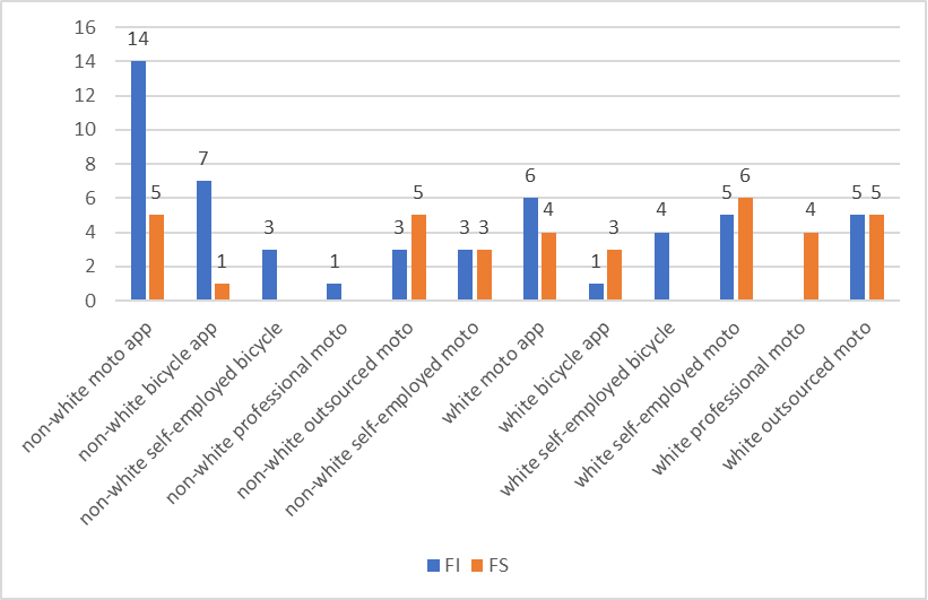
The chart shows that non-White app delivery moto drivers and cyclists are the ones with the highest food insecurity, followed by White moto apps drivers and self-employed moto drivers, which shows that the work process of app-based delivery harms proper nutrition for both non White and White people, but has more severe consequences for non-White delivery workers. Additionally, the delivery process affects FI levels. Motorcycle drivers, the only professionalized group with formal work and higher earnings, do not have any person classified under FI, whereas bicycle and app-based drivers do.
Food insecurity and work conditions are interconnected. Food-insecure delivery workers, primarily Black cyclists, struggle to improve their situations. Their just-in-time work process results in insufficient income to enhance their families’ food security or pursue better job opportunities. At home, they feel they miss earning opportunities, leading them to deliver food even while hungry. In summary, these workers often prioritize improving their home diet over investing in food while working, which perpetuates their cycles of hunger and food insecurity.
4. Conclusion
The precarious work conditions and structural racism perpetuated by delivery platforms and customers place non White delivery workers at a disadvantage, resulting in lower incomes, challenges in achieving financial stability and social mobility, and negative impacts on food, nutrition, and health. The precarization of precariousness was observed in the study through the intersection of an already precarious job and the heightened precariousness faced by non White delivery workers, whose work process ultimately reinforces the unfavorable socioeconomic conditions from the outset.
These challenges are particularly pronounced for non White delivery drivers, who experience ongoing prejudice due to the social devaluation of their profession, as well as direct instances of racism. This discrimination can undermine their customer scores and foster a climate of distrust, leading to fewer deliveries, longer wait times, extended working hours, and lower monthly income. In essence, the structural racism embedded in both the platforms and customer behaviour has harmful material effects on non White delivery drivers, complicating their ability to leave these platforms due to unfavorable working conditions.
There exists a relationship between hunger at work and food insecurity at home, causing a cycle of dependency. Food-insecure delivery workers, predominantly non White and bicycle delivery workers, find themselves trapped in this work process, unable to improve their circumstances. While on the job, they often cannot earn sufficient income to enhance their families’ food situations, advance their professional qualifications for better job prospects, or maintain adequate self-nourishment. Conversely, when at home—an environment where they could potentially secure better food—they feel they’re missing out on delivery opportunities and, thus, income. This leads to a financial strategy that prioritizes improving their home diet for themselves and their families, typically at the expense of food investment during work hours. Therefore, it can be concluded that delivery workers in vulnerable positions often continue to work while experiencing hunger. In doing so, their labour contributes to the hunger and food insecurity faced by this group.
The government, in turn, fails due to its difficulty in pressuring platforms to recognize their work status, in enforcing legislation that benefits these workers, and in having trouble including them in public policies, such as popular restaurants, an urban food security policy that could be beneficial but ends up not reaching this audience. In this sense, the research project itself helped in the recognition of this public policy by the couriers.
Regarding the behaviour of the delivery platforms, one of the food delivery platforms created an insurance policy to provide access to health services and psychological support. However, among the delivery workers interviewed, only one reported having utilized these services; the rest either were unaware of the service, found it excessively bureaucratic, or did not meet the required criteria for eligibility.
The failure to recognize delivery workers as employees absolves the company of any legal responsibilities. Consequently, additional services are presented as “bonuses,” or as one delivery worker put it, “to enhance the company’s image in society”. Despite the suffering and numerous violations of human rights—including the rights to life, health, decent work, and adequate food (the latter not addressed by any platform to date), companies continue to assert that they operate within acceptable standards and ultimately provide opportunities for these workers. This approach perpetuates and reinforces the dynamics of informal labour inherent in a capitalist system.
References
Abílio, L.C. (2019) Uberização: Do empreendedorismo para o autogerenciamento subordinado. Psicoperspectivas, 18(3).
Abílio, L.C. Uberização: gerenciamento e controle do trabalhador just-in-time. (2020). In: Antunes, R (Org). Uberização, trabalho digital e indústria 4.0. São Paulo: Boitempo Editorial, p.111-124.
Abílio, L.C. & Santiago, S.M. (2024). Dossiê das violações dos direitos humanos no trabalho uberizado: o caso dos motofretistas na cidade de Campinas [PDF] Campinas, Diretoria executiva de Direitos Humanos, Unicamp.
Aliança Bike. Associação Brasileira do Setor de Bicicletas. (2019). Pesquisa de Perfil dos Entregadores de Aplicativo.
Aquino, J.V, Pilate, F.D., Félix, Y.S. (2020). Uberização do trabalho e os riscos à saúde dos entregadores por aplicativo frente à pandemia da covid-19. Revista Direitos, trabalho e política social, 6 (11), p. 46-69.
Augusto, F., Canosa, M.A., Gifonni, M., Nascimento, R.(March 5, 2024). Entregador de aplicativo é baleado por PM de folga que não quis descer para pegar pedido. G1 – Globo.
Bajwa, U, Gastaldo, D, Di Ruggiero, E, Knorr, L. (2018). The health of workers in the global gig economy. Globalization and Health. 124.
Brasil. (2017) Lei n. 13.467, de 13 de julho de 2017. Altera a Consolidação das Leis do Trabalho (CLT). Secretaria Geral da Presidência da República.: L13467
Dantas, M.N.P, Silva, M.F.S., Barbosa, I.R. (2022). Reflexões sobre a mortalidade da população negra por covid-19 e a desigualdade racial no Brasil. Saúde e Sociedade, 31(3).
Gonzales, L. (2020). Por um feminismo afro-latino-americano. Flávia Rios & Márcia Lima (org). Rio de Janeiro: Zahar Editores, 2020.
Carvalho, D. (June 29 2020) Quais as reivindicações de entregadores que entram em greve nesta quarta? Ecoa Uol. Desigualdade.
Chan, J. (2021). Hunger for profit: how food delivery platforms manage couriers in China.
Sociologias, 23 (57, 58-82.
Espírito Santo, T., (March 9, 2024) Amigo de entregador baleado no Rio diz que parentes conseguiram medida protetiva contra policial militar. g1 Rio.
Grohmann, R. (2020). Plataformização do trabalho: características e alternativas. In: Antunes, Uberização, trabalho digital e indústria 4.0. São Paulo: Boitempo Editorial, 93-109.
Instituto Brasileiro de Geografia e Estatística (IBGE). (2020). Pesquisa de Orçamentos Familiares 2017-2018: análise da segurança alimentar no Brasil. POF 2017-2018 | IBGE
Instituto Brasileiro de Geografia e Estatística (IBGE). (2022a). Pesquisa Nacional por Amostra de Domicílios Contínua 2021/2022: características gerais dos moradores.
Instituto Brasileiro de Geografia e Estatística (IBGE). (2022b). Síntese de indicadores sociais: uma análise das condições de vida da população brasileira. Síntese de Indicadores Sociais. IBGE
Instituto Brasileiro de Geografia e Estatística – IBGE (2023). Teletrabalho e trabalho por meio de plataformas digitais. [PDF]. Investigações Experimentais – Pesquisa Nacional por Amostra de Domicílios Contínua.
Instituto Brasileiro de Geografia e Estatística – IBGE (2025). Pesquisa Nacional por Amostra de Domicílios Contínua. Segurança Alimentar 2024. Informativo PNAD Continua Segurança Alimentar 2024.
International Labour Organization (ILO) (2025). Realizing decent work in the platform economy. [PDF] International Labour Conference 113th Session, International Labour Office, Geneva.
Manzano, M.; Krein, A. (July 13 2020). A pandemia e o trabalho de motoristas e de entregadores por aplicativo no Brasil. Instituto de Economia da Unicamp.
Minayo, M.C. (2014). O desafio do conhecimento. Pesquisa qualitativa em saúde. 14 ed. Hucitec.
Minayo, M.C. (2017). Amostragem e saturação em pesquisa qualitativa: consensos e
controvérsias. Revista Pesquisa Qualitativa, 5 (7).
Ministério da Saúde. (2014). Guia alimentar para a população brasileira. Secretaria de Atenção à Saúde. Departamento de Atenção Básica. 2. ed. Brasília: Ministério da Saúde.
Ministério do Trabalho. (2022). As ocupações e o mercado de trabalho (assalariado formal). Ciclista Mensageiro. Guia Brasileiro de Ocupações — Ministério do Trabalho e Emprego. Programa de Disseminação das Estatísticas do Trabalho.
Moncau, G. (March 18 2024). Críticas ao PL do governo, fake news e greves: entenda disputas em torno do trabalho em apps. Brasil de Fato. Críticas ao PL do governo, fake news e greves: entenda | Geral
Parwez, S. (2022). Covid-19 pandemic and work precarity at digital food platforms: A
delivery worker’s perspective, Social Sciences & Humanities Open, 5 (1).
Pinheiro-Machado, R. (2004). La Garantia Soy Yo. Etnografia das práticas comerciais entre camelôs e sacoleiros nas cidades de Porto Alegre (Brasil) e Ciudad del Este (Paraguai). [Masters Dissertation]. Universidade Federal do Rio Grande do Sul.
Pinheiro-Machado, R. (2009). Made in China. Produção e circulação de mercadorias no circuito China-Paraguai-Brasil. [PhD Thesis]. Universidade Federal do Rio Grande do Sul.
Rede Brasileira de Pesquisa em Soberania e Segurança Alimentar (Rede PENSSAN). (2023). Inquérito nacional sobre a insegurança alimentar no contexto da pandemia da covid-19 no Brasil. http://olheparaafome.com.br
Rocha, C., Bezerra, M., Pequeno, N., Pinheiro, A., Lima, S., & Lyra, C. (2026). Moving Forward in Guaranteeing the Right to Food: Timeline on Food Security Policy in Brazil. In Rocha, C. & Moraes, A. (Eds), Agency for Food Security in Brazil: Social Mobilization, Participation, and Public Policies. Toronto: TMU Pressbooks.
Rodrigues, N. L. P. R., Moreira, A. S., & Lucca, S. R. de. (2021). O presente e o futuro do trabalho precarizado dos trabalhadores por aplicativo. Cadernos De Saúde Pública, 37(11).
Segall-Corrêa, A.B, Marin-León, L, Quiñonez, H.M., Pérez-Escamilla, R. (2014) Refinement of the Brazilian Household Food Insecurity Measurement Scale: Recommendation for a 14-item EBIA. Revista de Nutrição, 27(2).
Vieira, B. (June 21, 2020). Entregadores se unem por melhores condições de trabalho nos aplicativos. G1 Portal de Notícias.