
🛠️ Chapter 4: Relevance to Practice
27 4.3: Case Study: “Karen #2”
Case Study #5
This real-world scenario is excerpted from Karens: Examining White Female Power Dynamics in Dietetics, from the Journal of Critical Dietitians, with the permission of the author, Mikahelia Wellington, RD, MPH, from Ontario
I was near the end of my practical experience, finally gaining the enteral nutrition experience I required. Karen-2 told me that I had a knack for enteral and thought clinical might be a good fit for me. I found this gratifying, particularly because Karen-2 appeared to be difficult to impress and connect with. She insisted that I complete competencies that I had already mastered in other places; she requested that I rewrite chart notes she had already approved; and she never spent time with me outside of when she was offering me work to complete. I also felt that she did not value my efforts.
On two separate occasions leading up to my placement with Karen-2, I attended a scheduled visit to introduce myself in person and to discuss my goals. Each time, she forgot about the meeting and was off from work. Approaching the end of my placement with Karen-2, she wrote a comment on my ICDEP document requesting that I define and describe a particular competency instead of my experience with it at the placement. I thought I had misunderstood her request since it was not the correct way of completing the evaluation. So, I left the comment: “I don’t think I understand what you are asking”. The next day I met with her in person to review the document. She was upset. Her first statement was that she was offended with my comment and that she felt disappointed that, in all my time with her, I had not learned as much as she expected. Then she said that because of this, she did not want to sign off on my competencies. As one of the final weeks of my placement, this meant that I would not complete the program. I would not graduate with my peers. I would have to pay another $6000 for another semester. I would have to find another student loan. I would be further in debt. I would have to do another semester without lunch to pay for transit to my placement. I must admit that I was confused and very scared. Where was her offence coming from? I told Karen-2 that I was confused by what she meant. I ended up apologizing multiple times for things I did not know I had done. I felt I had to convince her of my sorrow. After I reached out to my program director about the issue, Karen-2 agreed to sign my competencies only if I extended my placement with her for another three weeks.
Analysis
Karen-2 exerted her power by not recognizing my previously acquired skill levels, micromanaging charting, and not scheduling any instructional time. She assumed victimhood by expressing offence when being asked to clarify what she meant, which is a normal process in preceptor-intern communication. This was also demonstrated by Karen-2’s initial desire to question my knowledge and assumed ill intentions. Finally, Karen-2 demonstrated white rage and used her gatekeeping power to the point of threatening to not allow my advancement into the profession.
Reflection Task:
Review the structural choices provided in the interactive layout below. Reflect critically on how institutional reporting structures, evaluation criteria, and white peer dynamics operate to penalize racialized students who deviate from Eurocentric communication defaults.
Reference: Wellington, M. (2021). Karens: Examining white female power dynamics in dietetics. Journal of Critical Dietetics, 6(1), 4-11. Access the full open-access article portal via the Journal of Critical Dietetics.
Although most of the dietetic data is currently from the U.S.A., we have learned from members of the Research in Canadian Dietetics team that Canadian data is underway. Figure 4.1 summarizes U.S.A and some Canadian findings.
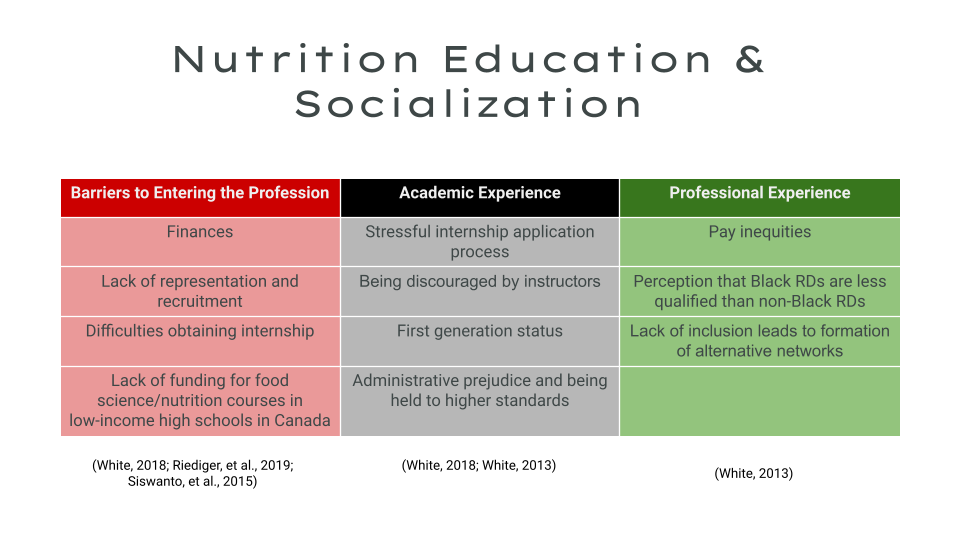
Building upon the systemic barriers analyzed in the “Karen #2” case study and the comparative data in Figure 4.1, the next step is to examine how these inequities manifest in everyday professional settings. The following categorization activity challenges you to classify real-world professional socialization obstacles into their structural domains.