🕸️ Chapter 3: Anti-Black Racism and White Supremacy
20 3.7: Barriers in Education
Video 3.3: Associate Professor Natalie Riediger (University of Manitoba) discusses the foundational institutional barriers, structural sorting, and systemic exclusions that Black students navigate when attempting to access and graduate from dietetics programs in Canada.
Despite the limited data regarding contemporary Canadian dietetic education, there is extensive documentation regarding the historical trajectory of anti-Black racism within the broader Canadian education system. From historical segregation policies to modern streaming practices, Black Canadian students continue to face systemic inequities.
Stop & Reflect: Mapping Power, Privilege and Educational Barriers
Educational journeys are rarely uniform. Access to resources, institutional trust, and systemic entryways often depend on overlapping social positions. Engage with the self-assessment framework below to explore how intersectional positions shape educational equity.
Part 1: Intersectional Identity Review
Kimberlé Crenshaw is one of the most influential scholars in critical race theory, feminist legal theory, and anti-discrimination law (Crenshaw, 2022). She coined the term the analytical concept of intersectionality in 1989 to describe how systems of oppression overlap and interact, creating experiences that can’t be understood by looking at one identity in isolation. Today, intersectionality is often used to understand how multiple identities and systems of power interact. Crenshaw has emphasized that intersectionality is not simply a list of identities. It is an analytical framework for understanding how institutions, policies, and social structures produce different outcomes for people whose identities intersect (Crenshaw, 2022).
The Wheel of Power/ Privilege is often used as a tool to illustrate the concept of intersectionality and can be a useful aid when reflecting on your own intersectionality. Use the image of the Wheel of Power/Privilege below to help you identify and reflect on any of the following systemic identity markers that have offered you privilege or created oppressive barriers, or added complexities to your personal food, nutrition, or dietetic education journey:
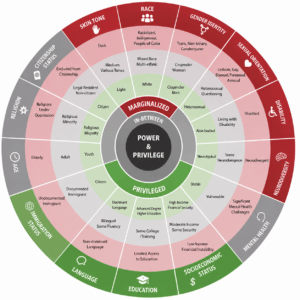
An individual’s place on the “Wheel of Power/Privilege ” is fluid, changing across time, spaces and institutions. Based on your structural advantages and systemic hurdles, where would you rate your institutional privilege (within the context of Canadian Higher Education) today?
Part 2: Identifying Systematic Stressors
Reflect on how structural barriers to equitable education might have impacted your academic or professional journey in food, nutrition or dietetics by answering the following questions. Has/was your personal educational timeline been actively impacted by:
- Gatekeeping: Being filtered out of opportunities due to unwritten institutional rules or biased references.
- Microaggressions / Macroaggressions: Navigating regular, exclusionary slights or overt racialized hostilities from peers or educators.
- Institutional / Structural Racism: Programs that rely on legacy networks, unpaid internships, and Eurocentric core criteria that naturally favour dominant white populations.
Part 3: Reflect
How might your experiences of privilege or oppression influence your day-to-day choices, professional security, and academic stamina compared to peers positioned on alternative points on the Wheel of Power/ Privilege?