Introduction
2 🎨 Intentional use of language, colours and symbolism
The project team behind the development of this Pressbook has been intentional in the use of language, symbols, images, and partnerships to reflect, represent, and empower the Canadian Black communities impacted by this work.
M. NourbeSe Philip performs at the Words Aloud 7 Spoken Word Festival in Durham, Ontario, Canada, November 2
Source: Words Aloud (2010)
In addition to the written, video, image, and interactive content throughout the Pressbook, you will notice.
The Use of Capital “B” for Black
In this Pressbook, we capitalize the letter “B” when referring to Black people, the Black community, Blackness as an identity, and Black experiences to recognize, honour, and uplift the generations of wisdom and advocacy led by Black leaders, communities, and everyday people across the diaspora.
Colours: Red, Black, Green
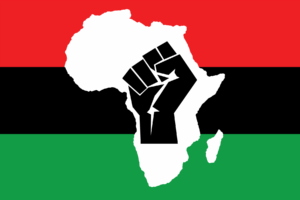
These are the colours of the Pan-African Flag, which has inspired the design of several national flags across Africa and the Caribbean. Although Pan-Africanism as a form of Black nationalism is not universally embraced by all Black individuals, we recognize and honour its intention and spirit of Black representation, community, and empowerment.
Red
Black
Green
Learn more about the Pan-African Flag
NEA ONNIM NO SUA A, OHU :
Ghana’s Adinkra symbols are ideographic scripts created by the ancient Akan people, a subgroup of the Asante. Each symbol expresses a proverb or philosophy understood within the context of Asante culture. Their meanings are originally conveyed in the Twi language (Danzy, 2009).
You will notice the use of the following Adinkra on the cover page and video interview graphics:
 NEA ONNIM NO SUA A, OHU
Translating to “He who does not know, can know from learning” (Kojo, 2017), this symbol embodies the spirit of lifelong education. We hope it serves as a reminder to continually expand your understanding of Anti-Black Racism (ABR), while recognizing the strength and wisdom that the Black community brings to Canadian culture and society.
African Proverbs
Teaching and Education
Proverbs are often used to teach moral lessons, critical thinking, and social values. Elders may use them to guide children and young people without directly criticizing or lecturing them. A proverb can communicate a complex lesson in just a few words.
For example, a proverb about patience may teach perseverance, while another about community may emphasize cooperation and responsibility.
Preserving Culture and History
Many African proverbs reflect the beliefs, experiences, environment, and histories of specific communities. They help preserve Indigenous knowledge, cultural identity, and ways of understanding the world. Because many African cultures historically relied heavily on oral traditions, proverbs became an important way to carry wisdom across generations.
Communication and Diplomacy
In many African cultures, proverbs are used in conversation, leadership, ceremonies, and conflict resolution. Speaking through proverbs can make difficult conversations more respectful, thoughtful, or indirect. A proverb may soften criticism, encourage reflection, or help people find common ground during disagreements.
Community and Relationships
African proverbs often emphasize collective well-being rather than individualism. Many highlight ideas, such as:
- interdependence
- respect for elders
- mutual care
- accountability
- hospitality
- harmony within the community.
This reflects the importance many African societies place on relationships and shared responsibility.
Spiritual and Philosophical Meaning
Some proverbs express deeper philosophical or spiritual ideas about human nature, destiny, wisdom, suffering, or the relationship between people and the natural world. They are often layered, meaning that the same proverb can have different meanings depending on the situation.
Artistic and Literary Importance
African proverbs are widely used in literature, poetry, music, speeches, and education. Writers and scholars often include them to connect readers to African worldviews and oral traditions. For example, Chinua Achebe famously wrote in Things Fall Apart that “proverbs are the palm oil with which words are eaten,” showing how essential proverbs are to meaningful communication.
Images of Food
At the beginning of each chapter you will find an image of a meal. You may click on each image to be directed to a recipe, website or video about that meal or tradition. Our intention is to share some of the amazing dishes that Black people have been preparing and nourishing themselves and their people for hundreds of years.These are foods you can find across the world but, because of slavery and chosen migration, you can also find them in the grocery stores, gardens, cupboards, tables and plates of Black people across Canada.
The World Food Atlas is fun and meaningful resource that you may use to learn about a variety of foods across the world.
However, if you are looking to learn specifically about the cultural foods of Black people, we encourage you to do your own research. There are a variety of resources online, some noted in Chapter 4.5: Biases in Nutrition Care, but you will learn best through interacting with friends, family, patients, grocers, restauranteurs, colleagues, food service workers who are a part of the Black community.
Authentic Voices
Black Canadians and allies across the country have contributed their experience, knowledge, wisdom and expertise by providing content for this Pressbook. This includes video recordings, testimonies, case studies, quotes, reflection questions, meditations and recommendations.
To recognize and honour their variety of expertise and lived experiences, we have made an intentional effort to allow them to speak for themselves. This also allows us to hold space for a variety of people who hold different perspectives, insights and even terms. Honouring the fact that although those of us involved in the work of anti-Black racism education and advocacy work towards similar goals, we are not a monolith.
References
Arthur, G. K. (2017). Cloth as Metaphor:(Re) Reading the Adinkra cloth: Symbols of the Akan of Ghana. iUniverse.
Garvey, M. (2021). Declaration of the rights of the Negro peoples of the world. Black Camera, 13(1), 335-342.
Danzy, J. (2009). Adinkra symbols: An ideographic writing system (Doctoral dissertation, The Graduate School, Stony Brook University: Stony Brook, NY.).
North Northamptonshire Council. (2022, September). Black History.
WordsAloud. (2011, February 5). M. NourbeSe Philip reads “Discourse on the logic of language” from She tries her tongue [Video]. YouTube. https://youtu.be/424yF9eqBsE