✊🏿 Chapter 1: Black Canadian Identity
4 1.1: Who are Black Canadians: Not a Monolith
For us to understand Anti-Black Racism (ABR), we need to recognize Blackness as a social construct often positioned in opposition to whiteness. This reductive categorization dictates societal perceptions of behaviours, actions, linguistics, and appearances of Black people. Those who do not fit this dominant idea of Blackness may experience microaggressions or other forms of violence. Typically, Blackness is associated with people from the African diaspora, but it fails to capture the diversity of their lived experiences and cultures. Importantly, Black people are not a monolith — they do not all act, think, or look the same. A deeper understanding of Black Canadian identity can be expanded through resources like the UNILEARNAL who offer resources including YouTube series below, which tackles the erasure of Black Canadian history and the experiences of Black youth, bridging past and present challenges and successes (UNILEARNAL, n.d.).
The videos highlight how mainstream narratives often overlook Black Canadian stories in favour of African American figures and events. Through lived experience and storytelling, Black youth reflect on their identities and shed light on key moments in Canadian history, helping bridge the gap between the past and present.
UNILEARNAL: What is 28 Moments of Black Canadian History?
Black Canadians have a rich history and a wide array of cultural backgrounds, including those from Africa, the Caribbean, and other regions. This diversity is emphasized in various studies. For example, Olanlesi-Aliu, Alaazi, and Salami (2023) explore how systemic racism contributes to healthcare disparities for Black Canadians, such as barriers to equitable care and a lack of culturally competent services (Olanlesi-Aliu, Alaazi, & Salami, 2023). Similarly, Etowa, Beagan, and Runnels (2020) discuss racialized healthcare inequities, highlighting how historical and structural racism impacts access to care. Their work calls for systemic reform and culturally appropriate practices to address these disparities. Understanding this diversity is crucial to fostering a more inclusive representation of Black Canadians in healthcare and other fields (Etowa, Beagan, & Runnels, 2020).
Within Canada, having these diverse backgrounds contributes to a complex cultural mosaic. For instance, African immigrants may face different cultural and systemic challenges compared to Caribbean descendants, who may have been in Canada for generations. These differences affect healthcare access, community dynamics, and interactions with systemic structures. Nonetheless, shared experiences of systemic racism often unite these groups as they collectively strive to address these issues within their communities (CBC News, 2022).
Recognizing the varied experiences within Black Canadian communities is essential for avoiding generalizations. Instead, engaging with these unique experiences helps foster inclusivity and accuracy, especially in fields like dietetics and healthcare. Dominant narratives tend to bind race and culture together, oversimplifying the diversity of African and Caribbean identities. For instance, despite Africa being one of the most diverse regions globally—with 54 countries and over 3,000 ethnic groups—the construct of Blackness often groups them together. A Sudanese person’s cultural background will differ significantly from an Ivorian’s, yet Blackness as a construct is used to group them under a singular identity. This tool of categorization reinforces racist structures and reduces the complexity of Black identities (Crenshaw, 2022; Davis, 1981; Hall, 1997; Hancock, 2007; Sue et al., 2008).
The Origins Of The Black Community From Coast To Coast
The diversity of the Black community across Canada has early origins. Their histories vary across the West Coast, throughout the prairies and towards the East Coast. Some were incentivized by rumours of freedom and promises of land and inclusion. Others settled because of forced migration or punishment. All experienced racist Canadian policies, yet still found ways to establish a home in Canada for themselves and their descendants.
Start learning more about the history of the first Black Canadian settlers by clicking the following links and images:
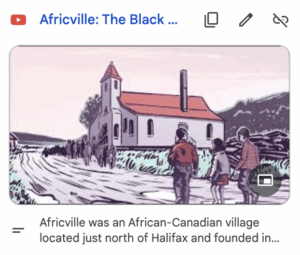
Africville (Nova Scotia)
Africville was a close‐knit Black community, founded 120 years ago on Miꞌkmaq territory in 1749, the area now known as the shores of the Bedford Basin in Halifax, Nova Scotia. Citizens included formerly enslaved people, Jamaican Maroons, and Black refugees from the War of 1812. The City demolished Africville in the 1960s, and its residents have been fighting for justice ever since (Canadian Museum of History, n.d.; McRae, n.d.). Learn more at:

Little Burgundy (Quebec)
Montréal’s St. Antoine neighbourhood, later renamed Little Burgundy, became a centre of Black life in the late 1800s as the railway industry attracted Black workers from the United States, the Caribbean, and the Maritimes. Despite facing racial discrimination in employment and housing, residents built a thriving community with Black-owned businesses, social organizations, churches, and a vibrant jazz scene. However, anti-Black racism and urban renewal policies led to the neighbourhood’s demolition in the 1960s and 1970s, displacing thousands of residents and dismantling one of Canada’s most significant historic Black communities (Canadian Museum of History, n.d.). Learn more at:
Chatham-Kent and Oro Township (Ontario)
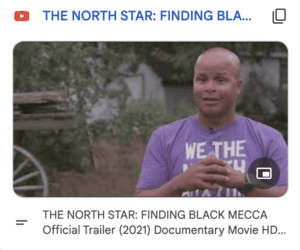
The Black settlements of Oro Township and Chatham-Kent represent important chapters in Ontario’s Black history. Established by free Black settlers, formerly enslaved people, and Underground Railroad refugees, these communities created thriving centres of farming, education, faith, and activism despite experiencing racism and exclusion. Their contributions helped shape the social and cultural development of Ontario and remain important legacies of Black resilience and community-building in Canada (County of Simcoe, n.d.; Municipality of Chatham-Kent, 2020). Learn more at:
Amber Valley (Alberta)

To attract settlers, Canada offered 160 acres of land for a small fee to those willing to develop it. Although the program primarily targeted white Europeans and Americans, many African Americans from Oklahoma migrated to Canada beginning in 1905 to escape segregation and seek greater opportunities. Their migration ended in 1912 due to widespread racism and hostility from the Canadian government and society (Alberta Labour History Institute, n.d.; Canadian Museum of History, n.d.; Kelly, n.d.). Learn more at:
Hogan’s Alley (British Columbia)
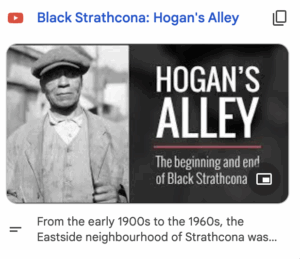
Hogan’s Alley was the centre of Vancouver’s Black community during the early and mid-twentieth century. Home to Black families, businesses, churches, and cultural institutions, it served as an important social and economic hub for Black Vancouverites. Despite its significance, discriminatory policies and urban renewal projects led to the neighbourhood’s demolition in the late 1960s and early 1970s. Today, Hogan’s Alley is remembered as an important site of Black Canadian history and a reminder of the lasting effects of systemic racism on communities (Compton, 2014). Learn more at:
Want More?
We’ve got you! Enjoy this podcast of the University of Guelph Debate Club featuring Professor Deirdre McCorkindale, an expert in Black Canadian history. To further develop your comfort and ease in having informed and generative conversations about ABR, consider viewing with friends or family.