
✊🏿 Chapter 1: Black Canadian Identity
6 1.3: What is Whiteness?
Why don’t we use the term “Caucasian”?
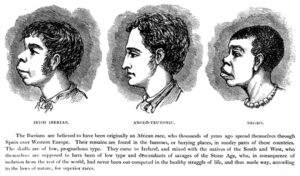
The term “Caucasian” was introduced in the late eighteenth century by German anatomist and anthropologist Johann Friedrich Blumenbach. Through his study of human skulls, he proposed that there were 5 distinct human groups, including “Caucasian,” “Ethiopian, “Oriental,” “Malay,” and “Red”. Then he concluded that people from the Caucasus region—located between the Black and Caspian Seas and including parts of present-day Georgia, Armenia, and Azerbaijan—possessed the most symmetrical and aesthetically “ideal” cranial features. Based on these assumptions, he identified the “Caucasian variety” as the original and most aesthetically desirable form of humanity (Picart, Bonner & Sandhu, 2025; Polluck, 2008; Shamambo & Henry, 2022).
Blumenbach’s classification system emerged within the broader context of eighteenth-century racial science, which sought to categorize human populations into biologically determined, hierarchical racial groups. Contemporary genetic research has since overwhelmingly discredited the concept of biological race as scientifically invalid (Polluck, 2008).
Today, the term “Caucasian” is widely recognized as a remnant of colonial-era racial classification systems that were used to legitimize ideologies of white superiority. As a result, many anthropologists, sociologists, and medical organizations discourage its use because of its historical association with racism and colonialism (Shamambo & Henry, 2022).
If you would like to expand your understanding of the history of scientific racism in Canada, here are some resources to get you started:
- Eugenics and Scientific Racism. A webpage created by the National Human Genome Institute
- Teaching the history of scientific racism, an article by Carmel Gillies
Whiteness
To align with the intentional use of language that we discussed in the introduction of this Pressbook, apart from the authentic/ unedited voices of our contributors, we have chosen to steer away from using the term “Caucasian” and instead to facilitate education regarding the social construct of whiteness.
Whiteness refers to the social, political, and cultural constructs associated with being perceived as white in a given society. It encompasses the privileges and advantages that come with being classified as white, and it shapes both individual and systemic interactions within society. Understanding Whiteness involves examining how these privileges are embedded in societal structures and norms, and how they contribute to the perpetuation of racial inequalities.
Historical and Social Constructs
Whiteness is not a biological fact, but a constantly shifting social category. Historically, who was considered ‘white’ shifted depending on geopolitical demands, immigration waves, and legal definitions designed to protect resource distribution and status.
Systemic Privileges
Systemic privileges refer to the unearned societal advantages granted to individuals perceived as white. These advantages exist within institutional policies, hiring practices, real estate equity, and systemic protection from racialized profiling.
Cultural Norms and Practices
This includes the ways in which white cultural habits, speech patterns, standards of beauty, and social practices are treated as the objective standard or default ‘norm’ in society, positioning other cultural practices as ‘different’ or ‘other’.
Impact on Racial Dynamics
Whiteness heavily influences cross-racial interactions, institutional barriers, and structural divides. It establishes hierarchies that directly dictate social mobilities and racial experiences within professional environments like healthcare and education.
Challenging Whiteness
Dismantling the supremacy of whiteness involves identifying its invisible mechanics, examining personal biases, and actively altering systemic defaults to create structures of equity and mutual respect.
Contemporary Relevance
Understanding whiteness remains essential today for analyzing disparities in judicial outcomes, health inequities, and socio-economic gaps that continue to impact racialized groups across Canada.
Keywords: Cultural Default, White Fragility