
🕸️ Chapter 3: Anti-Black Racism and White Supremacy
17 3.4: Gatekeepers Part 2
Case Study #4: Gatekeepers
Author: Kishon Warmington from Manitoba
Trigger warning: This case shares an example of interpersonal racism through gatekeeping, white entitlement, microaggression, and patrolling and policing Black people. It also demonstrates the impact on who is a part of the food system, which foods get produced, and if Black communities get to access them.
Keywords:
Gatekeeping, Interpersonal Racism, Surveillance, Spatial Discrimination
There was an incident with a neighbour down the street in which I went to introduce myself. She welcomed me and immediately proceeded to inform me that they had a neighbourhood watch in the area and that she kept track of every vehicle that came up and down the road. She started to ask me how many people lived at my farm, who visited, and what kind of vehicles frequently visited my farm. She tried to make it seem as if she was asking for the benefit of the neighbourhood.
I was immediately offended and once again felt as if I didn’t belong and was targeted or put on some watch list by my fellow neighbours. I realized these incidents triggered and traumatized me. I have talked to a few other Black farmers in Canada who can relate and have gone through the same experiences.
From my experiences, I now know why there are not many Black farmers in the prairies. We are left to feel like we do not belong. It is hard to imagine having more Black farmers on the land to build a more sustainable food system that is more culturally appropriate for our community when there is still systemic racism for Black people owning land.
Case Overview & Historical Context
Kishon’s contemporary experience as a Black farmer in the Prairies has striking historical parallels to what the first Black settlers experienced in the region during the early 1900s. When the Canadian government invited Americans to the Prairies to build the population and the agricultural economy, they offered to sell unceded, unfairly traded Indigenous land at a rate of $10 for 160 acres to encourage massive migration (Canadian Museum of History, n.d.).
What immigration authorities did not anticipate was a significant influx of Black immigrants from the United States seeking freedom and escaping oppressive Jim Crow laws. In response to this unexpected movement, discriminatory policies were put in place to cease the immigration of Black people to Canada. Those who remained faced severe institutional hostility, community gatekeeping, and spatial discrimination—barriers that mirror the modern gatekeeping Kishon continues to navigate on the land today.
To learn more about these foundational systemic dynamics, review the videos covering Black Canadians, including those living in the Prairies in Chapter 1.1, or visit the Canadian Museum of History website to read a short article about The Oklahoma Migration (Prairie Provinces)
By the Numbers: Ethnocultural Diversity among Canadian Farm Operators
The food system plays a major role in the health and nutrition of the Canadian Black community. However, structural boundaries dictate who participates in farming practices, who owns land, and who holds positions to draft or enforce agricultural legislation.
According to data from Statistics Canada (2021), Agriculture-Population Linkage, severe ethnocultural disparities persist across Canada’s farming landscape:
- Extreme Underrepresentation: Racialized groups and Indigenous peoples combined represent less than 5% (4.1%) of Canada’s total farm operators, compared with nearly one-third (31.4%) of Canada’s total population.
- The Black Farming Footprint: Out of the 5,390 farm operators who self-identified as being from a racialized group in 2021, over half were South Asian (53.7%), followed by Chinese (21.4%). Black farmers represented only 4.9% of the racialized farm operator population nationwide (amounting to just 265 operators total).
- Revenue Disparities: Systemic economic barriers are visible across revenue classes. The Diversity Index (DI) of Canadian farm operators is highest (12.3%) among small farms generating less than $10,000 in operating revenues, and experiences a sharp, steady decline as operational revenue scales up.
Table 3.4: Farm operators by racialized group, Canada, 2021
| Racialized Group | Number | Percent |
| South Asian | 2895 | 53.7 |
| Chinese | 1155 | 21.4 |
| Black | 265 | 4.9 |
| Japanese | 225 | 4.2 |
| Latin American | 145 | 2.7 |
| Southeast Asian | 135 | 2.5 |
| Filipino | 125 | 2.2 |
| Racialized groups, not included elsewhere | 100 | 1.0 |
| Multiple racialized groups | 95 | 1.8 |
| Korean | 95 | 1.8 |
| Arab | 80 | 1.5 |
| West Asian | 75 | 1.4 |
| Totals may not equal 100% due to rounding
Note. From Canadian agriculture at a glance: A story about the diversity of Canada’s farm operators, by Statistics Canada, 2021, Government of Canada (URL). |
||
Chart 1: Educational attainment for non-racialized and racialized farm operators, Canada, 2021
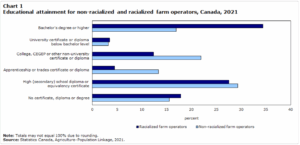
Note. From Canadian agriculture at a glance: A story about the diversity of Canada’s farm operators, by Statistics Canada, 2021, Government of Canada (URL).
To examine the complete datasets and explore emerging institutional support frameworks, review the primary source resources below:
Activity: Identify Gatekeeping Behaviours