
🛠️ Chapter 4: Relevance to Practice
25 4.1: How Racism Manifests In Nutrition and Dietetics
It is well documented and common knowledge among leaders engaged in anti-oppression education how difficult it can be to convince even the most interested healthcare professionals of the connection between social inequities and biomedical outcomes (Atkins & Brady, 2016; Ng & Way, 2021; Wellington, Lee, Ng & Mensah, 2021; Ng, Wellington, &Pabani, 2024). So we offer this chapter to assist you in your journey of seeing and making sense of the connections.
Interactive Activity: “Cultural Humility in Dietetic Practice”: An Interactive Case on ABR, Traditional Foodways, and Diabetes Management. A branching case scenario created by Halima Cherif Hassana, RD, B.Sc from Quebec.
Walk through the branching scenario for an example of how bias and systemic racism show up in a dietetic workplace.
“There’s just not enough Black people entering the profession to provide culturally affirmin, anti-racist care”- Amira Oyesegun
According to data from the Public Health Agency of Canada (PHAC, 2020), frequent exposure to racial discrimination and systemic exclusion is strongly associated with elevated risk factors and disproportionate chronic disease rates among Black Canadians. In the context of healthcare, racism operates as a structural determinant that manifests primarily through three distinct pathways:
Click on each section below to see details
Structural racism in health research, health education and healthcare
The barriers to receiving just, culturally informed, affirming and competent care that are created by systemic racism.
Examples:
- Limited access to Black health care professionals due to Canada’s long history of discriminating against Black students (e.g. Queen’s University’s 1918 ban on Black students) (Queen’s Alumni Review, 2020)
- Before 2021, the estimated glomerular filtration rate (eGFR) calculations used a race-based multiplier that artificially inflated kidney function scores for Black patients, leading to delayed diagnoses and barriers to organ transplant waitlists (American Kidney Fund, 2026)
- Delayed, missed or failure to diagnose mental health issues and cognitive delay in Black communities (CanFASD, 2026; Olanlesi-Aliu, Giwa & Salami, 2025)
Limited access to prerequisites for health
Systemic and institutional barriers that restrict equitable access to adequate income, employment, safe housing, and food security.
Example:
- Compounded health complications resulting from structural environmental toxin exposure and lack of urban resources (NCCDH, 2018).
.
The accumulation of chronic allostatic stress
The long, exploitative and oppressive history of treatment by White scientists and health professionals toward Black people perpetuates the prolonged physical and psychological wear-and-tear caused by systemic policies and interpersonal discrimination. This chronic stress pathway directly:
- Adversely impacts long-term metabolic and physiological health.
- Influences coping or health behaviours (such as altered physical activity levels or smoking).
- Impairs safe and equitable healthcare access.
- Affects other downstream neuroendocrine and biological mechanisms related to health.
Examples:
- Physiological changes due to stress (weathering and high allostatic load) and a significantly greater likelihood of developing early-onset chronic diseases (Siddiqui et al., 2017; NCCDH, 2018).
- Elevated risk profiles for clinical hypertension and childhood cancer (Siddiqui et al., 2017).
- Deep-seated psychosocial trauma from navigating biased institutional environments (NCCDH, 2018)
Braveman et al. (2022) and the National Collaborating Centre for Determinants of Health (NCCDH, 2018) report that Indigenous and Black populations experience the most severe health inequities in Canada. With Black communities living with:
| Health Issue | Disparities in the Black Canadian Population |
| Metabolic diseases |
|
| Mental health |
|
| Cancer |
|
Note: Current research and data reviewed failed to investigate, recognize or include similar health risks for gender-diverse Black Canadians, subsequently highlighting the need for safe, affirming and inclusive research.
(Black Health Alliance, n.d; Mental Health Commission of Canada, 2021; Statistics Canada, 2025)
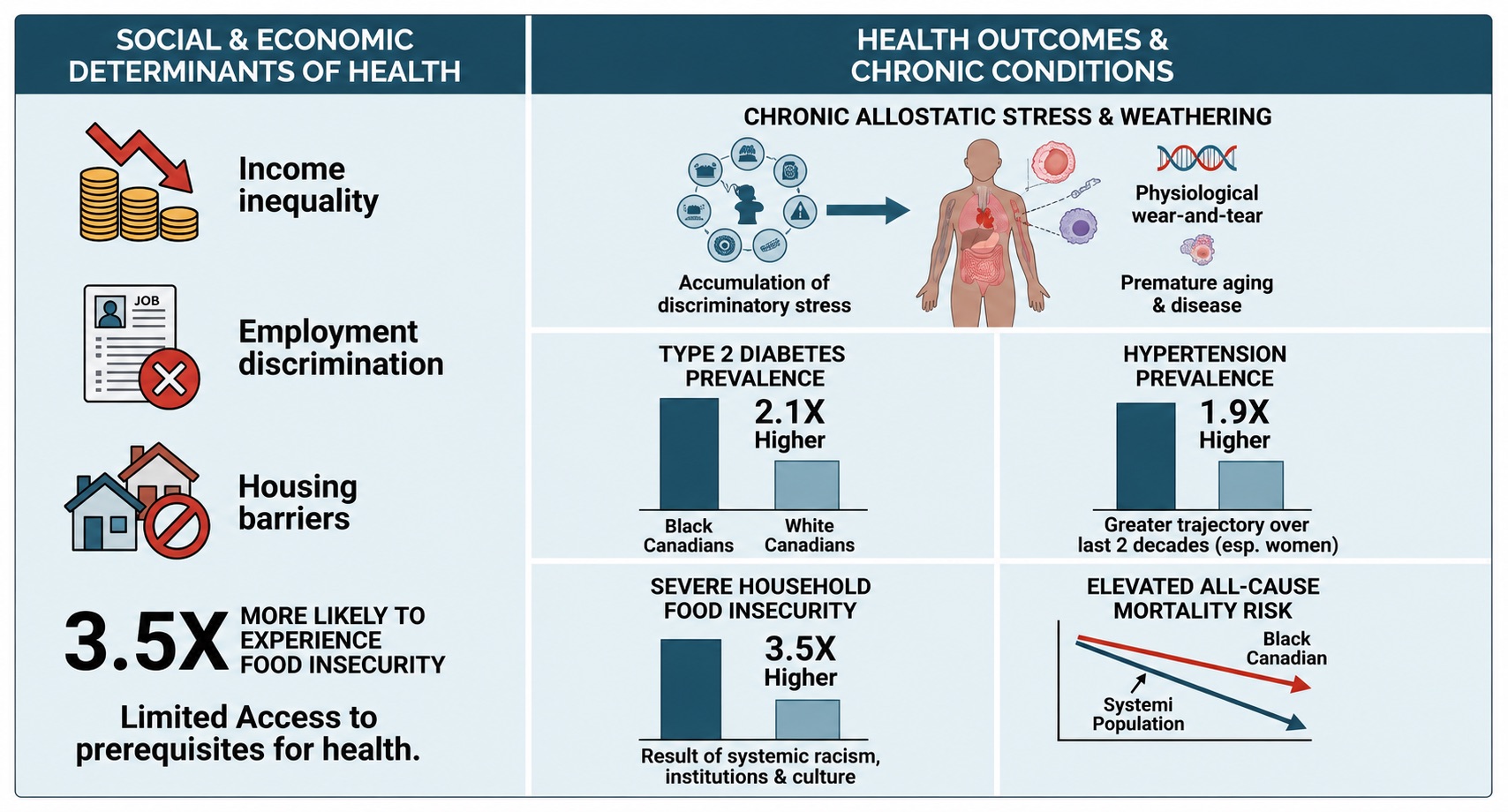
Manifests in Nutrition and Dietetic Practice
Systemic racism within nutrition and dietetics operates beyond an abstract level. Here are a few examples of how it can shape daily assessment, diagnostic criteria, and standard interventions:
Click on each section below to see details
Structural racism in nutrition research, nutrition education and the nutrition care process
Gaps and biases in practitioner knowledge
- Healthcare workers unable to recognize indicators of nutritional status or systemic illness (e.g. jaundice, cyanosis, or severe paleness/pallor) because they are not trained to spot these variations on darker skin tones. Subsequently, nutritional deficiencies or chronic health conditions are missed, or treatment is delayed (Stanford Center for Continuing Medical Education, n.d.)
- Nutrition professionals’ use of BMI or visual assessment of body composition contributes to weight bias, fat phobia and assumptions of poor health within Black communities (Strings, 2023).
- Making an incorrect nutrition assessment and plan after misjudging a patient’s nutrient intake because they are unfamiliar with traditional foods or preparation methods
Limited access to prerequisites for health
Low income and lack of access to health benefits/insurance coverage
- Low income, unemployment or precarious work conditions often limit access to employer-sponsored health benefits, creating barriers to accessing dietetic services.
- Subsequent dependence on limited access to free community dietetic services that may not be culturally affirming, particularly since there are very few Black dietitians practicing in Canada and non-Black dietitians have limited training on culturally affirming and anti-racist practice.
The accumulation of chronic allostatic stress
White racial framing
- The disrespectful and discriminatory behaviour of nutrition professionals who belittle cultural foods and ways of eating indirectly requests that Black patients deny parts of their cultural identity (Kumanyike, 2006)
Pathologizing health management adaptations (e.g. cultural racism)
- Nutrition professionals pointing blame at cultural and individual eating patterns and cooking traditions (e.g. cooking with oils high in saturated fats such as palm oil or regular inclusion of large portions of starchy foods like provisions) for health issues (e.g. diabetes, hypertension, obesity) while ignoring the current and historic systemic inequalities that perpetuate health issues (Ng, 2023).
Black communities’ distrust of non-black nutrition professionals and their messages
- Black patients withholding essential information to avoid judgement, being controlled or being harmed. (e.g. not telling a dietitian about their complementary and alternative medicines)
- Black people avoiding or ignoring recommendations intended to improve their health, rendering public health nutrition strategies and clinical dietetic interventions useless. (Etowa, Beagan, Eghan & Bernard, 2017; Beagan & Chapman, 2012).
Ultimately, we cannot speak about public health disparities that affect racialized populations without directly examining how our systems, institutions, and clinical cultures construct these conditions. Doing so leads to the development of chronic diseases within the Black community while also facilitating the visual and systemic erasure of Black individuals (Balde & Perreault, 2026).
The upcoming series of case studies and video interviews in the next few chapters offers direct insight into the variety of ways anti-Black racism within food, nutrition and dietetic practices impacts Black individuals and communities, patients and practitioners, students and educators.
Video 4.1: Matthew Adgbuyi, a Black Dietitian from Alberta, lists and describes three ways ABR manifests in the dietetic profession and how they can negatively impact the health and well-being of Black Canadians.
Video 4.2: Three Black Canadian Registered Dietitians from Quebec and Nova Scotia talk about how anti-Black racism and biases manifest health inequities for Black Canadians
Stop and Reflect