
🛠️ Chapter 4: Relevance to Practice
33 4.9: Food Insecurity and Food Justice
The manifestations of white supremacy and Anti-Black Racism (ABR) in dietetics have profound consequences for Black communities in Canada, exacerbating existing health disparities and contributing to socioeconomic challenges. These systemic issues not only limit access to culturally competent care but also undermine efforts toward achieving food sovereignty and equitable health outcomes (Etowa, Beagan, & Runnels, 2020).
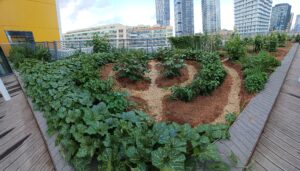
Food justice is an essential aspect of addressing systemic inequities within our food systems. It encompasses advocacy for dignity, equity, and community engagement, focusing on addressing food insecurity through community-based solutions. Food justice involves confronting systems of oppression, including patriarchy and misogyny, and understanding the intersectionality of various forms of economic injustice. Urban farming and culturally appropriate practices are vital components in promoting economic equity and ensuring that all communities have access to nutritious and culturally relevant foods.
Video 4.9: Co-Chair of the Toronto Youth Food Policy Council and an Urban Farmer and Equity Coordinator at Food Share Toronto, Sheldomar Elliott, discusses the connection between the health of the Canadian Black community and systems of oppression. Sheldomar’s insights highlight the importance of food sovereignty and food justice for marginalized communities, addressing the intersection of food systems and systemic barriers.
Keywords: Advocacy, Community-Based Initiative, Culturally Appropriate Food, Economic Injustice, Equity, Food Insecurity, Food Justice, Intersectionality, Misogyny. Patriarchy, Systems of Oppression.
Stop and Reflect:
For further reading on the connection between the land and the Black community, take a look at Amnesty International’s work in Black and Indigenous Solidarity Against Systemic Racism.
To further explore the role of community-based initiatives and food justice in addressing these inequities, we present a video featuring Nicole Austin, Black-led Programs Coordinator at Toronto Metropolitan University’s Urban Farm. Nicole discusses her work in advancing Black food sovereignty, highlighting the importance of collaboration and knowledge-sharing in creating sustainable, community-led solutions to health disparities.
Video 4.10: Food justice advocate, environmentalist and geographer, Nicole Austin from Ontario, makes the connection between dietetics, food sovereignty, and Black health.
Nicole Austin mentions the 3Bs: “Black-led, Black-mandated and Black-serving.” Sheldomar Elliott notes the importance of BIPOC not only being represented in food systems but also being “in positions of power”. When we acknowledge how the history of enslaved Black people who were forced to engage in the world’s food system (Activity in Chapter 1.2) has transformed into the current exploitative conditions experienced by BIPOC migrant food chain workers today, we can better understand the importance of recognizing how representation without power and sovereignty will perpetuate and replicate systems of exploitation and undermine food justice.
“Worker-led organizing is the way forward to a food system that is not exploitative, and nourishes all people,”- Elizabeth Walle, development coordinator at the Food Chain Workers Alliance. (Manek, n.d.)
The Food Chain Workers Alliance has made it their mission to empower food chain workers. They are a coalition of labour unions and worker organizations across Canada and the United States, representing individuals employed throughout the food system (e.g., farms, factories, warehouses, trucks, supermarkets, restaurants, cafeterias, and street vendors).
The Alliance’s mission is “to build a more sustainable food system that respects workers’ rights, based on the principles of social, environmental and racial justice, in which everyone has access to healthy and affordable food.” (Food Chain Workers Alliance, n.d.)
To advance this mission, the Alliance engages workers across industries and national borders through advocacy, education, and collective organizing initiatives.
Stop and Reflect
Additional Resources:
For further exploration, visit the Black Food Sovereignty Initiative: Black Food Sovereignty Initiative, read about the impact of the Urban Farm on the community: Urban Farm Brings Black Community Together Through Food and explore the Confronting Anti-Black Racism in Toronto initiative: Toronto Action Plan to Confront Anti-Black Racism (PDF).
You may even take a deeper look at the Black Food Sovereignty work underway in parts of the eastern region of the country. The African Nova Scotian & Black Food Advisory team, including Danielle Jackson, Nickaya Parris, Rodney Small and Wendi Wilson, shares their expertise on this Nova Scotia Human Rights Commission panel discussion.
Black Food Sovereignty In Mi’kma’ki | December 9, 2025. The African Nova Scotian & Black Food Advisory team — Danielle Jackson, Nickaya Parris, Rodney Small and Wendi Wilson — share their expertise on this Nova Scotia Human Rights Commission panel discussion.
Source: Nova Scotia Human Rights Commission (2025)